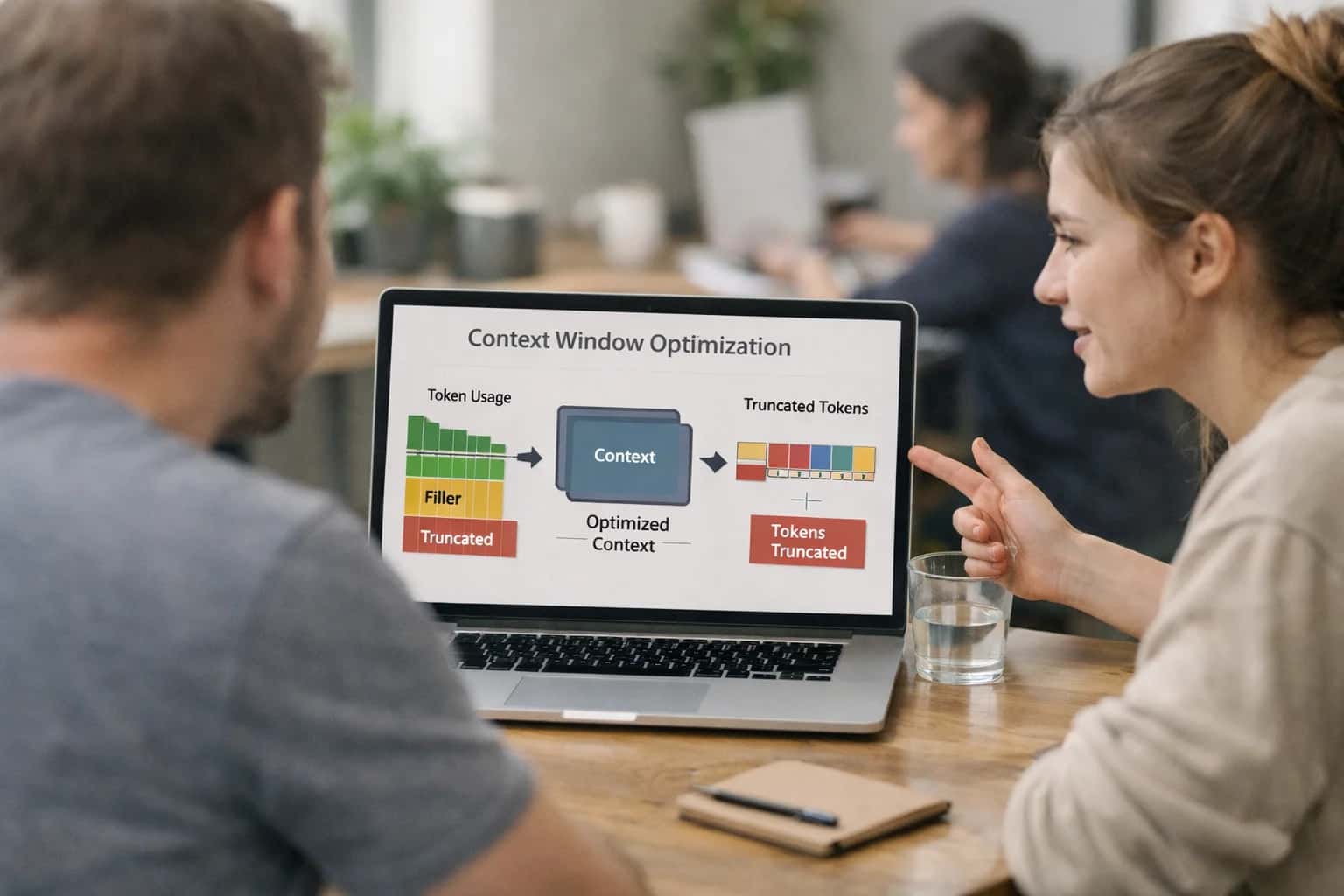
Context Window Optimization is the systematic engineering of a language model's finite input space to accommodate the maximum amount of relevant retrieved legal evidence without truncation. It involves strategically allocating tokens among instructions, retrieved document chunks, and generation space to ensure that binding precedential authority and complete statutory text are preserved.

Glossary
Context Window Optimization
The engineering practice of packing retrieved legal evidence into a language model's limited input space to maximize the amount of relevant statutory and precedential context without truncation.
LEGAL RAG ARCHITECTURES
What is Context Window Optimization?
The engineering practice of packing retrieved legal evidence into a language model's limited input space to maximize the amount of relevant statutory and precedential context without truncation.
Effective optimization employs techniques like propositional indexing, which segments documents into atomic facts rather than arbitrary chunks, and semantic re-ranking to prioritize the most authoritative passages. The goal is to prevent the model from reasoning on incomplete law by ensuring that the full logical chain of a court's holding fits within the available context.
MAXIMIZING EVIDENCE DENSITY
Core Techniques for Legal Context Optimization
Engineering strategies to pack the maximum amount of relevant statutory and precedential context into a language model's limited input space without truncation.
01
Strategic Text Compression
Applies lossless and lossy compression algorithms to legal text before insertion into the context window.
- LLMLingua: Uses a small language model to remove non-essential tokens while preserving legal entities and citations
- Selective Context: Drops low-perplexity sentences that contribute minimal information to the legal reasoning task
- Citation Preservation: Compression pipelines are explicitly instructed to never alter or remove case citations, statutory references, or pin-point page numbers
This technique can reduce token consumption by up to 50% without degrading the accuracy of downstream legal analysis.
02
Structured Prompt Scaffolding
Organizes retrieved legal documents into a rigid, hierarchical XML or Markdown structure within the prompt to maximize the model's ability to navigate and attribute evidence.
- Document Tagging: Each source is wrapped in
<document id='...' title='...'>tags for explicit source tracking - Hierarchical Chunking: Presents a document summary first, followed by relevant subsections, allowing the model to efficiently locate key passages
- Instruction-Context Separation: Uses clear delimiters to prevent the model from confusing system instructions with retrieved evidence
This structured approach reduces the cognitive load on the model and improves citation accuracy.
03
Dynamic Token Budgeting
Implements a programmatic allocation system that distributes the finite context window across multiple retrieved documents based on their relevance scores.
- Weighted Allocation: Assigns more tokens to highly relevant precedents and fewer to marginally relevant background material
- Reserved Generation Space: Explicitly reserves a fixed percentage of the context window for the model's final reasoning and answer
- Overflow Management: When retrieved evidence exceeds the budget, the system triggers summarization of lower-priority documents rather than truncation
This prevents the most critical authority from being cut off mid-sentence.
04
Propositional Chunking
Segments legal documents into atomic, self-contained factual propositions rather than arbitrary token windows to eliminate wasted context space.
- Atomic Units: Each chunk expresses exactly one legal fact, holding, or rule statement
- Context Independence: Every proposition is rewritten to include necessary contextual metadata, ensuring it is understandable in isolation
- Deduplication: Identical propositions from different sources are collapsed into a single entry with multiple citations
This fine-grained approach ensures that every token in the context window carries a discrete unit of legal information.
05
Parallel Context Windows
Distributes retrieved evidence across multiple parallel inference calls when a single context window is insufficient, then synthesizes the results.
- Map-Reduce Architecture: Each parallel call analyzes a subset of documents and generates intermediate findings
- Hierarchical Summarization: Intermediate outputs are aggregated and fed into a final synthesis step
- Cross-Reference Resolution: A post-processing step reconciles conflicting citations or interpretations that emerged across parallel windows
This technique effectively multiplies the available context capacity for cases requiring analysis of dozens of precedents.
06
Attention Sink Management
Engineers the prompt structure to prevent the model's attention mechanism from being diluted by long contexts, a phenomenon known as the 'lost in the middle' problem.
- Recency Bias Exploitation: Places the most authoritative binding precedent at the very end of the context window
- Primacy Bias Exploitation: Places the core legal question and jurisdictional constraints at the very beginning
- Signposting: Inserts explicit transitional markers to re-anchor the model's attention when switching between distinct legal issues
This counteracts the documented tendency of transformer models to overweight the beginning and end of the context while ignoring the middle.
CONTEXT ENGINEERING
Frequently Asked Questions
Answers to the most common technical questions about maximizing the utility of a language model's limited input space for complex legal reasoning tasks.
Context window optimization is the engineering practice of strategically packing retrieved legal evidence into a language model's fixed input space to maximize the amount of relevant statutory and precedential context without truncation. A context window defines the maximum number of tokens a model can process in a single forward pass. In legal reasoning, where a single Supreme Court opinion can span 10,000 tokens and a complex motion requires synthesizing a dozen such documents, the window is a critical bottleneck. Optimization involves token budgeting, chunk prioritization, and information density maximization to ensure the model sees the most authoritative and relevant text. Techniques include removing redundant procedural boilerplate, compressing verbose factual recitations, and using structured prompt templates that separate binding authority from persuasive commentary. The goal is to prevent the model from losing the thread of a multi-document argument because a key precedent was pushed out of the window by less relevant text.
COMPARATIVE ANALYSIS
Context Optimization vs. Related Techniques
How context window optimization differs from other retrieval and prompt engineering strategies in legal AI systems.
| Feature | Context Window Optimization | Semantic Re-Ranking | Query Decomposition |
|---|---|---|---|
Primary objective | Maximize relevant evidence density within fixed token budget | Reorder retrieved candidates by relevance score | Break complex query into simpler sub-queries |
Operates on | Final assembled context before generation | Intermediate retrieval results list | Initial user query before retrieval |
Token budget awareness | |||
Modifies retrieval order | |||
Handles multi-hop reasoning | |||
Typical latency impact | < 50 ms | 100-500 ms | 200-800 ms |
Risk of evidence omission | High if truncation is naive | Low if re-ranker is well-calibrated | Low if decomposition is exhaustive |
Synergy with other techniques | Applied after retrieval and re-ranking | Applied before context assembly | Applied before initial retrieval |
Enabling Efficiency, Speed & Accuracy
Intelligent Analysis, Decision & Execution
We build AI systems for teams that need search across company data, workflow automation across tools, or AI features inside products and internal software.
Talk to Us
Search across company data
Give teams answers from docs, tickets, runbooks, and product data with sources and permissions.
Useful when people spend too long searching or get different answers from different systems.
Enterprise searchRAGPermissions
Read more
Automate internal workflows
Use AI to route work, draft outputs, trigger actions, and keep approvals and logs in place.
Useful when repetitive work moves across multiple tools and teams.
AI agentsWorkflow automationGovernance
Read more
Add AI to products and internal tools
Build assistants, guided actions, or decision support into the software your team or customers already use.
Useful when AI needs to be part of the product, not a separate tool.
AI integrationDecision supportModel routing
Read more
About the author
Prasad Kumkar
CEO & MD, Inference Systems
Prasad Kumkar is the CEO & MD of Inference Systems and writes about AI systems architecture, LLM infrastructure, model serving, evaluation, and production deployment. Over 5+ years, he has worked across computer vision models, L5 autonomous vehicle systems, and LLM research, with a focus on taking complex AI ideas into real-world engineering systems.
His work and writing cover AI systems, large language models, AI agents, multimodal systems, autonomous systems, inference optimization, RAG, evaluation, and production AI engineering.
LinkedIn
Limited slotsGet a Free AI Consultation
Partnered with leading AI, data, and software stack.





How We Work
Custom AI workflows for your Business
One-fit-all AI don't work for modern businesses. At Inferensys, we aim to understand your business & custom requirements; which we use to define most efficient agentic workflows, the data, and the tools for your business.
01
Review the use case
We understand the task, the users, and where AI can actually help.
Read more02
Pick the right approach
We define what needs search, automation, or product integration.
Read more03
Build the first useful version
We implement the part that proves the value first.
Read more04
Improve from there
We add the checks and visibility needed to keep it useful.
Read moreThe first call is a practical review of your use case and the right next step.
Talk to Us