Prompt compression is a context engineering technique that transforms a verbose instruction into a denser, token-efficient representation. Unlike simple truncation, which discards potentially critical information, compression uses methods like extractive distillation (removing non-essential words) or abstractive summarization (rewriting the prompt more concisely) to maintain the original directive's intent. In legal AI, this is critical for processing multi-hundred-page contracts where raw text exceeds standard context limits.

Glossary
Prompt Compression
Prompt compression is the process of algorithmically reducing the token length of a language model prompt while preserving its essential semantic meaning, used to lower latency, cost, and context window utilization when processing lengthy legal documents.
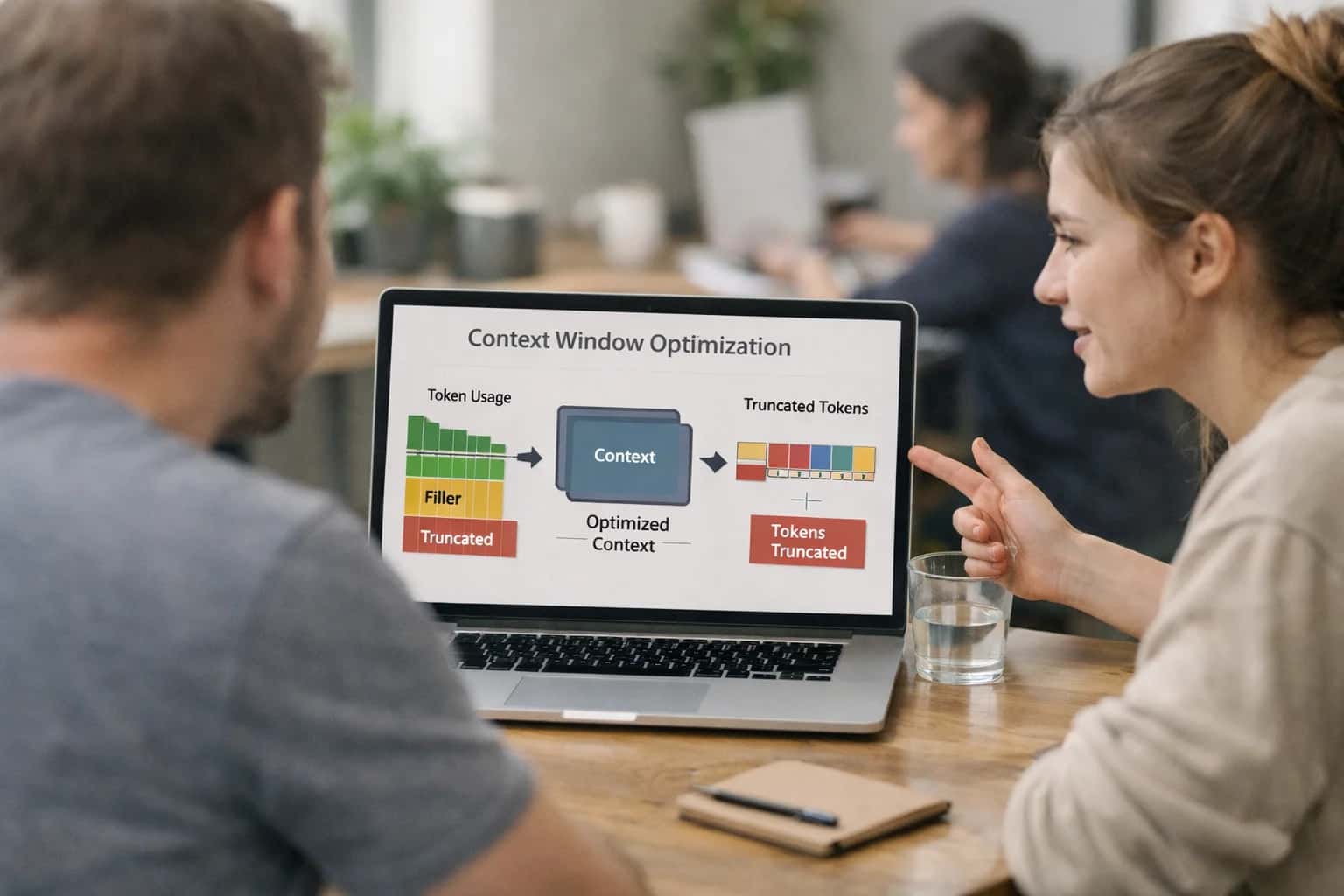
TOKEN OPTIMIZATION
What is Prompt Compression?
Prompt compression is the process of algorithmically reducing the token count of an input prompt while preserving its essential semantic meaning and task performance, primarily used to lower latency, reduce compute costs, and fit lengthy legal documents within a model's context window.
Advanced implementations leverage a small, fast language model to compress the prompt before passing it to a more powerful reasoning model, a process known as LLMLingua. The compressed prompt, often a sequence of high-entropy tokens, is not human-readable but retains the task's semantic structure. This directly reduces the time-to-first-token and the per-query cost, making it a vital optimization for production-scale legal reasoning systems that must balance citation fidelity with infrastructure efficiency.
TOKEN OPTIMIZATION
Key Prompt Compression Techniques
Prompt compression reduces the token footprint of legal instructions while preserving semantic fidelity, directly lowering latency and inference costs when processing lengthy contracts or case law.
01
Semantic Pruning
The systematic removal of linguistically redundant tokens that do not contribute to the core legal instruction. This technique identifies and strips filler phrases, verbose transitions, and tautological statements that inflate prompt length without adding analytical value.
- Mechanism: Uses dependency parsing to isolate essential syntactic heads and discard modifiers that do not alter legal meaning
- Example: Compressing 'It is important to note that the contract clearly states that the party shall' to 'The contract states the party shall'
- Risk: Over-pruning can remove legally significant qualifiers like 'reasonable' or 'material'
02
Entropy-Based Token Filtering
A statistical compression method that evaluates each token's information-theoretic contribution to the prompt. Tokens with low self-information scores—those highly predictable from surrounding context—are candidates for removal.
- Mechanism: Calculates token-level entropy using the model's own probability distribution; tokens above a threshold are retained
- Application: Particularly effective for compressing boilerplate legal clauses where language is formulaic and highly predictable
- Trade-off: Requires an additional forward pass to compute token probabilities before compression
03
Abstractive Summarization Pre-Processing
A two-stage pipeline where a smaller, faster language model first generates a condensed abstract of the source legal document, and this summary replaces the full text in the primary prompt. The technique trades minor fidelity loss for substantial token savings.
- Mechanism: A lightweight model (e.g., a fine-tuned T5 variant) produces a density-controlled summary before the main reasoning call
- Use Case: Compressing 50-page contracts into 2-page briefs for clause extraction tasks
- Critical Guardrail: The summarization model must be evaluated for citation fidelity to ensure no material obligations are dropped
04
Instructional Synonym Collapse
The replacement of verbose instructional phrases with compact, high-density directives that the model has been demonstrated to interpret identically. This technique relies on a curated mapping of semantically equivalent prompt fragments.
- Mechanism: Maintains a lookup table mapping wordy instructions (e.g., 'You are required to carefully analyze and provide a detailed explanation of') to compact equivalents (e.g., 'Analyze and explain')
- Validation: Each synonym pair must be empirically tested via A/B Prompt Testing to confirm behavioral equivalence
- Benefit: Reduces instruction overhead by 30-50% without altering model behavior
05
Context Window Budgeting
A resource-allocation strategy that partitions the available context window into fixed token budgets for each prompt component: system instructions, retrieved documents, few-shot examples, and the user query. Compression is applied differentially based on each component's marginal utility.
- Mechanism: Assigns hard token limits per section; a dynamic allocator can shift budget from instructions to evidence when document length exceeds thresholds
- Legal Application: Ensures that in a Legal RAG Architecture, retrieved case law always receives sufficient token allocation even if it requires compressing the system prompt
- Implementation: Often integrated with Prompt Versioning systems to track budget configurations
06
Soft Prompt Compression
A technique that replaces discrete natural language instructions with learned continuous vector embeddings optimized during fine-tuning. These 'soft prompts' occupy far fewer token slots while encoding complex behavioral directives.
- Mechanism: A small set of tunable embedding vectors (e.g., 5-20 tokens) is prepended to the input; these vectors are optimized via gradient descent to elicit target legal reasoning behavior
- Advantage: Compresses what would be a 500-token system prompt into 10 learned tokens
- Limitation: Soft prompts are model-specific and not human-readable, complicating Algorithmic Explainability audits
PROMPT COMPRESSION
Frequently Asked Questions
Clear answers to the most common technical questions about reducing token usage in legal AI pipelines without sacrificing analytical accuracy.
Prompt compression is the process of reducing the token length of an input prompt while preserving its essential semantic meaning, directly lowering latency and inference costs when processing lengthy legal documents. It works by identifying and removing redundant or non-contributory text—such as verbose instructions, repetitive clauses, or boilerplate—without altering the core analytical task. Techniques range from simple text truncation and summarization to sophisticated auto-encoders that learn to distill prompts into dense, information-preserving representations. In legal AI, a compressed prompt might condense a 50-page contract into a 5-page semantic equivalent, enabling a language model to analyze it within a constrained context window while maintaining high citation fidelity.
LEGAL PROMPT ENGINEERING
Prompt Compression vs. Related Optimization Techniques
A comparative analysis of prompt compression against other techniques used to optimize token usage and reasoning quality when processing lengthy legal documents.
| Feature | Prompt Compression | Prompt Chaining | RAG Architectures |
|---|---|---|---|
Primary Mechanism | Semantic distillation of a single prompt to reduce token count | Decomposition of a complex task into sequential, dependent sub-prompts | Retrieval of relevant external document chunks to inject into the prompt |
Preserves Full Document Context | |||
Reduces Latency | |||
Eliminates Irrelevant Tokens | |||
Maintains Single-Turn Simplicity | |||
Risk of Hallucinated Omission | High | Low | Low |
Optimal Use Case | Condensing a 50-page contract for a single summarization call | Analyzing a contract, then drafting a risk memo based on that analysis | Answering a specific question by retrieving only the governing law clause |
Enabling Efficiency, Speed & Accuracy
Intelligent Analysis, Decision & Execution
We build AI systems for teams that need search across company data, workflow automation across tools, or AI features inside products and internal software.
Talk to Us
Search across company data
Give teams answers from docs, tickets, runbooks, and product data with sources and permissions.
Useful when people spend too long searching or get different answers from different systems.
Enterprise searchRAGPermissions
Read more
Automate internal workflows
Use AI to route work, draft outputs, trigger actions, and keep approvals and logs in place.
Useful when repetitive work moves across multiple tools and teams.
AI agentsWorkflow automationGovernance
Read more
Add AI to products and internal tools
Build assistants, guided actions, or decision support into the software your team or customers already use.
Useful when AI needs to be part of the product, not a separate tool.
AI integrationDecision supportModel routing
Read more
About the author
Prasad Kumkar
CEO & MD, Inference Systems
Prasad Kumkar is the CEO & MD of Inference Systems and writes about AI systems architecture, LLM infrastructure, model serving, evaluation, and production deployment. Over 5+ years, he has worked across computer vision models, L5 autonomous vehicle systems, and LLM research, with a focus on taking complex AI ideas into real-world engineering systems.
His work and writing cover AI systems, large language models, AI agents, multimodal systems, autonomous systems, inference optimization, RAG, evaluation, and production AI engineering.
LinkedIn
Limited slotsGet a Free AI Consultation
Partnered with leading AI, data, and software stack.





How We Work
Custom AI workflows for your Business
One-fit-all AI don't work for modern businesses. At Inferensys, we aim to understand your business & custom requirements; which we use to define most efficient agentic workflows, the data, and the tools for your business.
01
Review the use case
We understand the task, the users, and where AI can actually help.
Read more02
Pick the right approach
We define what needs search, automation, or product integration.
Read more03
Build the first useful version
We implement the part that proves the value first.
Read more04
Improve from there
We add the checks and visibility needed to keep it useful.
Read moreThe first call is a practical review of your use case and the right next step.
Talk to Us