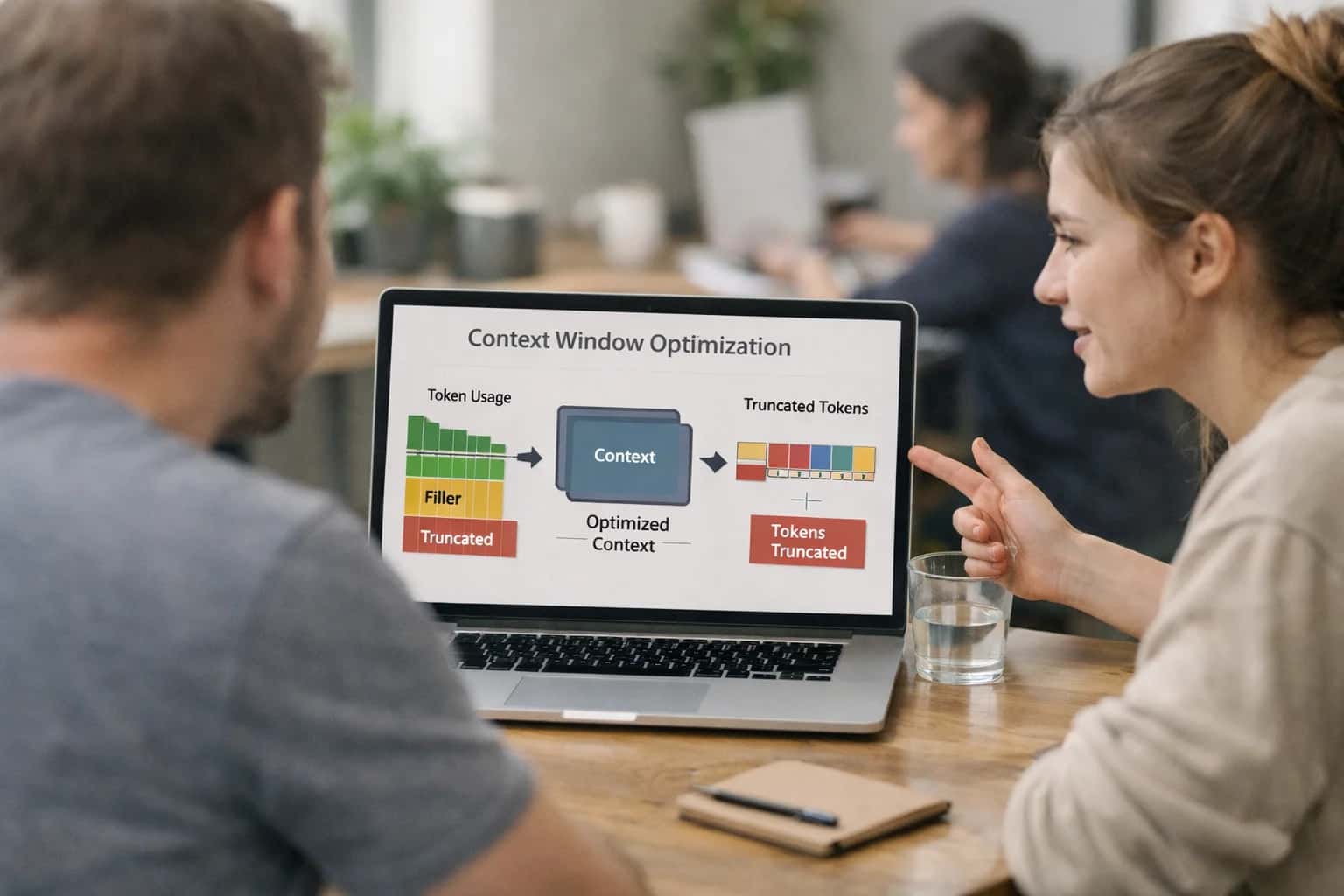
A context window is the maximum number of tokens a language model can process in a single request, defining the upper limit for the combined length of the system prompt, user query, and generated output. It represents the model's working memory, and any information exceeding this limit is truncated, creating a critical constraint for analyzing lengthy legal documents like multi-hundred-page contracts.

Glossary
Context Window
The maximum number of tokens a language model can process in a single request, defining the upper limit for the combined length of the system prompt, user query, and generated legal output.
FOUNDATIONAL ARCHITECTURE
What is a Context Window?
The context window defines the maximum amount of information a language model can consider at once, directly limiting the complexity of legal documents it can analyze in a single pass.
In legal AI, the context window size directly determines whether a model can perform holistic multi-document reasoning or must rely on chunking and retrieval strategies. A larger window allows a model to synthesize arguments across an entire case file without losing coherence, but it also increases computational cost and latency, requiring a careful balance between analytical scope and system performance.
ARCHITECTURAL CONSTRAINTS
Core Characteristics of the Context Window
The context window defines the maximum token capacity a language model can process in a single forward pass, establishing the hard boundary for the combined length of the system prompt, user query, and generated legal output.
01
Token Capacity and Measurement
The context window is measured in tokens, not words or characters. A token is a sub-word unit generated by the model's tokenizer, typically representing ~4 characters or 0.75 words in English text. For legal documents, this distinction is critical: a single complex statutory citation like '42 U.S.C. § 1983' may consume 6-8 tokens. Context windows range from 4K tokens in legacy models to 128K, 200K, or even 1M tokens in frontier architectures. A 128K-token window can hold approximately 96,000 words—roughly the length of a 300-page legal brief. The window encompasses the system prompt, user message, conversation history, and the model's generated response combined.
128K+
Standard Frontier Window
~0.75
Words per Token
04
Attention Complexity and Quadratic Scaling
The standard self-attention mechanism scales quadratically with context length: O(n²) in both computation and memory, where n is the number of tokens. A 128K-token window requires processing over 16 billion attention pairs per layer. This creates a fundamental tension between context capacity and inference cost. Architectural innovations addressing this include FlashAttention (IO-aware exact attention), ring attention (distributed computation across devices), and sparse attention patterns (Sliding Window Attention, Dilated Attention) that reduce complexity to O(n log n) or O(n). For legal deployments, this directly impacts the cost-per-query and latency of processing full case dockets.
O(n²)
Standard Attention Complexity
16B+
Pairs at 128K Tokens
06
Prompt Caching and KV-Cache Management
During autoregressive generation, the model stores computed Key-Value (KV) pairs for all previous tokens to avoid recomputation—this is the KV-cache. For long legal prompts, the KV-cache can consume gigabytes of GPU memory, becoming the primary bottleneck. Prompt caching allows reuse of the KV-cache for repeated system prompts or static document prefixes across multiple queries, dramatically reducing latency and cost. Providers implement context caching where identical prefix tokens are computed once and shared across requests. For legal RAG systems, structuring prompts with a static, cacheable system prompt and document preamble can yield 50-80% latency reductions on repeated queries against the same corpus.
50-80%
Latency Reduction via Caching
GBs
KV-Cache Memory Footprint
CONTEXT WINDOW
Frequently Asked Questions
Explore the fundamental mechanics of the context window, the critical architectural constraint that defines the maximum information a language model can process in a single legal reasoning task.
A context window is the maximum number of tokens a language model can process in a single forward pass, defining the upper limit for the combined length of the system prompt, user query, and generated output. It functions as the model's working memory. When a legal document is submitted, the model's tokenizer breaks the text into discrete units—words, subwords, or characters—and the attention mechanism computes relationships between every token within this fixed-size window. Any information exceeding this limit is truncated from the model's immediate attention, a phenomenon known as the lost-in-the-middle effect, where content in the center of long contexts is often poorly attended to. For legal applications, this means a model with a 128,000-token window can theoretically process a 300-page contract, but its reasoning fidelity may degrade on clauses positioned far from the beginning or end of the document.
Enabling Efficiency, Speed & Accuracy
Intelligent Analysis, Decision & Execution
We build AI systems for teams that need search across company data, workflow automation across tools, or AI features inside products and internal software.
Talk to Us
Search across company data
Give teams answers from docs, tickets, runbooks, and product data with sources and permissions.
Useful when people spend too long searching or get different answers from different systems.
Enterprise searchRAGPermissions
Read more
Automate internal workflows
Use AI to route work, draft outputs, trigger actions, and keep approvals and logs in place.
Useful when repetitive work moves across multiple tools and teams.
AI agentsWorkflow automationGovernance
Read more
Add AI to products and internal tools
Build assistants, guided actions, or decision support into the software your team or customers already use.
Useful when AI needs to be part of the product, not a separate tool.
AI integrationDecision supportModel routing
Read more
About the author
Prasad Kumkar
CEO & MD, Inference Systems
Prasad Kumkar is the CEO & MD of Inference Systems and writes about AI systems architecture, LLM infrastructure, model serving, evaluation, and production deployment. Over 5+ years, he has worked across computer vision models, L5 autonomous vehicle systems, and LLM research, with a focus on taking complex AI ideas into real-world engineering systems.
His work and writing cover AI systems, large language models, AI agents, multimodal systems, autonomous systems, inference optimization, RAG, evaluation, and production AI engineering.
LinkedIn
Limited slotsGet a Free AI Consultation
Partnered with leading AI, data, and software stack.





How We Work
Custom AI workflows for your Business
One-fit-all AI don't work for modern businesses. At Inferensys, we aim to understand your business & custom requirements; which we use to define most efficient agentic workflows, the data, and the tools for your business.
01
Review the use case
We understand the task, the users, and where AI can actually help.
Read more02
Pick the right approach
We define what needs search, automation, or product integration.
Read more03
Build the first useful version
We implement the part that proves the value first.
Read more04
Improve from there
We add the checks and visibility needed to keep it useful.
Read moreThe first call is a practical review of your use case and the right next step.
Talk to Us