Recital parsing is the automated process of isolating and structuring the prefatory recitals—often beginning with "Whereas"—from the main body of a legal document. These clauses articulate the background intent, factual context, and motivations of the parties, serving as an interpretive aid rather than creating direct legal obligations. The primary technical challenge lies in distinguishing these contextual statements from the operative provisions that follow.

Glossary
Recital Parsing
Recital parsing is the targeted extraction of the 'Whereas' clauses that provide background context and intent, distinct from the legally binding operative text of a contract or statute.
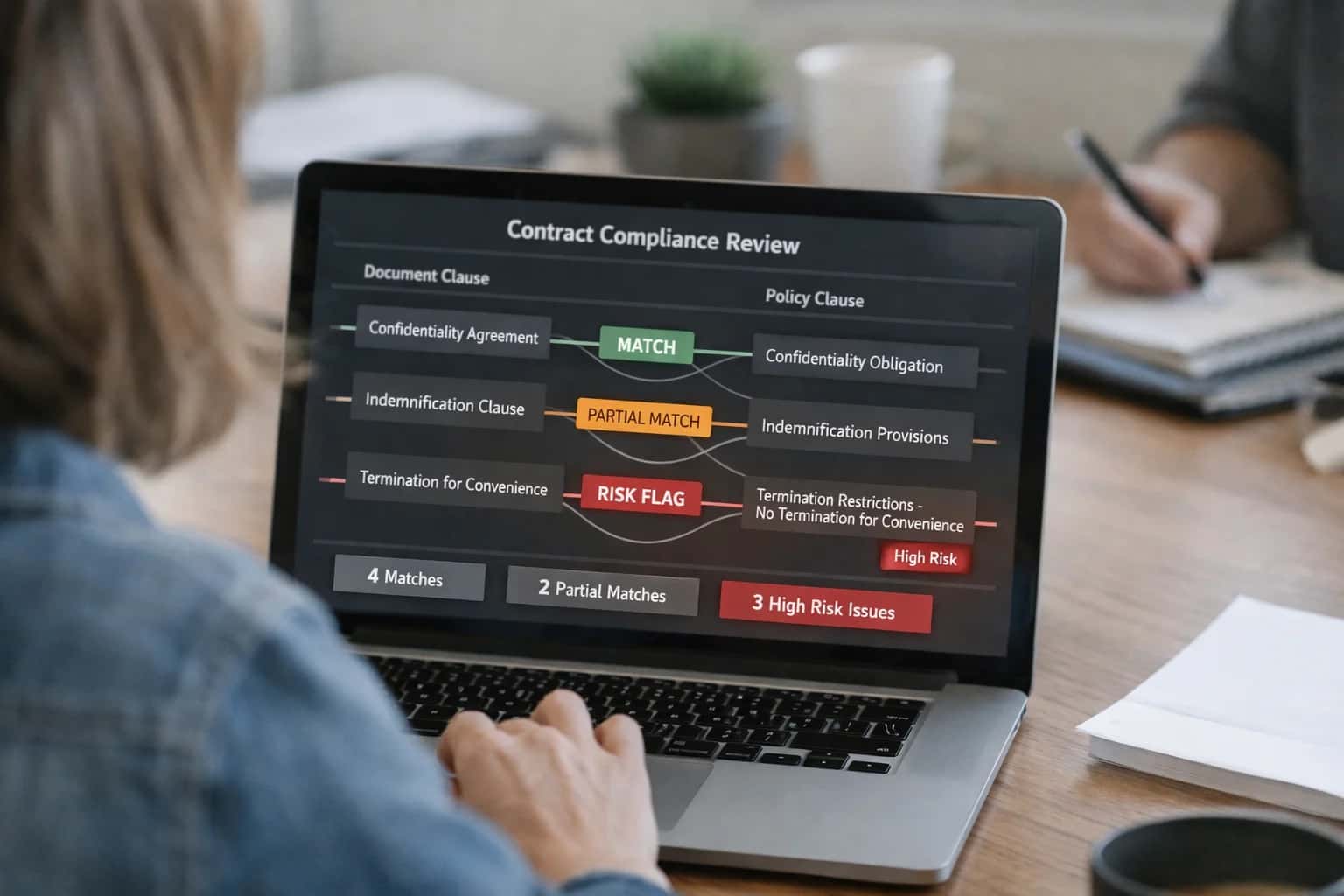
LEGAL DOCUMENT STRUCTURE PARSING
What is Recital Parsing?
Recital parsing is the targeted computational extraction of the 'Whereas' clauses that provide background context and intent, distinct from the legally binding operative text of a contract or statute.
Effective recital parsing relies on structural role classification and section boundary detection to identify where the recital block ends and the binding text begins. This process often integrates with deontic modality extraction to differentiate descriptive language from the imperative "shall" and "must" language of operative clauses, enabling downstream contract clause extraction and summarization systems to correctly weight the legal significance of each segment.
RECITAL PARSING
Frequently Asked Questions
Targeted answers to common questions about the automated extraction and analysis of 'Whereas' clauses in legal documents.
Recital parsing is the targeted computational extraction and structural analysis of the 'Whereas' clauses—formally known as recitals—that preface the legally binding operative text of a contract, statute, or directive. Unlike general document structure parsing, recital parsing specifically identifies the block of text beginning with 'Whereas' or 'Recital' and segments it into discrete, enumerated contextual statements. The process typically involves a pipeline of section boundary detection to isolate the preamble from the operative provisions, followed by token classification or rule-based heuristics to split the block into individual recitals based on numbering schemes (e.g., '(1)', '(A)', or 'Whereas') and line breaks. Advanced implementations use fine-tuned legal embedding models to classify the semantic function of each recital, distinguishing between background context, party intent, and definitions of key terms that inform the interpretation of the contract's binding articles.
Enabling Efficiency, Speed & Accuracy
Intelligent Analysis, Decision & Execution
We build AI systems for teams that need search across company data, workflow automation across tools, or AI features inside products and internal software.
Talk to Us
Search across company data
Give teams answers from docs, tickets, runbooks, and product data with sources and permissions.
Useful when people spend too long searching or get different answers from different systems.
Enterprise searchRAGPermissions
Read more
Automate internal workflows
Use AI to route work, draft outputs, trigger actions, and keep approvals and logs in place.
Useful when repetitive work moves across multiple tools and teams.
AI agentsWorkflow automationGovernance
Read more
Add AI to products and internal tools
Build assistants, guided actions, or decision support into the software your team or customers already use.
Useful when AI needs to be part of the product, not a separate tool.
AI integrationDecision supportModel routing
Read moreArchitectural Requirements
Key Characteristics of Recital Parsing Systems
Recital parsing requires specialized NLP pipelines distinct from general text extraction. These systems must distinguish contextual 'Whereas' clauses from operative provisions with high precision, often relying on structural, linguistic, and sequential cues.
01
Structural Boundary Detection
Identifies the precise textual boundaries where recitals begin and end. This relies on section boundary detection algorithms that recognize transitional phrases like 'Now, therefore' or 'The parties agree as follows' as terminal markers. Systems often combine font-based heuristic parsing for bold/italic headings with token classification models trained on BIO tagging schemes to segment the document object model.
95%+
Boundary Detection Accuracy
02
Linguistic Pattern Recognition
Detects the formulaic language unique to recitals. This goes beyond simple keyword matching for 'Whereas' to include deontic modality extraction that differentiates factual background statements from binding obligations. Key linguistic markers include:
- Declarative past tense constructions describing events
- Non-normative language lacking 'shall' or 'must'
- Purpose clauses beginning with 'with the intent of' or 'desiring to'
03
Hierarchical Recital Grouping
Reconstructs the logical nesting of multiple recitals. Individual 'Whereas' clauses are often semantically grouped into thematic sub-units. Advanced parsers use graph-based document parsing to link sequential recitals that share common entities or subjects, creating a structured preamble tree. This is critical for cross-reference resolution when operative provisions later cite 'the recitals set forth in Section A.'
04
Operative Provision Isolation
Performs the critical negative task of excluding binding text. The system must execute operative provision segmentation to isolate the actionable agreement body. This prevents the recital extraction pipeline from accidentally ingesting warranties or conditions. A robust structural role classification model assigns a 'recital' label to background text and an 'operative' label to the binding articles, ensuring clean separation.
05
Cross-Reference Anchoring
Links recitals to the operative clauses they contextualize. Recitals often provide the factual basis for specific indemnities or definitions. The parser must resolve pinpoint citation extraction references where an operative clause states 'as described in Recital (D).' This creates a navigable knowledge graph connecting background intent to legal effect.
06
Multi-Lingual & Legacy Format Handling
Processes recitals across jurisdictions and document formats. European contracts may use 'Attendu que' or 'Erwägungen' instead of 'Whereas'. Systems must handle PDF structural extraction from scanned legacy documents using zonal OCR and reading order detection to correctly sequence recitals that span multiple pages or columns, often normalizing Romanet parsing for nested sub-recitals (i, ii, iii).

About the author
Prasad Kumkar
CEO & MD, Inference Systems
Prasad Kumkar is the CEO & MD of Inference Systems and writes about AI systems architecture, LLM infrastructure, model serving, evaluation, and production deployment. Over 5+ years, he has worked across computer vision models, L5 autonomous vehicle systems, and LLM research, with a focus on taking complex AI ideas into real-world engineering systems.
His work and writing cover AI systems, large language models, AI agents, multimodal systems, autonomous systems, inference optimization, RAG, evaluation, and production AI engineering.
LinkedIn
Limited slotsGet a Free AI Consultation
Partnered with leading AI, data, and software stack.





How We Work
Custom AI workflows for your Business
One-fit-all AI don't work for modern businesses. At Inferensys, we aim to understand your business & custom requirements; which we use to define most efficient agentic workflows, the data, and the tools for your business.
01
Review the use case
We understand the task, the users, and where AI can actually help.
Read more02
Pick the right approach
We define what needs search, automation, or product integration.
Read more03
Build the first useful version
We implement the part that proves the value first.
Read more04
Improve from there
We add the checks and visibility needed to keep it useful.
Read moreThe first call is a practical review of your use case and the right next step.
Talk to Us