A Legal Localization Engine is an automated system that transforms a source legal document into a jurisdictionally compliant version by substituting governing law, mandatory clauses, and statutory references. It goes beyond linguistic translation to perform legal semantic normalization, mapping concepts from one sovereign framework to their functional equivalents in another while preserving the original commercial intent.

Glossary
Legal Localization Engine
An AI system that adapts a contract, policy, or legal document to comply with the specific statutory language and mandatory clauses of a target jurisdiction.
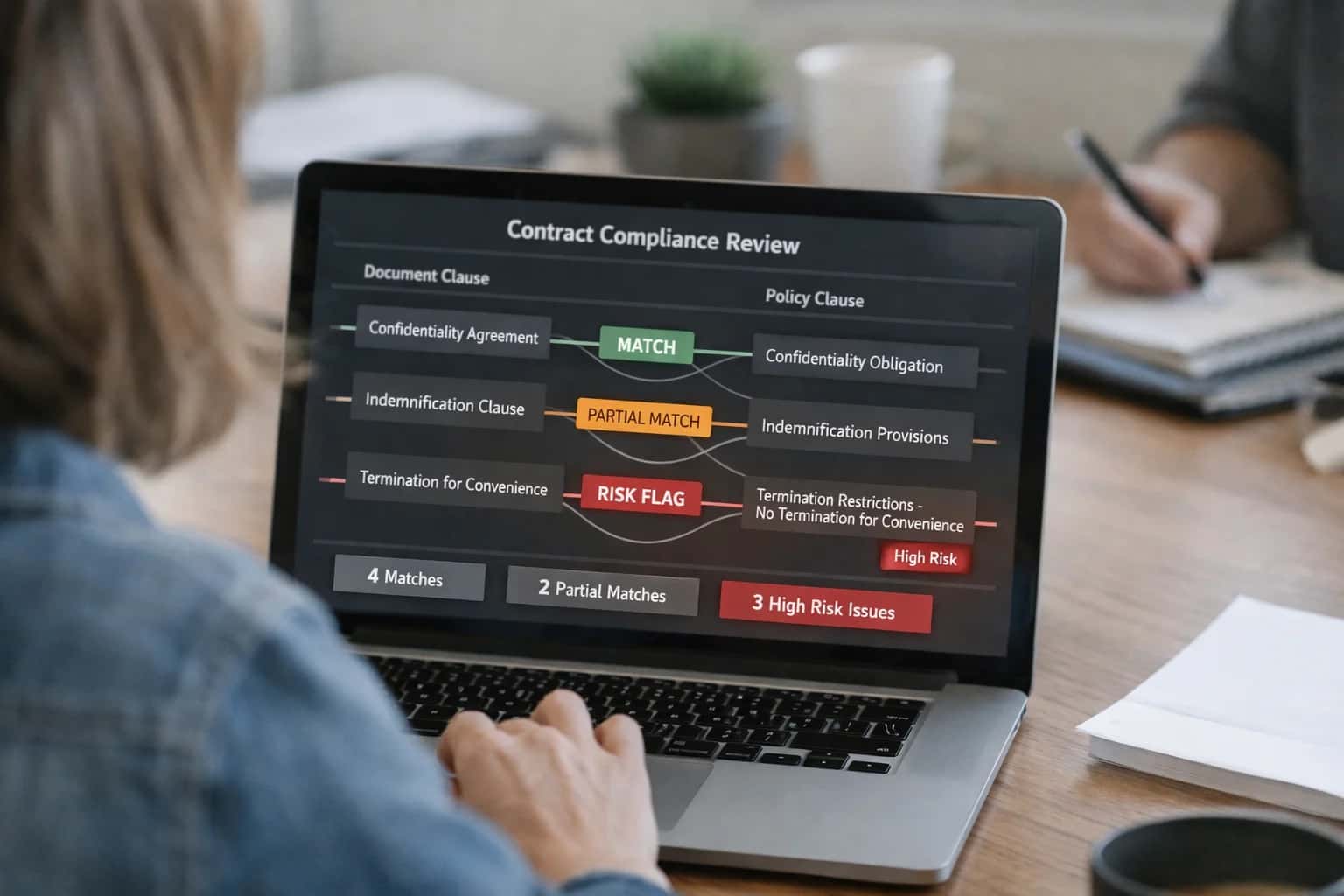
What is a Legal Localization Engine?
A Legal Localization Engine is an AI system that adapts a contract, policy, or legal document to comply with the specific statutory language and mandatory clauses of a target jurisdiction.
The engine leverages cross-jurisdictional embeddings and normative equivalence classes to identify where a foreign concept has a direct counterpart and where regulatory divergence requires structural redrafting. By integrating conflict of laws logic and statutory harmonization rules, it ensures the output document is enforceable under the target jurisdiction's legal system.
CORE CAPABILITIES
Key Features of a Legal Localization Engine
A Legal Localization Engine is an AI system that adapts a contract, policy, or legal document to comply with the specific statutory language and mandatory clauses of a target jurisdiction. The following capabilities define a production-grade engine.
01
Jurisdictional Taxonomy Alignment
Classifies the target legal system within a Jurisdictional Taxonomy—common law, civil law, or religious law—to activate the correct localization logic. This foundational step determines which mandatory clauses and default rules apply.
- Maps source jurisdiction to target using structured legal family trees
- Identifies fundamental structural divergences (e.g., concept of 'consideration' in common law vs. 'cause' in civil law)
- Triggers appropriate Comparative Law Ontology for downstream concept mapping
02
Norm Mapping & Regulatory Equivalence
Algorithmically aligns rules and obligations from the source jurisdiction to their functional equivalents in the target system. The engine performs Norm Mapping to identify semantic overlap and structural divergence.
- Determines Regulatory Equivalence for substituted compliance scenarios
- Identifies gaps where no direct equivalent exists, flagging for manual review
- Leverages Cross-Jurisdictional Embeddings to find functionally similar terms in vector space
03
Statutory Language Substitution
Replaces source-jurisdiction statutory references and defined terms with the precise language mandated by the target jurisdiction's legislative code. This is not translation—it is Legal Semantic Normalization.
- Swaps 'force majeure' clause triggers for jurisdiction-specific statutory formulations
- Replaces references to repealed or non-existent statutes with current local equivalents
- Ensures mandatory statutory wording is preserved verbatim where required by local law
04
Conflict of Laws Resolution
Applies choice-of-law rules to determine which sovereign jurisdiction's substantive law governs each provision. The Conflict of Laws Engine resolves multi-jurisdictional questions automatically.
- Analyzes party domicile, place of performance, and subject matter to apply correct governing law
- Flags provisions where mandatory local law overrides contractual choice of law
- Generates fallback positions when primary governing law selection is unenforceable
05
Compliance Gap Analysis
Performs a systematic Compliance Gap Analysis comparing the localized document against the target jurisdiction's full regulatory standard. Identifies specific areas of non-conformance before execution.
- Generates a redline showing all deviations from target jurisdiction requirements
- Assigns Regulatory Divergence Scores to prioritize remediation efforts
- Produces an audit trail documenting every localization decision for regulatory review
06
Multi-Lingual Legal NER & Translation Alignment
Deploys Multi-Lingual Legal NER to identify and classify jurisdiction-specific entities—courts, statutes, regulatory bodies—across languages. Coupled with Legal Translation Alignment for bilingual jurisdictions.
- Recognizes entity types unique to legal text (e.g., 'Bundesgerichtshof' as a court, not a generic organization)
- Aligns translated clauses with source text at the sentence level for verification
- Preserves legal precision over linguistic fluency in all substitutions
LEGAL LOCALIZATION ENGINE
Frequently Asked Questions
Clear, technical answers to the most common questions about how AI systems adapt legal documents across jurisdictional boundaries.
A Legal Localization Engine is an AI system that algorithmically adapts a contract, policy, or legal document to comply with the specific statutory language, mandatory clauses, and regulatory terminology of a target jurisdiction. It works by first parsing the source document into a structured semantic representation, then performing norm mapping to identify the functional equivalents of each clause in the target legal system. The engine queries a jurisdictional taxonomy and comparative law ontology to resolve terminological differences—for example, mapping the common law concept of 'indemnification' to its closest civil law counterpart. Finally, it synthesizes a new document that preserves the original commercial intent while substituting jurisdiction-specific mandatory language, adjusting for sovereign data boundary requirements, and flagging any compliance gap analysis items that require human review.
Enabling Efficiency, Speed & Accuracy
Intelligent Analysis, Decision & Execution
We build AI systems for teams that need search across company data, workflow automation across tools, or AI features inside products and internal software.
Talk to Us
Search across company data
Give teams answers from docs, tickets, runbooks, and product data with sources and permissions.
Useful when people spend too long searching or get different answers from different systems.
Enterprise searchRAGPermissions
Read more
Automate internal workflows
Use AI to route work, draft outputs, trigger actions, and keep approvals and logs in place.
Useful when repetitive work moves across multiple tools and teams.
AI agentsWorkflow automationGovernance
Read more
Add AI to products and internal tools
Build assistants, guided actions, or decision support into the software your team or customers already use.
Useful when AI needs to be part of the product, not a separate tool.
AI integrationDecision supportModel routing
Read moreCOMPARATIVE ANALYSIS
Legal Localization Engine vs. Related Technologies
Distinguishing the Legal Localization Engine from adjacent cross-jurisdictional technologies based on core function, output, and operational logic.
| Feature | Legal Localization Engine | Norm Mapping | Conflict of Laws Engine |
|---|---|---|---|
Primary Function | Adapts a specific document to comply with a target jurisdiction's statutory language | Aligns abstract rules and obligations between legal systems | Determines which jurisdiction's law applies to a dispute |
Core Output | A fully redrafted, jurisdictionally compliant contract or policy | A semantic map of equivalent norms and structural divergences | A binary or ranked jurisdictional determination |
Input Material | A single source document (contract, policy, terms of service) | Statutory texts, regulations, and legal concepts from two or more systems | A multi-jurisdictional fact pattern with conflicting legal contacts |
Mandatory Clause Injection | |||
Choice-of-Law Rule Application | |||
Operational Trigger | Business expansion into a new jurisdiction requiring localized contracts | Comparative legal research or compliance framework design | Litigation or dispute with cross-border elements |
Temporal Reasoning | Handles effective dates and transition periods within the localized document | Typically static; compares laws as they exist at a point in time | Applies rules to determine governing law at the time of contract formation or injury |
Entity Resolution Dependency | High; must resolve entity names to apply correct jurisdictional rules | Moderate; used for aligning institutional actors across systems | Low; primarily concerned with geographic and subject-matter connections |
LEGAL LOCALIZATION IN PRACTICE
Real-World Applications
Explore how Legal Localization Engines translate statutory intent across borders, enabling multinational operations to maintain a single source of truth while respecting sovereign legal diversity.
01
Global Employment Contract Adaptation
A multinational corporation uses a localization engine to adapt its standard employment agreement for 15+ jurisdictions. The system automatically:
- Replaces the 'at-will employment' clause with statutory dismissal protection language for German and French entities
- Inserts mandatory probationary period limits per local labor codes
- Localizes restrictive covenant language to ensure enforceability, as non-compete clauses are void in California but standard in London
- Flags a mandatory 13th-month salary requirement in Brazil for HR review
15+
Jurisdictions Harmonized
< 1 hour
Per Contract Adaptation
02
Cross-Border Data Processing Agreement
A SaaS provider localizes its Data Processing Agreement (DPA) to satisfy both GDPR and LGPD requirements simultaneously. The engine:
- Maps EU Standard Contractual Clauses to their Brazilian legal equivalents
- Inserts LGPD-specific data subject rights alongside GDPR articles
- Identifies a normative conflict where Brazilian law requires a shorter breach notification window than GDPR
- Generates a jurisdictional precedence clause specifying which law governs in case of conflict
2
Regimes Aligned
100%
Conflict Flagging Accuracy
03
Insurance Policy Localization for Lloyd's Syndicates
A global insurer localizes a master property policy for issuance across APAC markets. The engine:
- Replaces London market wordings with local regulatory phrasing required by the Monetary Authority of Singapore
- Inserts mandatory local endorsements specific to Japanese insurance law
- Adjusts claims notification periods to comply with each jurisdiction's statutory limitations
- Generates a compliance gap report highlighting where the master policy falls short of local requirements
8
APAC Markets Covered
99.5%
Clause Alignment Accuracy
04
Multi-Jurisdictional M&A Due Diligence
During a cross-border acquisition, a legal team deploys a localization engine to analyze target company contracts governed by Delaware, English, and Swiss law. The system:
- Normalizes change-of-control clauses across all three legal systems into a unified risk taxonomy
- Identifies that a Swiss-governed supply agreement contains a penalty clause unenforceable under English law principles
- Maps material adverse change definitions to their functional equivalents in each jurisdiction
- Produces a harmonized risk matrix for the acquirer's general counsel
3
Legal Systems Analyzed
500+
Contracts Processed
05
Automated Statutory Harmonization for Fintech
A fintech company expanding from the UK to the EU uses a localization engine to adapt its terms of service for MiCA compliance. The engine:
- Transposes FCA conduct of business rules to their EBA regulatory equivalents
- Inserts mandatory consumer protection disclosures required under German BGB
- Flags a regulatory divergence where crypto-asset classification differs between BaFin and the AMF
- Generates jurisdiction-specific risk warning language meeting each member state's gold-plating requirements
27
EU Member States Covered
95%
Regulatory Divergence Detection
06
Pharmaceutical Clinical Trial Agreement Localization
A CRO localizes a master clinical trial agreement for sites across North America, Europe, and Asia. The engine:
- Maps indemnification provisions to comply with each jurisdiction's liability regimes
- Inserts local ethics committee approval language per national competent authority requirements
- Adjusts intellectual property ownership clauses to reflect local inventorship laws
- Generates a norm hierarchy graph showing where local mandatory law overrides the master agreement terms
12
Countries Localized
100%
Mandatory Clause Insertion

About the author
Prasad Kumkar
CEO & MD, Inference Systems
Prasad Kumkar is the CEO & MD of Inference Systems and writes about AI systems architecture, LLM infrastructure, model serving, evaluation, and production deployment. Over 5+ years, he has worked across computer vision models, L5 autonomous vehicle systems, and LLM research, with a focus on taking complex AI ideas into real-world engineering systems.
His work and writing cover AI systems, large language models, AI agents, multimodal systems, autonomous systems, inference optimization, RAG, evaluation, and production AI engineering.
LinkedIn
Limited slotsGet a Free AI Consultation
Partnered with leading AI, data, and software stack.





How We Work
Custom AI workflows for your Business
One-fit-all AI don't work for modern businesses. At Inferensys, we aim to understand your business & custom requirements; which we use to define most efficient agentic workflows, the data, and the tools for your business.
01
Review the use case
We understand the task, the users, and where AI can actually help.
Read more02
Pick the right approach
We define what needs search, automation, or product integration.
Read more03
Build the first useful version
We implement the part that proves the value first.
Read more04
Improve from there
We add the checks and visibility needed to keep it useful.
Read moreThe first call is a practical review of your use case and the right next step.
Talk to Us