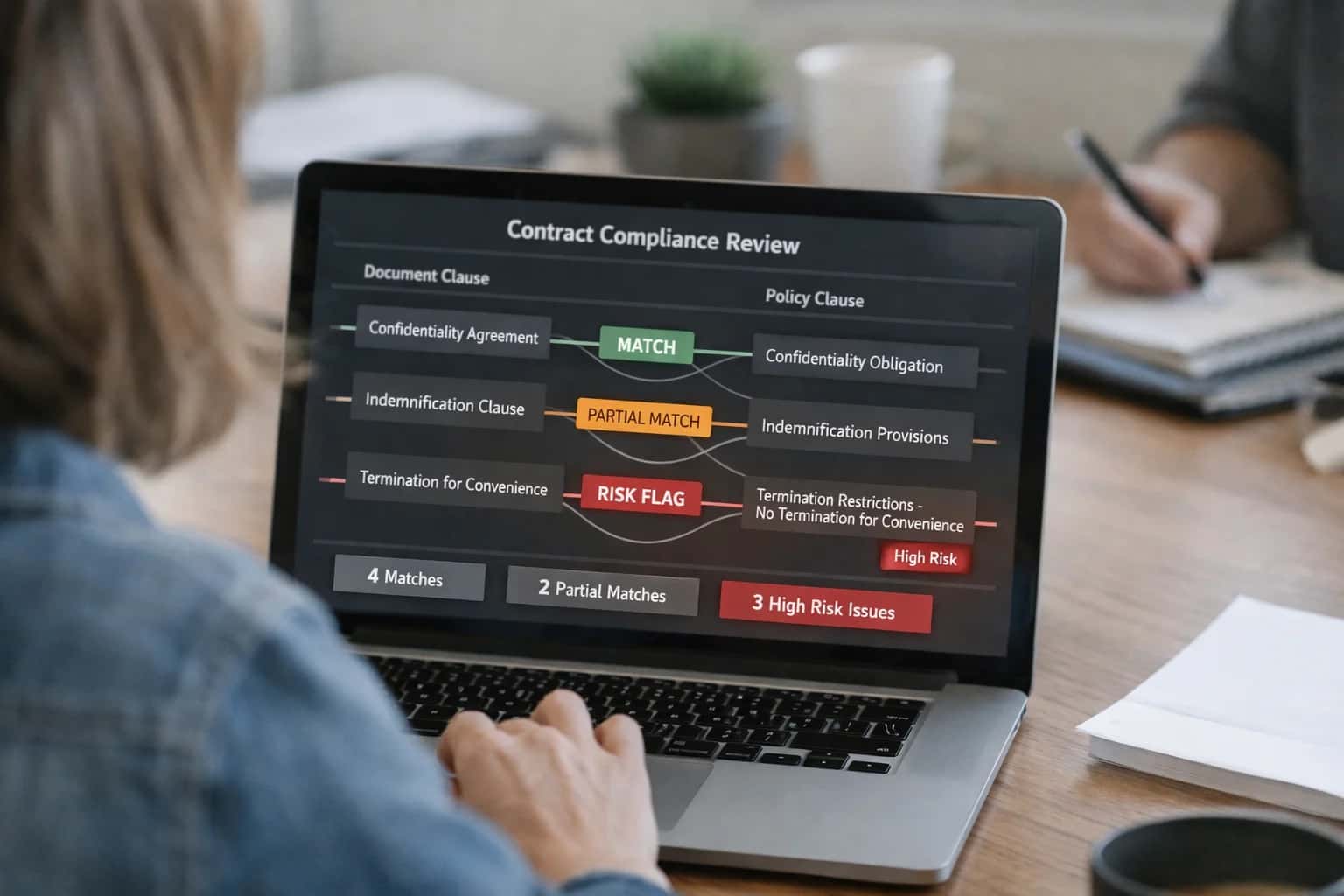
Cross-Border Compliance Mapping is the systematic process of creating a relational data structure that links a specific regulatory obligation in one sovereign jurisdiction to its corresponding requirement in another. It moves beyond simple translation to identify regulatory equivalence, where a foreign rule achieves the same supervisory objective as a domestic one, enabling a single, unified control framework to satisfy multiple regimes simultaneously.

Glossary
Cross-Border Compliance Mapping
The systematic process of linking specific regulatory obligations in one jurisdiction to their corresponding requirements in another to ensure a single business process meets all applicable standards.
GLOBAL REGULATORY INTELLIGENCE
What is Cross-Border Compliance Mapping?
The systematic engineering discipline of linking specific regulatory obligations in one jurisdiction to their functional equivalents in another, ensuring a single business process satisfies all applicable multi-national standards.
The output is a machine-readable compliance map that powers automated compliance gap analysis and regulatory change propagation. By codifying the relationships between statutes, rules, and administrative guidance across borders, this process allows global institutions to instantly assess the impact of a regulatory amendment in one country on their entire multi-jurisdictional compliance posture, eliminating redundant manual legal review.
MECHANICS
Core Characteristics
The fundamental components and operational logic that define a robust cross-border compliance mapping system.
01
Regulatory Equivalence Determination
The core algorithmic process of establishing that a foreign jurisdiction's requirement achieves the same regulatory objective as a domestic one. This is not a simple text match but a functional comparison of legislative intent and supervisory outcomes.
- Substituted Compliance: A formal finding that allows a firm to follow home-state rules abroad.
- Outcomes-Based Analysis: The engine compares the purpose of two laws, not just their text.
- Entity Resolution Dependency: Requires accurate Legal Entity Resolution to map the correct regulators to the correct rules.
02
Normative Equivalence Class
A logical grouping of legal rules from different sovereign systems that are treated as functionally identical for a specific compliance task. This abstraction layer prevents the system from treating semantically identical rules as distinct.
- Semantic Normalization: Relies on Legal Semantic Normalization to map synonyms like 'data controller' and 'data custodian' to a single class.
- Graph Integration: These classes form the nodes in a Norm Hierarchy Graph, linking equivalent statutes to their overriding constitutional principles.
- Dynamic Updating: Classes must be re-verified upon Regulatory Change Propagation to ensure the grouping logic remains valid.
03
Conflict of Laws Engine
An automated decision tree that applies choice-of-law rules to determine which jurisdiction's substantive law governs a specific multi-jurisdictional question. It resolves the 'which rule wins' problem before mapping begins.
- Connecting Factors: Analyzes domicile, location of data subject, and place of performance to establish jurisdiction.
- Mandatory Overriding Provisions: Identifies laws that apply regardless of the contract's chosen law, such as local labor or consumer protection statutes.
- Public Policy Exception: Flags when applying a foreign law would violate the fundamental public policy of the forum state.
04
Cross-Jurisdictional Embedding Space
A vector space model where legal concepts from different languages and systems are positioned based on functional similarity. This allows the system to mathematically calculate the distance between a GDPR obligation and its CCPA counterpart.
- Multi-Lingual Legal NER: Feeds the model by identifying key entities like 'data subject' and 'betroffene Person' as the same concept.
- Legal Textual Entailment: Used to train the model to recognize that 'right to erasure' entails 'right to deletion'.
- Zero-Shot Mapping: Enables the identification of functional equivalents in jurisdictions never explicitly seen during training.
05
Regulatory Divergence Scoring
A quantitative metric that measures the delta between two regulatory regimes for a specific requirement. This score prioritizes remediation efforts by highlighting the most severe compliance gaps.
- Gap Analysis Input: The score directly feeds the Compliance Gap Analysis report, turning a binary pass/fail into a risk-weighted spectrum.
- Scoring Vectors: Analyzes divergence across multiple axes including textual strictness, enforcement severity, and penalty magnitude.
- Arbitrage Detection: High divergence scores combined with low enforcement metrics trigger Regulatory Arbitrage Detection alerts.
06
Regulatory Change Propagation
The automated workflow that traces how an amendment in one jurisdiction cascades through the entire mapping ecosystem. A single statutory update triggers a recalculation of equivalence, divergence, and compliance status.
- Downstream Impact Analysis: Instantly identifies every Normative Equivalence Class and business process affected by the change.
- Versioned Mapping: Maintains a temporal record of all mappings to prove compliance posture at any historical point in time.
- Treaty Compliance Mapping: Automatically translates new treaty obligations into actionable domestic mapping updates for all signatory states.
CROSS-BORDER COMPLIANCE
Frequently Asked Questions
Clear, technically precise answers to the most common questions about mapping regulatory obligations across sovereign jurisdictions.
Cross-border compliance mapping is the systematic process of linking specific regulatory obligations in one jurisdiction to their corresponding requirements in another to ensure a single business process meets all applicable standards. The process begins with legal entity resolution to disambiguate organizational identities, followed by norm mapping to algorithmically align rules and obligations. A jurisdictional taxonomy classifies the legal systems involved, while regulatory equivalence determinations identify where substituted compliance is possible. The output is a structured mapping—often represented in a norm hierarchy graph—that enables automated compliance checking across borders.
CROSS-BORDER COMPLIANCE MAPPING
Practical Applications
Real-world implementations of systematic regulatory alignment across sovereign jurisdictions, enabling unified business processes that satisfy multiple legal regimes simultaneously.
01
GDPR-to-CCPA Data Subject Rights Mapping
A systematic alignment of individual data rights between the EU's General Data Protection Regulation and the California Consumer Privacy Act. This mapping identifies functional equivalences between GDPR's 'Right to Erasure' (Article 17) and CCPA's 'Right to Delete' (§1798.105), while flagging structural divergences such as GDPR's broader lawful basis requirements.
- Maps 8 GDPR data subject rights to their CCPA counterparts
- Identifies gaps where CCPA provides narrower protections
- Generates a unified privacy request handling workflow
- Flags GDPR-only obligations like Data Protection Impact Assessments
8→5
Rights Mapped (GDPR→CCPA)
3
GDPR-Only Gaps Identified
02
Cross-Border Transfer Impact Assessment Automation
An AI-driven system that automates the Transfer Impact Assessment (TIA) required under GDPR for international data flows. The engine ingests the legal framework of the destination jurisdiction, compares it against EU essential equivalence standards, and generates a risk-scored compliance report.
- Analyzes surveillance laws and government access powers in destination countries
- Maps supplementary measures (encryption, pseudonymization) to specific risks
- Generates auditable documentation for supervisory authority review
- Updates assessments automatically when regulatory change propagation detects amendments
72 hrs
Assessment Turnaround
160+
Jurisdictions Modeled
03
Multi-Jurisdictional Anti-Money Laundering Rule Synthesis
A transnational rule synthesis engine that ingests AML regulations from the US Bank Secrecy Act, EU 6th Anti-Money Laundering Directive, and Singapore's MAS Notice 626, then generates a consolidated 'golden standard' compliance framework.
- Resolves conflicting Customer Due Diligence thresholds across regimes
- Creates a unified suspicious transaction reporting logic tree
- Maps politically exposed person definitions to a single screening taxonomy
- Generates jurisdiction-specific addenda for local deviations
94%
Rule Overlap Identified
1
Unified Policy Output
04
Medical Device Regulatory Equivalence Engine
A specialized compliance mapping system that determines regulatory equivalence between the FDA's 21 CFR Part 820 (Quality System Regulation) and the EU's Medical Device Regulation 2017/745. The engine parses both texts, aligns quality management clauses, and identifies where FDA QSR requirements satisfy MDR obligations for substituted compliance filings.
- Maps design control clauses to MDR Annex IX conformity assessment routes
- Flags MDR-unique requirements like Unique Device Identification (UDI) and Person Responsible for Regulatory Compliance
- Generates gap analysis reports for Notified Body submissions
- Maintains alignment as both regulations evolve
87%
Clause-Level Equivalence
13%
MDR-Unique Requirements
05
Cross-Border Employment Contract Localization
A legal localization engine that adapts a master employment agreement to comply with the mandatory statutory language of multiple target jurisdictions simultaneously. The system ingests labor codes from Germany, Japan, and Brazil, then generates jurisdiction-specific contract variants while preserving the employer's core commercial terms.
- Inserts mandatory statutory leave entitlements per jurisdiction
- Adjusts termination notice periods to local minimums
- Maps restrictive covenant enforceability across common law and civil law systems
- Flags clauses void under local public policy (e.g., at-will employment outside the US)
40+
Jurisdiction Templates
98%
Clause Preservation Rate
06
Financial Services Regulatory Passporting Tracker
An automated system that monitors and operationalizes regulatory passporting mechanisms across the EU single market and equivalent third-country regimes. The engine tracks a firm's home-state authorization under MiFID II and maps the precise scope of services that can be passported into each host member state.
- Maintains a real-time norm hierarchy graph of EU directives and local implementing measures
- Alerts compliance officers when host states impose additional local conduct of business rules
- Maps equivalence determinations for third-country firms under MiFIR
- Generates regulatory perimeter visualizations for board reporting
27
EU Member States Tracked
Real-time
Regulatory Change Detection
DISCIPLINE DIFFERENTIATION
Comparison with Related Disciplines
How Cross-Border Compliance Mapping compares to adjacent legal harmonization and regulatory analysis disciplines across key operational dimensions.
| Feature | Cross-Border Compliance Mapping | Regulatory Equivalence | Conflict of Laws Engine |
|---|---|---|---|
Primary objective | Link specific obligations across jurisdictions to enable unified business processes | Determine if a foreign regime achieves the same regulatory objective as domestic rules | Apply choice-of-law rules to select which jurisdiction governs a dispute |
Output type | Obligation-to-obligation mapping matrix with gap identification | Binary or graded equivalence determination | Single jurisdictional designation for a legal question |
Temporal orientation | Prospective and continuous | Point-in-time assessment | Reactive to dispute or transaction |
Automation readiness | High; suited for AI-driven mapping and continuous monitoring | Moderate; requires regulatory judgment and formal assessment | Moderate; rule-based logic with interpretive nuance |
Handles regulatory gaps | |||
Requires formal regulatory recognition | |||
Typical update frequency | Continuous or triggered by regulatory change | Periodic review cycles | Case-by-case application |
Primary user persona | Global compliance officer | Regulatory affairs counsel | Litigation or transactional attorney |
Enabling Efficiency, Speed & Accuracy
Intelligent Analysis, Decision & Execution
We build AI systems for teams that need search across company data, workflow automation across tools, or AI features inside products and internal software.
Talk to Us
Search across company data
Give teams answers from docs, tickets, runbooks, and product data with sources and permissions.
Useful when people spend too long searching or get different answers from different systems.
Enterprise searchRAGPermissions
Read more
Automate internal workflows
Use AI to route work, draft outputs, trigger actions, and keep approvals and logs in place.
Useful when repetitive work moves across multiple tools and teams.
AI agentsWorkflow automationGovernance
Read more
Add AI to products and internal tools
Build assistants, guided actions, or decision support into the software your team or customers already use.
Useful when AI needs to be part of the product, not a separate tool.
AI integrationDecision supportModel routing
Read more
About the author
Prasad Kumkar
CEO & MD, Inference Systems
Prasad Kumkar is the CEO & MD of Inference Systems and writes about AI systems architecture, LLM infrastructure, model serving, evaluation, and production deployment. Over 5+ years, he has worked across computer vision models, L5 autonomous vehicle systems, and LLM research, with a focus on taking complex AI ideas into real-world engineering systems.
His work and writing cover AI systems, large language models, AI agents, multimodal systems, autonomous systems, inference optimization, RAG, evaluation, and production AI engineering.
LinkedIn
Limited slotsGet a Free AI Consultation
Partnered with leading AI, data, and software stack.





How We Work
Custom AI workflows for your Business
One-fit-all AI don't work for modern businesses. At Inferensys, we aim to understand your business & custom requirements; which we use to define most efficient agentic workflows, the data, and the tools for your business.
01
Review the use case
We understand the task, the users, and where AI can actually help.
Read more02
Pick the right approach
We define what needs search, automation, or product integration.
Read more03
Build the first useful version
We implement the part that proves the value first.
Read more04
Improve from there
We add the checks and visibility needed to keep it useful.
Read moreThe first call is a practical review of your use case and the right next step.
Talk to Us