Material Adverse Change Parsing is the natural language processing (NLP) task of automatically identifying, extracting, and structuring the definitional components of a MAC or MAE clause from a merger or acquisition agreement. The parser must isolate the core definition—what constitutes a material adverse effect on the target's business, assets, or financial condition—and distinguish it from the critical carve-outs that exclude systemic risks like general economic downturns, industry-wide changes, or acts of war from triggering the clause.

Glossary
Material Adverse Change Parsing
Material Adverse Change Parsing is the automated extraction and structuring of definitions, exceptions, and carve-outs within a Material Adverse Change (MAC) or Material Adverse Effect (MAE) clause from a legal contract using natural language processing.
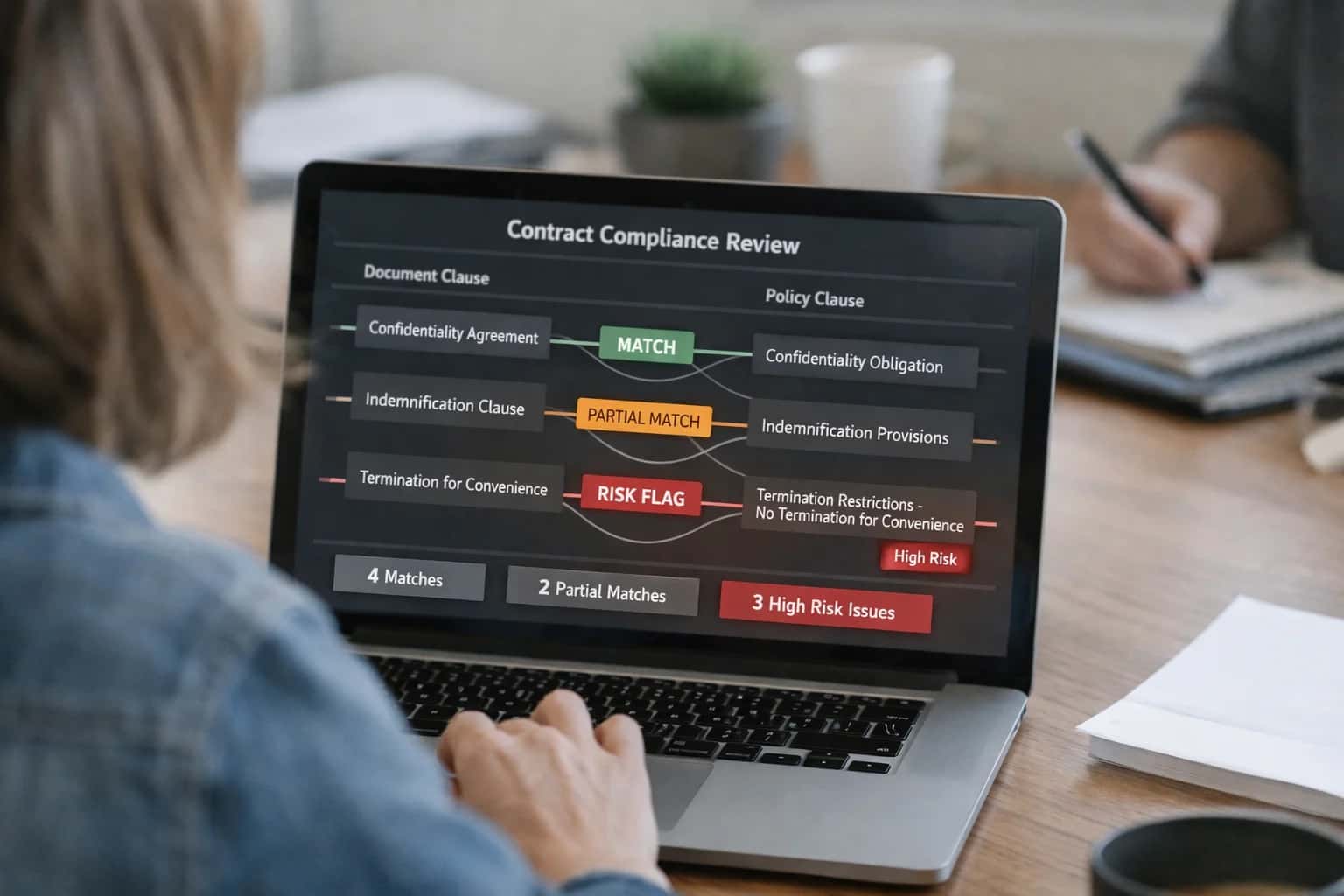
CONTRACT CLAUSE EXTRACTION
What is Material Adverse Change Parsing?
The automated extraction and structural analysis of Material Adverse Change (MAC) or Material Adverse Effect (MAE) clauses, which define the conditions under which a buyer can terminate an acquisition if a significant negative event impacts the target company's value.
The technical challenge lies in resolving the complex interplay between the broad, qualitative MAC definition and the specific, negotiated exceptions list. A robust parsing engine must accurately extract the durational qualifiers (e.g., 'would reasonably be expected to have'), the proportionality thresholds, and the precise allocation of risk for events like pandemics or regulatory changes, structuring this logic into a machine-readable schema for downstream obligation extraction and risk analysis.
MATERIAL ADVERSE CHANGE INTELLIGENCE
Key Features of MAC Parsing Systems
Parsing Material Adverse Change clauses requires systems that move beyond simple keyword search to understand complex syntactic structures, cascading definitions, and the interplay between broad grants and specific carve-outs.
01
Recursive Definitional Unpacking
MAC clauses are not monolithic; they are defined by nested, cross-referenced terms. A parsing system must resolve a chain of definitions—for example, linking 'Material Adverse Effect' to 'Target Material Adverse Effect' and further to 'Subsidiary Material Adverse Effect'—to build a complete semantic picture. This requires graph-based entity resolution to track how a single defined term cascades through an entire purchase agreement, ensuring no interpretive gap exists between the parent definition and its progeny.
02
Carve-Out vs. Exception Classification
The core of MAC negotiation lies in the carve-outs—events that do not constitute a MAC despite meeting the general definition. A robust parser must distinguish between:
- Systemic risk carve-outs: Changes in general economic conditions, industry-wide events, or acts of war.
- Disproportionate impact exceptions: The critical 'except to the extent' language that pulls an event back into MAC territory if it affects the target more severely than peers.
- Pre-existing condition carve-outs: Matters disclosed in the disclosure schedules.
03
Prospective vs. Retrospective Temporal Analysis
MAC definitions pivot on temporal triggers. The parser must differentiate between:
- Prospective MACs: Events that 'would reasonably be expected to have' a material adverse effect, requiring probabilistic modeling of future outcomes.
- Retrospective MACs: Events that 'have had' a material adverse effect, requiring analysis of historical financial impact.
- Look-forward dates: Specific dates between signing and closing that serve as measurement points, often tied to interim financial statements.
04
Quantitative Materiality Threshold Extraction
While MAC is inherently qualitative, modern clauses increasingly include numeric materiality scrapers. The parser must extract and normalize:
- Percentage-of-revenue thresholds: e.g., 'a reduction of 15% or more in consolidated revenues.'
- Absolute dollar floors: e.g., 'Losses exceeding $10,000,000 individually or in the aggregate.'
- EBITDA impact metrics: Specific reductions in earnings metrics over a trailing twelve-month period. These quantitative hooks provide objective triggers that override the vague 'material' standard.
05
Standalone vs. Conjunctive Condition Logic
A MAC clause is typically one of several conditions precedent to closing. The parsing system must map the logical relationship between the MAC condition and other closing conditions. A buyer may have the right to terminate if a MAC occurs and the breach of a representation is not cured. Alternatively, the MAC may be a standalone walk-away right. Understanding this Boolean logic—whether the MAC is a necessary or sufficient condition for termination—is critical for risk assessment.
06
Knowledge Qualifier Parsing
MAC clauses are often subject to knowledge qualifiers that limit their scope. The parser must extract and model the precise definition of 'Knowledge'—typically a capitalized defined term referencing specific individuals (e.g., 'the actual knowledge of the officers listed on Schedule 1.1'). This creates a critical link between the MAC clause and the disclosure schedules, as events known to key individuals but not disclosed may trigger a breach of a representation rather than a standalone MAC, altering the remedy structure.
Enabling Efficiency, Speed & Accuracy
Intelligent Analysis, Decision & Execution
We build AI systems for teams that need search across company data, workflow automation across tools, or AI features inside products and internal software.
Talk to Us
Search across company data
Give teams answers from docs, tickets, runbooks, and product data with sources and permissions.
Useful when people spend too long searching or get different answers from different systems.
Enterprise searchRAGPermissions
Read more
Automate internal workflows
Use AI to route work, draft outputs, trigger actions, and keep approvals and logs in place.
Useful when repetitive work moves across multiple tools and teams.
AI agentsWorkflow automationGovernance
Read more
Add AI to products and internal tools
Build assistants, guided actions, or decision support into the software your team or customers already use.
Useful when AI needs to be part of the product, not a separate tool.
AI integrationDecision supportModel routing
Read moreMATERIAL ADVERSE CHANGE PARSING
Frequently Asked Questions
Essential questions about the automated extraction and analysis of Material Adverse Change (MAC) and Material Adverse Effect (MAE) clauses in transactional agreements.
A Material Adverse Change (MAC) clause, often used interchangeably with Material Adverse Effect (MAE), is a contractual provision in merger and acquisition agreements that allocates the risk of unknown, adverse events occurring between signing and closing. It defines the threshold at which a negative development impacting the target company's business, assets, financial condition, or results of operations is sufficiently significant to permit the buyer to terminate the transaction without penalty. The clause functions as a risk-shifting mechanism: the seller bears the risk of ordinary business fluctuations, while the buyer is protected against extraordinary, unforeseen events that fundamentally alter the long-term earning power of the acquired entity. Parsing these clauses computationally requires identifying the operative definition, the enumerated carve-outs, and the specific knowledge qualifiers that limit the buyer's walk-away rights.

About the author
Prasad Kumkar
CEO & MD, Inference Systems
Prasad Kumkar is the CEO & MD of Inference Systems and writes about AI systems architecture, LLM infrastructure, model serving, evaluation, and production deployment. Over 5+ years, he has worked across computer vision models, L5 autonomous vehicle systems, and LLM research, with a focus on taking complex AI ideas into real-world engineering systems.
His work and writing cover AI systems, large language models, AI agents, multimodal systems, autonomous systems, inference optimization, RAG, evaluation, and production AI engineering.
LinkedIn
Limited slotsGet a Free AI Consultation
Partnered with leading AI, data, and software stack.





How We Work
Custom AI workflows for your Business
One-fit-all AI don't work for modern businesses. At Inferensys, we aim to understand your business & custom requirements; which we use to define most efficient agentic workflows, the data, and the tools for your business.
01
Review the use case
We understand the task, the users, and where AI can actually help.
Read more02
Pick the right approach
We define what needs search, automation, or product integration.
Read more03
Build the first useful version
We implement the part that proves the value first.
Read more04
Improve from there
We add the checks and visibility needed to keep it useful.
Read moreThe first call is a practical review of your use case and the right next step.
Talk to Us