A consequential damages waiver is a clause in which contracting parties mutually or unilaterally disclaim liability for losses that do not flow directly and immediately from a breach but instead arise from the injured party's specific circumstances. These indirect losses typically include lost profits, loss of business reputation, diminished goodwill, and operational downtime. The waiver confines recoverable damages to those naturally resulting from the breach itself, creating a predictable liability ceiling.

Glossary
Consequential Damages Waiver
A contractual provision where one or both parties agree to waive liability for indirect, special, or consequential losses arising from a breach of contract.
CONTRACTUAL LIABILITY LIMITATION
What is a Consequential Damages Waiver?
A consequential damages waiver is a contractual provision where one or both parties agree to exclude liability for indirect, special, or consequential losses arising from a breach of contract, limiting recovery to direct damages only.
Courts distinguish consequential damages from direct damages by applying the Hadley v. Baxendale foreseeability test: losses are consequential if they stem from special circumstances communicated at contract formation. Sophisticated parties often draft these waivers with explicit carve-outs for breaches of confidentiality, indemnification obligations, or third-party intellectual property infringement to preserve recourse for high-severity risks while barring speculative economic claims.
CONTRACT LIABILITY
Frequently Asked Questions
Clear answers to common questions about consequential damages waivers, their enforcement, and their critical role in limiting contractual liability exposure.
A consequential damages waiver is a contractual provision where one or both parties agree to exclude liability for indirect, special, or consequential losses arising from a breach of contract. These waivers function as a risk-allocation mechanism, preventing the non-breaching party from recovering damages that do not flow directly and immediately from the breach itself. Consequential damages typically include lost profits, loss of business opportunity, diminution of market value, and damage to reputation. The waiver operates by contractually narrowing the scope of recoverable damages under the default rules of contract law, such as those established in the English case Hadley v. Baxendale (1854), which limits consequential damages to those reasonably foreseeable at the time of contracting. In practice, the clause creates a contractual barrier that courts will enforce unless it is found to be unconscionable or contrary to public policy. A mutual waiver applies to both parties, while a unilateral waiver protects only one—often the service provider or vendor with greater exposure to business interruption claims.
CONTRACT CLAUSE EXTRACTION
How AI Extracts Consequential Damages Waivers
Automated identification of provisions that waive liability for indirect, special, or consequential losses arising from a breach of contract.
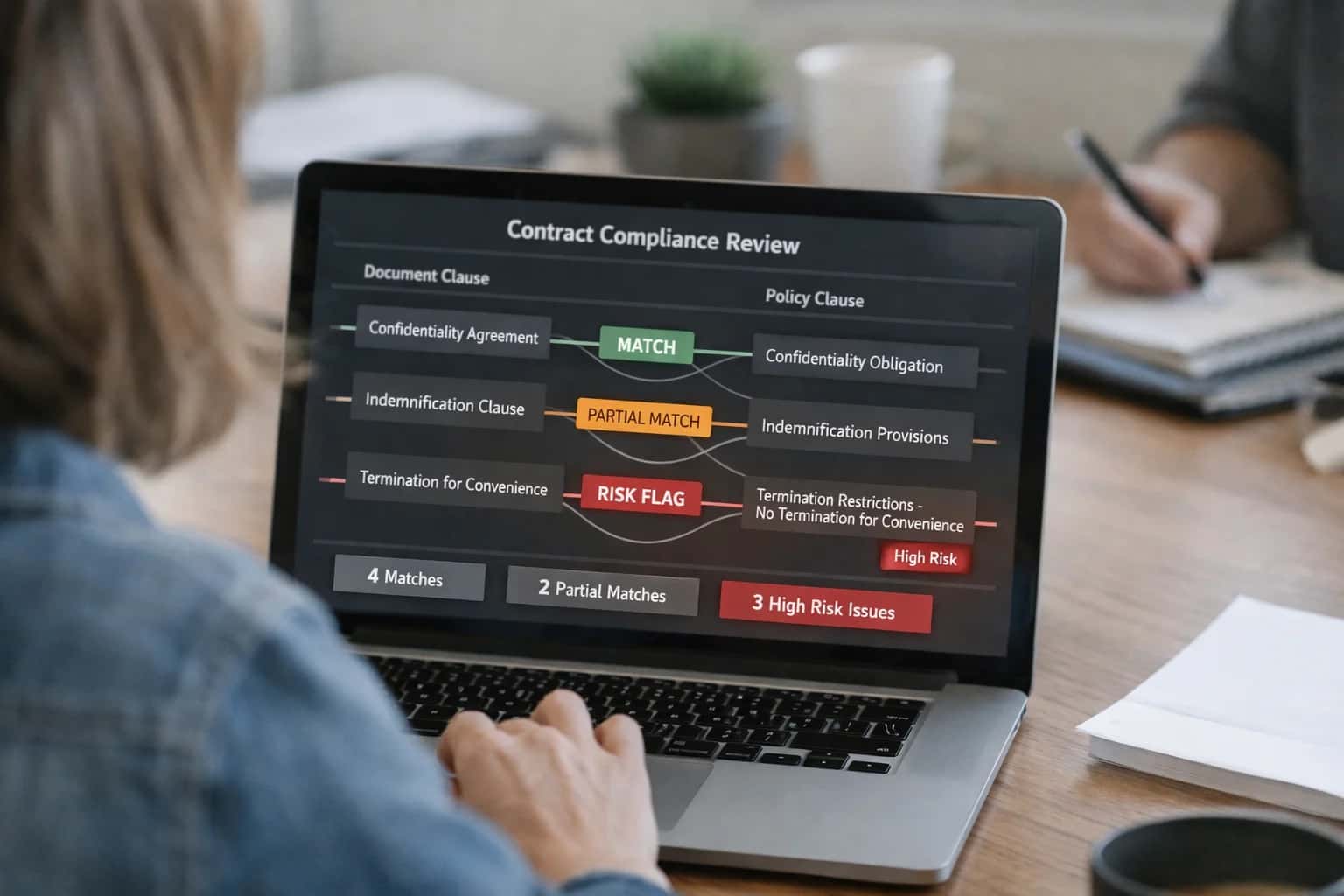
AI extracts consequential damages waivers by fine-tuning domain-specific language models on annotated legal corpora to recognize the semantic patterns of mutual or unilateral liability exclusion. These models identify the clause by detecting the specific interplay between defined loss categories—such as lost profits, business interruption, or loss of data—and the explicit waiver language that disclaims them, distinguishing consequential waivers from direct damage limitations.
The extraction pipeline employs semantic clause classification to differentiate a consequential damages waiver from adjacent provisions like liability cap parsing or indemnification clause identification. By leveraging legal embedding models trained on the structural logic of contracts, the system accurately captures the scope of the waiver, including any carve-outs for gross negligence, willful misconduct, or breaches of confidentiality that may survive the exclusion.
CONSEQUENTIAL DAMAGES WAIVER
Key Characteristics for AI Detection
The computational identification of a consequential damages waiver requires the model to distinguish between direct and indirect losses, recognize mutual vs. unilateral structures, and parse intricate carve-out logic.
01
Direct vs. Indirect Loss Distinction
The core linguistic challenge is differentiating direct damages (flowing naturally from the breach) from consequential damages (special losses arising from the injured party's specific circumstances). AI must identify key signaling phrases like:
- 'lost profits'
- 'loss of business opportunity'
- 'loss of goodwill'
- 'diminution in value'
- 'business interruption' The model must also recognize when these terms are explicitly categorized as direct losses via contractual definition, overriding common law defaults.
02
Mutual vs. Unilateral Waiver Detection
The AI must classify the waiver's reciprocity structure by analyzing the subject of the waiver provision:
- Mutual Waiver: Both parties disclaim consequential damages against each other. Look for language like 'neither party shall be liable...'
- Unilateral Waiver: Only one party waives the right to claim consequential damages. Often found in vendor-friendly agreements.
- Asymmetric Waiver: Both parties waive, but one party retains specific exceptions (e.g., for indemnification or data breaches). The model must map the waiver scope to each defined party role precisely.
03
Carve-Out and Exception Parsing
Sophisticated waivers contain carve-outs that preserve liability for specific categories. The AI must extract these exceptions, which commonly include:
- Breach of confidentiality obligations
- Indemnification obligations
- IP infringement claims
- Gross negligence or willful misconduct
- Data breach liabilities
- Bodily injury or property damage
- Payment obligations
- Breach of data protection clauses (e.g., GDPR-related fines) The model must link each carve-out to the correct party and determine if it applies to direct damages, consequential damages, or both.
04
Liability Cap Interaction
The consequential damages waiver rarely operates in isolation. The AI must analyze its interaction with the overall liability cap:
- Does the waiver sit outside the cap (i.e., it is a separate, uncapped exclusion)?
- Is it subject to the cap (i.e., waived damages also count toward the aggregate limit)?
- Does a super-cap or enhanced cap apply to carved-out consequential damages? The model must trace cross-references between the waiver clause and the limitation of liability section to construct the complete financial exposure profile.
05
Jurisdictional Default Rule Awareness
The legal effect of a consequential damages waiver varies by governing law. The AI must contextualize the clause against jurisdictional defaults:
- UCC Article 2: The default rule in U.S. commercial law allows consequential damages unless excluded by contract.
- Civil Law Systems: Some jurisdictions (e.g., France, Germany) have narrower concepts of consequential loss, often tied to the foreseeability test under the Hadley v. Baxendale rule.
- Consumer Protection Overrides: In B2C contexts, statutory rights may invalidate blanket waivers. The model should flag clauses where the governing law may render the waiver partially unenforceable.
06
Foreseeability and Causation Language
Advanced waivers incorporate foreseeability qualifiers that modify the scope of excluded damages. The AI must detect and classify these linguistic modifiers:
- 'Whether or not foreseeable'
- 'Even if advised of the possibility'
- 'Arising out of or in connection with'
- 'Directly or indirectly'
- 'Special, incidental, punitive, or exemplary' These phrases signal an intent to waive damages broadly, including those that might otherwise be recoverable under the Hadley v. Baxendale foreseeability test. The model must distinguish between a narrow waiver (excluding only unforeseeable consequential losses) and a broad waiver (excluding all indirect losses regardless of foreseeability).
Enabling Efficiency, Speed & Accuracy
Intelligent Analysis, Decision & Execution
We build AI systems for teams that need search across company data, workflow automation across tools, or AI features inside products and internal software.
Talk to Us
Search across company data
Give teams answers from docs, tickets, runbooks, and product data with sources and permissions.
Useful when people spend too long searching or get different answers from different systems.
Enterprise searchRAGPermissions
Read more
Automate internal workflows
Use AI to route work, draft outputs, trigger actions, and keep approvals and logs in place.
Useful when repetitive work moves across multiple tools and teams.
AI agentsWorkflow automationGovernance
Read more
Add AI to products and internal tools
Build assistants, guided actions, or decision support into the software your team or customers already use.
Useful when AI needs to be part of the product, not a separate tool.
AI integrationDecision supportModel routing
Read moreDAMAGES LIMITATION COMPARISON
Consequential Damages Waiver vs. Related Clauses
Distinguishing the consequential damages waiver from adjacent contractual risk allocation mechanisms.
| Feature | Consequential Damages Waiver | Liquidated Damages Clause | Liability Cap |
|---|---|---|---|
Primary Function | Excludes liability for indirect, special, or consequential losses | Pre-agreed sum payable for a specific breach | Limits maximum aggregate financial exposure |
Type of Loss Addressed | Indirect losses (lost profits, business interruption) | Direct losses from a defined breach event | All losses (direct and indirect) up to a ceiling |
Trigger Mechanism | Breach of contract | Occurrence of specified breach event | Any claim or series of claims |
Damages Recoverable | Only direct, general damages | Fixed sum regardless of actual loss | Actual proven damages up to the cap amount |
Court Scrutiny Level | Generally enforced if clear and mutual | Must not constitute a penalty; must be reasonable estimate | Often subject to carve-outs for gross negligence or willful misconduct |
Typical Carve-Outs | Gross negligence, willful misconduct, death/bodily injury, IP infringement | None; liquidated sum is exclusive remedy | Third-party indemnity claims, fraud, confidentiality breaches |
Risk Allocation Purpose | Shifts risk of unforeseeable business losses | Provides certainty for high-probability delay/performance failures | Places a ceiling on total monetary exposure |
Common Pairing | Mutual waiver with a liability cap | Often paired with a consequential damages waiver | Often paired with a consequential damages waiver |

About the author
Prasad Kumkar
CEO & MD, Inference Systems
Prasad Kumkar is the CEO & MD of Inference Systems and writes about AI systems architecture, LLM infrastructure, model serving, evaluation, and production deployment. Over 5+ years, he has worked across computer vision models, L5 autonomous vehicle systems, and LLM research, with a focus on taking complex AI ideas into real-world engineering systems.
His work and writing cover AI systems, large language models, AI agents, multimodal systems, autonomous systems, inference optimization, RAG, evaluation, and production AI engineering.
LinkedIn
Limited slotsGet a Free AI Consultation
Partnered with leading AI, data, and software stack.





How We Work
Custom AI workflows for your Business
One-fit-all AI don't work for modern businesses. At Inferensys, we aim to understand your business & custom requirements; which we use to define most efficient agentic workflows, the data, and the tools for your business.
01
Review the use case
We understand the task, the users, and where AI can actually help.
Read more02
Pick the right approach
We define what needs search, automation, or product integration.
Read more03
Build the first useful version
We implement the part that proves the value first.
Read more04
Improve from there
We add the checks and visibility needed to keep it useful.
Read moreThe first call is a practical review of your use case and the right next step.
Talk to Us