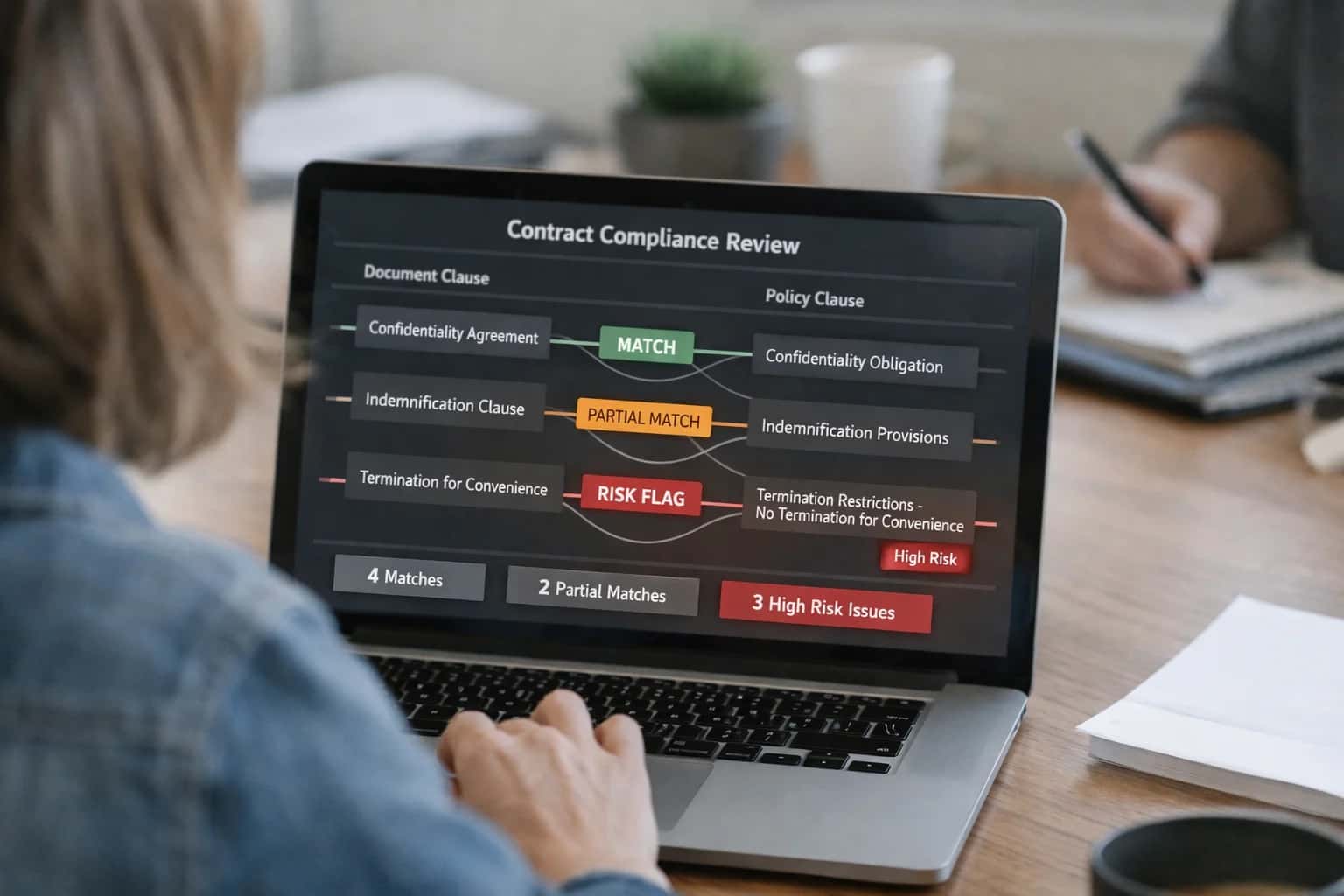
Confidentiality clause tagging is a specialized natural language processing task that identifies and labels provisions governing the protection of proprietary or sensitive information. Unlike simple keyword matching, this process uses semantic clause classification models trained on legal corpora to distinguish confidentiality obligations from related concepts like non-disclosure, trade secret protection, and data security requirements. The tagging system analyzes the deontic structure of each provision—identifying the receiving party, the disclosing party, the scope of protected information, and any temporal limitations or permitted disclosures—to assign accurate metadata labels.

Glossary
Confidentiality Clause Tagging
The automated classification of provisions that restrict the disclosure and use of non-public information exchanged between contracting parties.
CONTRACT INTELLIGENCE
What is Confidentiality Clause Tagging?
Confidentiality clause tagging is the automated classification of contractual provisions that restrict the disclosure and use of non-public information exchanged between parties, enabling rapid identification of sensitive data obligations across large document corpora.
Modern confidentiality clause tagging leverages domain-specific language models fine-tuned on annotated contract datasets to handle the linguistic variability of legal drafting. The system must correctly classify clauses regardless of heading conventions, recognizing that confidentiality obligations may appear under labels such as 'Confidential Information,' 'Proprietary Rights,' or 'Non-Disclosure.' Advanced implementations integrate with contract taxonomy alignment frameworks to map tagged clauses to standardized ontologies, enabling consistent cross-document analysis for due diligence, compliance audits, and obligation extraction pipelines that feed downstream contract lifecycle management systems.
CONFIDENTIALITY CLAUSE ANATOMY
Key Attributes Extracted by Tagging Models
Modern NLP models decompose confidentiality clauses into structured, machine-readable attributes. This granular extraction moves beyond simple clause detection to enable automated risk analysis, obligation tracking, and cross-document comparison.
01
Definition of Confidential Information
The model identifies the scope of what constitutes protected data. This includes parsing enumerated categories (technical specs, business plans, customer lists) and catch-all phrases.
- Tangible media: Marked 'Confidential' in writing
- Intangible disclosures: Oral briefings summarized in follow-up memos
- Carve-outs: Public domain, prior knowledge, independent development, compelled disclosure
The extraction captures whether the definition is unilateral (one-way) or mutual (reciprocal), a critical risk distinction.
02
Permitted Use & Purpose Limitation
Tagging models extract the specific business purpose for which data can be used. This is a binding constraint, not a preamble.
- Evaluation of a potential transaction (M&A due diligence)
- Performance of a Statement of Work (vendor services)
- Joint development (R&D collaboration)
Any use outside this defined purpose constitutes a breach. The model links this attribute to the Obligation Extraction sibling task to populate compliance checklists.
03
Disclosure Permissions & Recipients
The system identifies the authorized recipients and the conditions under which disclosure is permitted. This creates a hierarchical access control list from unstructured text.
- Employees: On a strict need-to-know basis with binding confidentiality agreements
- Affiliates: Parent companies and subsidiaries, often requiring a guaranty
- Professional Advisors: Lawyers, accountants, and bankers who owe a professional duty of confidentiality
- Regulatory Disclosures: Compelled disclosures to government agencies, often with a notice requirement
04
Term & Survival Period
Extraction models parse the temporal dimensions of the confidentiality obligation, which often bifurcates into two distinct periods.
- Contract Term: The duration of the agreement itself (e.g., 3 years from the Effective Date)
- Survival Period: The tail period after termination during which confidentiality duties persist (e.g., 5 years post-termination)
- Trade Secret Exception: Indefinite protection for information qualifying as a trade secret under the Defend Trade Secrets Act (DTSA) or the EU Trade Secrets Directive
05
Return or Destruction Obligations
The model identifies the post-termination procedures for handling confidential materials, a frequently litigated provision.
- Mandatory return of all physical copies
- Secure deletion of electronic data with written certification of compliance
- Retention carve-outs: One archival copy for legal/regulatory compliance or backup tapes in the ordinary course of IT rotation
- Destruction triggers: Upon written request or automatically upon contract termination
06
Equitable Relief & Remedies
Tagging models flag the remedy stack specific to confidentiality breaches, which differs from standard contract damages.
- Injunctive Relief: Admission that monetary damages are inadequate and the disclosing party is entitled to seek an injunction without posting bond
- Specific Performance: Court-ordered compliance with return/destruction obligations
- Cumulative Remedies: Clarification that equitable relief is in addition to, not in lieu of, legal damages
- Fee Shifting: Prevailing party attorney's fees in enforcement actions
CONFIDENTIALITY CLAUSE TAGGING
Frequently Asked Questions
Precise answers to the most common technical and operational questions about automating the identification and classification of confidentiality provisions in legal agreements.
Confidentiality clause tagging is the automated process of using natural language understanding (NLU) models to locate and classify provisions within a contract that restrict the disclosure and use of non-public information. The mechanism typically involves a pipeline: first, a document structure parser segments the contract into hierarchical elements (sections, subsections). Next, a fine-tuned semantic clause classifier—often a transformer model adapted for legal text—analyzes each segment to determine if it imposes a duty of confidentiality. The model identifies linguistic triggers such as "shall hold in confidence," "non-disclosure," or "proprietary information." Finally, the system applies a label from a predefined contract taxonomy, distinguishing a unilateral confidentiality clause from a mutual non-disclosure provision. This structured output enables downstream tasks like obligation extraction and cross-document risk comparison.
Enabling Efficiency, Speed & Accuracy
Intelligent Analysis, Decision & Execution
We build AI systems for teams that need search across company data, workflow automation across tools, or AI features inside products and internal software.
Talk to Us
Search across company data
Give teams answers from docs, tickets, runbooks, and product data with sources and permissions.
Useful when people spend too long searching or get different answers from different systems.
Enterprise searchRAGPermissions
Read more
Automate internal workflows
Use AI to route work, draft outputs, trigger actions, and keep approvals and logs in place.
Useful when repetitive work moves across multiple tools and teams.
AI agentsWorkflow automationGovernance
Read more
Add AI to products and internal tools
Build assistants, guided actions, or decision support into the software your team or customers already use.
Useful when AI needs to be part of the product, not a separate tool.
AI integrationDecision supportModel routing
Read more
About the author
Prasad Kumkar
CEO & MD, Inference Systems
Prasad Kumkar is the CEO & MD of Inference Systems and writes about AI systems architecture, LLM infrastructure, model serving, evaluation, and production deployment. Over 5+ years, he has worked across computer vision models, L5 autonomous vehicle systems, and LLM research, with a focus on taking complex AI ideas into real-world engineering systems.
His work and writing cover AI systems, large language models, AI agents, multimodal systems, autonomous systems, inference optimization, RAG, evaluation, and production AI engineering.
LinkedIn
Limited slotsGet a Free AI Consultation
Partnered with leading AI, data, and software stack.





How We Work
Custom AI workflows for your Business
One-fit-all AI don't work for modern businesses. At Inferensys, we aim to understand your business & custom requirements; which we use to define most efficient agentic workflows, the data, and the tools for your business.
01
Review the use case
We understand the task, the users, and where AI can actually help.
Read more02
Pick the right approach
We define what needs search, automation, or product integration.
Read more03
Build the first useful version
We implement the part that proves the value first.
Read more04
Improve from there
We add the checks and visibility needed to keep it useful.
Read moreThe first call is a practical review of your use case and the right next step.
Talk to Us