Condition Precedent Parsing is the NLP task of extracting contingent events from legal text that must be satisfied to trigger a contractual duty. Unlike unconditional obligations, these clauses create a temporal and logical gate—no performance is due until the specified event occurs, such as regulatory approval, financing, or a third-party action.

Glossary
Condition Precedent Parsing
The automated extraction of events that must occur before a party's performance obligation is triggered or a contract becomes effective.
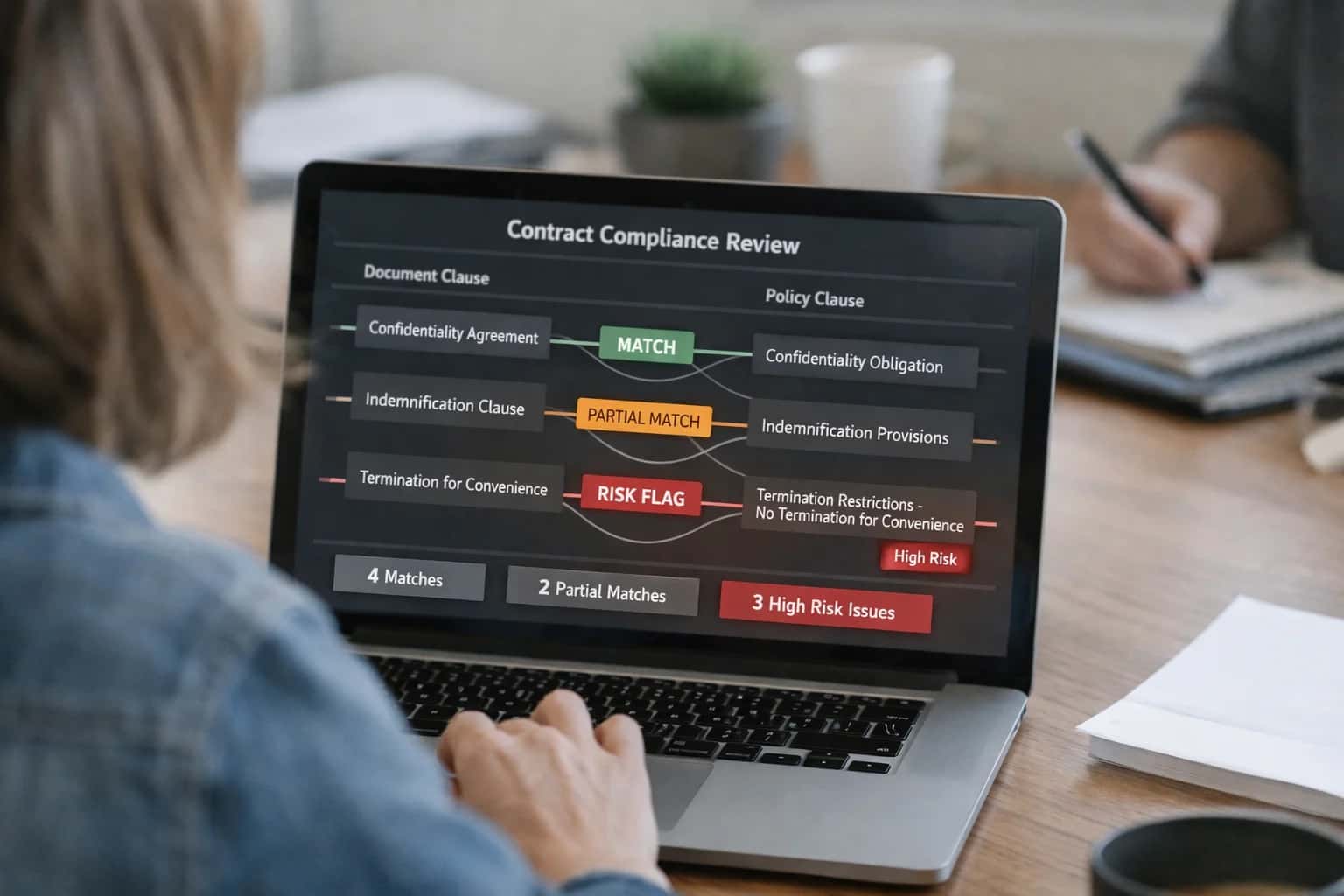
CONTRACTUAL TRIGGER EXTRACTION
What is Condition Precedent Parsing?
The automated identification and structuring of events that must occur before a party's performance obligation is activated or a contract becomes effective.
The parser must identify the condition trigger (the event), the obligation it unlocks, and the standard of satisfaction (e.g., reasonable efforts, sole discretion). This requires resolving syntactic subordination and cross-references, distinguishing true conditions precedent from mere covenants or conditions subsequent that discharge existing duties.
TRIGGER EXTRACTION
Key Characteristics of Condition Precedent Parsing
The core mechanics of identifying and structuring the contingent events that gate contractual performance obligations.
01
Linguistic Trigger Patterns
Condition precedent parsing relies on identifying specific syntactic and lexical markers that signal contingency. These patterns distinguish a conditional obligation from an absolute one.
- Subordinating conjunctions: "provided that," "on condition that," "subject to"
- Temporal prepositions: "upon," "prior to," "following receipt of"
- Conditional clauses: "if and when," "unless and until"
- Nominal triggers: "a condition precedent to payment is..."
A robust parser must handle both explicit markers and implicit conditions where the contingency is embedded in the definition of a defined term.
02
Event Sequencing and Dependency Graphs
Parsing a condition precedent requires extracting not just the event itself but its temporal relationship to other contractual milestones. The output is a directed acyclic graph of dependencies.
- Pre-condition: Event A must occur before Obligation B is triggered
- Post-condition: The state of the world after Obligation B is performed
- Concurrent conditions: Events that must occur simultaneously
- External dependencies: Conditions reliant on third-party actions (e.g., regulatory approval)
The parser must resolve anaphoric references like "such approval" or "the foregoing" to correctly link conditions to their governing clauses.
03
Satisfaction Standard Classification
Not all conditions are binary. The parser must classify the standard of satisfaction that governs whether a condition is met, as this determines the risk allocation between parties.
- Objective satisfaction: Measurable by a reasonable person standard (e.g., "obtain a building permit")
- Subjective satisfaction: Dependent on a party's personal judgment (e.g., "satisfactory to Buyer in its sole discretion")
- Commercial reasonableness: A middle ground requiring efforts consistent with industry norms
- Best efforts / reasonable efforts: Imposes an affirmative duty to cause the condition to occur
Misclassifying the standard can fundamentally alter the enforceability analysis of the entire obligation.
04
Condition vs. Covenant Distinction
A critical parsing challenge is distinguishing a condition precedent from a covenant. The semantic difference carries massive legal consequences.
- Condition: Failure excuses the counterparty's performance; no breach occurs, but the obligation never ripens
- Covenant: Failure constitutes a breach of contract, entitling the counterparty to damages
- Hybrids: Drafting ambiguities like "provided that the Buyer shall deliver..." require contextual disambiguation
Advanced parsers use deontic logic classifiers trained on annotated legal corpora to detect the operative language of duty versus contingency.
05
Waiver and Estoppel Detection
A condition precedent may be waived by the party it protects. The parser must identify language that either preserves or extinguishes the right to assert non-satisfaction.
- Express waiver: "Buyer may waive this condition by written notice"
- Anti-waiver clauses: "No waiver shall be effective unless in writing"
- Deemed satisfaction: "Condition deemed satisfied upon Closing"
- Estoppel certificates: Statements that conditions have been met, barring later contrary claims
Extracting these provisions is essential for building a complete picture of whether a condition remains a live gating item or has been discharged.
06
Multi-Jurisdictional Condition Mapping
Conditions precedent are treated differently across legal systems. A parser designed for cross-border contracts must normalize these concepts into a unified schema.
- Common law: Strict compliance required; "time is of the essence" clauses elevate timing to a condition
- Civil law (e.g., France): The concept of condition suspensive operates similarly but with good faith overlays
- UNIDROIT / CISG: Uses the concept of impediment and hardship rather than strict conditions
- Regulatory conditions: CFIUS clearance, antitrust approval (Hart-Scott-Rodino), and FDI regimes
The parser must tag conditions with their governing law context to enable accurate cross-jurisdictional comparison.
Enabling Efficiency, Speed & Accuracy
Intelligent Analysis, Decision & Execution
We build AI systems for teams that need search across company data, workflow automation across tools, or AI features inside products and internal software.
Talk to Us
Search across company data
Give teams answers from docs, tickets, runbooks, and product data with sources and permissions.
Useful when people spend too long searching or get different answers from different systems.
Enterprise searchRAGPermissions
Read more
Automate internal workflows
Use AI to route work, draft outputs, trigger actions, and keep approvals and logs in place.
Useful when repetitive work moves across multiple tools and teams.
AI agentsWorkflow automationGovernance
Read more
Add AI to products and internal tools
Build assistants, guided actions, or decision support into the software your team or customers already use.
Useful when AI needs to be part of the product, not a separate tool.
AI integrationDecision supportModel routing
Read moreCONDITION PRECEDENT PARSING
Frequently Asked Questions
Targeted answers to the most common technical and operational questions regarding the automated extraction of condition precedent logic from contractual agreements.
Condition precedent parsing is the automated NLP task of extracting events that must occur before a party's performance obligation is triggered or a contract becomes effective. It works by employing a combination of semantic clause classification and deontic logic modeling to identify the specific linguistic triggers (e.g., 'subject to,' 'provided that,' 'on the condition that') that signal a conditional state. The parser then extracts the protasis (the conditional event) and the apodosis (the triggered obligation), structuring them into a machine-readable graph that links the condition to the duty. This process often uses fine-tuned transformer models trained on annotated legal corpora to distinguish between true conditions precedent and mere temporal sequences or covenants.

About the author
Prasad Kumkar
CEO & MD, Inference Systems
Prasad Kumkar is the CEO & MD of Inference Systems and writes about AI systems architecture, LLM infrastructure, model serving, evaluation, and production deployment. Over 5+ years, he has worked across computer vision models, L5 autonomous vehicle systems, and LLM research, with a focus on taking complex AI ideas into real-world engineering systems.
His work and writing cover AI systems, large language models, AI agents, multimodal systems, autonomous systems, inference optimization, RAG, evaluation, and production AI engineering.
LinkedIn
Limited slotsGet a Free AI Consultation
Partnered with leading AI, data, and software stack.





How We Work
Custom AI workflows for your Business
One-fit-all AI don't work for modern businesses. At Inferensys, we aim to understand your business & custom requirements; which we use to define most efficient agentic workflows, the data, and the tools for your business.
01
Review the use case
We understand the task, the users, and where AI can actually help.
Read more02
Pick the right approach
We define what needs search, automation, or product integration.
Read more03
Build the first useful version
We implement the part that proves the value first.
Read more04
Improve from there
We add the checks and visibility needed to keep it useful.
Read moreThe first call is a practical review of your use case and the right next step.
Talk to Us