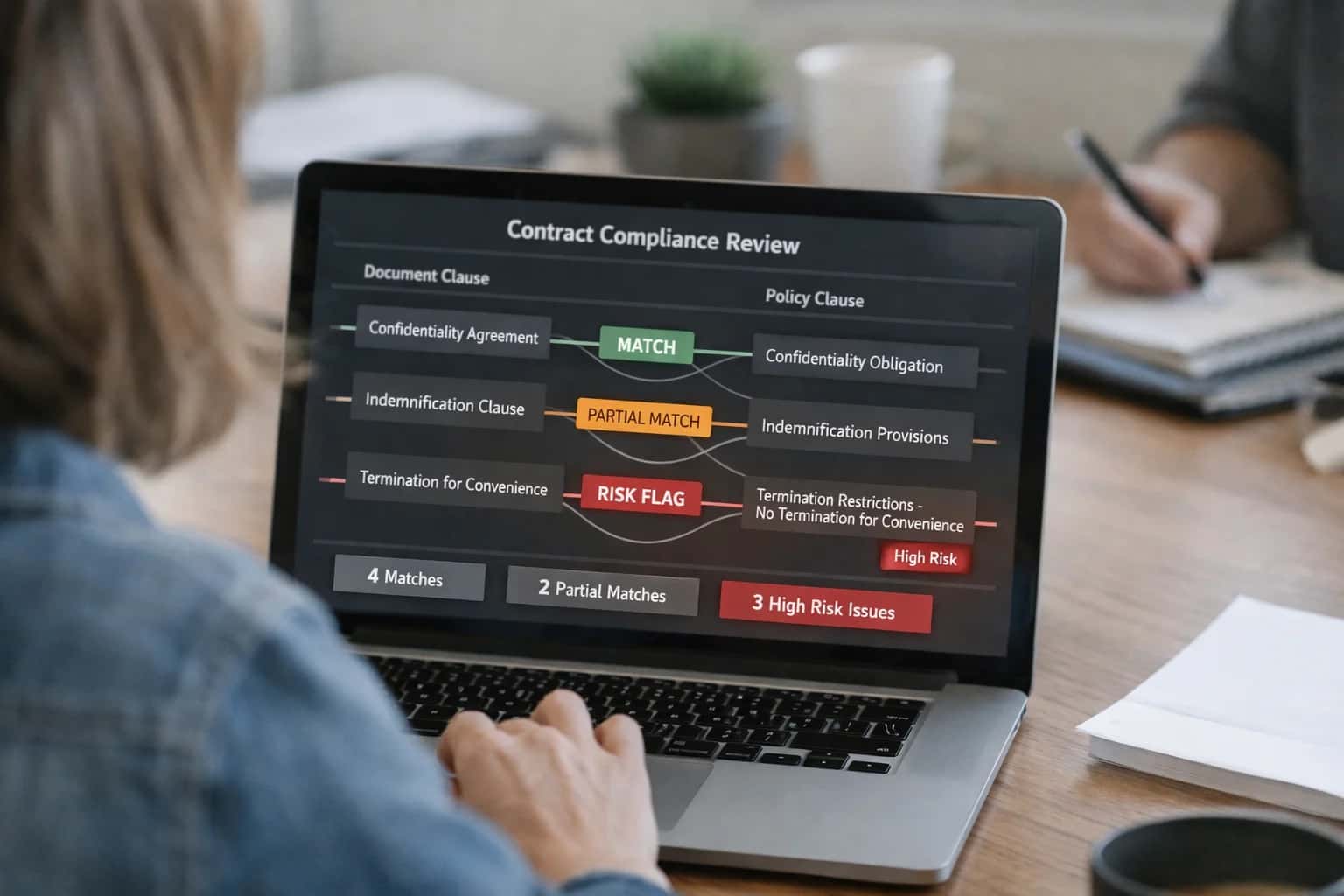
Change of Control Identification is the computational process of locating and classifying provisions within legal agreements that are activated by a fundamental shift in a contracting party's ownership structure. These clauses, often embedded in financing agreements, licensing deals, and supply contracts, grant the non-transferring party specific rights—such as termination for convenience, accelerated payment obligations, or consent requirements—upon the occurrence of a defined trigger event like a merger, acquisition, or sale of substantially all assets.

Glossary
Change of Control Identification
The automated detection of contractual clauses triggered by a merger, acquisition, or sale of a party's equity, often granting the counterparty termination or consent rights.
CONTRACT ANALYSIS
What is Change of Control Identification?
Change of Control Identification is the automated detection of contractual clauses triggered by a merger, acquisition, or sale of a party's equity, often granting the counterparty termination or consent rights.
The technical challenge lies in distinguishing a generic assignment clause from a true change of control provision, which requires semantic parsing of complex, multi-layered definitions. An effective identification model must extract not only the trigger event but also the specific carve-outs (e.g., internal reorganizations) and the precise remedial consequences assigned to the counterparty, enabling automated risk assessment during due diligence.
Structural Triggers and Consent Rights
Key Characteristics of Change of Control Clauses
Change of Control clauses are critical risk-allocation mechanisms in commercial agreements. They define the specific corporate events that grant a counterparty the right to terminate, demand accelerated payment, or withhold consent. Understanding their precise structural components is essential for accurate automated extraction.
01
Definition of the Triggering Event
The clause must precisely define what constitutes a 'Change of Control.' This is not a generic concept but a specific contractual definition. Common triggers include:
- A merger or consolidation where the party is not the surviving entity.
- The sale of all or substantially all assets of the party.
- An acquisition of more than 50% of voting equity by a third party.
- A change in the composition of the board of directors over a specified period.
The exact percentage threshold and the nature of the transaction are critical data points for extraction.
02
Counterparty Rights and Remedies
Upon a triggering event, the non-changing party is typically granted specific contractual rights. Automated systems must classify these remedies accurately:
- Termination for Convenience: The right to exit the contract without penalty.
- Acceleration of Payment: All future or contingent payments become immediately due.
- Consent or Approval Right: The transaction cannot proceed without the counterparty's prior written consent, often with a clause stating that consent 'shall not be unreasonably withheld.'
- Assignment by Operation of Law: A clause clarifying that a merger does not constitute an impermissible assignment of the agreement.
03
Carve-Outs and Exceptions
Sophisticated clauses contain explicit exceptions to prevent routine corporate restructuring from triggering adverse consequences. Key carve-outs to identify include:
- Internal Reorganizations: Transactions with wholly-owned subsidiaries or affiliates.
- Employee Stock Plans: Changes in voting control resulting from broad-based employee equity compensation.
- Passive Investment: Acquisitions by institutional investors like pension funds or mutual funds that do not seek board representation.
- Threshold Exceptions: Specific carve-outs for acquisitions below a defined percentage (e.g., 'less than 15% of outstanding shares').
04
Direct vs. Indirect Transfers
The scope of the clause is a major negotiation point. The language must be parsed to determine if it captures only direct changes at the contracting entity level or also indirect changes up the ownership chain.
- Direct Change: Only a change in the immediate party to the contract is covered.
- Indirect Change: A change in the ultimate parent company or any entity in the ownership chain triggers the clause.
- Drag-Along Logic: If an indirect change is included, the clause often specifies the 'top-level' entity whose ownership is monitored, preventing multiple triggers in a multi-tiered holding structure.
05
Notice and Cure Periods
The procedural mechanics following a Change of Control are as important as the definition itself. Extraction must capture temporal constraints:
- Notice Obligation: The changing party must provide written notice within a specific number of days (e.g., 'within 30 days following the closing').
- Option Exercise Window: The non-changing party has a limited time after receiving notice to exercise its termination or acceleration rights.
- Failure to Notify: Some clauses stipulate that failure to provide timely notice constitutes a material breach, independent of the underlying transaction.
06
Assignment Nexus and Anti-Assignment Clauses
Change of Control clauses are functionally and logically linked to Anti-Assignment Provisions. A common legal dispute is whether a merger by operation of law violates a standard anti-assignment clause. Automated systems must analyze these clauses in tandem:
- Merger Language: Modern contracts explicitly state whether a merger constitutes an assignment.
- Void vs. Breach: Distinguishing between clauses that render an unauthorized transfer 'void' versus those that make it a 'breach' is critical for risk assessment.
- De Facto Assignment: A Change of Control clause often serves as a 'belt-and-suspenders' approach to capture transactions that might not technically qualify as a legal assignment but transfer economic control.
Enabling Efficiency, Speed & Accuracy
Intelligent Analysis, Decision & Execution
We build AI systems for teams that need search across company data, workflow automation across tools, or AI features inside products and internal software.
Talk to Us
Search across company data
Give teams answers from docs, tickets, runbooks, and product data with sources and permissions.
Useful when people spend too long searching or get different answers from different systems.
Enterprise searchRAGPermissions
Read more
Automate internal workflows
Use AI to route work, draft outputs, trigger actions, and keep approvals and logs in place.
Useful when repetitive work moves across multiple tools and teams.
AI agentsWorkflow automationGovernance
Read more
Add AI to products and internal tools
Build assistants, guided actions, or decision support into the software your team or customers already use.
Useful when AI needs to be part of the product, not a separate tool.
AI integrationDecision supportModel routing
Read moreCHANGE OF CONTROL
Frequently Asked Questions
Precise answers to the most common technical and legal questions surrounding the automated identification of change of control provisions in commercial agreements.
A Change of Control (CoC) clause is a contractual provision that grants a counterparty specific rights—most commonly termination or consent—upon the occurrence of a defined corporate event, such as a merger, acquisition, or sale of a party's voting equity. Automated identification relies on semantic clause classification models fine-tuned on legal corpora. The system does not merely search for the keyword 'change of control'; it analyzes the syntactic structure to detect the deontic trigger (the right or obligation) and the conditional event (the corporate transaction). A high-precision extraction pipeline typically combines a named entity recognition (NER) layer to identify the affected legal entities with a textual entailment model to verify that the linguistic context matches the legal definition of a control-triggering event, distinguishing it from mere changes in management or board composition.

About the author
Prasad Kumkar
CEO & MD, Inference Systems
Prasad Kumkar is the CEO & MD of Inference Systems and writes about AI systems architecture, LLM infrastructure, model serving, evaluation, and production deployment. Over 5+ years, he has worked across computer vision models, L5 autonomous vehicle systems, and LLM research, with a focus on taking complex AI ideas into real-world engineering systems.
His work and writing cover AI systems, large language models, AI agents, multimodal systems, autonomous systems, inference optimization, RAG, evaluation, and production AI engineering.
LinkedIn
Limited slotsGet a Free AI Consultation
Partnered with leading AI, data, and software stack.





How We Work
Custom AI workflows for your Business
One-fit-all AI don't work for modern businesses. At Inferensys, we aim to understand your business & custom requirements; which we use to define most efficient agentic workflows, the data, and the tools for your business.
01
Review the use case
We understand the task, the users, and where AI can actually help.
Read more02
Pick the right approach
We define what needs search, automation, or product integration.
Read more03
Build the first useful version
We implement the part that proves the value first.
Read more04
Improve from there
We add the checks and visibility needed to keep it useful.
Read moreThe first call is a practical review of your use case and the right next step.
Talk to Us