An orchestration engine is the central controller in a multi-agent system that manages the lifecycle of tasks, enforces dependencies, and coordinates the interactions between distributed agents according to a predefined plan or policy. It functions as the system's workflow engine, translating high-level objectives into a sequence of executable steps, assigning them to specialized agents via capability matching, and monitoring execution state. This ensures deterministic, reliable, and efficient completion of complex processes that no single agent could handle alone.

Glossary
Orchestration Engine
An orchestration engine is the core software component in a multi-agent system responsible for executing defined workflows, managing task lifecycles, enforcing dependencies, and coordinating interactions between distributed agents.
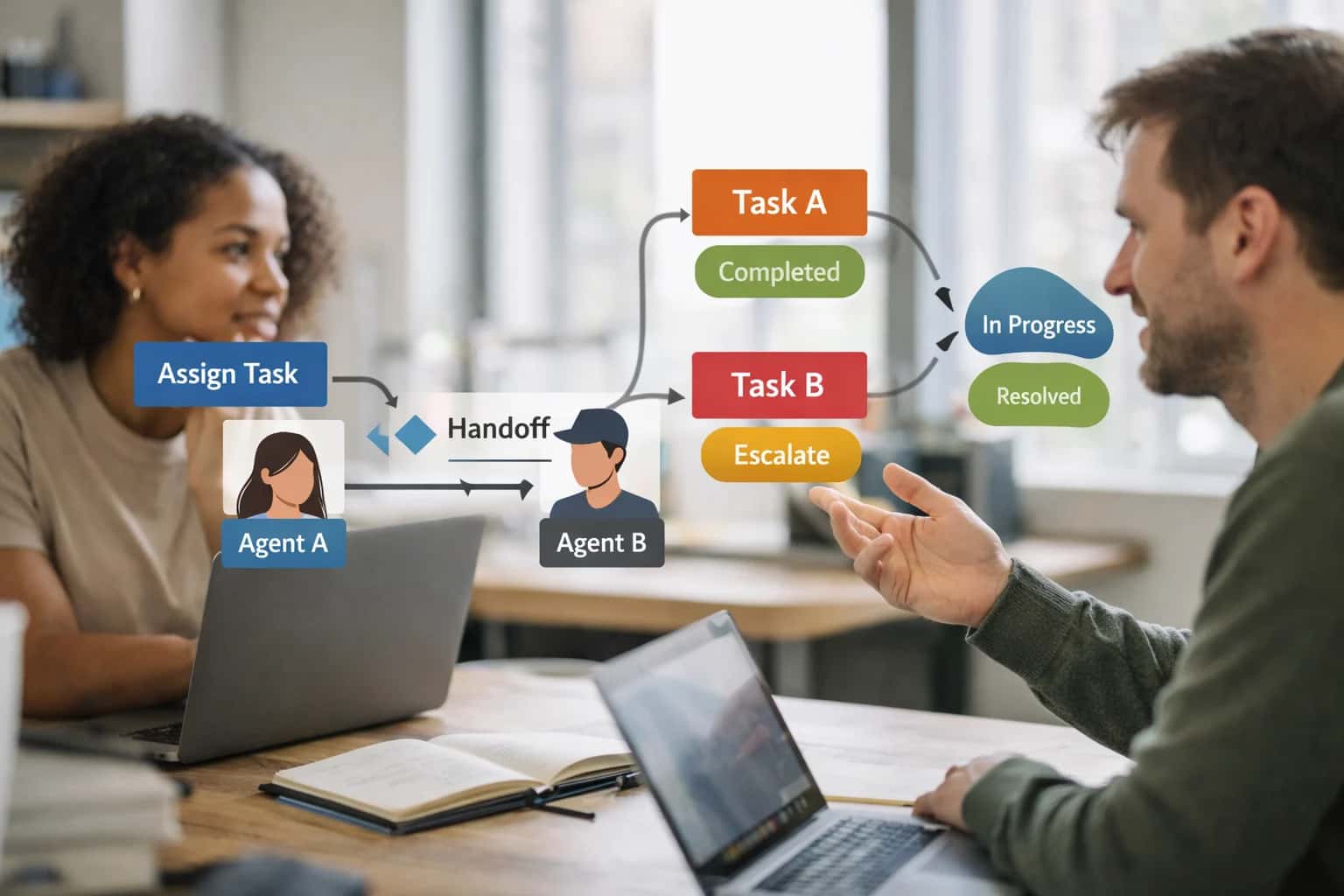
MULTI-AGENT SYSTEM ORCHESTRATION
What is an Orchestration Engine?
The core software component that coordinates the execution of complex workflows across a distributed network of autonomous agents.
The engine's architecture is built around managing task dependency graphs, often modeled as Directed Acyclic Graphs (DAGs), to enforce correct execution order. It handles critical functions like agent lifecycle management, state synchronization, and fault tolerance, providing a unified layer of orchestration observability through logging and tracing. By abstracting the complexity of distributed coordination, it allows developers to focus on agent design while the engine guarantees that the collective system behavior aligns with the intended business logic and performance objectives.
MULTI-AGENT SYSTEM ORCHESTRATION
Core Functions of an Orchestration Engine
An orchestration engine is the central nervous system of a multi-agent system. It translates high-level objectives into executable workflows, managing the lifecycle of tasks and the complex interactions between distributed, specialized agents.
01
Workflow Execution & State Management
The engine's primary function is to execute a defined workflow, which is often modeled as a Directed Acyclic Graph (DAG) of tasks. It manages the task state machine (e.g., Pending, Running, Completed, Failed) for each node, enforcing dependencies to ensure tasks run only when their prerequisites are satisfied. This provides deterministic control over complex, multi-step processes.
02
Agent Coordination & Communication Routing
The engine acts as a message bus and mediator. It routes communications between agents according to the workflow, handling inter-agent protocols and data marshaling. This abstracts direct peer-to-peer communication, simplifying agent logic and enabling centralized conflict resolution and consensus mechanisms when agents have competing sub-goals or resource requests.
03
Dynamic Task Allocation & Scheduling
Based on the decomposed task graph, the engine performs capability matching to assign atomic tasks to suitable agents. It employs scheduling algorithms—considering factors like load balancing, task affinity, and deadlines—to optimize system-wide objectives such as minimizing makespan. This can involve decentralized mechanisms like the Contract Net Protocol or centralized optimizers.
04
Fault Tolerance & Resilience
A robust engine implements patterns for fault tolerance in multi-agent systems. This includes monitoring agent health, detecting failures (e.g., timeouts, crashes), and triggering recovery actions such as retries, task reassignment to a redundant agent, or workflow rollback to a known good state. This ensures the overall system goal can still be achieved despite individual component failures.
05
Observability & Telemetry
The engine provides a unified view of system execution through comprehensive orchestration observability. It emits structured logs, metrics (e.g., task latency, agent utilization), and traces that map the execution path of a request across multiple agents. This data is critical for debugging, performance optimization, and auditing agentic behavior in production.
06
Policy Enforcement & Security
The engine enforces governance and orchestration security policies at runtime. This includes authenticating and authorizing agents, validating inputs/outputs against schemas, applying rate limits, and executing guardrails to prevent undesirable or unsafe agent actions. It serves as a policy enforcement point, ensuring all orchestrated activity complies with defined rules.
ARCHITECTURAL COMPARISON
Orchestration Engine vs. Task Scheduler
A technical comparison of the core software components responsible for managing workflows and task execution in multi-agent systems, highlighting their distinct roles and capabilities.
| Feature / Dimension | Orchestration Engine | Task Scheduler |
|---|---|---|
Primary Objective | Execute complex, stateful workflows coordinating multiple heterogeneous agents to achieve a business goal. | Execute a set of predefined tasks on available resources, optimizing for metrics like makespan or resource utilization. |
Scope of Control | End-to-end business process or multi-step agentic workflow (macro-level). | Individual job or batch execution on compute resources (micro-level). |
State Management | Maintains persistent, shared workflow state across agents and over extended timeframes. | Typically stateless per job; state is managed by the task or external systems. |
Agent Coordination | Directly manages agent interactions, communication protocols, and conflict resolution. | No inherent agent model; schedules computational units, not intelligent actors. |
Dynamic Adaptation | Can modify workflow paths at runtime based on agent outputs, errors, or external events (conditional logic, loops). | Follows a static schedule; dynamic changes require rescheduling from scratch. |
Dependency Handling | Manages complex, semantic dependencies between agent actions (e.g., Task B requires the result of Task A). | Manages simple, syntactic precedence constraints (e.g., Task B starts after Task A finishes). |
Fault Tolerance Strategy | Agent-level retries, alternative agent selection, workflow compensation (rollback/forward), and escalation policies. | Task retry, reschedule failed task on another node, or fail the entire job. |
Observability Focus | Business logic flow, agent collaboration patterns, conversation traces, and collective outcome validation. | Resource utilization, job completion rates, queue lengths, and individual task runtimes. |
Typical Use Case | Automating a customer service resolution involving a classifier, a research agent, and a draft-response agent. | Running a nightly data pipeline with ETL jobs on a Kubernetes cluster. |
Integration Point | Sits atop a scheduler or agent framework; invokes schedulers for sub-task execution. | Integrates with a resource manager (e.g., Kubernetes, YARN) or operating system kernel. |
ORCHESTRATION ENGINE
Frequently Asked Questions
An orchestration engine is the central nervous system of a multi-agent system, responsible for executing workflows, managing task lifecycles, and coordinating distributed agents. These FAQs address its core functions, architecture, and role in enterprise AI.
An orchestration engine is the core software component that manages the execution of defined workflows in a multi-agent system. It works by interpreting a structured plan—often defined as a Directed Acyclic Graph (DAG) or a state machine—and sequentially or concurrently triggering the execution of atomic tasks by specialized agents. The engine enforces dependencies between tasks, manages the task lifecycle (Pending, Assigned, Executing, Completed, Failed), handles errors, and coordinates the flow of data and context between agents. It acts as a centralized controller or a decentralized coordinator, ensuring the overall system progresses toward its objective deterministically.
Enabling Efficiency, Speed & Accuracy
Intelligent Analysis, Decision & Execution
We build AI systems for teams that need search across company data, workflow automation across tools, or AI features inside products and internal software.
Talk to Us
Search across company data
Give teams answers from docs, tickets, runbooks, and product data with sources and permissions.
Useful when people spend too long searching or get different answers from different systems.
Enterprise searchRAGPermissions
Read more
Automate internal workflows
Use AI to route work, draft outputs, trigger actions, and keep approvals and logs in place.
Useful when repetitive work moves across multiple tools and teams.
AI agentsWorkflow automationGovernance
Read more
Add AI to products and internal tools
Build assistants, guided actions, or decision support into the software your team or customers already use.
Useful when AI needs to be part of the product, not a separate tool.
AI integrationDecision supportModel routing
Read more
About the author
Prasad Kumkar
CEO & MD, Inference Systems
Prasad Kumkar is the CEO & MD of Inference Systems and writes about AI systems architecture, LLM infrastructure, model serving, evaluation, and production deployment. Over 5+ years, he has worked across computer vision models, L5 autonomous vehicle systems, and LLM research, with a focus on taking complex AI ideas into real-world engineering systems.
His work and writing cover AI systems, large language models, AI agents, multimodal systems, autonomous systems, inference optimization, RAG, evaluation, and production AI engineering.
LinkedIn
Limited slotsGet a Free AI Consultation
Partnered with leading AI, data, and software stack.





How We Work
Custom AI workflows for your Business
One-fit-all AI don't work for modern businesses. At Inferensys, we aim to understand your business & custom requirements; which we use to define most efficient agentic workflows, the data, and the tools for your business.
01
Review the use case
We understand the task, the users, and where AI can actually help.
Read more02
Pick the right approach
We define what needs search, automation, or product integration.
Read more03
Build the first useful version
We implement the part that proves the value first.
Read more04
Improve from there
We add the checks and visibility needed to keep it useful.
Read moreThe first call is a practical review of your use case and the right next step.
Talk to Us