A Directed Acyclic Graph (DAG) is a finite directed graph with no directed cycles, used in workflow orchestration to model tasks as nodes and their dependencies as directed edges. This structure guarantees a non-circular execution order, ensuring tasks only run once their upstream dependencies are satisfied. In platforms like Apache Airflow, a DAG defines the entire workflow, with the engine scheduling tasks according to the graph's topological ordering.

Glossary
Directed Acyclic Graph (DAG)
A Directed Acyclic Graph (DAG) is a finite directed graph with no directed cycles, used in computer science to model dependencies between tasks in workflow orchestration systems.
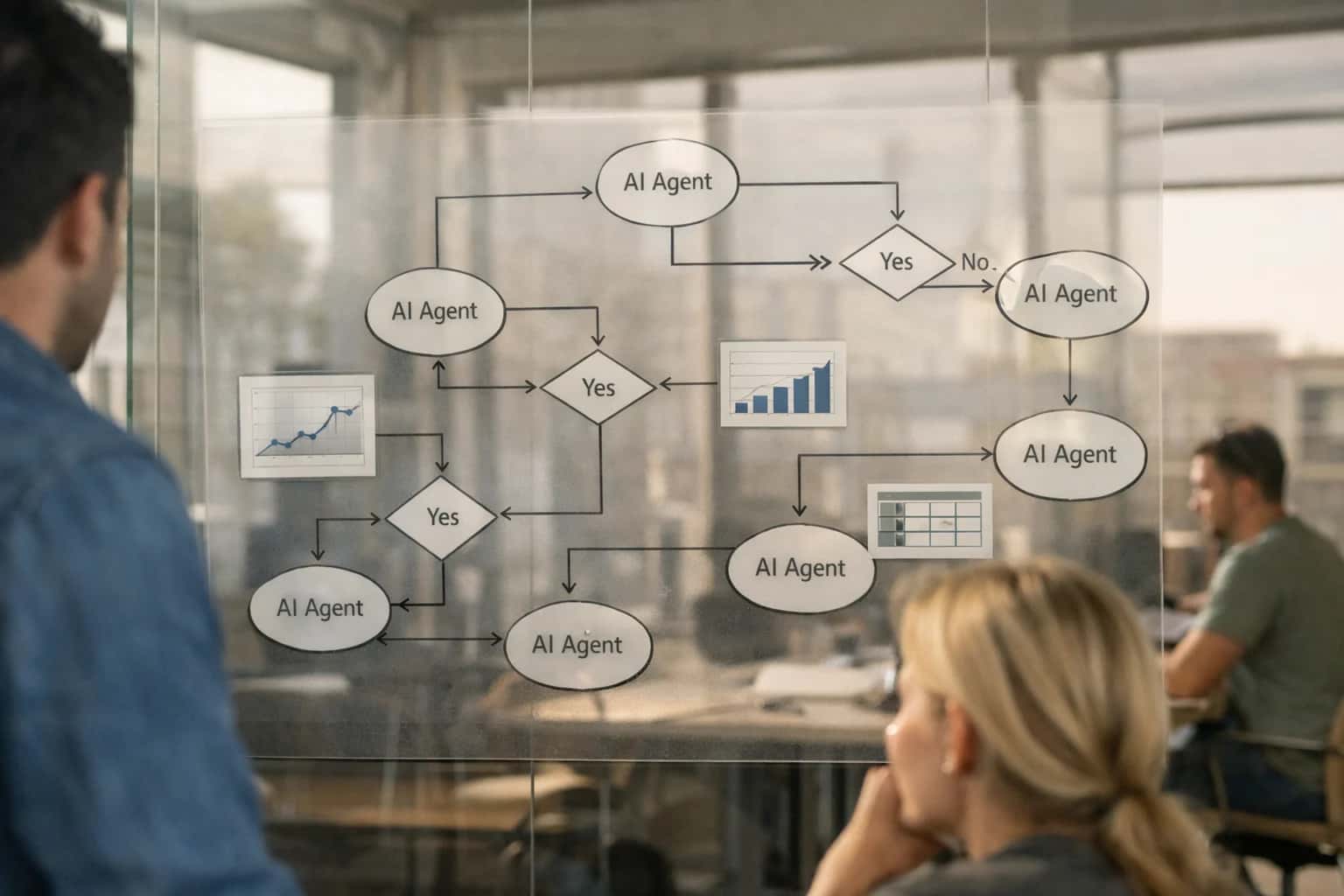
WORKFLOW ENGINE
What is a Directed Acyclic Graph (DAG)?
A Directed Acyclic Graph (DAG) is the fundamental data structure for modeling deterministic task dependencies in modern workflow orchestration engines.
The acyclic property is critical for preventing infinite loops and enabling deterministic execution. DAGs allow for complex patterns like parallel execution of independent branches and conditional branching based on runtime data. This model provides a clear, visual, and code-based representation of data pipelines and multi-agent coordination logic, making dependencies explicit and execution predictable for platform engineers.
ORCHESTRATION WORKFLOW ENGINES
Key Characteristics of a DAG
A Directed Acyclic Graph (DAG) is a finite directed graph with no cycles, used in workflow orchestration to model tasks as nodes and their dependencies as edges, ensuring a non-circular execution order. Its core characteristics define its utility in scheduling and managing complex, dependent processes.
01
Directed Edges
The edges in a DAG have a direction, representing a one-way dependency or data flow from one node (task) to another. This directionality is fundamental to defining the order of execution.
- An edge from Node A to Node B means A must complete before B can start.
- This creates a partial order among tasks, where some tasks must precede others, but independent tasks can be unordered relative to each other.
02
Acyclic Structure
A DAG contains no cycles—it is impossible to start at a node and follow a sequence of directed edges that returns to the same node. This property is critical for preventing infinite loops in workflow execution.
- Ensures tasks have a clear beginning and end.
- Guarantees that a topological ordering of nodes exists, which is the sequence used for execution.
- In orchestration, a cycle would represent a logical paradox (e.g., Task A depends on Task B, which depends on Task A).
03
Nodes as Tasks
In workflow orchestration, each node in the DAG represents a discrete, executable unit of work or an activity. Nodes encapsulate the logic to be performed.
- Examples include: running a script, querying a database, calling an API, or training a machine learning model.
- Nodes can have properties like execution timeouts, retry policies, and resource requirements.
- The granularity of a node is defined by the workflow designer.
04
Edges as Dependencies
The edges define the dependencies and data flow between tasks. They enforce execution order and can optionally pass data or context from upstream to downstream tasks.
- A downstream task cannot execute until all of its upstream dependencies are satisfied (e.g., completed successfully).
- This dependency graph allows the orchestrator to automatically schedule tasks as soon as their prerequisites are met.
- Edges enable the modeling of complex, fan-in/fan-out dependency patterns.
05
Topological Ordering
A topological sort is a linear ordering of a DAG's nodes where for every directed edge from node A to node B, A appears before B in the ordering. This ordering is the blueprint for sequential execution.
- Workflow engines perform a topological sort to determine a valid execution sequence.
- Multiple valid orderings may exist for the same DAG, but all respect the dependency constraints.
- This is the algorithmic foundation that makes DAGs executable.
06
Inherent Parallelism
Because a DAG only specifies partial order, tasks that are not directly or indirectly dependent on each other can be executed in parallel. This is a key advantage for performance optimization.
- The orchestrator identifies independent branches of the graph and can schedule their nodes concurrently.
- This maximizes resource utilization and reduces end-to-end workflow runtime.
- The degree of parallelism is constrained only by the dependency structure, not by the definition language.
ARCHITECTURAL COMPARISON
DAG vs. Other Workflow Models
A technical comparison of Directed Acyclic Graph (DAG) orchestration against other prevalent workflow models, highlighting key architectural features for platform engineers and CTOs.
| Feature / Metric | Directed Acyclic Graph (DAG) | Linear Sequence (Pipeline) | State Machine (Finite) | Event-Driven Choreography |
|---|---|---|---|---|
Core Structural Model | Graph of nodes (tasks) and directed edges (dependencies) | Ordered list of sequential steps | Finite states with defined transitions and actions | Decoupled services reacting to published events |
Explicit Dependency Definition | ||||
Native Support for Parallel Execution | ||||
Cyclic Execution Paths | ||||
Primary Control Flow Paradigm | Data & dependency-driven | Imperative, step-by-step | Event & state-transition driven | Reactive, message-driven |
Centralized Orchestrator Required | ||||
Complexity for Dynamic Runtime Paths | Medium (requires graph mutation) | High (requires pipeline reconstruction) | Low (built into state model) | Low (emergent from events) |
Fault Isolation & Partial Re-execution | ||||
State Management Model | Externalized (engine-managed variables) | Often implicit in pipeline context | Centralized (in the state object) | Distributed (across services) |
Visualization & Debugging Clarity | High (explicit graph) | High (linear flow) | High (state diagram) | Low (distributed tracing required) |
Example Systems/Tools | Apache Airflow, Prefect, Kubeflow Pipelines | Jenkins Pipeline, GitHub Actions (basic) | AWS Step Functions, XState | Apache Kafka, NATS, custom service meshes |
ORCHESTRATION WORKFLOW ENGINES
Frequently Asked Questions
Essential questions about Directed Acyclic Graphs (DAGs), the foundational data structure for modeling task dependencies and execution order in modern workflow orchestration engines.
A Directed Acyclic Graph (DAG) is a finite directed graph with no cycles, used in workflow orchestration to model tasks as nodes and their dependencies as directed edges, ensuring a non-circular, deterministic execution order. In this context, a 'graph' is a set of vertices (tasks) connected by edges (dependencies). 'Directed' means dependencies have a one-way relationship (Task A must complete before Task B). 'Acyclic' is the critical constraint: no path can loop back on itself, preventing infinite loops and guaranteeing a start and end point. This structure allows orchestration engines like Apache Airflow, AWS Step Functions, and Temporal to calculate an execution plan, schedule tasks only when their upstream dependencies are satisfied, and visualize complex pipelines.
Enabling Efficiency, Speed & Accuracy
Intelligent Analysis, Decision & Execution
We build AI systems for teams that need search across company data, workflow automation across tools, or AI features inside products and internal software.
Talk to Us
Search across company data
Give teams answers from docs, tickets, runbooks, and product data with sources and permissions.
Useful when people spend too long searching or get different answers from different systems.
Enterprise searchRAGPermissions
Read more
Automate internal workflows
Use AI to route work, draft outputs, trigger actions, and keep approvals and logs in place.
Useful when repetitive work moves across multiple tools and teams.
AI agentsWorkflow automationGovernance
Read more
Add AI to products and internal tools
Build assistants, guided actions, or decision support into the software your team or customers already use.
Useful when AI needs to be part of the product, not a separate tool.
AI integrationDecision supportModel routing
Read more
About the author
Prasad Kumkar
CEO & MD, Inference Systems
Prasad Kumkar is the CEO & MD of Inference Systems and writes about AI systems architecture, LLM infrastructure, model serving, evaluation, and production deployment. Over 5+ years, he has worked across computer vision models, L5 autonomous vehicle systems, and LLM research, with a focus on taking complex AI ideas into real-world engineering systems.
His work and writing cover AI systems, large language models, AI agents, multimodal systems, autonomous systems, inference optimization, RAG, evaluation, and production AI engineering.
LinkedIn
Limited slotsGet a Free AI Consultation
Partnered with leading AI, data, and software stack.





How We Work
Custom AI workflows for your Business
One-fit-all AI don't work for modern businesses. At Inferensys, we aim to understand your business & custom requirements; which we use to define most efficient agentic workflows, the data, and the tools for your business.
01
Review the use case
We understand the task, the users, and where AI can actually help.
Read more02
Pick the right approach
We define what needs search, automation, or product integration.
Read more03
Build the first useful version
We implement the part that proves the value first.
Read more04
Improve from there
We add the checks and visibility needed to keep it useful.
Read moreThe first call is a practical review of your use case and the right next step.
Talk to Us