An intelligent agent is an autonomous software entity that perceives its environment through sensors, reasons using internal models or learned policies, and acts upon that environment through effectors to achieve designated goals. Its core architecture, such as the Belief-Desire-Intention (BDI) model, defines how it processes inputs, maintains state, and selects actions. This foundational abstraction enables the construction of complex multi-agent systems (MAS) where multiple agents interact and collaborate.

Glossary
Intelligent Agent
An intelligent agent is an autonomous software entity that perceives its environment through sensors, reasons using internal models or learned policies, and acts upon that environment through effectors to achieve designated goals.
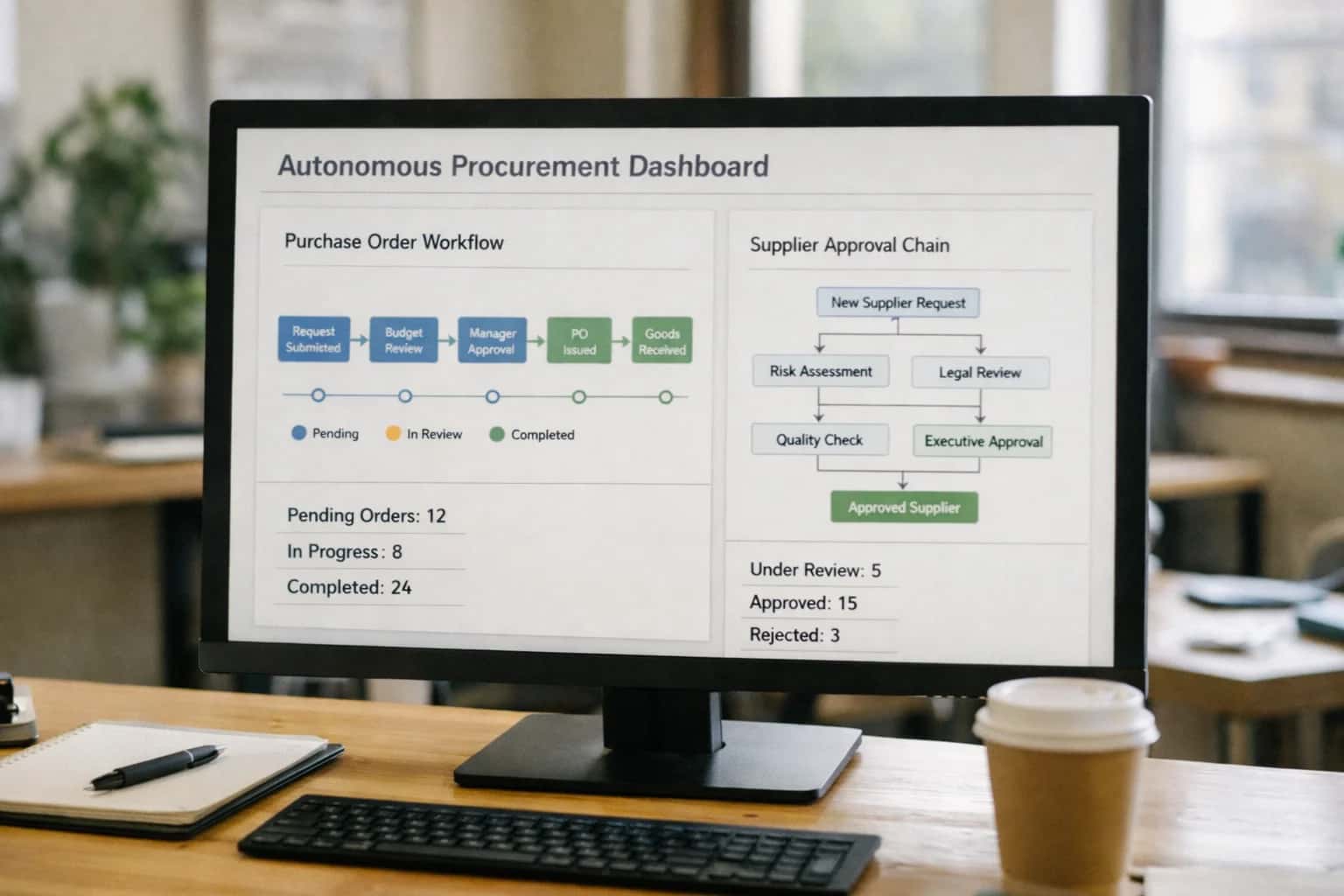
FOUNDATIONAL CONCEPT
What is an Intelligent Agent?
An intelligent agent is the fundamental autonomous unit within artificial intelligence systems, designed to perceive, reason, and act to achieve specific objectives.
In enterprise orchestration, an intelligent agent's autonomy is governed by its agent policy—a set of rules or a learned function mapping state to action. Agents are deployed within a managed agent container and communicate via standardized Agent Communication Languages (ACL). Their effectiveness is measured by their ability to maximize a utility function, adapt via agent learning, and operate reliably within a multi-agent framework to solve business problems no single agent could manage alone.
DEFINING ATTRIBUTES
Core Characteristics of an Intelligent Agent
An intelligent agent is defined by a set of core functional attributes that distinguish it from simple software scripts. These characteristics collectively enable autonomous, goal-directed behavior within an environment.
01
Autonomy
An intelligent agent operates without direct, continuous intervention from a human operator or external program. It controls its own internal state and actions based on its perceptions and objectives.
- Key Mechanism: Decision-making is driven by an internal policy or reasoning engine.
- Contrast: Unlike a traditional API that only responds to requests, an autonomous agent can initiate actions proactively to achieve its goals.
- Example: A trading agent that continuously monitors market data and executes buy/sell orders based on its learned strategy, without requiring manual approval for each trade.
02
Perception (Sensing)
An agent perceives its environment through sensors or input channels. This data forms its belief state—a representation of the world upon which it reasons.
- Sensors Can Be: API calls, database queries, computer vision systems, network packets, or user input.
- Partial Observability: Most real-world environments are partially observable; the agent must infer the full state from limited, often noisy, sensor data.
- Example: A warehouse logistics agent perceives its environment via IoT sensors (for inventory levels), GPS data (for robot locations), and order management system APIs.
03
Action (Actuation)
An agent affects its environment through effectors or output channels. Actions are chosen to bring about desired changes that satisfy the agent's goals.
- Effectors Can Be: Sending API requests, writing to a database, controlling a robotic actuator, displaying information, or sending a message.
- Action Space: The set of all possible actions an agent can take. In complex systems, this space can be vast and require sophisticated planning.
- Example: The same warehouse agent acts by sending navigation commands to autonomous mobile robots, updating order statuses, and triggering replenishment requests.
04
Goal-Directed Behavior
An agent is designed to achieve one or more goals. Its actions are not random but are selected to maximize progress toward these objectives, often evaluated via a utility function.
- Goal Types: Can be static ("maintain room temperature") or dynamic ("win this game of chess").
- Rationality: A rational agent selects the action expected to maximize its performance measure, given its perceptual history and built-in knowledge.
- Example: A customer service chatbot has the primary goal of resolving user queries correctly and efficiently, measured by first-contact resolution rate and customer satisfaction scores.
05
Reactivity & Proactiveness
An agent must balance reactivity and proactiveness.
- Reactivity: The ability to perceive changes in the environment and respond in a timely fashion. A purely reactive agent acts based on current perceptions with little internal state (e.g., a thermostat).
- Proactiveness (Goal-Oriented): The ability to take initiative and pursue goals by generating and executing plans, not merely responding to immediate stimuli.
- Hybrid Architectures: Most sophisticated agents use hybrid architectures (e.g., BDI) to combine reactive responses with deliberative, plan-driven proactiveness.
06
Social Ability (Interaction)
Agents often operate in environments containing other agents (a Multi-Agent System). Social ability is the capacity to interact with these other agents via an Agent Communication Language (ACL) to cooperate, coordinate, or negotiate.
- Coordination: Required to avoid conflicts and achieve shared or interdependent goals (e.g., agents bidding in an auction).
- Standard Protocols: Use standardized message formats (e.g., FIPA ACL) with performatives like
request,inform,propose. - Example: In a supply chain MAS, a procurement agent negotiates prices with a supplier agent, while a logistics agent coordinates delivery schedules with a fleet management agent.
CORE MECHANISM
How an Intelligent Agent Works: The Sense-Think-Act Loop
The fundamental operational cycle of an intelligent agent, which defines its autonomy and goal-directed behavior.
An intelligent agent is an autonomous software entity that operates through a continuous Sense-Think-Act loop to achieve goals. It first senses its environment via software sensors or data inputs, creating a perceptual model. It then thinks by applying internal logic, a learned policy, or a planning algorithm to this model to decide on an action. Finally, it acts by executing that decision through software effectors, such as API calls or command outputs, to change the environment.
This loop is foundational to agent-oriented programming. The think phase can be simple (reactive rules) or complex (deliberative planning with a belief-desire-intention model). The agent's policy or utility function guides its decisions to maximize goal achievement. In a multi-agent system, this individual loop is coordinated with others by an agent orchestrator, requiring state synchronization and agent communication protocols to manage collective behavior.
INTELLIGENT AGENT
Frequently Asked Questions
An intelligent agent is a foundational concept in artificial intelligence and multi-agent systems. These FAQs address its core definition, operation, and role within larger orchestrated frameworks.
An intelligent agent is an autonomous software entity that perceives its environment through sensors, reasons using internal models or learned policies, and acts upon that environment through effectors to achieve designated goals. It is the fundamental building block of agent-oriented programming and multi-agent systems (MAS). Unlike simple scripts, an intelligent agent operates with a degree of autonomy, proactivity, and often social ability to interact with other agents. Its intelligence is derived from its capacity to map perceptions to actions that maximize a measure of success, defined by its utility function or goals.
Enabling Efficiency, Speed & Accuracy
Intelligent Analysis, Decision & Execution
We build AI systems for teams that need search across company data, workflow automation across tools, or AI features inside products and internal software.
Talk to Us
Search across company data
Give teams answers from docs, tickets, runbooks, and product data with sources and permissions.
Useful when people spend too long searching or get different answers from different systems.
Enterprise searchRAGPermissions
Read more
Automate internal workflows
Use AI to route work, draft outputs, trigger actions, and keep approvals and logs in place.
Useful when repetitive work moves across multiple tools and teams.
AI agentsWorkflow automationGovernance
Read more
Add AI to products and internal tools
Build assistants, guided actions, or decision support into the software your team or customers already use.
Useful when AI needs to be part of the product, not a separate tool.
AI integrationDecision supportModel routing
Read more
About the author
Prasad Kumkar
CEO & MD, Inference Systems
Prasad Kumkar is the CEO & MD of Inference Systems and writes about AI systems architecture, LLM infrastructure, model serving, evaluation, and production deployment. Over 5+ years, he has worked across computer vision models, L5 autonomous vehicle systems, and LLM research, with a focus on taking complex AI ideas into real-world engineering systems.
His work and writing cover AI systems, large language models, AI agents, multimodal systems, autonomous systems, inference optimization, RAG, evaluation, and production AI engineering.
LinkedIn
Limited slotsGet a Free AI Consultation
Partnered with leading AI, data, and software stack.





How We Work
Custom AI workflows for your Business
One-fit-all AI don't work for modern businesses. At Inferensys, we aim to understand your business & custom requirements; which we use to define most efficient agentic workflows, the data, and the tools for your business.
01
Review the use case
We understand the task, the users, and where AI can actually help.
Read more02
Pick the right approach
We define what needs search, automation, or product integration.
Read more03
Build the first useful version
We implement the part that proves the value first.
Read more04
Improve from there
We add the checks and visibility needed to keep it useful.
Read moreThe first call is a practical review of your use case and the right next step.
Talk to Us