A task allocation algorithm is a decentralized computational method for dynamically distributing subtasks among a swarm of autonomous agents. It is a core mechanism in swarm intelligence and multi-agent systems, enabling efficient division of labor without centralized command. Inspired by biological systems like ant colonies and bee hives, these algorithms allow agents to self-organize based on local information, such as individual capability, current workload, and environmental stimuli. The goal is to maximize collective efficiency, balance workloads, and adapt to changing conditions in real-time.

Glossary
Task Allocation Algorithm
A task allocation algorithm is a decentralized method for dynamically distributing subtasks among a swarm of agents based on factors like agent capability, workload, and environmental stimuli.
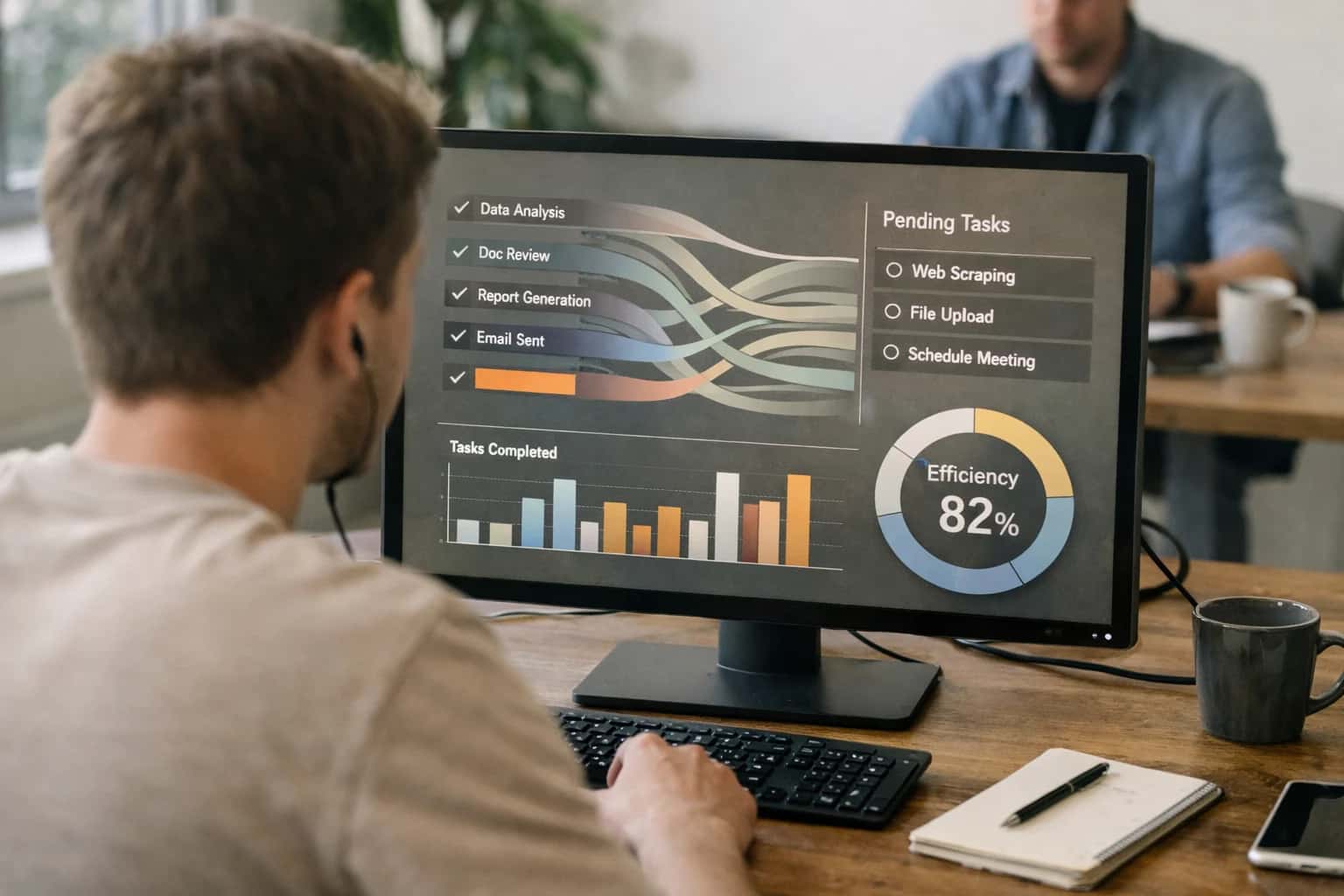
AGENT SWARM INTELLIGENCE
What is a Task Allocation Algorithm?
A task allocation algorithm is a decentralized method for dynamically distributing subtasks among a swarm of agents based on factors like agent capability, workload, and environmental stimuli, often inspired by division of labor in social insects.
These algorithms often employ mechanisms like the response threshold model, where agents have an internal propensity to perform certain tasks. When a task's stimulus exceeds an agent's threshold, the agent engages. This leads to natural specialization and dynamic load balancing. Other approaches use market-based protocols or auction systems for agents to bid on tasks. Effective task allocation is critical for applications in swarm robotics, distributed computing, and autonomous supply chain intelligence, where many simple agents must collaboratively solve complex problems.
CORE MECHANISMS AND MODELS
Task Allocation Algorithm
A task allocation algorithm is a decentralized method for dynamically distributing subtasks among a swarm of agents based on factors like agent capability, workload, and environmental stimuli, often inspired by division of labor in social insects.
01
Core Mechanism: Response Threshold Model
This foundational model explains how specialization emerges without a central planner. Each agent has an internal threshold for responding to a specific task stimulus. Agents with a lower threshold for a given task type are more likely to perform it. As they complete the task, their threshold may increase (due to fatigue), while inactive agents' thresholds decrease, creating a dynamic, self-regulating workforce.
- Key Principle: Stochastic task selection based on individual sensitivity.
- Biological Inspiration: Task specialization in insect colonies (e.g., brood care, foraging).
- Algorithmic Implementation: Agents probabilistically select tasks where
(stimulus intensity) / (agent threshold)is highest.
02
Key Factor: Dynamic Environmental Stimuli
The algorithm's primary input is a stimulus signal that quantifies the need for a task in the environment. This signal can increase due to new events or decrease as agents work on the task. For example:
- In a data processing swarm, a growing queue of unprocessed files creates a high stimulus for a 'processing' task.
- In a robotic cleaning swarm, the concentration of debris in an area acts as a stimulus for a 'cleaning' task.
- The stimulus is often locally perceived, ensuring agents respond to conditions in their immediate vicinity, promoting efficient spatial distribution.
03
Agent State: Capability and Workload
Allocation decisions are modulated by the internal state of each agent. The algorithm evaluates:
- Agent Capability: Not all agents are identical. Specialized hardware, software skills, or physical attributes make an agent more or less suited for a task. The algorithm matches task requirements to agent profiles.
- Current Workload: To prevent overloading single agents and ensure balanced utilization, the algorithm factors in an agent's existing commitments. An agent already executing multiple tasks will have a higher effective threshold for taking on new work.
- State Vector: An agent's decision is often a function of
f(stimulus, threshold, capability, workload).
04
Decentralized vs. Centralized Allocation
This distinguishes swarm algorithms from traditional schedulers.
- Decentralized (Swarm): Each agent makes its own task selection based on local information (stimulus, neighbor states). There is no single point of failure. It scales naturally with swarm size. Examples: Ant colony foraging, robotic swarm search.
- Centralized (Orchestrator): A master node (orchestrator) has global knowledge of all tasks and agents, computing an optimal assignment (e.g., using a Hungarian algorithm). This is efficient for small, known systems but becomes a bottleneck and single point of failure.
- Hybrid Approaches: Some systems use a decentralized algorithm for most decisions but employ a lightweight central monitor for global objective setting or anomaly detection.
05
Related Concept: Stigmergic Coordination
Task allocation is often coupled with stigmergy, a powerful indirect coordination mechanism. Agents modify the environment, which becomes the communication medium.
- Digital Pheromones: A common implementation. An agent performing a task deposits a virtual 'pheromone' at that location. Other agents sense this pheromone concentration, which acts as an amplified stimulus, attracting more workers until the task is complete, at which point the pheromone evaporates.
- Process: 1) Task creates stimulus. 2) First agent responds, works, deposits pheromone. 3) Pheromone increases local stimulus. 4) More agents are attracted. 5) Task completes, pheromone evaporation stops recruitment.
- This creates positive feedback for urgent tasks and negative feedback for completed ones, enabling complex coordination without direct agent-to-agent messaging.
06
Practical Applications & Examples
These algorithms move from biological inspiration to engineered solutions.
- Robotic Warehouse Fulfillment: A swarm of mobile robots dynamically allocates itself to picking stations based on order queue length (stimulus), robot battery level (workload), and proximity.
- Cloud/Edge Computing: Containerized microservices (agents) autonomously scale to handle incoming API request loads, with new instances spawned in response to high latency or queue depth stimuli.
- Disaster Response Swarms: UAVs allocate themselves to search sectors. A UAV finding signs of life increases the stimulus for 'detailed search' in that sector, attracting other UAVs with medical payloads.
- Network Packet Routing: Inspired by Ant Colony Optimization, data packets explore paths and deposit feedback, leading to the emergent allocation of traffic to optimal, uncongested routes.
ALGORITHM TAXONOMY
Comparison of Task Allocation Approaches
A technical comparison of decentralized methods for distributing tasks among a swarm of agents, highlighting core mechanisms, performance characteristics, and suitability for different operational environments.
| Algorithmic Feature / Metric | Market-Based (Auction) | Stigmergic (Pheromone) | Response Threshold | Consensus-Based (Voting) |
|---|---|---|---|---|
Primary Inspiration | Economic markets & game theory | Ant/termite colony foraging | Division of labor in social insects | Democratic decision-making |
Coordination Mechanism | Explicit bidding & auction protocols | Implicit, via environmental modification | Individual sensitivity to task stimuli | Direct communication & ballot aggregation |
Communication Overhead | High (per-task negotiation) | Low (indirect, via environment) | Very Low (individual perception) | Medium (broadcast & tally) |
Scalability (Agent Count) | ~10-100 agents (network congestion) |
|
| ~10-100 agents (consensus latency) |
Dynamic Task Adaptation | < 1 sec (real-time bidding) | 1-10 sec (pheromone diffusion) | < 1 sec (instant threshold check) | 1-5 sec (vote collection period) |
Fault Tolerance | High (failed agent = withdrawn bid) | Very High (environment persists) | High (task re-perceived by others) | Medium (requires quorum; fails if lost) |
Resource Optimization | ✅ (Minimizes global cost) | ✅ (Finds shortest paths) | ❌ (Ignores efficiency for urgency) | ✅ (Can optimize for group utility) |
Load Balancing | ✅ (Explicit work distribution) | ❌ (Can lead to traffic jams) | ✅ (Emerges from varied thresholds) | ✅ (Can be encoded in vote weights) |
Requires Shared Memory/State | ❌ (Auctioneer only) | ✅ (Pheromone map) | ❌ (Individual state only) | ✅ (Shared ballot or ledger) |
Typical Use Case | Drone delivery scheduling | Robotic warehouse foraging | Emergency response team dispatch | Sensor network data fusion |
TASK ALLOCATION ALGORITHMS
Frequently Asked Questions
Task allocation algorithms are the decentralized decision-making engines that enable swarms of agents to efficiently distribute work. These FAQs address their core mechanisms, design considerations, and real-world applications.
A task allocation algorithm is a decentralized method for dynamically distributing subtasks among a swarm of agents based on factors like agent capability, workload, and environmental stimuli. It operates without a central commander, using local rules and interactions to achieve efficient global workload distribution. The process typically involves three phases: agents perceive task stimuli (e.g., a work item's priority or location), evaluate their own internal state (e.g., current workload, specialization), and apply a decision rule (like a threshold model) to commit to a task. This mechanism is directly inspired by the division of labor observed in social insects like ants and bees, where such algorithms ensure colony resilience and adaptability.
Enabling Efficiency, Speed & Accuracy
Intelligent Analysis, Decision & Execution
We build AI systems for teams that need search across company data, workflow automation across tools, or AI features inside products and internal software.
Talk to Us
Search across company data
Give teams answers from docs, tickets, runbooks, and product data with sources and permissions.
Useful when people spend too long searching or get different answers from different systems.
Enterprise searchRAGPermissions
Read more
Automate internal workflows
Use AI to route work, draft outputs, trigger actions, and keep approvals and logs in place.
Useful when repetitive work moves across multiple tools and teams.
AI agentsWorkflow automationGovernance
Read more
Add AI to products and internal tools
Build assistants, guided actions, or decision support into the software your team or customers already use.
Useful when AI needs to be part of the product, not a separate tool.
AI integrationDecision supportModel routing
Read more
About the author
Prasad Kumkar
CEO & MD, Inference Systems
Prasad Kumkar is the CEO & MD of Inference Systems and writes about AI systems architecture, LLM infrastructure, model serving, evaluation, and production deployment. Over 5+ years, he has worked across computer vision models, L5 autonomous vehicle systems, and LLM research, with a focus on taking complex AI ideas into real-world engineering systems.
His work and writing cover AI systems, large language models, AI agents, multimodal systems, autonomous systems, inference optimization, RAG, evaluation, and production AI engineering.
LinkedIn
Limited slotsGet a Free AI Consultation
Partnered with leading AI, data, and software stack.





How We Work
Custom AI workflows for your Business
One-fit-all AI don't work for modern businesses. At Inferensys, we aim to understand your business & custom requirements; which we use to define most efficient agentic workflows, the data, and the tools for your business.
01
Review the use case
We understand the task, the users, and where AI can actually help.
Read more02
Pick the right approach
We define what needs search, automation, or product integration.
Read more03
Build the first useful version
We implement the part that proves the value first.
Read more04
Improve from there
We add the checks and visibility needed to keep it useful.
Read moreThe first call is a practical review of your use case and the right next step.
Talk to Us