A Swarm Digital Twin is a high-fidelity, executable virtual model of a physical swarm system that is continuously synchronized with real-time data from its physical counterpart. It serves as a sandbox for simulation, enabling the prediction of emergent behaviors, optimization of agent coordination strategies, and stress-testing of the system under various conditions before deployment. This virtual representation is foundational for predictive maintenance and what-if analysis in complex, decentralized systems.

Glossary
Swarm Digital Twin
A swarm digital twin is a high-fidelity virtual model of a physical swarm system that is continuously updated with real-time data, used for simulation, prediction, optimization, and control of the physical counterpart.
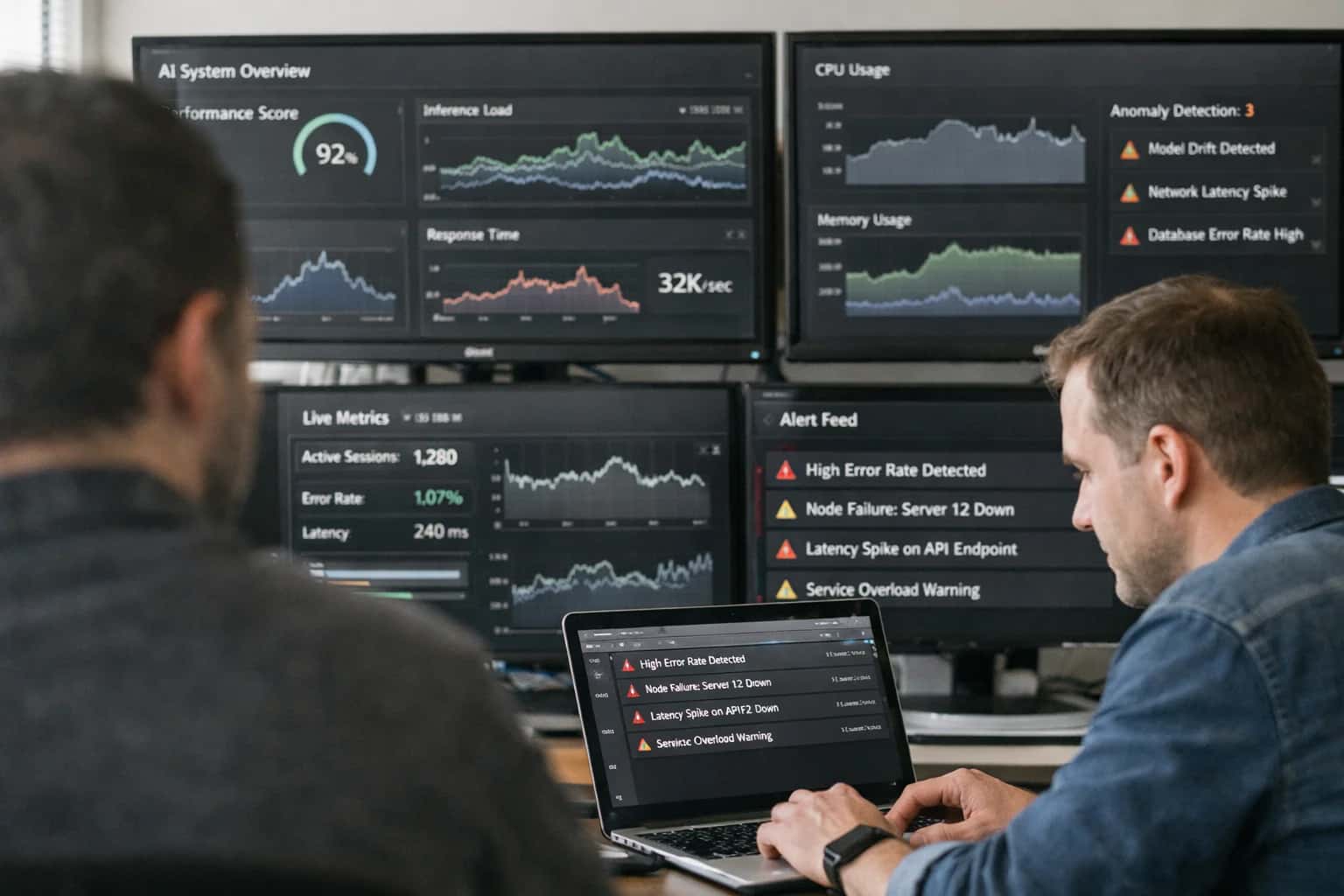
MULTI-AGENT SYSTEM ORCHESTRATION
What is a Swarm Digital Twin?
A swarm digital twin is a high-fidelity, data-driven virtual model of a physical multi-agent swarm system, used for simulation, analysis, and control.
The twin integrates data streams from the physical swarm's sensors, agent states, and environmental inputs to maintain a live, accurate simulation. This allows operators to implement closed-loop control, where commands are first validated in the virtual model before being sent to the physical agents. By leveraging techniques from multi-agent reinforcement learning (MARL) and swarm intelligence, the digital twin can also be used to autonomously discover and refine optimal collective decision-making and task allocation policies for the real-world swarm.
ARCHITECTURAL PRINCIPLES
Core Characteristics of a Swarm Digital Twin
A Swarm Digital Twin is a high-fidelity virtual model of a physical swarm system, continuously synchronized with real-time data. Its core characteristics define its ability to simulate, predict, optimize, and control the physical counterpart.
01
Decentralized Virtual Architecture
The twin's internal structure mirrors the physical swarm's decentralized control. Instead of a single monolithic model, it comprises a network of interconnected agent-level sub-models, each representing an individual physical unit (e.g., a drone, robot, or sensor node). This architecture enables parallel simulation of local interactions and emergent global behaviors, providing a more scalable and fault-tolerant virtual representation than a centralized model.
02
Bidirectional Real-Time Data Synchronization
The twin maintains a continuous, bidirectional data flow with the physical swarm. This involves:
- Ingestion of real-time telemetry (position, sensor readings, battery status).
- Ingestion of environmental data from external sources.
- Output of optimized control parameters or suggested actions back to the physical agents. This live link creates a closed-loop system where the twin is not just a passive mirror but an active participant in the swarm's operation, enabling predictive maintenance and dynamic re-planning.
03
Emergent Behavior Simulation & Prediction
A primary function is to simulate the emergent behaviors that arise from simple local rules. The twin executes models like the Boid algorithm (separation, alignment, cohesion) or stigmergic coordination within a high-fidelity physics engine. By running "what-if" scenarios—such as agent failure, new obstacles, or changing objectives—it predicts the swarm's macroscopic response before changes are enacted in reality, allowing for safe validation of new coordination protocols.
04
Multi-Fidelity Modeling Layers
The twin employs models of varying complexity to balance computational cost with accuracy:
- High-fidelity physics models for critical, short-term predictions (e.g., collision avoidance).
- Reduced-order or data-driven models (e.g., trained via Multi-Agent Reinforcement Learning) for long-horizon strategy simulation.
- Abstract logical models for task allocation and workflow validation. This layered approach allows the system to allocate computational resources efficiently, switching model fidelity based on the required prediction horizon and precision.
05
Collective State Estimation & Fusion
The twin acts as a central state estimation engine, fusing noisy, partial observations from individual agents to construct a coherent, global understanding of the swarm and its environment. It implements distributed algorithms like a Swarm Kalman Filter to collaboratively track dynamic targets or the swarm's own state. This synthesized "ground truth" is often more accurate than any single agent's perception and is used to correct individual agent errors or fill sensor gaps.
06
Human-Swarm Interaction Interface
It provides the critical interface for Human-Swarm Interaction (HSI), translating high-level human commands (e.g., "search this area") into low-level swarm-executable protocols. Operators can visualize the swarm's collective state, projected paths, and health metrics. They can intervene at different levels of abstraction—directing a single agent, modifying the parameters of a coordination pattern, or setting new global objectives—with the twin simulating the consequences of intervention before execution.
AGENT SWARM INTELLIGENCE
How a Swarm Digital Twin Works
A swarm digital twin is a high-fidelity virtual model of a physical swarm system, continuously updated with real-time data for simulation, prediction, and control.
A Swarm Digital Twin is a dynamic, data-driven virtual representation of a physical multi-agent system, such as a robotic fleet or drone swarm. It operates by ingesting real-time telemetry—including position, sensor data, and agent state—from the physical swarm via IoT protocols. This creates a synchronized simulation that mirrors the live system's behavior, enabling operators to monitor, analyze, and predict collective dynamics. The core mechanism is a closed-loop where the twin's state is perpetually aligned with its physical counterpart, forming a bidirectional data bridge.
The twin's primary function is predictive simulation and what-if analysis. Engineers can test new coordination algorithms, task allocation strategies, or conflict resolution protocols in the risk-free virtual environment before deployment. It uses the ingested data to run Monte Carlo simulations, forecasting potential failures or emergent behaviors. This allows for preemptive optimization of swarm logistics and resilience. Ultimately, commands optimized in the digital twin can be sent back to orchestrate the physical swarm, enabling adaptive, model-predictive control of the entire collective.
SWARM DIGITAL TWIN
Frequently Asked Questions
A Swarm Digital Twin is a virtual replica of a physical multi-agent system, enabling simulation, optimization, and predictive control. These questions address its core mechanisms, applications, and differentiation from related concepts.
A Swarm Digital Twin is a high-fidelity, data-driven virtual model of a physical swarm system that is continuously synchronized with real-time sensor and operational data. It works by creating a one-to-one mapping between each physical agent (e.g., a robot, drone, or software agent) and its virtual counterpart within a simulated environment. The twin ingests live data streams via IoT protocols and uses physics engines and agent-based models to simulate the swarm's behavior, dynamics, and interactions. This allows for what-if analysis, predictive maintenance, and optimization of control parameters in the virtual space before deploying commands back to the physical swarm.
Enabling Efficiency, Speed & Accuracy
Intelligent Analysis, Decision & Execution
We build AI systems for teams that need search across company data, workflow automation across tools, or AI features inside products and internal software.
Talk to Us
Search across company data
Give teams answers from docs, tickets, runbooks, and product data with sources and permissions.
Useful when people spend too long searching or get different answers from different systems.
Enterprise searchRAGPermissions
Read more
Automate internal workflows
Use AI to route work, draft outputs, trigger actions, and keep approvals and logs in place.
Useful when repetitive work moves across multiple tools and teams.
AI agentsWorkflow automationGovernance
Read more
Add AI to products and internal tools
Build assistants, guided actions, or decision support into the software your team or customers already use.
Useful when AI needs to be part of the product, not a separate tool.
AI integrationDecision supportModel routing
Read more
About the author
Prasad Kumkar
CEO & MD, Inference Systems
Prasad Kumkar is the CEO & MD of Inference Systems and writes about AI systems architecture, LLM infrastructure, model serving, evaluation, and production deployment. Over 5+ years, he has worked across computer vision models, L5 autonomous vehicle systems, and LLM research, with a focus on taking complex AI ideas into real-world engineering systems.
His work and writing cover AI systems, large language models, AI agents, multimodal systems, autonomous systems, inference optimization, RAG, evaluation, and production AI engineering.
LinkedIn
Limited slotsGet a Free AI Consultation
Partnered with leading AI, data, and software stack.





How We Work
Custom AI workflows for your Business
One-fit-all AI don't work for modern businesses. At Inferensys, we aim to understand your business & custom requirements; which we use to define most efficient agentic workflows, the data, and the tools for your business.
01
Review the use case
We understand the task, the users, and where AI can actually help.
Read more02
Pick the right approach
We define what needs search, automation, or product integration.
Read more03
Build the first useful version
We implement the part that proves the value first.
Read more04
Improve from there
We add the checks and visibility needed to keep it useful.
Read moreThe first call is a practical review of your use case and the right next step.
Talk to Us