Agent scheduling is the algorithmic process by which an orchestration system assigns a specific agent instance to run on a particular compute node or host machine. This decision is based on a set of constraints, resource requirements (CPU, memory, GPU), and declarative affinity or anti-affinity rules. The scheduler's primary goal is to optimize for system-wide objectives like load balancing, minimizing latency, reducing cost, and ensuring high availability, all while adhering to the defined policies.

Glossary
Agent Scheduling
Agent scheduling is the orchestration process that determines which compute node or host machine should run a specific AI agent instance based on constraints, resource requirements, and affinity rules.
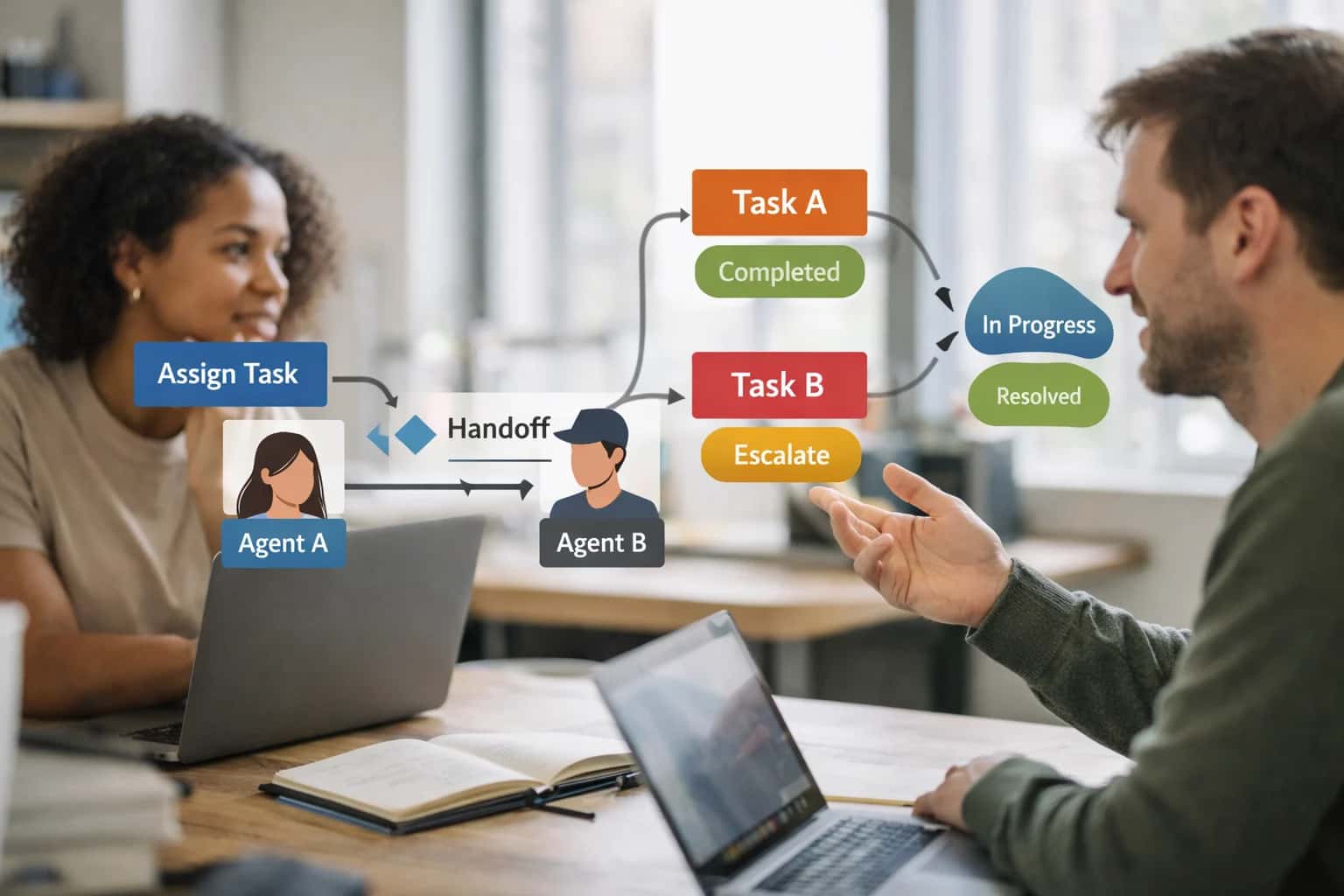
MULTI-AGENT SYSTEM ORCHESTRATION
What is Agent Scheduling?
Agent scheduling is the core orchestration process that determines where and when computational agents are executed within a distributed system.
In practice, scheduling is a continuous optimization problem solved by platforms like Kubernetes. It evaluates candidate nodes against the agent's resource requests and limits, checks for nodeSelector or nodeAffinity rules, and considers taints and tolerations. For stateful agents, it also factors in persistent volume claims. Effective scheduling is critical for performance isolation, fault tolerance (via anti-affinity), and enabling auto-scaling by efficiently packing or distributing agent workloads across the available infrastructure.
AGENT LIFECYCLE MANAGEMENT
Key Scheduling Factors & Constraints
Agent scheduling is the decision-making process by which an orchestration system selects the optimal compute node to host an agent instance. This selection is governed by a complex set of declarative requirements and system-imposed limitations.
01
Resource Requests & Limits
The foundational constraints for scheduling. Resource requests specify the minimum guaranteed CPU and memory an agent needs to run, which the scheduler uses to find a node with sufficient capacity. Resource limits define the maximum amount an agent can consume, preventing a single agent from starving others on the same node. These directly influence the agent's Quality of Service (QoS) class (Guaranteed, Burstable, BestEffort), which affects its priority during resource contention and eviction.
- Example: An agent with a request of
500mCPU and1Gimemory will only be placed on a node with at least that much allocatable resource.
02
Node Selectors & Affinity/Anti-Affinity
Rules that guide the scheduler toward or away from specific nodes or groups of nodes.
- Node Selectors: Simple key-value pairs that schedule an agent only on nodes with matching labels (e.g.,
accelerator: gpu-a100). - Node Affinity/Anti-Affinity: More expressive rules using operators like
In,NotIn,Exists. Affinity attracts agents to nodes with certain properties, while Anti-Affinity repels them, crucial for distributing agents for high availability. - Inter-Pod Affinity/Anti-Affinity: Controls co-location. Use affinity to place latency-sensitive agents together; use anti-affinity to prevent a single node failure from taking down all replicas of a critical agent.
03
Taints, Tolerations & Node Conditions
A push model for node-level constraints. A taint is applied to a node to repel all pods unless they have a matching toleration. This is used for dedicating nodes to specific workloads (e.g., dedicated=ai-agent:NoSchedule) or marking nodes as problematic.
Node conditions like MemoryPressure, DiskPressure, or NodeNotReady are system-generated taints that prevent new agents from being scheduled onto unhealthy nodes. The scheduler also respects node capacity and existing allocated resources when making placement decisions.
04
Topology Spread Constraints
Advanced rules for controlling the distribution of agent pods across failure domains to maximize availability and performance. These constraints spread agents evenly across:
- Zones/Regions (Cloud failure domains)
- Hosts/Nodes
- Custom topology keys (e.g., rack labels in a data center)
You define a maxSkew, which is the maximum difference in the number of pods between any two topology domains. This ensures agents are not overly concentrated in a single zone or rack, protecting against domain-level failures.
05
Scheduling Policies & Profiles
The scheduler's internal scoring and filtering logic. The scheduler first filters out nodes that don't meet hard requirements (resources, taints). Then, it scores remaining nodes based on policies:
- LeastAllocated: Favors nodes with the most free resources.
- BalancedResourceAllocation: Favors nodes with balanced CPU and memory usage.
- NodeAffinity/InterPodAffinity: Scores higher for nodes matching affinity rules.
- ImageLocality: Prefers nodes that already have the required container image cached.
The node with the highest aggregate score is selected. These policies can be customized via scheduler profiles.
06
Pod Priority, Preemption & Quotas
Mechanisms for managing cluster contention.
- Pod Priority: Indicates the relative importance of an agent pod. Higher-priority pods can preempt (evict) lower-priority pods from a node if resources are needed.
- Resource Quotas: Enforced at the namespace level, limiting the total amount of CPU, memory, or number of pods a team's agents can collectively consume. This prevents a single project from monopolizing cluster resources and is a critical constraint the scheduler must respect.
- Pod Disruption Budgets (PDBs): While not a direct scheduler input, PDBs limit voluntary disruptions (e.g., node drains) by ensuring a minimum number of pods for an application remain available, indirectly influencing rescheduling decisions during maintenance.
AGENT SCHEDULING
Frequently Asked Questions
Agent scheduling is the critical orchestration process that determines where and when autonomous agents execute within a distributed system. These questions address the core mechanisms, constraints, and optimizations involved in placing agent workloads.
Agent scheduling is the process by which an orchestration system's scheduler component decides which compute node or host machine should run a specific agent instance. It works by evaluating a pool of candidate nodes against the agent's declared resource requests (e.g., CPU, memory, GPU), affinity/anti-affinity rules, node selectors, and other constraints to select an optimal placement. The scheduler's goal is to maximize resource utilization while ensuring agents run on nodes that satisfy their operational requirements. In platforms like Kubernetes, this involves the kube-scheduler scoring nodes based on these factors and binding the agent pod to the highest-scoring node.
Enabling Efficiency, Speed & Accuracy
Intelligent Analysis, Decision & Execution
We build AI systems for teams that need search across company data, workflow automation across tools, or AI features inside products and internal software.
Talk to Us
Search across company data
Give teams answers from docs, tickets, runbooks, and product data with sources and permissions.
Useful when people spend too long searching or get different answers from different systems.
Enterprise searchRAGPermissions
Read more
Automate internal workflows
Use AI to route work, draft outputs, trigger actions, and keep approvals and logs in place.
Useful when repetitive work moves across multiple tools and teams.
AI agentsWorkflow automationGovernance
Read more
Add AI to products and internal tools
Build assistants, guided actions, or decision support into the software your team or customers already use.
Useful when AI needs to be part of the product, not a separate tool.
AI integrationDecision supportModel routing
Read more
About the author
Prasad Kumkar
CEO & MD, Inference Systems
Prasad Kumkar is the CEO & MD of Inference Systems and writes about AI systems architecture, LLM infrastructure, model serving, evaluation, and production deployment. Over 5+ years, he has worked across computer vision models, L5 autonomous vehicle systems, and LLM research, with a focus on taking complex AI ideas into real-world engineering systems.
His work and writing cover AI systems, large language models, AI agents, multimodal systems, autonomous systems, inference optimization, RAG, evaluation, and production AI engineering.
LinkedIn
Limited slotsGet a Free AI Consultation
Partnered with leading AI, data, and software stack.





How We Work
Custom AI workflows for your Business
One-fit-all AI don't work for modern businesses. At Inferensys, we aim to understand your business & custom requirements; which we use to define most efficient agentic workflows, the data, and the tools for your business.
01
Review the use case
We understand the task, the users, and where AI can actually help.
Read more02
Pick the right approach
We define what needs search, automation, or product integration.
Read more03
Build the first useful version
We implement the part that proves the value first.
Read more04
Improve from there
We add the checks and visibility needed to keep it useful.
Read moreThe first call is a practical review of your use case and the right next step.
Talk to Us