Joint Intentions is a formal framework in multi-agent systems that defines the conditions under which a team of autonomous agents can be said to have a collective commitment to a shared goal. It extends the Belief-Desire-Intention (BDI) model from individual to group reasoning, requiring agents to not only intend a goal individually but also to mutually believe in the team's joint commitment and to monitor its status collectively. This creates a robust foundation for collaborative problem-solving where agents must coordinate their actions interdependently.

Glossary
Joint Intentions
Joint Intentions is a formal theory for modeling collaborative behavior where a team of agents commits to a mutual goal and maintains a shared belief about their collective commitment until they mutually believe the goal is achieved or irrelevant.
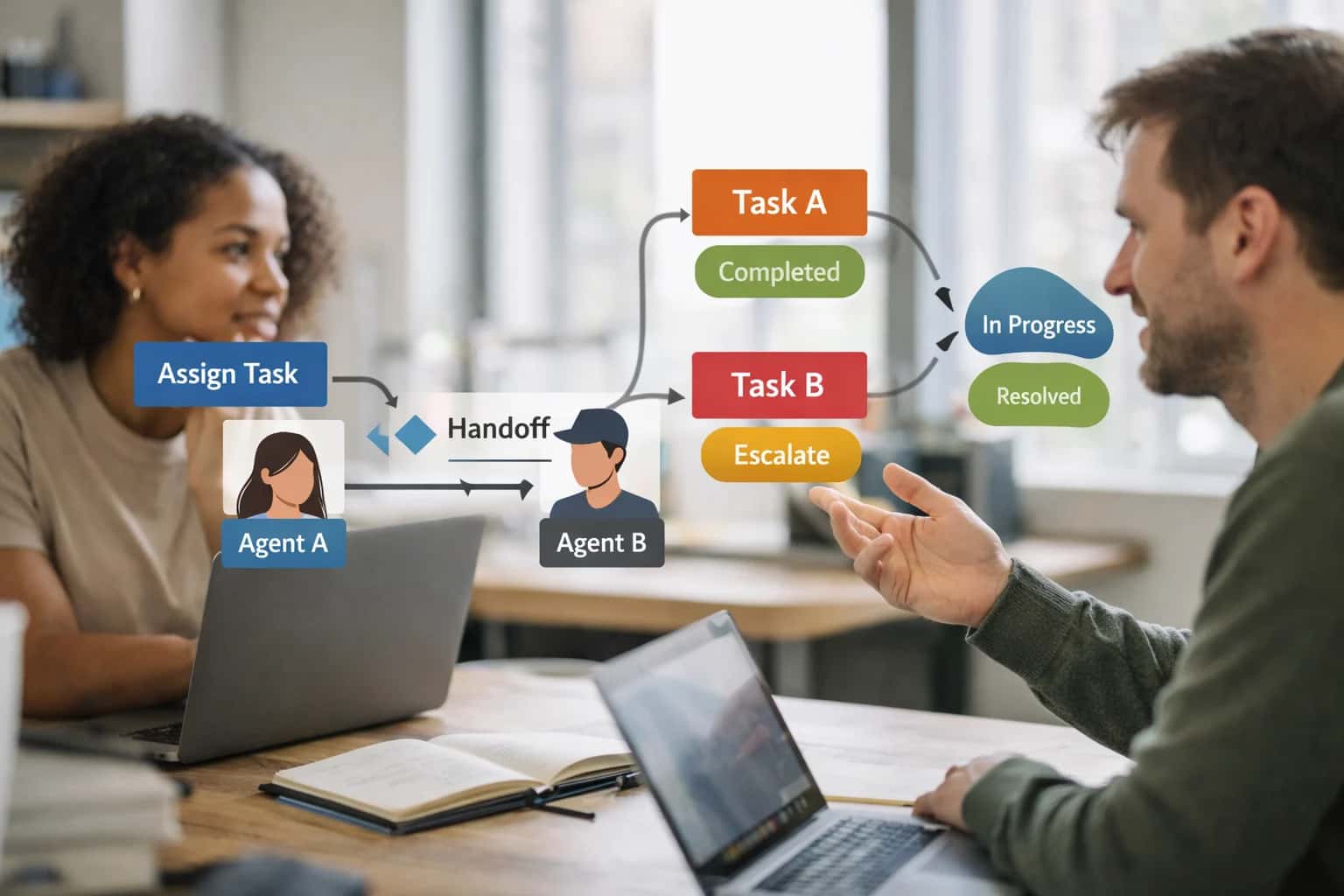
AGENT COORDINATION PATTERNS
What is Joint Intentions?
Joint Intentions is a formal theory for modeling collaborative behavior, where a team of agents commits to a mutual goal and maintains a shared belief about their collective commitment until they mutually believe the goal is achieved or irrelevant.
The theory specifies that a joint intention persists until the team mutually believes the goal is achieved, is unachievable, or is no longer relevant. This requires continuous state synchronization and communication, often implemented via protocols for establishing common knowledge or shared beliefs. It is foundational for designing reliable multi-agent plans in domains like collaborative robotics, distributed sensor networks, and automated supply chains, where failure to maintain a shared context can lead to coordination breakdowns.
THEORETICAL FOUNDATIONS
Key Characteristics of Joint Intentions
Joint Intentions is a formal theory for modeling collaborative behavior, where a team of agents commits to a mutual goal and maintains a shared belief about their collective commitment until they mutually believe the goal is achieved or irrelevant. The theory is defined by a set of necessary and sufficient conditions that distinguish it from mere simultaneous individual action.
01
Mutual Belief in the Goal
The foundational requirement for a joint intention is that all participating agents possess a mutual belief in a common goal. This is stronger than each agent individually knowing the goal; it requires that each agent believes the goal, believes that the other agents believe it, believes that the others believe that it believes it, and so on, ad infinitum. This recursive, nested belief structure ensures the goal is truly common knowledge within the team, preventing coordination failures due to private misunderstandings.
02
Commitment to the Joint Activity
Each agent must make a social commitment not just to the goal itself, but to the joint activity of achieving it with the team. This commitment is conditional and interdependent:
- It persists as long as the mutual belief in the goal and the team's ability to achieve it persists.
- It obligates the agent to act towards the goal while appropriately coordinating with others.
- It creates an obligation to inform teammates if the agent can no longer participate, triggering a re-evaluation of the joint commitment. This transforms a collection of individual intentions into a unified, accountable collective.
03
Mutual Responsiveness
Agents operating under a joint intention must be mutually responsive to the actions and intentions of their teammates. This characteristic ensures the collaboration is dynamic and adaptive. It involves:
- Monitoring teammate actions and the environment.
- Adjusting one's own actions to mesh with the team's progress.
- Supporting teammates who are struggling with their sub-tasks.
- Avoiding actions that would undermine the collective effort. This responsiveness is what differentiates a team from a set of agents executing pre-programmed scripts in parallel.
04
Persistence Until Mutual Belief of Termination
A joint intention does not dissolve simply because one agent decides to stop. It is persistent until a specific termination condition becomes mutual belief among the team. Termination occurs when the team mutually believes either:
- The goal has been achieved.
- The goal is no longer achievable.
- The goal is no longer relevant. This persistence condition prevents premature abandonment and requires a joint exit ritual, such as communication to establish the mutual belief that the endeavor is over, ensuring a clean and coordinated conclusion to the collaborative state.
05
Contrast with Individual Intentions
A joint intention is not equivalent to the mere conjunction of individual intentions toward the same goal ("I intend that we J" vs. "We intend that we J"). Key distinctions include:
- Interdependence: My commitment is contingent on your continued participation.
- Obligations: I acquire social obligations to you (e.g., to inform you of problems).
- Robustness: The joint activity can often survive the failure of an individual plan, as the team can replan.
- Exit Conditions: I cannot unilaterally drop the intention without violating a social commitment to the team. This framework is crucial for designing agents that can engage in robust, human-like teamwork.
06
Formalization and Implementation
The theory is formalized using modal logics of belief, intention, and action (e.g., BDI logics). In practical multi-agent systems, implementations approximate these ideal conditions using:
- Shared Plan Representations: Using structures like Hierarchical Task Networks (HTN) to represent the common goal and sub-task structure.
- Communication Protocols: Employing Agent Communication Languages (ACL) with speech acts like
inform,request, andconfirmto establish and maintain mutual beliefs. - Teamwork Models: Frameworks like STEAM (Shell for TEAMwork) operationalize joint intentions by defining team plans with explicit commitment and synchronization points, translating theory into executable agent code.
AGENT COORDINATION PATTERNS
How Joint Intentions Work in Multi-Agent Systems
Joint Intentions is a formal theory for modeling collaborative behavior, where a team of agents commits to a mutual goal and maintains a shared belief about their collective commitment until they mutually believe the goal is achieved or irrelevant.
Joint Intentions is a formal theory in distributed artificial intelligence that models a team's persistent, collaborative commitment to a shared goal. It extends the Belief-Desire-Intention (BDI) architecture for multi-agent contexts, requiring agents to not only intend a goal individually but also to mutually believe in the team's joint commitment and to maintain it until they mutually believe the goal is satisfied, unachievable, or irrelevant. This framework provides a rigorous semantic foundation for collaborative problem-solving and robust teamwork in dynamic environments.
The theory's power lies in its defined termination conditions, which prevent premature abandonment. Agents must continuously monitor the goal's status and communicate failures or changes. This ensures fault-tolerant coordination, as the team persists or rationally re-evaluates its commitment together. Joint Intentions underpin advanced interaction protocols and is a cornerstone for designing reliable multi-agent systems where coherent, goal-directed collective action is paramount, distinguishing it from simpler, non-committal cooperation.
JOINT INTENTIONS
Frequently Asked Questions
Joint Intentions is a formal theory for modeling collaborative behavior in multi-agent systems. This FAQ addresses common technical questions about its mechanisms, implementation, and relationship to other coordination patterns.
Joint Intentions theory is a formal framework for modeling collaborative behavior where a team of agents commits to a mutual goal and maintains a shared belief about their collective commitment until they mutually believe the goal is achieved or becomes irrelevant. It extends the Belief-Desire-Intention (BDI) model from individual to team reasoning, providing a rigorous logical foundation for persistent group cooperation. The theory defines precise conditions for when a joint intention is formed, sustained, and terminated, ensuring agents do not unilaterally abandon a shared objective without team consensus. This formalism is critical for building reliable, collaborative multi-agent systems in domains like autonomous fleets, disaster response, and collaborative manufacturing, where unpredictable events require robust, team-level commitment management.
Enabling Efficiency, Speed & Accuracy
Intelligent Analysis, Decision & Execution
We build AI systems for teams that need search across company data, workflow automation across tools, or AI features inside products and internal software.
Talk to Us
Search across company data
Give teams answers from docs, tickets, runbooks, and product data with sources and permissions.
Useful when people spend too long searching or get different answers from different systems.
Enterprise searchRAGPermissions
Read more
Automate internal workflows
Use AI to route work, draft outputs, trigger actions, and keep approvals and logs in place.
Useful when repetitive work moves across multiple tools and teams.
AI agentsWorkflow automationGovernance
Read more
Add AI to products and internal tools
Build assistants, guided actions, or decision support into the software your team or customers already use.
Useful when AI needs to be part of the product, not a separate tool.
AI integrationDecision supportModel routing
Read more
About the author
Prasad Kumkar
CEO & MD, Inference Systems
Prasad Kumkar is the CEO & MD of Inference Systems and writes about AI systems architecture, LLM infrastructure, model serving, evaluation, and production deployment. Over 5+ years, he has worked across computer vision models, L5 autonomous vehicle systems, and LLM research, with a focus on taking complex AI ideas into real-world engineering systems.
His work and writing cover AI systems, large language models, AI agents, multimodal systems, autonomous systems, inference optimization, RAG, evaluation, and production AI engineering.
LinkedIn
Limited slotsGet a Free AI Consultation
Partnered with leading AI, data, and software stack.





How We Work
Custom AI workflows for your Business
One-fit-all AI don't work for modern businesses. At Inferensys, we aim to understand your business & custom requirements; which we use to define most efficient agentic workflows, the data, and the tools for your business.
01
Review the use case
We understand the task, the users, and where AI can actually help.
Read more02
Pick the right approach
We define what needs search, automation, or product integration.
Read more03
Build the first useful version
We implement the part that proves the value first.
Read more04
Improve from there
We add the checks and visibility needed to keep it useful.
Read moreThe first call is a practical review of your use case and the right next step.
Talk to Us