Model drift detection is the automated, continuous monitoring process that identifies a statistically significant degradation in a deployed model's predictive performance or a shift in the distribution of its input features relative to a baseline training dataset. It functions as a critical safety circuit for production AI, quantifying the divergence between the real-world data a model encounters and the data it was originally validated on. This divergence, if undetected, leads to silent algorithmic failure in clinical settings.

Glossary
Model Drift Detection
The continuous monitoring process that identifies when a deployed model's statistical properties or predictive performance degrade over time due to changes in the input data distribution.
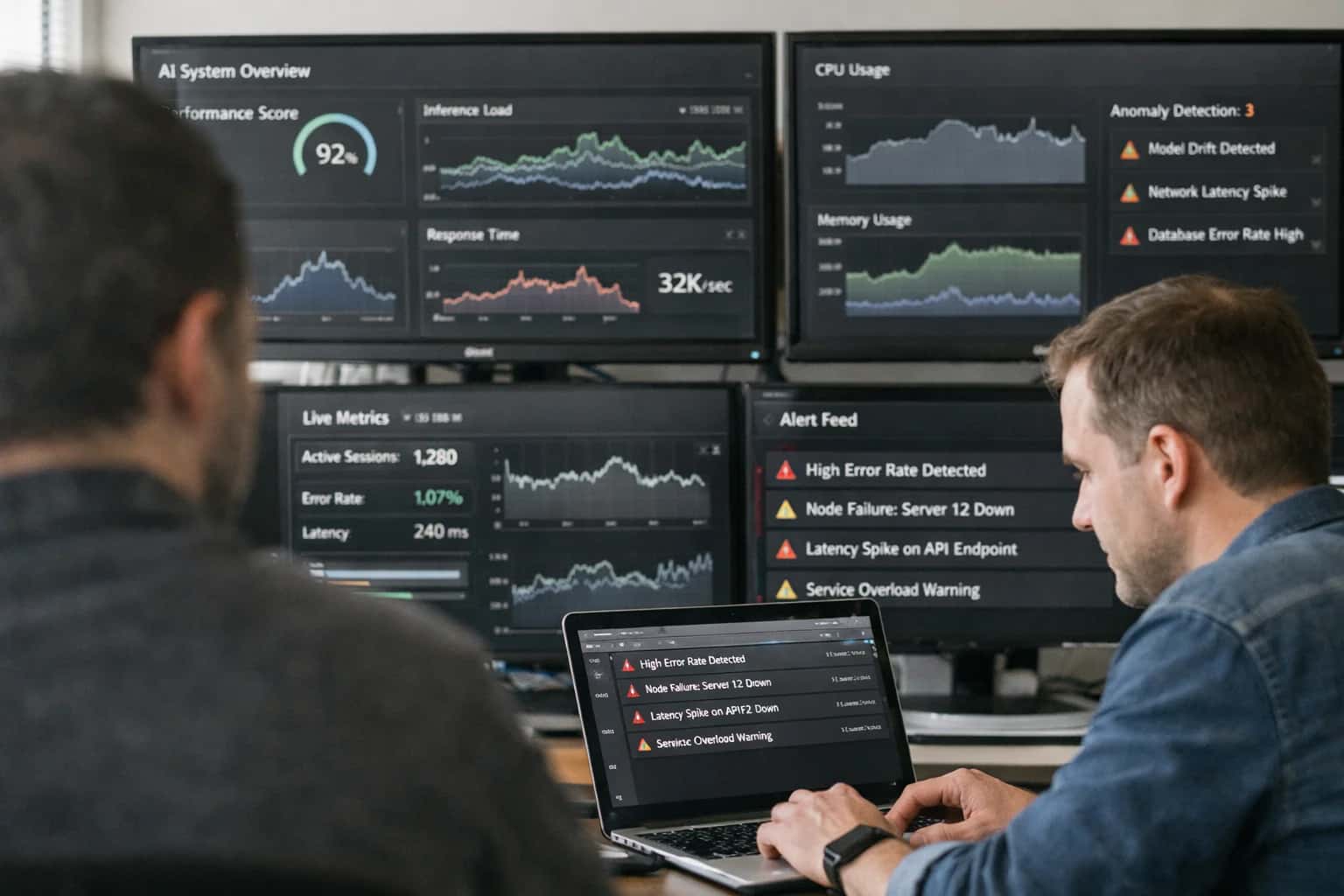
PRODUCTION ML MONITORING
What is Model Drift Detection?
The continuous monitoring process that identifies when a deployed model's statistical properties or predictive performance degrade over time due to changes in the input data distribution.
The core mechanism involves a background monitoring service that computes a distance metric—such as the Population Stability Index (PSI) or Kullback-Leibler divergence—between the training data distribution and a sliding window of live inference data. When this metric exceeds a predefined threshold, the system triggers an alert, signaling that the model's foundational assumptions no longer hold and that recalibration or retraining is required to maintain diagnostic accuracy.
Production ML Monitoring
Core Characteristics of Drift Detection
The continuous monitoring process that identifies when a deployed model's statistical properties or predictive performance degrade over time due to changes in the input data distribution.
01
Data Drift (Feature Drift)
Measures changes in the distribution of input features (e.g., pixel intensity histograms, texture patterns) between the training baseline and live production data. This is the most common form of drift in medical imaging, often triggered by a new scanner vendor, updated acquisition protocol, or a demographic shift in the patient population. Detection relies on statistical distance metrics like the Population Stability Index (PSI) or Kullback-Leibler divergence applied to each feature independently.
02
Concept Drift
Occurs when the fundamental relationship between the input data and the target variable changes, rendering the model's learned mapping obsolete. For example, the clinical definition of a positive finding might be updated in new treatment guidelines, or a novel disease variant presents with different radiographic features. Unlike data drift, concept drift requires ground truth labels or proxy outcomes to detect, making it significantly harder to monitor in real-time diagnostic pipelines.
03
Prediction Distribution Shift
Monitors the output layer of the deployed model for statistically significant changes in the distribution of predicted class probabilities or confidence scores. A sudden spike in high-confidence positive predictions or an unexpected flattening of the softmax output can signal upstream data corruption or a genuine epidemiological event. This is a lightweight, label-free monitoring technique that serves as an early warning system before ground truth verification is available.
04
Statistical Hypothesis Testing
The mathematical backbone of drift detection, employing two-sample tests to determine if observed deviations are statistically significant or merely noise. Common approaches include:
- Kolmogorov-Smirnov test: Compares cumulative distribution functions for continuous features.
- Chi-squared test: Evaluates categorical feature distributions.
- Maximum Mean Discrepancy (MMD): A kernel-based method capable of detecting subtle, high-dimensional shifts without assuming a parametric distribution.
05
Temporal Windowing Strategies
Defines how production data is segmented for comparison against the reference baseline. Sliding windows (e.g., last 7 days) detect gradual, cumulative drift, while fixed windows (e.g., daily batches) catch abrupt shifts caused by a software update or hardware recalibration. The optimal strategy balances detection latency against false positive rate, as overly narrow windows amplify statistical noise in low-throughput clinical settings.
06
Automated Retraining Triggers
The operational logic that translates a drift alert into a concrete action. A robust system defines severity thresholds (e.g., PSI > 0.2 triggers a warning, PSI > 0.5 triggers an automatic pipeline halt). In regulated medical device software, these triggers must be deterministic and auditable, often routing flagged cases to a human-in-the-loop review queue rather than initiating unsupervised model updates, to maintain compliance with FDA change control protocols.
MODEL DRIFT DETECTION
Frequently Asked Questions
Essential questions about identifying and mitigating performance degradation in deployed diagnostic AI models due to shifting data distributions.
Model drift is the degradation of a deployed machine learning model's predictive performance over time due to a change in the statistical properties of the input data. It works by silently eroding accuracy as the relationship between the model's inputs and the target variable shifts. In medical imaging, this occurs when a model trained on scans from one scanner vendor encounters images from a new vendor with different reconstruction algorithms, or when patient demographics in a deployment site differ from the training population. Drift detection systems continuously monitor the model's input distributions and output confidence scores, comparing them against a reference baseline established during validation. When a statistically significant divergence is detected, an alert is triggered to initiate investigation or retraining workflows.
Enabling Efficiency, Speed & Accuracy
Intelligent Analysis, Decision & Execution
We build AI systems for teams that need search across company data, workflow automation across tools, or AI features inside products and internal software.
Talk to Us
Search across company data
Give teams answers from docs, tickets, runbooks, and product data with sources and permissions.
Useful when people spend too long searching or get different answers from different systems.
Enterprise searchRAGPermissions
Read more
Automate internal workflows
Use AI to route work, draft outputs, trigger actions, and keep approvals and logs in place.
Useful when repetitive work moves across multiple tools and teams.
AI agentsWorkflow automationGovernance
Read more
Add AI to products and internal tools
Build assistants, guided actions, or decision support into the software your team or customers already use.
Useful when AI needs to be part of the product, not a separate tool.
AI integrationDecision supportModel routing
Read more
About the author
Prasad Kumkar
CEO & MD, Inference Systems
Prasad Kumkar is the CEO & MD of Inference Systems and writes about AI systems architecture, LLM infrastructure, model serving, evaluation, and production deployment. Over 5+ years, he has worked across computer vision models, L5 autonomous vehicle systems, and LLM research, with a focus on taking complex AI ideas into real-world engineering systems.
His work and writing cover AI systems, large language models, AI agents, multimodal systems, autonomous systems, inference optimization, RAG, evaluation, and production AI engineering.
LinkedIn
Limited slotsGet a Free AI Consultation
Partnered with leading AI, data, and software stack.





How We Work
Custom AI workflows for your Business
One-fit-all AI don't work for modern businesses. At Inferensys, we aim to understand your business & custom requirements; which we use to define most efficient agentic workflows, the data, and the tools for your business.
01
Review the use case
We understand the task, the users, and where AI can actually help.
Read more02
Pick the right approach
We define what needs search, automation, or product integration.
Read more03
Build the first useful version
We implement the part that proves the value first.
Read more04
Improve from there
We add the checks and visibility needed to keep it useful.
Read moreThe first call is a practical review of your use case and the right next step.
Talk to Us