Continuous Deployment (CD) is a software engineering practice where every code change that passes automated tests is automatically released to a production environment. This practice extends Continuous Integration (CI) by eliminating manual gates, enabling multiple daily deployments. The core mechanism relies on a deployment pipeline—an automated sequence of stages including build, test, and deployment—that rigorously validates changes. This approach minimizes lead time, reduces deployment risk through small, incremental changes, and provides rapid user feedback.

Glossary
Continuous Deployment (CD)
Continuous Deployment (CD) is a software engineering practice where every code change that passes automated tests is automatically deployed to production, enabling rapid and reliable releases.
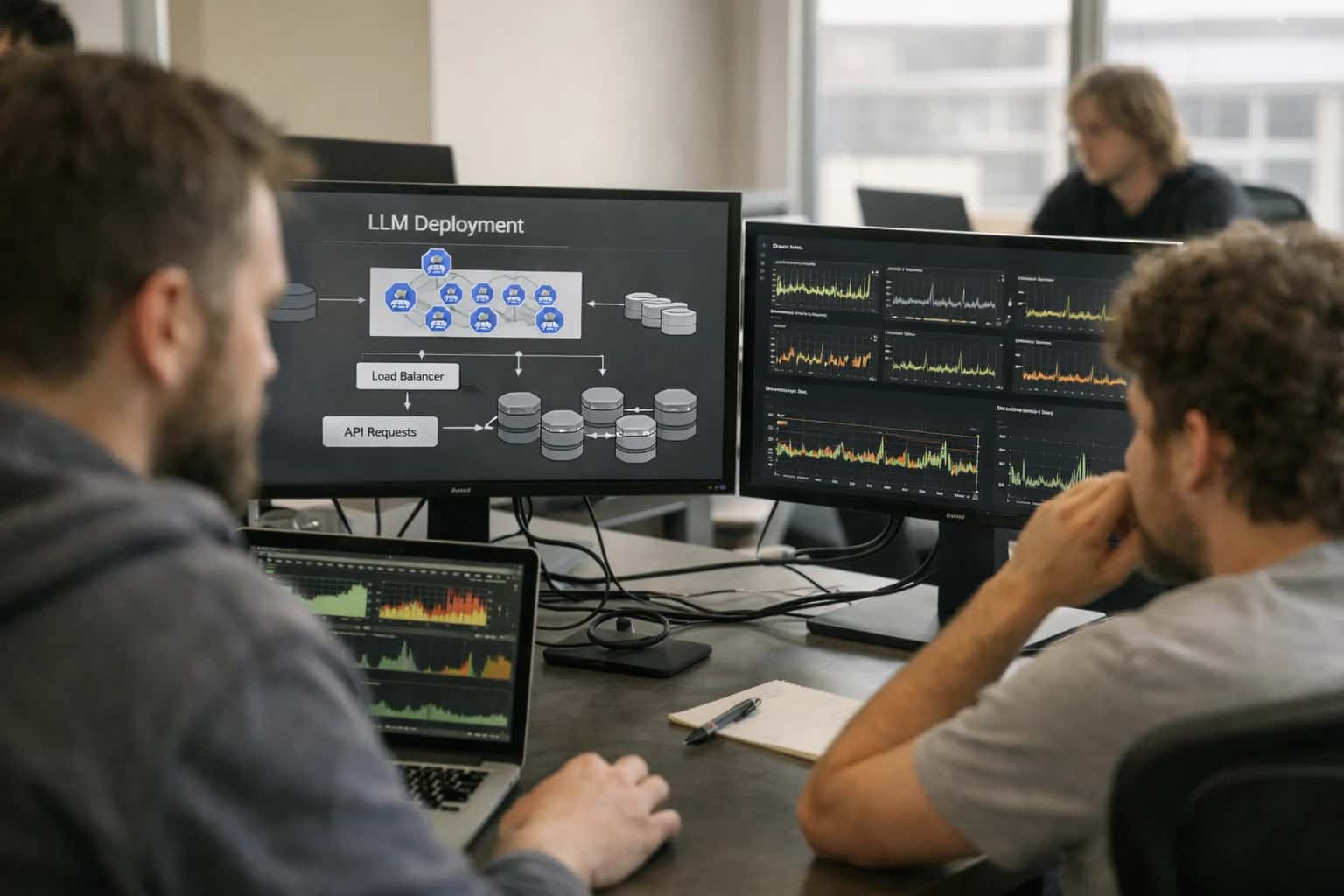
DEPLOYMENT STRATEGY
What is Continuous Deployment (CD)?
Continuous Deployment (CD) is the automated process of delivering validated code changes directly to production, enabling rapid, reliable software releases.
In the context of Large Language Model Operations (LLMOps), CD is critical for managing the iterative lifecycle of AI applications. It automates the rollout of new model versions, prompt templates, and retrieval-augmented generation (RAG) index updates. CD pipelines for AI systems incorporate specialized validation stages, such as hallucination detection, output safety checks, and performance benchmarking against a golden dataset. This ensures that improvements to foundation models or agentic systems are delivered to users swiftly and safely, maintaining a high service level objective (SLO) for AI-powered features.
TRAFFIC AND DEPLOYMENT STRATEGIES
Core Characteristics of Continuous Deployment
Continuous Deployment (CD) is defined by a set of engineering practices and architectural patterns that enable the fully automated, reliable, and safe release of code changes to production. These characteristics distinguish it from manual or semi-automated release processes.
01
Full Automation from Commit to Production
The defining characteristic of CD is the complete automation of the release pipeline. Once a developer's code change passes all automated checks (build, unit tests, integration tests), it is automatically deployed to production without any manual intervention or approval gates. This requires a robust deployment pipeline with comprehensive test suites, including performance, security, and smoke tests, to act as the sole gatekeeper for release quality.
02
Small, Frequent, and Low-Risk Releases
CD enables a high release cadence, often multiple times per day. This is achieved by deploying small batches of changes. The risk of each deployment is minimized because:
- The scope of change is limited, making issues easier to diagnose and roll back.
- Problems are detected and fixed immediately, preventing the accumulation of defects.
- This practice reduces the mean time to recovery (MTTR) and aligns with the principle of trunk-based development, where developers integrate small changes directly into the main branch frequently.
03
Advanced Deployment Strategies for Safety
While deployment is automatic, it is not reckless. CD pipelines leverage sophisticated deployment patterns to mitigate risk:
- Blue-Green Deployment: Maintains two identical production environments. Traffic is switched from the old (blue) to the new (green) version instantly, enabling zero-downtime releases and fast rollbacks.
- Canary Releases: The new version is deployed to a small, controlled subset of users or infrastructure first. Key metrics (latency, error rate) are monitored before a full rollout.
- Feature Flags: Decouple deployment from release. New code is deployed but kept dormant, activated later for specific user segments via runtime toggles, enabling progressive delivery and A/B testing.
04
Comprehensive Monitoring and Fast Feedback
Automated deployment necessitates automated verification. CD relies on a telemetry-driven feedback loop. After a deployment, systems automatically monitor:
- Business metrics: Conversion rates, user engagement.
- Application performance: Latency (p95, p99), throughput, error rates.
- Infrastructure health: CPU, memory, disk I/O.
- Synthetic transactions: Simulated user flows to verify critical paths.
This data is aggregated into dashboards and alerts. If a Service Level Objective (SLO) is breached, the system can trigger automated rollbacks or alert engineers for immediate investigation.
05
Immutable Infrastructure and Declarative Configuration
CD treats servers and runtime environments as immutable infrastructure. Instead of patching or updating existing servers, new deployments build entirely new, versioned artifacts (e.g., container images, VM images) that are provisioned from a known, tested state. This is managed through Infrastructure as Code (IaC) tools like Terraform or AWS CloudFormation, and orchestrated by platforms like Kubernetes. The desired state of the entire system—application and infrastructure—is declaratively defined in version-controlled configuration files, ensuring consistency and reproducibility across all environments.
06
Cultural Foundation: Shared Ownership and Blameless Postmortems
Successful CD is as much a cultural shift as a technical one. It requires:
- Shared ownership: Developers are responsible for the operation of their code in production ("You build it, you run it").
- Blameless culture: When failures occur, the focus is on improving systems and processes, not assigning individual fault. Postmortems analyze root causes to prevent recurrence.
- Continuous improvement: Teams constantly refine their deployment pipeline, test coverage, and monitoring to reduce lead time and increase deployment frequency, as measured by the DORA metrics (Deployment Frequency, Lead Time for Changes, Time to Restore Service, Change Failure Rate).
TRAFFIC AND DEPLOYMENT STRATEGIES
How Continuous Deployment Works
Continuous Deployment (CD) is the automated process of delivering validated code changes directly to production, enabling rapid, reliable software releases.
Continuous Deployment (CD) is a software engineering practice where every code change that passes automated testing is automatically released to production. This process is triggered by a successful merge into the main branch, initiating a CI/CD pipeline that builds, tests, and deploys the artifact without manual intervention. The goal is to achieve a rapid, reliable flow of changes from commit to customer, reducing lead time and deployment risk.
Key enabling technologies include infrastructure as code (IaC) for environment consistency, comprehensive test suites (unit, integration, end-to-end), and progressive delivery mechanisms like canary deployments and feature flags. These controls allow teams to validate changes with a subset of users before a full rollout, ensuring stability and enabling instant rollback if issues are detected, thus maintaining high availability.
KEY DIFFERENCES
Continuous Deployment vs. Continuous Delivery
A comparison of two core DevOps practices for automating the software release pipeline, highlighting the critical distinction in the final production deployment step.
| Feature / Characteristic | Continuous Delivery | Continuous Deployment |
|---|---|---|
Core Objective | Ensure code is always in a deployable state | Automatically deploy every change that passes tests |
Production Deployment | A manual, business-triggered decision | Fully automated after pipeline success |
Release Cadence | Frequent, but controlled by manual approval | Continuous and immediate upon validation |
Primary Automation Scope | Build, test, and staging deployment | Build, test, staging deployment, and production deployment |
Human Intervention Point | Required for final production release | Only for monitoring and rollback decisions |
Risk Profile | Lower, due to manual gating | Higher, mitigated by robust automated testing |
Suitable For | Environments requiring compliance approvals or strict business scheduling | Teams with exceptional test coverage and a culture of rapid iteration |
Key Prerequisite | Comprehensive automated testing suite | Comprehensive automated testing suite AND advanced monitoring/rollback capabilities |
CONTINUOUS DEPLOYMENT (CD)
Frequently Asked Questions
Continuous Deployment (CD) automates the release of validated code changes directly to production, enabling rapid, reliable software delivery. This FAQ addresses its core mechanisms, benefits, and role in modern LLM operations.
Continuous Deployment (CD) is an automated software engineering practice where every code change that passes automated tests is automatically released to a production environment. The core workflow involves a continuous integration (CI) pipeline that builds and tests the code, followed by automated deployment stages that progressively roll out the change, often using strategies like canary deployments or blue-green deployments. For LLM-powered applications, this can include automatically deploying new prompt versions, updated model fine-tunes, or changes to the inference service infrastructure. The process is governed by a GitOps model, where a Git repository serves as the single source of truth, and automated agents reconcile the live state with the declared configuration.
Enabling Efficiency, Speed & Accuracy
Intelligent Analysis, Decision & Execution
We build AI systems for teams that need search across company data, workflow automation across tools, or AI features inside products and internal software.
Talk to Us
Search across company data
Give teams answers from docs, tickets, runbooks, and product data with sources and permissions.
Useful when people spend too long searching or get different answers from different systems.
Enterprise searchRAGPermissions
Read more
Automate internal workflows
Use AI to route work, draft outputs, trigger actions, and keep approvals and logs in place.
Useful when repetitive work moves across multiple tools and teams.
AI agentsWorkflow automationGovernance
Read more
Add AI to products and internal tools
Build assistants, guided actions, or decision support into the software your team or customers already use.
Useful when AI needs to be part of the product, not a separate tool.
AI integrationDecision supportModel routing
Read more
About the author
Prasad Kumkar
CEO & MD, Inference Systems
Prasad Kumkar is the CEO & MD of Inference Systems and writes about AI systems architecture, LLM infrastructure, model serving, evaluation, and production deployment. Over 5+ years, he has worked across computer vision models, L5 autonomous vehicle systems, and LLM research, with a focus on taking complex AI ideas into real-world engineering systems.
His work and writing cover AI systems, large language models, AI agents, multimodal systems, autonomous systems, inference optimization, RAG, evaluation, and production AI engineering.
LinkedIn
Limited slotsGet a Free AI Consultation
Partnered with leading AI, data, and software stack.





How We Work
Custom AI workflows for your Business
One-fit-all AI don't work for modern businesses. At Inferensys, we aim to understand your business & custom requirements; which we use to define most efficient agentic workflows, the data, and the tools for your business.
01
Review the use case
We understand the task, the users, and where AI can actually help.
Read more02
Pick the right approach
We define what needs search, automation, or product integration.
Read more03
Build the first useful version
We implement the part that proves the value first.
Read more04
Improve from there
We add the checks and visibility needed to keep it useful.
Read moreThe first call is a practical review of your use case and the right next step.
Talk to Us