Retrieval-augmented generation (RAG) prompting is a technique where a large language model's (LLM) prompt is dynamically augmented with relevant information retrieved from an external knowledge source to improve the accuracy and grounding of its responses. It mitigates hallucinations by providing the model with factual, up-to-date context from a vector database or other knowledge store, effectively separating the model's parametric memory from its non-parametric, retrievable memory.

Glossary
Retrieval-Augmented Generation (RAG) Prompting
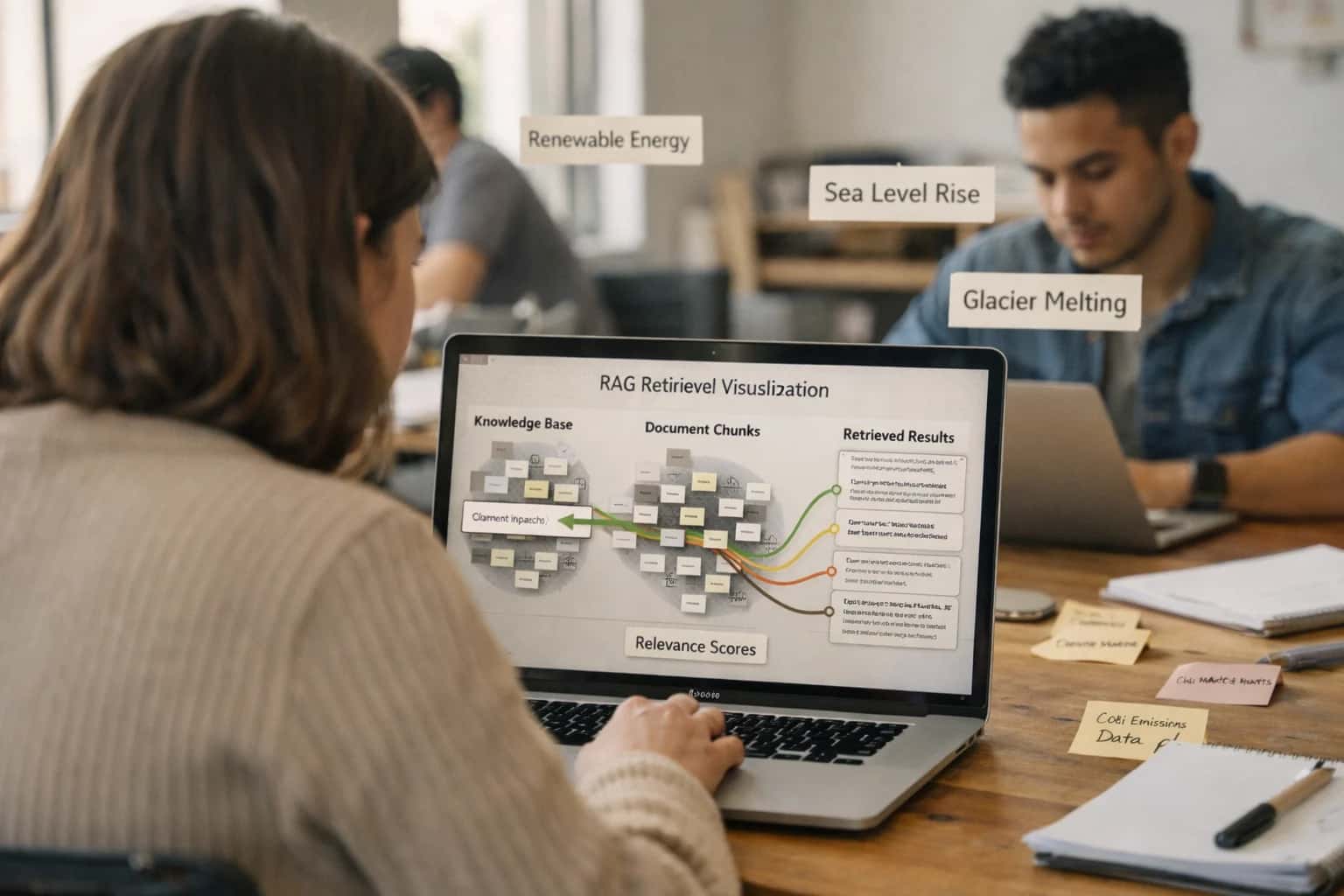
Retrieval-Augmented Generation (RAG) prompting is a technique that dynamically augments a large language model's (LLM) prompt with relevant information retrieved from an external knowledge source to improve response accuracy and grounding.
PROMPT ENGINEERING MANAGEMENT
What is Retrieval-Augmented Generation (RAG) Prompting?
A technique for grounding large language model responses in external, proprietary data.
The RAG architecture operates in a two-stage process: first, a retriever (often a dense vector search) finds documents relevant to the user's query from a knowledge base. Second, these documents are injected as context into a carefully engineered prompt template, which instructs the LLM to synthesize an answer based solely on the provided evidence. This approach is foundational for enterprise applications requiring factual grounding without the cost of model retraining.
ARCHITECTURAL BREAKDOWN
Key Components of a RAG System
A Retrieval-Augmented Generation (RAG) system is a composite architecture that dynamically grounds a large language model's responses in external, proprietary data. Its core components work in sequence to retrieve relevant information and inject it into the model's context.
01
Document Indexer & Vector Store
This is the system's long-term memory. It pre-processes and indexes source documents (PDFs, wikis, databases) for rapid retrieval.
- Chunking: Documents are split into semantically meaningful segments (e.g., 512-token chunks with overlap).
- Embedding: Each chunk is converted into a high-dimensional vector embedding (e.g., using text-embedding-ada-002) that captures its semantic meaning.
- Indexing: These vectors are stored in a specialized vector database (e.g., Pinecone, Weaviate, pgvector) optimized for approximate nearest neighbor (ANN) search.
02
Query Encoder & Retriever
This component translates a user's natural language question into a format that can search the indexed knowledge base.
- At query time, the user's input is encoded into a query embedding using the same model that indexed the documents.
- The retriever performs a semantic similarity search in the vector store, finding the
kdocument chunks whose embeddings are closest to the query embedding (e.g., using cosine similarity). - Advanced systems may use hybrid search, combining semantic search with traditional keyword (BM25) matching for better recall of specific terms.
03
Context Augmentation & Prompt Builder
This module constructs the final, augmented prompt sent to the LLM. It is a critical piece of context engineering.
- The top
kretrieved document chunks are formatted into a coherent context block. - This context is inserted into a prompt template alongside the original user query and system instructions. A common pattern is:
"Answer the question based only on the following context:\n\n[Context]\n\nQuestion: [User Query]\nAnswer:" - The template explicitly instructs the model to ground its answer solely in the provided context, a primary defense against hallucination.
04
Generator (LLM)
The large language model acts as the reasoning and synthesis engine. It generates the final answer conditioned on the augmented prompt.
- The model is not fine-tuned on the proprietary data; it reads the provided context in-context.
- The system prompt constrains it to cite or base its response on the retrieved passages.
- Performance depends heavily on the model's in-context learning ability and instruction-following fidelity. Models like GPT-4, Claude 3, and command-focused variants (e.g., Llama 2 Chat) are commonly used.
05
Re-Ranker (Advanced)
An optional, post-retrieval component that improves precision by re-scoring the initially retrieved documents.
- Initial vector search maximizes recall (finding all possibly relevant chunks).
- A cross-encoder model (e.g., a BERT-based model fine-tuned for relevance) then evaluates the query against each retrieved chunk in a more computationally expensive but accurate pairwise manner.
- The top
nre-ranked chunks are passed to the prompt builder, ensuring the most relevant context is within the LLM's limited context window. This step significantly improves answer quality for complex queries.
06
Evaluation & Feedback Loop
The operational component that monitors and improves the RAG pipeline over time.
- Key Metrics: Track retrieval accuracy (e.g., Hit Rate, Mean Reciprocal Rank), answer faithfulness (grounding in source), and answer relevance.
- User Feedback: Logs correct/incorrect flags or thumbs-up/down signals to identify failing queries.
- Iterative Tuning: Feedback drives adjustments to chunking strategies, embedding models, hybrid search weights, and prompt templates, closing the loop for continuous model learning.
ARCHITECTURAL COMPARISON
RAG Prompting vs. Alternative Knowledge Integration Methods
A technical comparison of methods for integrating external, proprietary knowledge into large language model (LLM) applications, focusing on implementation complexity, factual grounding, and operational characteristics.
| Feature / Metric | Retrieval-Augmented Generation (RAG) | Full Fine-Tuning | Prompt Engineering (Static Knowledge) |
|---|---|---|---|
Core Mechanism | Dynamic retrieval from external vector database at inference time | Static update of the model's internal weights via gradient descent | Reliance on static instructions & examples within the fixed context window |
Knowledge Update Cadence | Near real-time (minutes) | Weeks to months (retraining cycle) | Manual prompt update (hours to days) |
Factual Grounding & Hallucination Control | |||
Explainability / Citation of Sources | |||
Implementation & Iteration Speed | Fast (days) | Slow (months) | Very Fast (hours) |
Computational Cost (Ongoing Inference) | Medium (retrieval + LLM call) | Low (standard LLM call) | Low (standard LLM call) |
Computational Cost (Upfront/Update) | Low (embedding generation) | Very High (full model training) | Negligible (prompt editing) |
Handles Proprietary/Private Data | |||
Contextual Precision (Answer Relevance) | High (retrieved chunks are query-specific) | Medium (knowledge is generalized in weights) | Low (limited by static prompt context) |
Primary Risk of Staleness | Data in knowledge base | Entire model snapshot | Information in static prompt examples |
RAG PROMPTING
Frequently Asked Questions
Retrieval-augmented generation (RAG) prompting is a foundational technique for grounding large language models in external, up-to-date knowledge. These questions address its core mechanisms, benefits, and implementation.
Retrieval-augmented generation (RAG) prompting is a technique where a large language model's (LLM) prompt is dynamically augmented with relevant information retrieved from an external knowledge source (like a vector database) to improve the accuracy, relevance, and factual grounding of its responses.
It works by first converting a user's query into a numerical representation called an embedding. This embedding is used to perform a semantic search over a pre-indexed corpus of documents (e.g., company wikis, product manuals, or legal documents) to find the most relevant text passages. These retrieved passages are then inserted into the LLM's prompt as context, instructing the model to base its answer primarily on this provided evidence. This architecture effectively decouples the LLM's parametric memory (its static, trained knowledge) from an updatable, non-parametric external memory, allowing for responses that are current, specific, and verifiable.
Enabling Efficiency, Speed & Accuracy
Intelligent Analysis, Decision & Execution
We build AI systems for teams that need search across company data, workflow automation across tools, or AI features inside products and internal software.
Talk to Us
Search across company data
Give teams answers from docs, tickets, runbooks, and product data with sources and permissions.
Useful when people spend too long searching or get different answers from different systems.
Enterprise searchRAGPermissions
Read more
Automate internal workflows
Use AI to route work, draft outputs, trigger actions, and keep approvals and logs in place.
Useful when repetitive work moves across multiple tools and teams.
AI agentsWorkflow automationGovernance
Read more
Add AI to products and internal tools
Build assistants, guided actions, or decision support into the software your team or customers already use.
Useful when AI needs to be part of the product, not a separate tool.
AI integrationDecision supportModel routing
Read more
About the author
Prasad Kumkar
CEO & MD, Inference Systems
Prasad Kumkar is the CEO & MD of Inference Systems and writes about AI systems architecture, LLM infrastructure, model serving, evaluation, and production deployment. Over 5+ years, he has worked across computer vision models, L5 autonomous vehicle systems, and LLM research, with a focus on taking complex AI ideas into real-world engineering systems.
His work and writing cover AI systems, large language models, AI agents, multimodal systems, autonomous systems, inference optimization, RAG, evaluation, and production AI engineering.
LinkedIn
Limited slotsGet a Free AI Consultation
Partnered with leading AI, data, and software stack.





How We Work
Custom AI workflows for your Business
One-fit-all AI don't work for modern businesses. At Inferensys, we aim to understand your business & custom requirements; which we use to define most efficient agentic workflows, the data, and the tools for your business.
01
Review the use case
We understand the task, the users, and where AI can actually help.
Read more02
Pick the right approach
We define what needs search, automation, or product integration.
Read more03
Build the first useful version
We implement the part that proves the value first.
Read more04
Improve from there
We add the checks and visibility needed to keep it useful.
Read moreThe first call is a practical review of your use case and the right next step.
Talk to Us