A context window is the fixed maximum number of tokens—encompassing both input and generated output—that a large language model (LLM) can process in a single interaction. This limit defines the model's immediate working memory, constraining the amount of conversational history, provided instructions, and retrieved data (as in Retrieval-Augmented Generation) it can consider when formulating a response. The size, measured in tokens (e.g., 4K, 128K), is a key architectural specification that directly impacts an application's ability to handle long documents or extended dialogues.

Glossary
Context Window
A context window is the fixed maximum number of tokens (input and output combined) that a large language model (LLM) can process in a single interaction.
LLM INFRASTRUCTURE
What is a Context Window?
A fundamental architectural constraint defining the operational memory of a large language model.
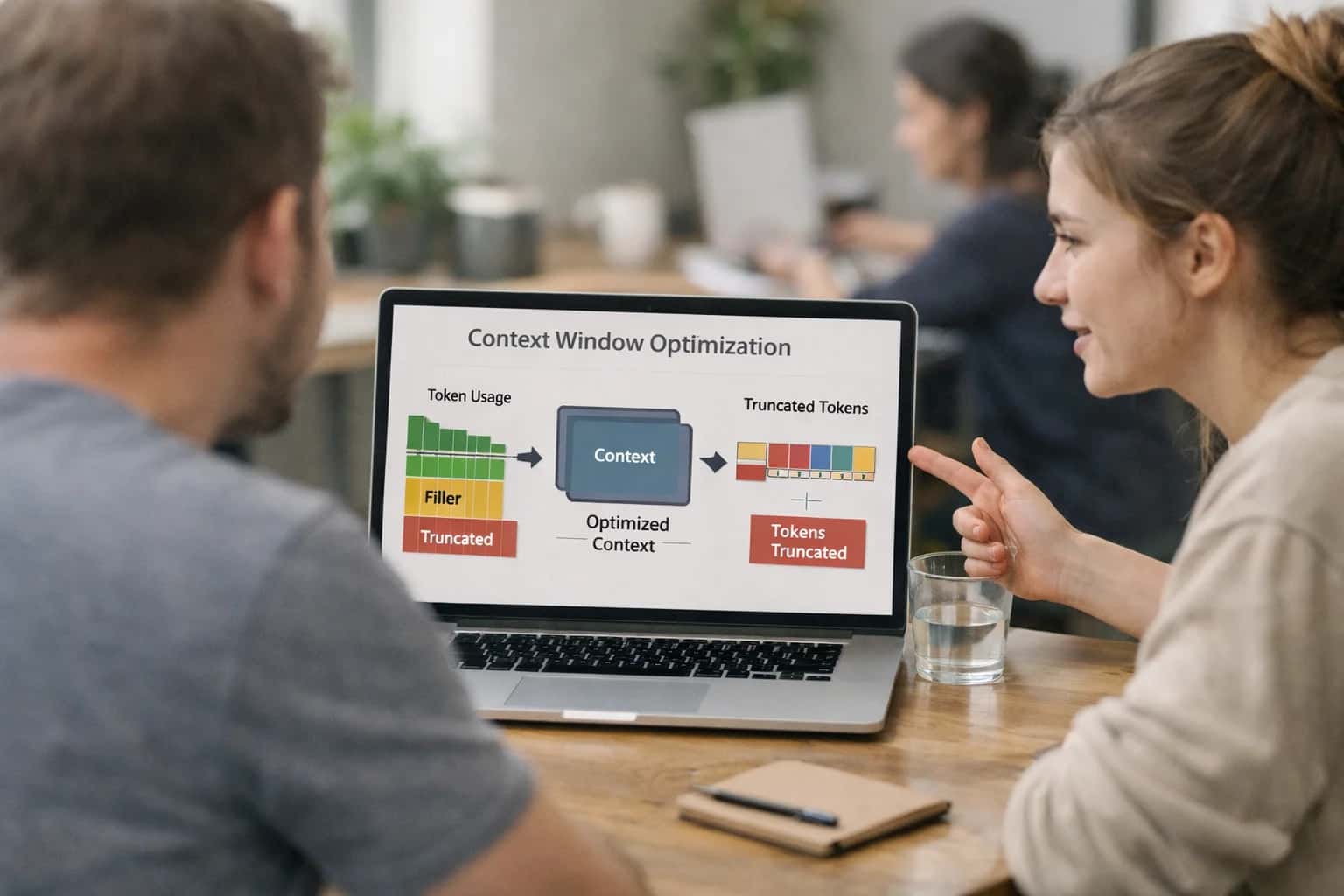
Managing the context window is a core engineering challenge. As the token count approaches the limit, models may experience performance degradation on information located in the middle of the context (the 'lost-in-the-middle' phenomenon) and incur higher computational costs. Techniques like context caching, sliding windows, and strategic summarization are employed to optimize usage. Exceeding the window typically results in the oldest tokens being dropped, making effective context management essential for building robust, production-scale LLM applications.
LLM INFRASTRUCTURE
Key Characteristics of a Context Window
A context window is a fundamental architectural constraint of transformer-based language models. Understanding its properties is essential for designing efficient prompts, managing conversation history, and architecting systems like RAG.
01
Fixed Token Capacity
The context window is a hard, pre-defined limit set during the model's architecture design and training. It is measured in tokens (sub-word units), not characters or words. For example, GPT-4 Turbo has a 128K token context window. This limit is non-negotiable at inference time; input that exceeds it will be truncated or rejected. The capacity is shared between the prompt (input) and the generated completion (output).
02
Sliding Window & Attention
Within the window, the model uses self-attention mechanisms to compute relationships between all token pairs. This creates a computational complexity of O(n²) for sequence length n, making longer contexts exponentially more expensive. Some architectures use optimizations like sliding window attention (e.g., Mistral 7B) where a token only attends to a fixed number of preceding tokens, reducing cost but limiting long-range coherence. The model has no memory of interactions beyond its current window unless explicitly managed externally.
03
Input & Output Token Budget
Every token consumed counts against the limit. The budget is partitioned as:
- Input Tokens: System instructions, user queries, conversation history, and retrieved documents (in RAG).
- Output Tokens: The model's generated response.
Example: With a 4K window, a 3.5K token prompt leaves only 500 tokens for the answer. Exceeding the output budget causes truncation. Effective prompt engineering requires frugal use of input tokens to preserve space for high-quality completions.
04
Impact on Long-Context Tasks
The window size directly enables or constrains specific applications:
- Long Document Analysis: Summarizing legal contracts or research papers requires windows of 100K+ tokens.
- Extended Conversations: Maintaining coherence in multi-session chats.
- Retrieval-Augmented Generation (RAG): Determines how many retrieved document chunks can be included for grounding.
Trade-off: Larger windows increase capability but also dramatically raise memory (VRAM) usage and inference latency due to the quadratic attention cost. Models often show performance degradation ("lost in the middle" phenomenon) for information placed far from the start or end of very long contexts.
05
Context Window vs. Memory
It is critical to distinguish the context window from agentic or system memory:
- Context Window: The model's immediate, working memory for a single inference call. It is volatile and reset for each new call unless history is explicitly re-submitted.
- External Memory (Vector DBs, Knowledge Graphs): Persistent storage systems that hold information across sessions. Data is retrieved and injected into the context window as needed.
- Conversation Buffer: An application-level construct that manages dialogue history, strategically selecting which past exchanges to re-insert into the context window for the next API call.
06
Management Techniques
Engineers use several strategies to work within context limits:
- Prompt Compression: Techniques like selective context or summarization to reduce token count.
- Strategic Truncation: Prioritizing recent messages or most relevant document snippets.
- Structured Caching: Using key-value (KV) caching to avoid recomputing attention for prefix tokens, speeding up sequential generation.
- Architectural Solutions: Employing models with efficient attention (FlashAttention, Ring Attention) or systems that dynamically stream context in chunks.
MECHANISM
How a Context Window Works Technically
A technical breakdown of the context window's role as a fixed, sliding buffer of attention in transformer-based language models.
A context window is the fixed-size, contiguous sequence of tokens—comprising the user's prompt, the model's response, and any system instructions—that a transformer-based language model can attend to in a single forward pass. It functions as a sliding attention buffer, where the model's self-attention mechanism computes relationships between every token in this window, establishing the immediate conversational history and informational grounding for the current generation step. The window's maximum length, measured in tokens, is a hard architectural constraint determined during pre-training.
Technically, the context window is managed via the model's key-value (KV) cache, a memory structure that stores computed attention states for previously processed tokens to avoid redundant computation. As new tokens are generated, they are appended to this cache, and the oldest tokens are evicted once the limit is reached, enforcing the sliding window behavior. This mechanism defines the model's working memory, directly impacting its ability to maintain coherence in long conversations, follow complex instructions, and utilize provided in-context examples or retrieved documents in Retrieval-Augmented Generation (RAG) systems.
COMPARISON
Context Window Sizes Across Major Models
A comparison of the maximum token capacity (input + output) for prominent commercial and open-source large language models, illustrating the evolution of long-context capabilities.
| Model / Family | Provider / Developer | Context Window (Tokens) | Key Architecture Note |
|---|---|---|---|
GPT-4 Turbo | OpenAI | 128,000 | Supports 128K input; output counts against limit |
GPT-4o | OpenAI | 128,000 | Multimodal; uniform 128K context for all modalities |
Claude 3 Opus | Anthropic | 200,000 | Industry-leading 200K context at launch |
Gemini 1.5 Pro | 1,000,000 | Experimental 1M token context via limited preview | |
Gemini 1.5 Flash | 1,000,000 | Efficient model with same 1M token experimental capacity | |
Llama 3.1 405B Instruct | Meta | 131,072 | Open-weight model with 128K context |
Command R+ | Cohere | 128,000 | Optimized for enterprise RAG workflows |
Mixtral 8x22B | Mistral AI | 65,536 | Sparse Mixture-of-Experts (MoE) architecture |
Qwen2.5 72B Instruct | Alibaba Cloud | 131,072 | Leading open-source model for long context in its class |
CONTEXT WINDOW
Engineering Implications and Strategies
The fixed token limit of a model's context window imposes specific architectural constraints and operational trade-offs. Effective engineering requires strategies to work within, extend, or bypass this fundamental boundary.
01
Cost and Latency Scaling
The computational cost and latency of processing a prompt scale quadratically with the context length for Transformer-based models due to the self-attention mechanism. This makes long-context inference significantly more expensive.
- Engineering Impact: A 128k-token context can be over 100x more computationally intensive than a 1k-token context.
- Strategy: Implement context length-based tiering for pricing and load balancing. Use continuous batching to improve GPU utilization for mixed-length requests.
- Monitoring: Track tokens-per-second and latency-per-token metrics segmented by context length to identify cost outliers.
02
Information Prioritization (Context Management)
With a finite window, engineers must implement systems to decide which information to include, exclude, or compress.
- Key Techniques:
- Recency/Frequency Heuristics: Prioritize the most recent user messages and frequently referenced documents.
- Semantic Relevance Scoring: Use a separate, cheaper model to score and rank retrieved chunks before insertion.
- Summarization/Compression: Condense older sections of the conversation or documents into concise summaries to free up tokens for new data.
- Architecture: This logic is often implemented in a context manager or orchestration layer separate from the LLM call.
04
Prompt Architecture and Template Design
The context window is a shared resource between system instructions, few-shot examples, conversation history, and user input. Each component must be sized deliberately.
- Fixed Overhead: Reserve a token budget for the system prompt and any critical few-shot examples. This is your non-negotiable foundation.
- Variable Allocation: The remaining budget is dynamically allocated to user query and retrieved context. Use templating engines to assemble the final prompt, ensuring the total never exceeds the model's limit.
- Optimization: Compress instructions and examples. Use structured output prompts (JSON, XML) which can be more token-efficient than verbose natural language.
05
State Management for Long Conversations
For multi-turn dialogues (e.g., customer support bots) that exceed a single window, engineers must implement conversation state persistence.
- Problem: Without state management, the model 'forgets' earlier exchanges once they are pushed out of the window.
- Solution Patterns:
- Summary-and-Carry: Periodically summarize the conversation and inject the summary into the context of subsequent turns.
- Explicit State Variable: Maintain key facts, decisions, and user intent in a structured database, querying and updating it each turn.
- Windowed Memory: Implement a sliding window that keeps only the last N messages, ensuring the most recent interaction is always in context.
06
Model Selection and Evaluation
Context window size is a first-order criterion in model selection, directly impacting application feasibility.
- Evaluation Requirement: Benchmarks must be performed at the intended operational context length. A model performing well on 4k tokens may degrade at 32k.
- Trade-off Analysis: Larger-context models (e.g., 128k+) often have higher baseline latency and cost. The engineering decision balances the need for extended context against these operational factors.
- Future-Proofing: Consider the effective context window, which may be shorter than advertised due to performance degradation on information placed in the middle of very long contexts. Test with needle-in-a-haystack evaluations.
CONTEXT WINDOW
Frequently Asked Questions
Essential questions about the context window, the fundamental constraint defining how much information a large language model can process in a single interaction.
A context window is the fixed maximum number of tokens (input and output combined) that a large language model can process in a single forward pass, defining the absolute limit of immediate conversational history, provided instructions, and retrieved data it can consider.
It functions as the model's working memory for a given interaction. Once this token limit is reached, the model cannot 'remember' or reference earlier parts of the conversation unless they are explicitly re-submitted, a process known as context truncation. The size is a hard architectural limit determined during the model's pre-training, with modern models offering windows ranging from 4K tokens (e.g., early GPT-3) to over 1M tokens (e.g., Claude 3).
Enabling Efficiency, Speed & Accuracy
Intelligent Analysis, Decision & Execution
We build AI systems for teams that need search across company data, workflow automation across tools, or AI features inside products and internal software.
Talk to Us
Search across company data
Give teams answers from docs, tickets, runbooks, and product data with sources and permissions.
Useful when people spend too long searching or get different answers from different systems.
Enterprise searchRAGPermissions
Read more
Automate internal workflows
Use AI to route work, draft outputs, trigger actions, and keep approvals and logs in place.
Useful when repetitive work moves across multiple tools and teams.
AI agentsWorkflow automationGovernance
Read more
Add AI to products and internal tools
Build assistants, guided actions, or decision support into the software your team or customers already use.
Useful when AI needs to be part of the product, not a separate tool.
AI integrationDecision supportModel routing
Read more
About the author
Prasad Kumkar
CEO & MD, Inference Systems
Prasad Kumkar is the CEO & MD of Inference Systems and writes about AI systems architecture, LLM infrastructure, model serving, evaluation, and production deployment. Over 5+ years, he has worked across computer vision models, L5 autonomous vehicle systems, and LLM research, with a focus on taking complex AI ideas into real-world engineering systems.
His work and writing cover AI systems, large language models, AI agents, multimodal systems, autonomous systems, inference optimization, RAG, evaluation, and production AI engineering.
LinkedIn
Limited slotsGet a Free AI Consultation
Partnered with leading AI, data, and software stack.





How We Work
Custom AI workflows for your Business
One-fit-all AI don't work for modern businesses. At Inferensys, we aim to understand your business & custom requirements; which we use to define most efficient agentic workflows, the data, and the tools for your business.
01
Review the use case
We understand the task, the users, and where AI can actually help.
Read more02
Pick the right approach
We define what needs search, automation, or product integration.
Read more03
Build the first useful version
We implement the part that proves the value first.
Read more04
Improve from there
We add the checks and visibility needed to keep it useful.
Read moreThe first call is a practical review of your use case and the right next step.
Talk to Us