A validation gate is a predefined quality or performance checkpoint that a model must pass before it can be promoted to the next stage of the deployment pipeline. It acts as an automated or manual approval workflow, enforcing governance policies by verifying that key criteria—such as accuracy, fairness, latency, or business metrics—are met. This gate is a core component of MLOps pipelines and CI/CD for ML, ensuring only validated models advance toward production.

Glossary
Validation Gate
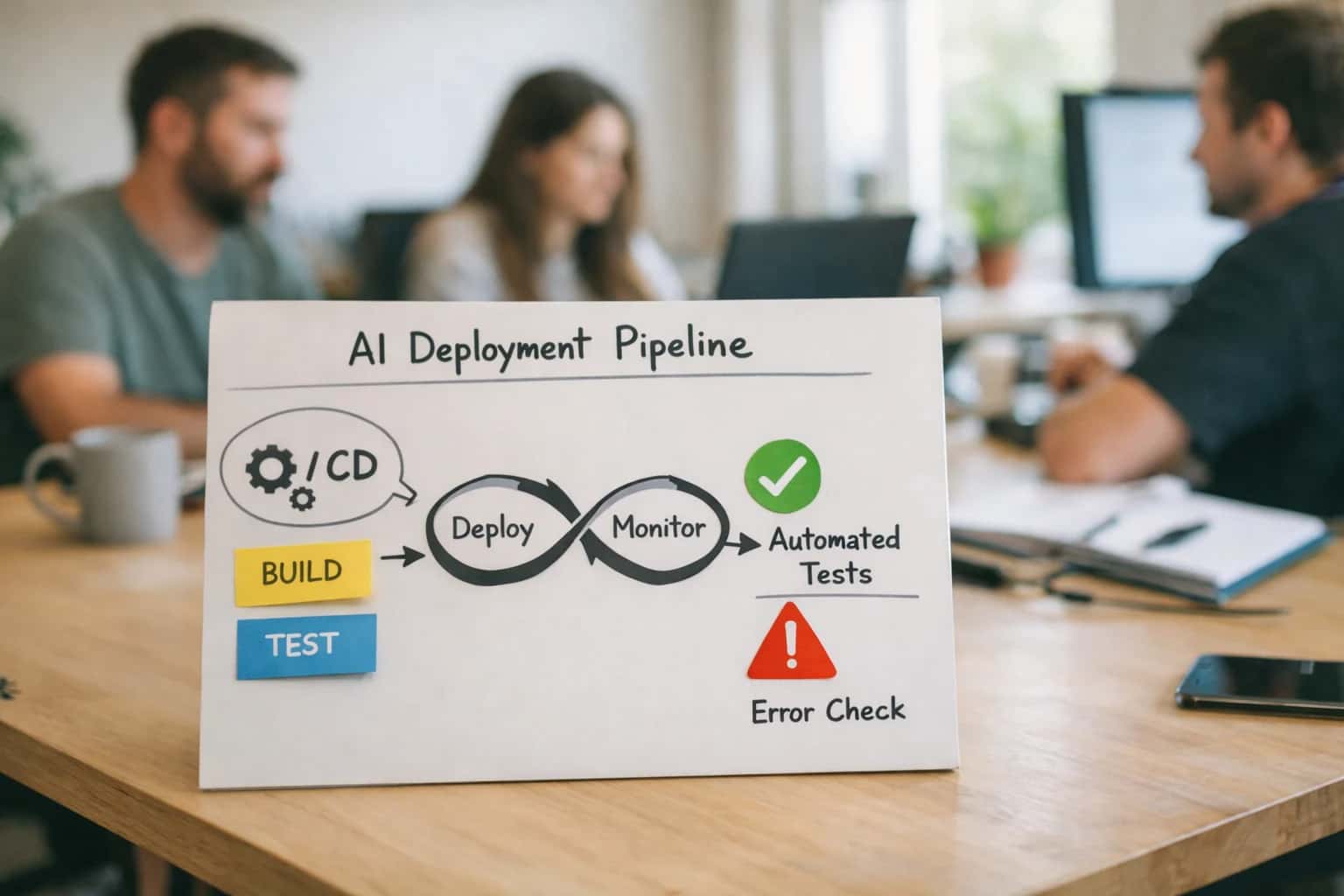
A validation gate is a predefined quality or performance checkpoint in a machine learning deployment pipeline that a model must pass before being promoted to the next stage.
MODEL LIFECYCLE MANAGEMENT
What is a Validation Gate?
A validation gate is a critical control point in the machine learning lifecycle that enforces quality standards before a model progresses.
Common validation criteria include surpassing a performance baseline, passing automated unit and integration tests, and receiving human sign-off for high-risk changes. Gates are strategically placed between environments, such as after training and before a canary deployment. This systematic enforcement prevents model regressions, manages risk, and is fundamental to achieving reproducibility and maintaining an auditable model lineage throughout the lifecycle.
MODEL LIFECYCLE MANAGEMENT
Key Characteristics of a Validation Gate
A validation gate is a formal, automated checkpoint in the MLOps pipeline that enforces predefined quality, performance, and compliance standards before a model can progress to the next lifecycle stage.
01
Automated and Objective
A validation gate is fundamentally an automated test suite, not a manual review. It executes a predefined set of checks against quantifiable metrics (e.g., accuracy, latency, fairness scores). This eliminates subjective human judgment, ensuring consistent, repeatable, and unbiased promotion decisions. The gate passes or fails based on whether the model meets or exceeds all configured thresholds.
- Example: A gate may require a challenger model's F1-score to be >0.92 and its 99th percentile inference latency to be <100ms before it can be promoted to a canary deployment.
02
Policy-Driven Governance
Each gate encodes and enforces organizational governance policies. These are codified rules that define what "production-ready" means for a specific use case. Policies can cover:
- Performance Standards: Minimum accuracy, precision, or recall.
- Operational Requirements: Maximum latency, throughput, or memory footprint.
- Compliance & Safety: Absence of toxic output, adherence to fairness thresholds (e.g., demographic parity), or checks for data privacy violations (e.g., PII leakage).
- Business Logic: Validation against key business metrics or guardrails specific to the domain.
03
Stage-Gated Progression
Validation gates are placed at specific transition points in the model lifecycle, creating a stage-gated process. A model must sequentially pass each gate to advance. Common gates include:
- Pre-Training: Validates data quality and schema before training begins.
- Post-Training: Evaluates model performance on a hold-out validation set.
- Pre-Staging: Checks integration, packaging, and basic serving health.
- Pre-Production (Promotion): The critical gate comparing a new challenger model against the current champion model, often using A/B test results or shadow deployment metrics.
- In-Production: Continuous gates that monitor for drift and trigger alerts or retraining.
04
Immutable and Auditable
Every execution of a validation gate creates an immutable audit record. This log captures:
- The exact model artifact and version being evaluated.
- The complete set of test inputs, metrics, and outputs.
- The final pass/fail decision and the specific thresholds used.
- Timestamp and contextual metadata (e.g., git commit hash, pipeline run ID).
This record is essential for reproducibility, compliance (e.g., for regulations like the EU AI Act), and root-cause analysis if a promoted model later fails. It answers the question, "Why was this model approved?"
05
Integrated with CI/CD for ML
Validation gates are the core decision nodes in a Machine Learning CI/CD pipeline. They are triggered automatically by events such as a new model commit, a scheduled retraining job, or performance drift alerts. The pipeline's workflow is determined by the gate's outcome:
- Pass: The pipeline proceeds to the next stage (e.g., deployment, traffic shifting).
- Fail: The pipeline is halted, and alerts are sent to the responsible team. The failing model artifact is typically archived with its failure report for analysis.
This integration enables continuous delivery of models, where only validated, high-quality candidates flow automatically toward production.
06
Context-Aware Evaluation
Effective gates evaluate a model within the context of its intended production environment and operational data. This goes beyond static test sets. Key techniques include:
- Shadow Mode Evaluation: Running the candidate model on a sample of live production traffic and comparing its outputs to the champion's, without affecting users.
- Data Drift Detection: Checking that the statistical properties of the current production inference data are similar to the model's training data.
- Canary/Beta Testing: Using the gate to control the release to a small, representative user segment and evaluating live business metrics.
This ensures the model is validated against real-world conditions, not just historical benchmarks.
MODEL LIFECYCLE MANAGEMENT
How Does a Validation Gate Work?
A validation gate is a critical control point in the machine learning deployment pipeline, enforcing quality and compliance before a model progresses.
A validation gate is a predefined checkpoint in a model deployment pipeline that a candidate model must pass to advance to the next stage, such as from staging to production. It enforces governance policies by automatically executing a suite of tests against performance baselines, model schemas, and safety thresholds. This creates a deterministic promotion process, preventing models with regressions or compliance failures from impacting users.
The gate's logic typically integrates with a model registry and MLOps pipeline to evaluate metrics like accuracy, latency, and drift detection scores. If a model fails, the pipeline halts, triggering alerts or routing the artifact for review. This automated approval workflow replaces manual checks, ensuring only models meeting strict SLA and regulatory requirements are deployed, which is foundational for continuous delivery for ML (ML CI/CD) and robust lifecycle orchestration.
COMPARISON
Common Types of Validation Gates
A comparison of validation gate types used to enforce quality and compliance at different stages of the model lifecycle.
| Gate Type | Pre-Deployment Gate | Post-Deployment Gate | Governance Gate |
|---|---|---|---|
Primary Objective | Ensure model meets performance & functional specs before release | Monitor model health & detect degradation in production | Enforce compliance, ethics, and policy adherence |
Triggering Event | Model promotion request, CI/CD pipeline stage completion | Scheduled interval, performance alert, drift detection | Policy update, audit request, regulatory change |
Key Metrics Evaluated | Accuracy/Precision/RecallInference latency < 500msBias/fairness scores below threshold | Prediction drift scoreData drift scoreService health (uptime, latency) | Explainability scoreAdversarial robustnessLicense & copyright compliance |
Automation Level | Fully Automated | Mostly Automated | Semi-Automated (requires human review) |
Typical Action on Failure | Block promotion, return to development | Trigger alert, initiate canary rollback, flag for retraining | Block deployment, require mitigation plan, escalate to governance board |
Common Tools/Frameworks | MLflow, Kubeflow Pipelines, unit test frameworks | Evidently AI, Arize, WhyLabs, Grafana dashboards | Model Cards, IBM AI Fairness 360, Google's What-If Tool |
Primary Stakeholders | ML Engineers, Data Scientists | MLOps Engineers, SREs | Compliance Officers, Legal, Ethics Board |
Integration Point | End of training/staging, before model registry promotion | Continuous in production, post-inference logging pipeline | Pre-deployment approval workflow, scheduled audit cycles |
VALIDATION GATE
Frequently Asked Questions
A validation gate is a critical control point in the machine learning lifecycle. These questions address its purpose, implementation, and role in enterprise MLOps.
A validation gate is a predefined quality or performance checkpoint that a machine learning model must pass before it can be promoted to the next stage of the deployment pipeline. It acts as an automated or manual decision point within an MLOps pipeline, enforcing governance policies and ensuring only models meeting specific criteria advance toward production. Gates are triggered after key lifecycle stages, such as training completion or shadow deployment, and evaluate metrics against a performance baseline. Failure at a gate halts promotion, triggering alerts for investigation, retraining, or model iteration, thereby preventing substandard models from impacting live systems.
Enabling Efficiency, Speed & Accuracy
Intelligent Analysis, Decision & Execution
We build AI systems for teams that need search across company data, workflow automation across tools, or AI features inside products and internal software.
Talk to Us
Search across company data
Give teams answers from docs, tickets, runbooks, and product data with sources and permissions.
Useful when people spend too long searching or get different answers from different systems.
Enterprise searchRAGPermissions
Read more
Automate internal workflows
Use AI to route work, draft outputs, trigger actions, and keep approvals and logs in place.
Useful when repetitive work moves across multiple tools and teams.
AI agentsWorkflow automationGovernance
Read more
Add AI to products and internal tools
Build assistants, guided actions, or decision support into the software your team or customers already use.
Useful when AI needs to be part of the product, not a separate tool.
AI integrationDecision supportModel routing
Read more
About the author
Prasad Kumkar
CEO & MD, Inference Systems
Prasad Kumkar is the CEO & MD of Inference Systems and writes about AI systems architecture, LLM infrastructure, model serving, evaluation, and production deployment. Over 5+ years, he has worked across computer vision models, L5 autonomous vehicle systems, and LLM research, with a focus on taking complex AI ideas into real-world engineering systems.
His work and writing cover AI systems, large language models, AI agents, multimodal systems, autonomous systems, inference optimization, RAG, evaluation, and production AI engineering.
LinkedIn
Limited slotsGet a Free AI Consultation
Partnered with leading AI, data, and software stack.





How We Work
Custom AI workflows for your Business
One-fit-all AI don't work for modern businesses. At Inferensys, we aim to understand your business & custom requirements; which we use to define most efficient agentic workflows, the data, and the tools for your business.
01
Review the use case
We understand the task, the users, and where AI can actually help.
Read more02
Pick the right approach
We define what needs search, automation, or product integration.
Read more03
Build the first useful version
We implement the part that proves the value first.
Read more04
Improve from there
We add the checks and visibility needed to keep it useful.
Read moreThe first call is a practical review of your use case and the right next step.
Talk to Us