Model deployment is the engineering process of operationalizing a trained and validated machine learning model, making its predictive function available via an API or embedded service within a live application. This involves model packaging, containerization, and integration with existing software infrastructure to handle inference requests at scale. The goal is to transition from a static artifact to a reliable, low-latency service that delivers business value. Key outputs include a serving endpoint, load balancers, and monitoring hooks.

Glossary
Model Deployment
Model deployment is the process of integrating a trained and validated machine learning model into a live production environment where it can serve predictions via an API to end-users or downstream systems.
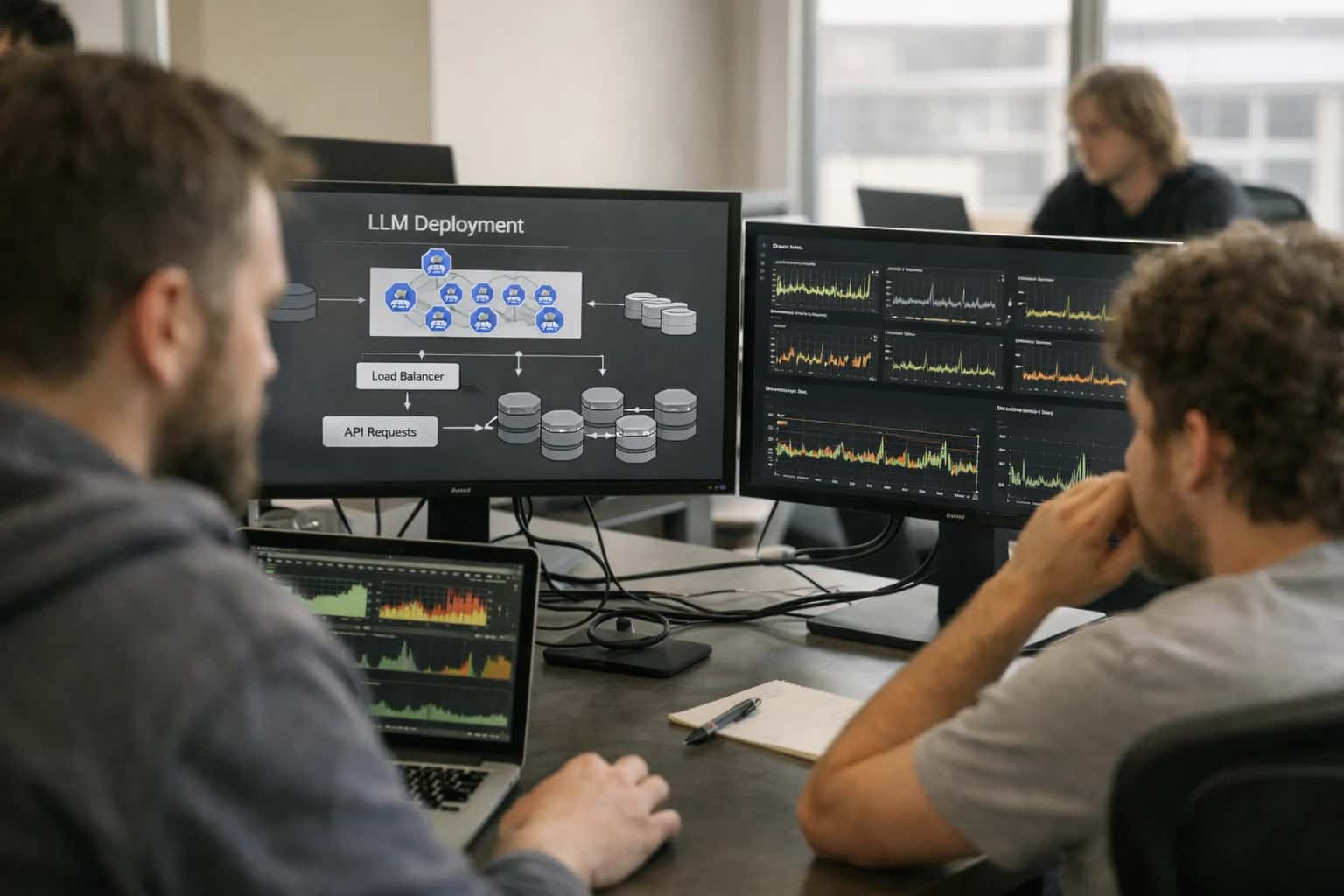
LLMOPS
What is Model Deployment?
Model deployment is the final, operational phase of the machine learning lifecycle where a validated model is integrated into a live production environment to serve real-time predictions.
Successful deployment requires rigorous MLOps practices to manage the model's lifecycle post-launch. This includes strategies like canary or blue-green deployments for safe rollouts, continuous performance monitoring for data drift and concept drift, and established rollback procedures. The process is governed by validation gates and approval workflows to ensure the model meets all operational, performance, and compliance standards before and during its service in production.
MODEL LIFECYCLE MANAGEMENT
Key Components of a Deployment Pipeline
A deployment pipeline automates the transition of a machine learning model from a development artifact to a live production service. It consists of sequential, automated stages that enforce quality, security, and operational readiness.
01
Model Packaging
The process of bundling a trained model artifact with its runtime dependencies, inference code, and configuration into a standardized, deployable unit. This creates an immutable artifact that ensures consistency across environments.
- Common formats: ONNX, TensorFlow SavedModel, PyTorch TorchScript, or container images (Docker).
- Includes: Model weights, preprocessing logic, a defined API schema, and environment specifications.
- Purpose: Decouples model development from infrastructure, enabling reliable, reproducible deployments.
02
Validation & Testing Gate
An automated checkpoint where the packaged model must pass a suite of tests before progressing. This is a core tenet of CI/CD for ML.
- Functional Tests: Verify the model loads and returns predictions in the expected format.
- Performance Tests: Benchmark inference latency and throughput against service-level agreements (SLAs).
- Fairness & Bias Checks: Evaluate predictions across protected subgroups for regulatory compliance.
- Adversarial Robustness: Test model resilience against crafted input attacks.
03
Serving Infrastructure
The low-latency, scalable system that hosts the packaged model and exposes it as an API for real-time inference or batch prediction. Key architectural patterns include:
- Model Server: Dedicated software (e.g., TensorFlow Serving, TorchServe, Triton Inference Server) optimized for GPU/CPU execution.
- Serverless Functions: Event-triggered, stateless execution for variable or sporadic traffic.
- Embedded Dedicated Endpoint: A standalone API service, often containerized, for a single model.
- Multi-Model Endpoint: A shared service that can load and serve multiple models dynamically to optimize resource use.
04
Traffic Orchestration & Rollout
The layer that manages how user requests are routed to model versions, enabling safe, controlled releases. This implements deployment strategies to mitigate risk.
- Canary Deployment: Route a small percentage of traffic (e.g., 5%) to the new model, monitoring for errors or performance drift.
- Shadow Deployment: Send a copy of live traffic to the new model (challenger) without affecting user responses, comparing outputs to the current model (champion).
- Blue-Green Deployment: Maintain two identical production environments; switch all traffic from the old (blue) to the new (green) model instantaneously.
- A/B Testing: Route traffic based on user segments to conduct statistically rigorous business metric comparisons.
05
Observability & Monitoring
The integrated system for tracking the operational health and predictive performance of the deployed model. This goes beyond standard application monitoring.
- Infrastructure Metrics: Compute utilization, memory, network I/O, and endpoint latency.
- Business Metrics: Track key performance indicators (KPIs) influenced by model predictions.
- Model-Specific Telemetry: Automated drift detection for data drift and concept drift, prediction distribution logging, and input/output sampling.
- Alerting: Configure alerts for SLA breaches, error rate spikes, or detected drift to trigger a retraining trigger or model rollback.
06
Governance & Lifecycle Control
The policy enforcement and management layer that provides auditability, compliance, and control over the model in production.
- Model Registry: The source of truth for versioned, approved model artifacts and their metadata.
- Approval Workflows: Mandatory human or automated sign-off at validation gates before production promotion.
- Audit Trail: Immutable logs of who deployed which model, when, and with what justification.
- Lifecycle Actions: Automated or manual triggers for model retirement, archival, or rollback based on policy rules.
DEFINITION
Model Deployment
Model deployment is the final, critical phase of the machine learning lifecycle where a validated model is integrated into a live production environment to serve real-time predictions.
Model deployment is the process of integrating a trained and validated machine learning model into a production environment where it can serve predictions via an API to end-users or downstream systems. This operationalization phase transitions the model from a static artifact to a live service, requiring robust infrastructure for serving, traffic management, and performance monitoring. The goal is to deliver reliable, low-latency inference while maintaining strict version control and rollback capabilities.
Successful deployment relies on MLOps practices like containerization and CI/CD pipelines to automate promotion from staging. Strategies such as canary or blue-green deployments mitigate risk by gradually exposing new model versions to traffic. Post-deployment, continuous drift detection and health checks are essential to ensure the model's predictions remain accurate and valuable as real-world data evolves, triggering retraining or rollback when necessary.
COMPARISON
Common Model Deployment Strategies
A technical comparison of core strategies for releasing machine learning models into production, detailing their operational characteristics, risk profiles, and typical use cases.
| Feature / Metric | Canary Deployment | Shadow Deployment | Blue-Green Deployment | A/B Testing |
|---|---|---|---|---|
Core Mechanism | Gradual traffic shift to new version | Parallel inference with no user impact | Instant traffic switch between identical environments | Split traffic for comparative performance measurement |
Primary Objective | Risk mitigation via phased rollout | Safe performance validation on live data | Zero-downtime updates and instant rollback | Statistical hypothesis testing of model impact |
User Exposure | Controlled subset (e.g., 1-5%) | 0% (predictions are logged only) | 100% (all traffic to one environment) | Split percentage (e.g., 50%/50%) |
Rollback Capability | Fast (revert traffic split) | Instant (stop logging) | Instant (switch traffic back) | Slow (requires re-routing traffic) |
Validation Data Source | Live user traffic & business metrics | Live user input data | Live user traffic & system health | Live user traffic & business outcomes |
Operational Overhead | Medium (requires traffic routing logic) | Low (additional compute for logging) | High (duplicate infrastructure cost) | High (requires experiment analysis platform) |
Typical Use Case | Initial production launch of a new model | Validating a complete model replacement | High-availability API serving with strict SLAs | Optimizing a business metric (e.g., conversion rate) |
Risk Level | Low | Very Low | Low | Medium |
MODEL DEPLOYMENT
Critical Challenges & Engineering Considerations
Transitioning a model from a research artifact to a reliable production service involves navigating a complex landscape of technical, operational, and business constraints. These core challenges define the discipline of MLOps.
02
Cost Management & Resource Efficiency
The compute cost of serving large models, especially LLMs, is a primary operational expense. Critical levers include:
- Autoscaling: Dynamically adjusts compute resources based on request traffic, crucial for handling spiky demand.
- Instance selection: Choosing optimal hardware (e.g., GPU type, memory size) for the specific model's requirements.
- Multi-tenancy: Safely serving multiple models or clients on shared hardware to improve resource utilization.
- Spot instance strategies: Using interruptible cloud instances for cost savings, requiring robust checkpointing and failover. Without careful management, inference costs can quickly exceed training costs.
03
Model & Data Drift Monitoring
A model's performance decays as production data evolves. Continuous monitoring is essential:
- Data Drift: Detects changes in the statistical distribution of input features (e.g., mean, variance) compared to training data. Tools like Evidently AI or Amazon SageMaker Model Monitor automate this.
- Concept Drift: Identifies when the relationship between inputs and the target variable changes, requiring model retraining.
- Performance Monitoring: Tracks business and accuracy metrics (e.g., precision, recall) directly, often the ultimate signal of drift. Unaddressed drift leads to silent model failure and degraded business outcomes.
04
Robust Serving & Fault Tolerance
Production models must be highly available and resilient. Key patterns include:
- Health checks & readiness probes: Ensure the serving container is alive and ready to accept requests before receiving traffic.
- Circuit breakers & retries: Prevent cascading failures by failing fast when downstream dependencies (e.g., feature stores) are unhealthy.
- Graceful degradation: Allows the system to provide a fallback response (e.g., a cached result or a simpler heuristic) if the primary model fails.
- Redundant deployments: Geographically distributed deployments with load balancing guard against regional outages. Engineering for failure is a core requirement, not an optimization.
05
Versioning & Safe Rollout Strategies
Safely introducing new model versions without disrupting service requires controlled deployment techniques:
- Shadow Deployment: The new model processes live requests in parallel, but its outputs are only logged for comparison, not returned to users.
- Canary Deployment: The new version is released to a small, representative subset of users/traffic to validate performance.
- A/B Testing: Traffic is split between the old (champion) and new (challenger) models to statistically compare business metrics.
- Blue-Green Deployment: Maintains two identical production environments; traffic is switched instantly from the old (blue) to the new (green) environment, enabling instant rollback. These strategies de-risk releases and provide empirical validation.
06
Security & Compliance Hardening
Deployed models are attack surfaces and must adhere to regulatory standards. Critical areas are:
- Adversarial Robustness: Protecting against malicious inputs designed to fool the model (adversarial examples) or extract training data (model inversion).
- Input/Output Validation & Sanitization: Scrutinizing all inputs for injection attacks (e.g., prompt injection for LLMs) and filtering outputs for sensitive data leakage.
- Access Control & Authentication: Ensuring only authorized services and users can call the model endpoint, typically via API keys or service meshes.
- Audit Logging: Recording all inference requests and responses for compliance (e.g., GDPR, EU AI Act) and forensic analysis. Neglecting security transforms a model into a liability.
MODEL DEPLOYMENT
Frequently Asked Questions
Essential questions and answers on the process of integrating trained machine learning models into production environments to serve predictions.
Model deployment is the process of integrating a trained and validated machine learning model into a production environment where it can serve predictions to end-users or downstream systems via an API. It is critical because it represents the transition from a theoretical artifact to a live business asset that generates value. Without robust deployment, models remain trapped in research notebooks, unable to impact real-world decisions or operations. The deployment phase introduces unique challenges not present during training, including managing latency, ensuring scalability, maintaining availability, and guaranteeing security and reproducibility under variable load. A successful deployment bridges the gap between data science experimentation and reliable software engineering, requiring collaboration between ML engineers, DevOps, and platform teams to operationalize the model's intelligence.
Enabling Efficiency, Speed & Accuracy
Intelligent Analysis, Decision & Execution
We build AI systems for teams that need search across company data, workflow automation across tools, or AI features inside products and internal software.
Talk to Us
Search across company data
Give teams answers from docs, tickets, runbooks, and product data with sources and permissions.
Useful when people spend too long searching or get different answers from different systems.
Enterprise searchRAGPermissions
Read more
Automate internal workflows
Use AI to route work, draft outputs, trigger actions, and keep approvals and logs in place.
Useful when repetitive work moves across multiple tools and teams.
AI agentsWorkflow automationGovernance
Read more
Add AI to products and internal tools
Build assistants, guided actions, or decision support into the software your team or customers already use.
Useful when AI needs to be part of the product, not a separate tool.
AI integrationDecision supportModel routing
Read more
About the author
Prasad Kumkar
CEO & MD, Inference Systems
Prasad Kumkar is the CEO & MD of Inference Systems and writes about AI systems architecture, LLM infrastructure, model serving, evaluation, and production deployment. Over 5+ years, he has worked across computer vision models, L5 autonomous vehicle systems, and LLM research, with a focus on taking complex AI ideas into real-world engineering systems.
His work and writing cover AI systems, large language models, AI agents, multimodal systems, autonomous systems, inference optimization, RAG, evaluation, and production AI engineering.
LinkedIn
Limited slotsGet a Free AI Consultation
Partnered with leading AI, data, and software stack.





How We Work
Custom AI workflows for your Business
One-fit-all AI don't work for modern businesses. At Inferensys, we aim to understand your business & custom requirements; which we use to define most efficient agentic workflows, the data, and the tools for your business.
01
Review the use case
We understand the task, the users, and where AI can actually help.
Read more02
Pick the right approach
We define what needs search, automation, or product integration.
Read more03
Build the first useful version
We implement the part that proves the value first.
Read more04
Improve from there
We add the checks and visibility needed to keep it useful.
Read moreThe first call is a practical review of your use case and the right next step.
Talk to Us