Environment parity is the principle of maintaining identical software, library dependencies, configurations, and infrastructure across all stages of the machine learning lifecycle—typically development, staging, and production. This strict consistency eliminates the "it works on my machine" problem by ensuring that code and models behave predictably when promoted, guaranteeing that a model validated in staging will perform identically in production. The goal is to create a deterministic, reproducible pathway for model deployment, where the only variable is the data or traffic, not the underlying system environment.

Glossary
Environment Parity
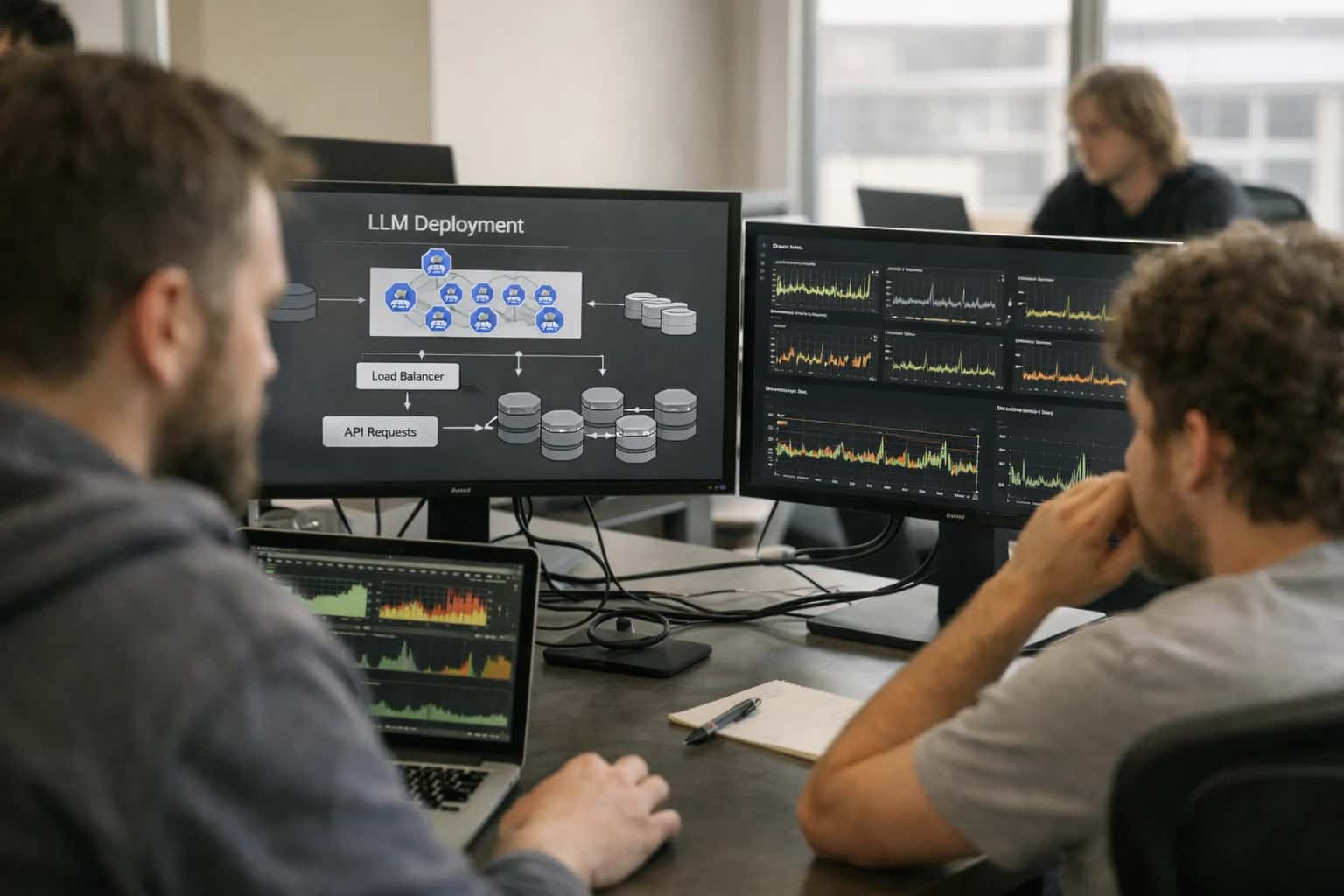
Environment parity is the principle of maintaining identical software, libraries, and configurations across development, staging, and production environments to ensure machine learning model reproducibility and reliable deployment.
MLOPS PRINCIPLE
What is Environment Parity?
Environment parity is a foundational engineering discipline in machine learning operations (MLOps) and software development.
Achieving parity requires infrastructure as code (IaC) tools like Terraform, containerization with Docker, and dependency management via pinned versioning in files like requirements.txt or environment.yml. In MLOps, this extends to consistent access to feature stores, model registries, and monitoring backends. Without environment parity, teams risk deployment failures, subtle performance degradation, and debugging nightmares, as discrepancies in library versions or system resources can cause silent errors. It is a prerequisite for reliable continuous integration and delivery (CI/CD) pipelines and effective model lifecycle management.
MODEL LIFECYCLE MANAGEMENT
Key Components of Environment Parity
Environment parity ensures that a model's behavior is consistent and predictable as it moves from development to production. This principle is critical for reproducibility, debugging, and reliable deployment.
01
Software & Library Consistency
Maintaining identical versions of all software dependencies across environments. This includes:
- Programming language runtime (e.g., Python 3.11.4)
- Machine learning frameworks (e.g., PyTorch 2.1.0, TensorFlow 2.15.0)
- Utility libraries (e.g., NumPy, pandas, scikit-learn)
- Model-serving libraries (e.g., vLLM, TensorRT-LLM, Hugging Face
transformers)
Version mismatches are a primary cause of the "it works on my machine" problem, leading to silent numerical errors or runtime failures in production.
02
System Configuration & Hardware
Aligning the underlying system environment and compute specifications. Key elements include:
- Operating System and kernel version
- System libraries (e.g., CUDA drivers for GPU acceleration, BLAS libraries)
- Hardware accelerators (GPU type, memory) or their emulated equivalents
- Resource limits (CPU cores, memory allocation, disk I/O)
Disparities here can cause drastic performance differences or failures, especially for compute-intensive LLM inference.
03
Data & Feature Pipeline Parity
Ensuring the preprocessing and feature engineering logic applied to data is identical at all stages. This involves:
- Identical preprocessing code for tokenization, normalization, or embedding generation
- Consistent feature stores or data versioning (e.g., using DVC or LakeFS)
- Same reference data for encoders, vocabularies, and vectorizers
A drift in feature calculation between training and inference is a common source of model performance degradation.
04
Model Artifact Immutability
Using the exact same, versioned model artifact across all environments after validation. This principle relies on:
- A model registry to store and serve immutable artifacts
- Deterministic serialization formats (e.g., SafeTensors, ONNX)
- Hash-based verification to guarantee byte-for-byte identity
Promoting a validated, immutable artifact prevents accidental modification or corruption during deployment.
05
Secrets & External Service Configuration
Managing environment-specific variables and external dependencies securely and consistently. This includes:
- API keys and credentials for external model APIs, vector databases, or tools
- Service endpoints and connection strings
- Configuration flags that toggle behavior (e.g., debug logging, dry-run modes)
Using a secrets management system and environment-specific config files prevents production systems from accidentally using development resources.
06
Orchestration & Deployment Parity
Applying the same deployment patterns and orchestration logic. Critical practices are:
- Infrastructure as Code (IaC) using Terraform or Pulumi to define identical environments
- Containerization (Docker) to bundle the model, code, and OS dependencies
- Orchestrator parity (e.g., Kubernetes manifests, Docker Compose files) for local testing vs. production clusters
This ensures the deployment topology and networking are consistent, eliminating environment-specific integration bugs.
IMPLEMENTATION
How is Environment Parity Implemented?
Environment parity is achieved through a combination of infrastructure-as-code, containerization, and rigorous dependency management to enforce consistency across the software development lifecycle.
Implementation begins with infrastructure-as-code (IaC) tools like Terraform or Pulumi, which programmatically define and provision identical compute, networking, and storage resources for each environment. This is paired with containerization using Docker, which packages the application, its language runtime, system libraries, and all dependencies into a single, immutable artifact that runs identically anywhere. A container registry then serves as the single source of truth for these approved images.
Dependency management is enforced using lock files (e.g., requirements.txt, poetry.lock, package-lock.json) to pin exact versions of all libraries. Configuration management separates environment-specific settings (like API endpoints) from the codebase, injecting them at runtime via environment variables or secure vaults. Finally, a CI/CD pipeline automates the promotion of the same container image and configuration through staged environments, preventing manual "works on my machine" inconsistencies.
COMPARISON
Environment Parity vs. Related Concepts
A comparison of Environment Parity with other key concepts in the Model Lifecycle Management domain, highlighting their distinct scopes and primary objectives.
| Concept | Environment Parity | Reproducibility | Containerization | CI/CD for ML |
|---|---|---|---|---|
Primary Goal | Ensure consistency across dev, staging, and prod environments | Recreate an exact model artifact and its performance metrics | Package code and dependencies for consistent execution | Automate testing and deployment of ML systems |
Core Scope | Software, libraries, configurations, and external service dependencies | Code, data, hyperparameters, and computational environment | Runtime environment, system libraries, and application code | Build, test, and release pipelines for ML artifacts |
Key Mechanism | Infrastructure-as-Code, configuration management, service mocking | Version control for code/data, dependency pinning, experiment tracking | Docker/OCI images, container orchestration (e.g., Kubernetes) | Automated triggers, pipeline stages, validation gates |
Addresses Deployment Risk | ||||
Ensures Training Consistency | ||||
Foundation for Reliable Promotion | ||||
Typical Tools | Terraform, Ansible, Docker Compose, service virtualization | MLflow, DVC, Weights & Biases, Conda/Pipenv | Docker, Podman, Kubernetes, Amazon ECS | Jenkins, GitHub Actions, GitLab CI, Kubeflow Pipelines |
ENVIRONMENT PARITY
Frequently Asked Questions
Essential questions about maintaining consistency across development, staging, and production environments to ensure reliable, reproducible machine learning systems.
Environment parity is the engineering principle of maintaining identical or near-identical software, libraries, configurations, and infrastructure across development, staging, and production environments. Its primary goal is to eliminate the "it works on my machine" problem by ensuring that a model's behavior is reproducible and predictable when promoted through the deployment pipeline. This involves strict version control for dependencies (e.g., Python, CUDA, PyTorch/TensorFlow), consistent operating system kernels, matching hardware accelerators (or emulated behavior), and identical access to data sources and external services. In MLOps, parity extends to the machine learning pipeline itself, ensuring training, validation, and inference code paths are consistent. A breach in parity is a primary cause of model decay and performance drift when moving from a development setting to a live system.
Enabling Efficiency, Speed & Accuracy
Intelligent Analysis, Decision & Execution
We build AI systems for teams that need search across company data, workflow automation across tools, or AI features inside products and internal software.
Talk to Us
Search across company data
Give teams answers from docs, tickets, runbooks, and product data with sources and permissions.
Useful when people spend too long searching or get different answers from different systems.
Enterprise searchRAGPermissions
Read more
Automate internal workflows
Use AI to route work, draft outputs, trigger actions, and keep approvals and logs in place.
Useful when repetitive work moves across multiple tools and teams.
AI agentsWorkflow automationGovernance
Read more
Add AI to products and internal tools
Build assistants, guided actions, or decision support into the software your team or customers already use.
Useful when AI needs to be part of the product, not a separate tool.
AI integrationDecision supportModel routing
Read more
About the author
Prasad Kumkar
CEO & MD, Inference Systems
Prasad Kumkar is the CEO & MD of Inference Systems and writes about AI systems architecture, LLM infrastructure, model serving, evaluation, and production deployment. Over 5+ years, he has worked across computer vision models, L5 autonomous vehicle systems, and LLM research, with a focus on taking complex AI ideas into real-world engineering systems.
His work and writing cover AI systems, large language models, AI agents, multimodal systems, autonomous systems, inference optimization, RAG, evaluation, and production AI engineering.
LinkedIn
Limited slotsGet a Free AI Consultation
Partnered with leading AI, data, and software stack.





How We Work
Custom AI workflows for your Business
One-fit-all AI don't work for modern businesses. At Inferensys, we aim to understand your business & custom requirements; which we use to define most efficient agentic workflows, the data, and the tools for your business.
01
Review the use case
We understand the task, the users, and where AI can actually help.
Read more02
Pick the right approach
We define what needs search, automation, or product integration.
Read more03
Build the first useful version
We implement the part that proves the value first.
Read more04
Improve from there
We add the checks and visibility needed to keep it useful.
Read moreThe first call is a practical review of your use case and the right next step.
Talk to Us