Blue-green deployment is a release management strategy that maintains two identical, fully provisioned production environments—labeled 'blue' and 'green'—where only one environment actively serves live user traffic at any time. This approach enables zero-downtime deployments and instant rollback by switching all incoming traffic from the live environment (e.g., blue) to the idle one (green) after the new version is deployed and validated. It is a foundational pattern in continuous delivery and MLOps for managing model updates.

Glossary
Blue-Green Deployment
A deployment strategy that maintains two identical production environments (blue and green), allowing for instant rollback by switching traffic between them.
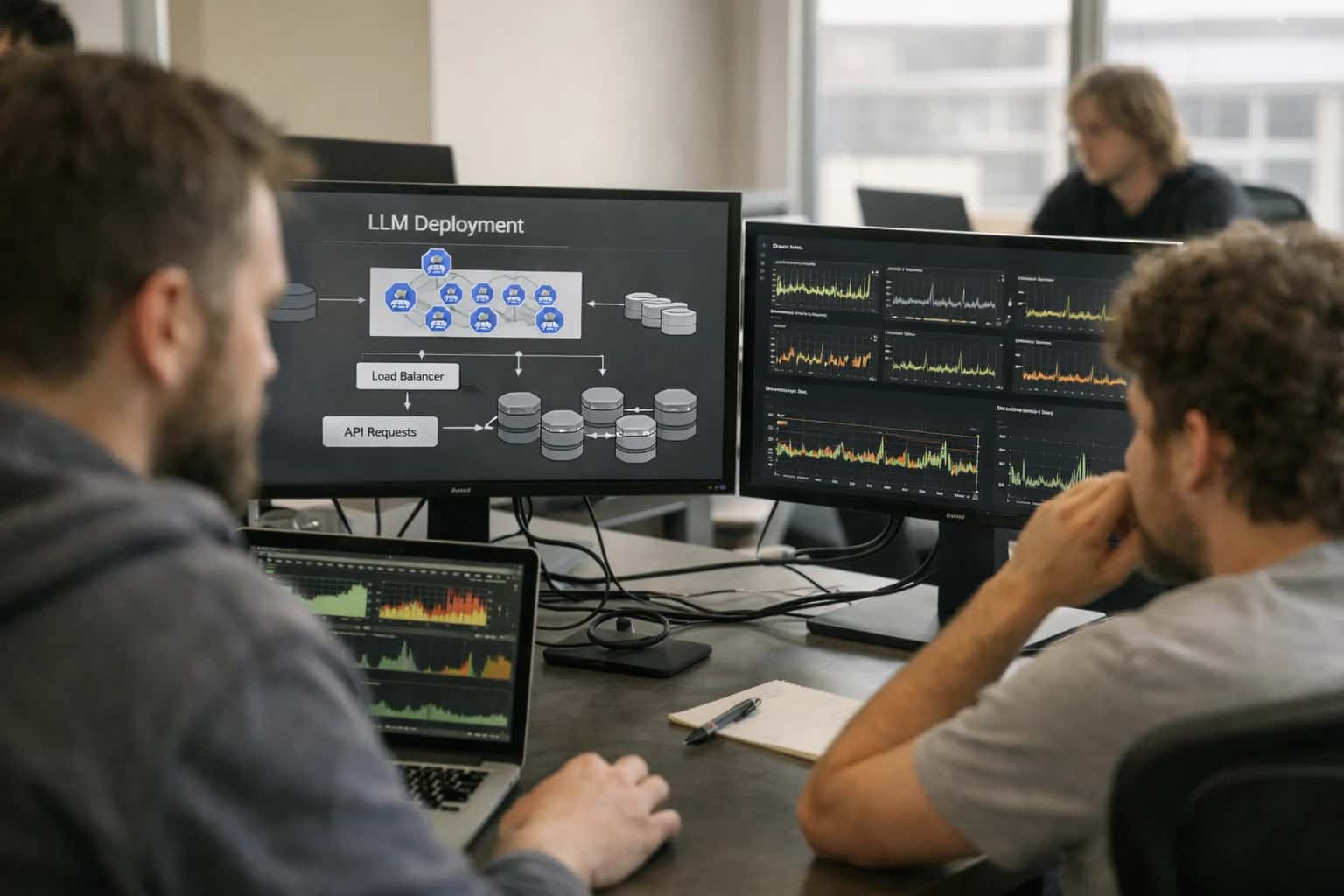
MODEL LIFECYCLE MANAGEMENT
What is Blue-Green Deployment?
A robust deployment strategy for minimizing downtime and risk during software or model updates.
The core mechanism involves deploying the new application or model version to the idle environment, running comprehensive health checks and integration tests, and then rerouting production traffic using a load balancer or router. If the new version fails, traffic is instantly switched back to the stable environment. This strategy eliminates the risk associated with in-place updates and is often combined with canary deployments for gradual traffic shifting. It requires careful management of data schema migrations and backward compatibility to ensure seamless transitions.
MODEL LIFECYCLE MANAGEMENT
Key Characteristics of Blue-Green Deployment
Blue-Green Deployment is a release management strategy that maintains two identical, isolated production environments to enable zero-downtime updates and instant rollback. This approach is critical for managing high-stakes LLM deployments where model quality and service availability are paramount.
01
Zero-Downtime Updates
The core benefit of blue-green deployment is the elimination of service interruption during releases. The active environment (e.g., Green) serves all live traffic while the new version is deployed and fully tested in the idle environment (Blue). Once validated, a router or load balancer switches all traffic from Green to Blue in a single atomic operation. This is essential for LLM APIs that must maintain 99.9%+ availability for enterprise applications, preventing user-facing errors during model updates.
02
Instant Rollback Capability
If the new model version in the Blue environment exhibits performance degradation, increased latency, or hallucinations, operators can instantly revert by switching traffic back to the stable Green environment. This rollback is a simple router configuration change, often taking < 1 second, compared to complex and time-consuming rollback procedures in traditional deployments. It provides a critical safety net for deploying unpredictable LLMs, allowing rapid response to production issues without impacting users.
03
Traffic Routing & Load Balancer Integration
Implementation relies on an external traffic router—typically a load balancer (e.g., AWS ALB, NGINX) or a service mesh (e.g., Istio). This router is the single point of control that directs 100% of user requests to the active environment. The switch is a metadata change (e.g., updating a target group) rather than a code deployment. For LLMs, this allows for seamless transitions between model versions with different computational footprints or hardware requirements.
04
Identical, Isolated Environments
The Blue and Green environments must be fully independent duplicates. This includes:
- Identical Infrastructure: Same compute instance types, GPU configurations, and auto-scaling policies.
- Separate Data & State: Dedicated databases, vector stores, or caches to prevent cross-environment contamination. For stateful LLM sessions, careful session migration or sticky routing is required.
- Parity in Configuration: Matching environment variables, model weights, and dependent service endpoints. This isolation ensures a failed deployment in one environment cannot cascade to the other.
05
Post-Switch Validation & Cleanup
After traffic is cut over to the new environment, a critical phase begins:
- Smoke Testing: Automated health checks verify the new environment is serving correct predictions under load.
- Performance Monitoring: Key metrics like latency (P99), token throughput, and error rates are closely watched for anomalies.
- Old Environment Decommissioning: The previous active environment is kept idle for a predefined period as a hot standby for rollback. It is then terminated or recycled for the next deployment cycle, managing cloud infrastructure costs.
06
Contrast with Canary & Shadow Deployments
Blue-Green is often compared to other progressive delivery strategies:
- vs. Canary Deployment: Canary releases a new version to a small percentage of users (e.g., 5%) to gather real-world performance data before a full rollout. Blue-Green is an all-or-nothing switch. Canary is better for gradual validation; Blue-Green is better for atomic, immediate changes.
- vs. Shadow Deployment: In a shadow deployment, the new model processes live traffic in parallel but its outputs are discarded or logged, not served to users. Blue-Green's new environment is idle until the switch. Shadow is for safe performance testing; Blue-Green is for release and rollback.
TRAFFIC AND DEPLOYMENT STRATEGIES
How Blue-Green Deployment Works for Machine Learning Models
Blue-green deployment is a release management strategy that minimizes downtime and risk by maintaining two identical production environments, enabling instant rollback.
Blue-green deployment is a release strategy that maintains two identical production environments, designated blue (active) and green (idle). A new model version is deployed to the idle environment and validated. Once verified, a router or load balancer switches all user traffic from the blue environment to the green environment in an atomic operation. This switch makes the new model the active champion and the old version the idle challenger, enabling instant rollback by simply switching traffic back.
This strategy provides a clean rollback mechanism, essential for mitigating performance regression or failures in new model versions. It is a core pattern in MLOps for achieving zero-downtime releases and is often combined with canary deployments for gradual traffic shifts. The approach requires infrastructure for managing two environments and precise traffic routing, ensuring environment parity to guarantee consistent model behavior.
COMPARISON
Blue-Green vs. Other Deployment Strategies
A feature-by-feature comparison of Blue-Green Deployment against other common strategies for releasing machine learning models and software updates.
| Feature / Metric | Blue-Green Deployment | Canary Deployment | Shadow Deployment | Rolling Update |
|---|---|---|---|---|
Core Mechanism | Two identical, full-scale environments (Blue & Green). Instant traffic switch. | Gradual traffic shift to new version across a single environment. | New version processes traffic in parallel but outputs are not served. | In-place, incremental replacement of instances in a single environment. |
Rollback Speed | < 1 sec | Minutes to hours | Instant (no user-facing change required) | Minutes to hours |
Infrastructure Cost | High (2x full environment capacity) | Low (incremental capacity) | High (2x compute for inference) | Low (incremental capacity) |
Risk Exposure During Rollout | Zero (old environment remains untouched) | Controlled (small initial user group) | Zero (users unaffected) | Medium (partial instability possible) |
Traffic Control Granularity | All-or-nothing switch | Fine-grained (by %, user segment, etc.) | 100% of traffic can be shadowed | Coarse (instance-level) |
Performance Validation | Before switch via testing on Green | During rollout via live user metrics | During parallel run via logged predictions | During update via health checks |
Best For | Major version updates, zero-downtime mandates, instant rollback needs | Low-risk validation of new features, performance testing with real users | Testing model accuracy/behavior with live data without risk | Stateless applications, frequent minor patches, resource-constrained environments |
Stateful Data Handling Complexity | High (requires data synchronization or replay) | Medium (shared data store) | High (requires dual-write or log capture) | Low (shared data store) |
BLUE-GREEN DEPLOYMENT
Frequently Asked Questions
A deployment strategy that maintains two identical production environments (blue and green), allowing for instant rollback by switching traffic between them. This glossary answers common technical questions about its implementation and role in LLM lifecycle management.
Blue-green deployment is a release management strategy that maintains two identical, fully provisioned production environments—labeled 'blue' and 'green'—where only one environment serves live user traffic at any given time. The process works by deploying and fully validating a new application or model version (e.g., an updated LLM) into the idle environment. Once validated, a router or load balancer switches all incoming traffic from the live environment to the newly updated one. This switch is typically instantaneous, enabling zero-downtime deployments and providing a simple, fast rollback mechanism by switching traffic back to the previous environment if issues are detected.
In the context of Model Lifecycle Management, this strategy is critical for deploying new LLM versions, prompt ensembles, or fine-tuned models without disrupting service. The idle environment serves as a perfect staging ground for final health checks, performance baseline validation, and shadow deployment analysis before the cutover.
Enabling Efficiency, Speed & Accuracy
Intelligent Analysis, Decision & Execution
We build AI systems for teams that need search across company data, workflow automation across tools, or AI features inside products and internal software.
Talk to Us
Search across company data
Give teams answers from docs, tickets, runbooks, and product data with sources and permissions.
Useful when people spend too long searching or get different answers from different systems.
Enterprise searchRAGPermissions
Read more
Automate internal workflows
Use AI to route work, draft outputs, trigger actions, and keep approvals and logs in place.
Useful when repetitive work moves across multiple tools and teams.
AI agentsWorkflow automationGovernance
Read more
Add AI to products and internal tools
Build assistants, guided actions, or decision support into the software your team or customers already use.
Useful when AI needs to be part of the product, not a separate tool.
AI integrationDecision supportModel routing
Read more
About the author
Prasad Kumkar
CEO & MD, Inference Systems
Prasad Kumkar is the CEO & MD of Inference Systems and writes about AI systems architecture, LLM infrastructure, model serving, evaluation, and production deployment. Over 5+ years, he has worked across computer vision models, L5 autonomous vehicle systems, and LLM research, with a focus on taking complex AI ideas into real-world engineering systems.
His work and writing cover AI systems, large language models, AI agents, multimodal systems, autonomous systems, inference optimization, RAG, evaluation, and production AI engineering.
LinkedIn
Limited slotsGet a Free AI Consultation
Partnered with leading AI, data, and software stack.





How We Work
Custom AI workflows for your Business
One-fit-all AI don't work for modern businesses. At Inferensys, we aim to understand your business & custom requirements; which we use to define most efficient agentic workflows, the data, and the tools for your business.
01
Review the use case
We understand the task, the users, and where AI can actually help.
Read more02
Pick the right approach
We define what needs search, automation, or product integration.
Read more03
Build the first useful version
We implement the part that proves the value first.
Read more04
Improve from there
We add the checks and visibility needed to keep it useful.
Read moreThe first call is a practical review of your use case and the right next step.
Talk to Us