Shadow deployment is a software release strategy where a new version of a model or service processes live production requests in parallel with the stable primary version, but its outputs are discarded and never returned to end-users. This technique, also known as dark launching or shadow traffic, allows teams to compare the performance, correctness, and stability of the new candidate against the incumbent under identical real-world load with absolutely no user impact. It is a critical practice for LLM performance monitoring and model lifecycle management, providing empirical validation before any user-facing change.

Glossary
Shadow Deployment
A testing strategy where a new LLM version processes live production requests in parallel with the primary version, but its outputs are not returned to users, enabling zero-risk performance comparison.
LLM PERFORMANCE MONITORING
What is Shadow Deployment?
A zero-risk testing strategy for validating new model versions against live production traffic.
In an LLM context, the shadow model receives a copy of each incoming user request. It performs a full inference cycle, generating outputs that are logged and compared to the primary model's responses using predefined evaluation metrics. This enables the detection of output drift, latency regressions, or functional errors. The data collected is essential for validating Service Level Objectives (SLOs) and conducting a root cause analysis of any discrepancies. This strategy is often a precursor to a canary deployment, where the new version begins serving a small percentage of live traffic.
LLM PERFORMANCE MONITORING
Key Characteristics of Shadow Deployment
Shadow deployment is a zero-risk testing strategy where a new model version processes live traffic in parallel with the production model, but its outputs are not served to users. This enables direct, apples-to-apples performance comparison.
01
Zero User Impact
The defining feature of a shadow deployment is that live production traffic is duplicated and sent to the new (shadow) model, but its generated outputs are discarded or logged for analysis only. End-users continue to receive responses from the stable primary model, ensuring no degradation in user experience during testing. This makes it the safest method for evaluating high-risk changes, such as a new model architecture or a major fine-tuned version.
02
Direct A/B Comparison
By processing identical input requests, shadow deployments enable a statistically rigorous comparison between the incumbent and candidate models. Key metrics for comparison include:
- Performance: Latency (TTFT, inter-token latency), throughput (Tokens Per Second), and resource utilization.
- Quality: Output correctness, adherence to format, factual accuracy, and scores from evaluation frameworks.
- Cost: Comparative inference cost per request based on hardware efficiency. This data is critical for a go/no-go decision on a full rollout.
03
Real-World Data Fidelity
Unlike testing with a static golden dataset, shadow deployment uses actual, real-time user requests. This exposes the candidate model to the full, uncurated distribution of production inputs, including:
- Edge cases and long-tail queries.
- Evolving user behavior and new topics (concept drift).
- Live data formats and context from upstream systems. Testing with synthetic or historical data can miss these nuances, making shadow deployment essential for validating model robustness.
04
Infrastructure and Observability Overhead
Implementing shadow deployment requires significant engineering investment:
- Traffic Duplication: A mechanism to clone incoming requests without adding latency to the primary path.
- Dual Inference Pipelines: Separate, load-balanced endpoints for the primary and shadow models, often with independent scaling.
- Comprehensive Telemetry: A unified observability stack (e.g., OpenTelemetry, Prometheus) to collect, correlate, and visualize metrics and traces from both model versions. This overhead is justified for major model changes but may be excessive for minor prompt updates.
05
Contrast with Canary Deployment
Shadow and canary deployment are complementary but distinct strategies.
| Characteristic | Shadow Deployment | Canary Deployment |
|---|---|---|
| User Exposure | Zero users see shadow outputs. | A small percentage of users see the new version. |
| Primary Goal | Gather performance/quality data with zero risk. | Validate stability and user acceptance with limited risk. |
| Typical Use Case | Testing a fundamentally new model. | Rolling out a validated, vetted update. |
A common practice is to use shadow deployment first for validation, followed by a canary deployment for a controlled rollout.
06
Detection of Latent Issues
Beyond measuring average performance, shadow deployments are excellent for uncovering tail-latency issues and intermittent failures that only manifest under specific, hard-to-predict conditions. By running in parallel for an extended period (hours or days), the system can:
- Identify memory leaks or GPU out-of-memory errors under sustained load.
- Detect rare but severe hallucinations or safety filter failures on niche queries.
- Establish a performance baseline for key latency percentiles (P99) under real traffic patterns, which is more accurate than load testing.
LLM PERFORMANCE MONITORING
How Shadow Deployment Works
Shadow deployment is a zero-risk testing strategy for evaluating new LLM versions against live production traffic.
Shadow deployment is a release strategy where a new version of an LLM model processes incoming production requests in parallel with the stable primary version, but its outputs are discarded and not returned to end-users. This technique allows for direct, apples-to-apples comparison of latency, throughput, and output quality (e.g., against a golden dataset) under real-world load with absolutely no user impact. It is a critical tool for performance monitoring and regression detection before a canary deployment.
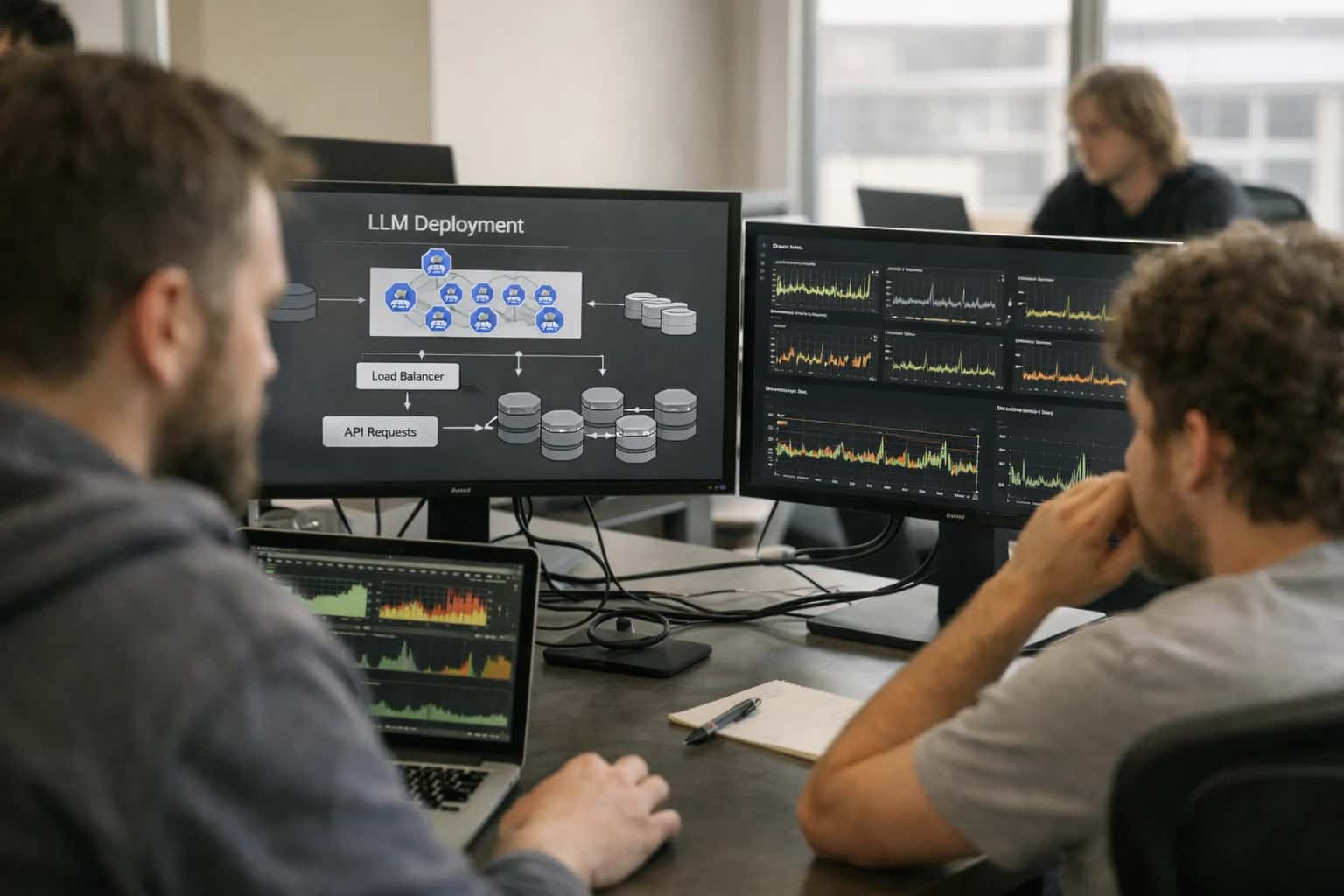
The architecture typically involves a router that duplicates each live request, sending one copy to the primary model and another to the shadow model. Telemetry from both inference paths—including Time to First Token (TTFT), Tokens per Second (TPS), and output embeddings—is collected for analysis using distributed tracing and observability platforms like Prometheus and Grafana. This data is used to validate Service Level Objective (SLO) compliance and detect output drift or concept drift prior to any user-facing change.
LLM PERFORMANCE MONITORING
Common Use Cases for Shadow Deployment
Shadow deployment is a zero-risk validation strategy. These are the primary scenarios where it provides critical insights before exposing users to a new model.
01
Performance Benchmarking
Measures the latency and throughput of a new model version against the incumbent using identical live traffic. This provides a realistic performance profile under true production load.
- Key Metrics: Time to First Token (TTFT), Inter-Token Latency, Tokens per Second (TPS), GPU utilization.
- Goal: Quantify the infrastructure impact and user experience implications of a new model before it serves any real requests.
02
Output Quality & Drift Detection
Compares the textual outputs and embedding distributions of two models in parallel to detect regressions or improvements.
- Output Drift: Statistical analysis of differences in response length, tone, or structure.
- Concept Drift: Monitoring for shifts in the model's "understanding" of inputs over time.
- Golden Dataset Validation: Running shadow traffic against a curated set of known-good examples to catch subtle quality degradations not visible in offline tests.
03
Hallucination & Safety Evaluation
Assesses the factual accuracy and safety of a new model's generations without user risk. This is critical for updates to Retrieval-Augmented Generation (RAG) systems or fine-tuned models.
- Grounding Check: Verifies that outputs are faithful to provided source context.
- Safety Filter Tuning: Tests new content moderation classifiers or filters in parallel to measure false positive/negative rates.
- Example: A new model version might be more creative but also more prone to hallucination; shadow deployment quantifies this trade-off.
04
Infrastructure & Cost Validation
Validates the operational stability and resource consumption of the new model's serving stack under real-world conditions.
- Scaling Requirements: Identifies the necessary compute, memory (including KV Cache usage), and networking resources.
- Cost Projection: Provides data to accurately forecast the inference cost per request for the new version.
- Failure Testing: Observes how the new serving infrastructure handles edge-case traffic patterns and errors.
05
Prompt & Configuration Testing
Tests new prompt architectures, system instructions, or inference parameters (like temperature) with live user queries.
- A/B Testing Prompts: Evaluates which prompt version yields more accurate or useful outputs without exposing users to suboptimal versions.
- Parameter Optimization: Finds the optimal balance between creativity and determinism for a specific use case.
- Context Window Utilization: Tests the effectiveness of providing more or fewer few-shot examples in the prompt.
06
Precursor to Canary Deployment
Serves as the essential first phase in a staged rollout strategy, preceding a canary deployment.
- Workflow: 1. Shadow Deployment (0% traffic, 100% observation). 2. Canary Deployment (1-5% traffic, with user feedback). 3. Full rollout.
- Advantage: Eliminates the risk of the canary group experiencing a catastrophic failure by catching major issues in the shadow phase.
- Decision Gate: The data from shadow deployment provides the go/no-go signal for advancing to a canary release.
LLM TRAFFIC MANAGEMENT
Shadow Deployment vs. Other Release Strategies
A comparison of strategies for releasing new LLM models into production, focusing on risk mitigation, user impact, and validation capabilities.
| Feature / Metric | Shadow Deployment | Canary Deployment | Blue-Green Deployment | Big Bang / All-at-Once |
|---|---|---|---|---|
Primary Goal | Zero-risk performance & correctness validation | Risk-limited validation with real users | Instant, zero-downtime version switch | Immediate, full userbase update |
User Impact | None (outputs not returned) | Limited to canary cohort | None during switch; full impact post-cutover | Full impact on all users immediately |
Traffic Routing Logic | 100% of traffic duplicated to shadow model | Small % (e.g., 5%) routed to canary; rest to primary | 100% of traffic routed to one active environment (Blue OR Green) | 100% of traffic routed to new version |
Validation Data Source | Live production requests & inputs | Live production requests & user feedback from canary group | Pre-switch synthetic tests; post-switch live traffic | Live production requests from entire userbase |
Rollback Capability | Not applicable (no user-facing change) | Instant (reroute traffic from canary to primary) | Instant (reroute traffic back to previous environment) | Complex; requires redeployment of old version |
Risk Profile | Lowest (no production impact) | Low (impact contained to small cohort) | Medium (risk of undiscovered bugs in new environment) | Highest (full exposure to any new defects) |
Infrastructure Cost | High (requires resources to run two full models concurrently) | Medium (resources for primary + fractional canary capacity) | High (requires duplicate full-stack environments) | Low (single version in production) |
Best For | Performance benchmarking, detecting output/concept drift, validating against a golden dataset | Gathering real-user feedback on new features, gradual confidence building | Mission-critical applications requiring guaranteed availability and instant rollback | Non-critical updates, scheduled maintenance, or when other strategies are infeasible |
SHADOW DEPLOYMENT
Frequently Asked Questions
Shadow deployment is a critical testing strategy for LLMs that allows for safe, real-world validation. These questions address its core mechanics, benefits, and implementation.
Shadow deployment is a release strategy where a new version of a machine learning model (or application) processes live production requests in parallel with the currently deployed primary version, but its outputs are not returned to end-users. This allows for direct performance and behavioral comparison against the baseline with zero user impact.
In an LLM context, this means the shadow model receives the exact same prompts and context as the primary model. Its generated completions are logged and compared for metrics like latency, token usage, output quality, and safety, but only the primary model's response is served to the user. This creates a perfectly controlled, real-world testing environment.
Enabling Efficiency, Speed & Accuracy
Intelligent Analysis, Decision & Execution
We build AI systems for teams that need search across company data, workflow automation across tools, or AI features inside products and internal software.
Talk to Us
Search across company data
Give teams answers from docs, tickets, runbooks, and product data with sources and permissions.
Useful when people spend too long searching or get different answers from different systems.
Enterprise searchRAGPermissions
Read more
Automate internal workflows
Use AI to route work, draft outputs, trigger actions, and keep approvals and logs in place.
Useful when repetitive work moves across multiple tools and teams.
AI agentsWorkflow automationGovernance
Read more
Add AI to products and internal tools
Build assistants, guided actions, or decision support into the software your team or customers already use.
Useful when AI needs to be part of the product, not a separate tool.
AI integrationDecision supportModel routing
Read more
About the author
Prasad Kumkar
CEO & MD, Inference Systems
Prasad Kumkar is the CEO & MD of Inference Systems and writes about AI systems architecture, LLM infrastructure, model serving, evaluation, and production deployment. Over 5+ years, he has worked across computer vision models, L5 autonomous vehicle systems, and LLM research, with a focus on taking complex AI ideas into real-world engineering systems.
His work and writing cover AI systems, large language models, AI agents, multimodal systems, autonomous systems, inference optimization, RAG, evaluation, and production AI engineering.
LinkedIn
Limited slotsGet a Free AI Consultation
Partnered with leading AI, data, and software stack.





How We Work
Custom AI workflows for your Business
One-fit-all AI don't work for modern businesses. At Inferensys, we aim to understand your business & custom requirements; which we use to define most efficient agentic workflows, the data, and the tools for your business.
01
Review the use case
We understand the task, the users, and where AI can actually help.
Read more02
Pick the right approach
We define what needs search, automation, or product integration.
Read more03
Build the first useful version
We implement the part that proves the value first.
Read more04
Improve from there
We add the checks and visibility needed to keep it useful.
Read moreThe first call is a practical review of your use case and the right next step.
Talk to Us