Model serving is the operational phase of the machine learning lifecycle where a trained model is deployed into a production environment to provide inference—converting input data into predictions—via a dedicated API endpoint. This infrastructure, often called an inference server, handles request routing, batching, load balancing, and scaling to meet latency and throughput Service Level Objectives (SLOs). Key serving frameworks include Triton Inference Server, vLLM, and Text Generation Inference (TGI), which implement optimizations like continuous batching and KV cache management.

Glossary
Model Serving
Model serving is the operational process of hosting a trained machine learning model to make predictions (inference) available to applications via an API.
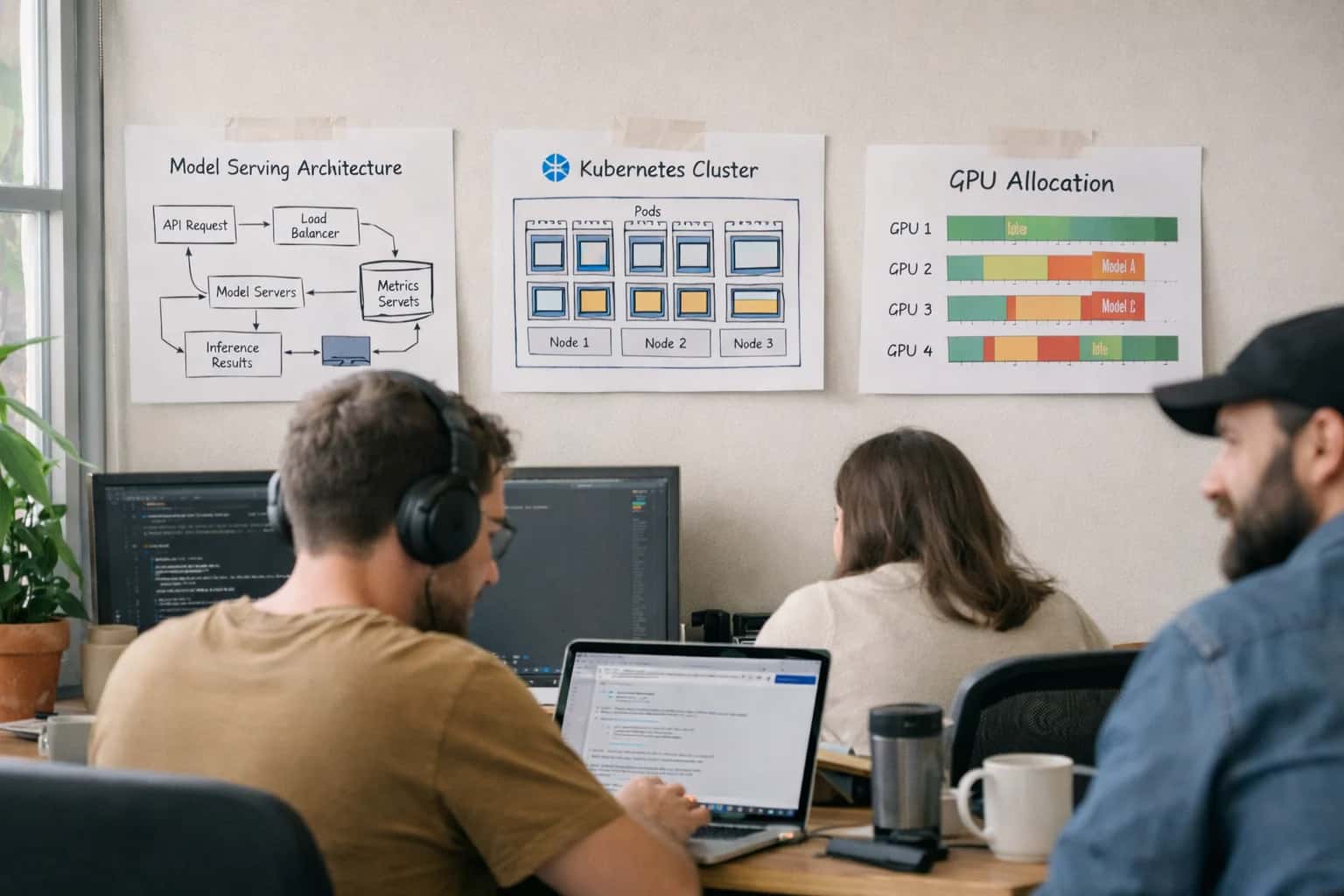
LLM DEPLOYMENT AND SERVING
What is Model Serving?
The operational process of hosting a trained machine learning model to make predictions via an API.
Effective serving architecture separates business logic from the model runtime, enabling canary deployments, A/B testing, and robust observability with metrics, logging, and distributed tracing. For large language models, serving is computationally intensive, necessitating techniques like model parallelism, quantization, and GPU acceleration to manage cost and latency. The serving layer must also enforce rate limiting, authentication via Role-Based Access Control (RBAC), and integrate with a model registry for version control and governance, ensuring reliable, scalable, and secure predictions.
ARCHITECTURAL OVERVIEW
Core Components of a Model Serving System
A production-grade model serving system is composed of several specialized layers that work together to provide reliable, scalable, and efficient inference. These components handle everything from request routing and compute optimization to monitoring and lifecycle management.
01
Serving Runtime & Inference Engine
The serving runtime is the core software that loads the model into memory and executes the computational graph. It is responsible for:
- Performing the forward pass through the neural network.
- Managing the model's computational graph and dependencies.
- Implementing critical optimizations like continuous batching and KV Cache management.
Examples include specialized engines like vLLM, Text Generation Inference (TGI), and TensorRT-LLM, which are optimized for transformer-based LLMs, as well as general-purpose servers like Triton Inference Server.
02
API Gateway & Request Router
This component is the public-facing interface that receives client requests. Its primary functions are:
- Exposing a standardized REST or gRPC API endpoint (e.g.,
/v1/completions). - Handling authentication, authorization, and rate limiting.
- Routing requests to the appropriate backend service or model version.
- Managing request queues and implementing load balancing across multiple inference pods or replicas to distribute traffic evenly.
03
Model Repository & Registry
A centralized system for storing, versioning, and managing trained model artifacts. It provides:
- Version control for model weights, configurations, and metadata.
- Secure storage for model files (e.g., using formats like Safetensors).
- A catalog for discovering available models and their properties.
- Governance controls to promote models from staging to production. This acts as the single source of truth for what models are deployable.
04
Orchestration & Scaling Controller
This layer manages the lifecycle and resource allocation of the serving infrastructure, typically implemented using Kubernetes. Key capabilities include:
- Horizontal Pod Autoscaler (HPA): Automatically scales the number of inference pod replicas based on metrics like request queue length or GPU utilization.
- Health checks and auto-remediation for failed instances.
- Resource scheduling to ensure pods are placed on nodes with sufficient GPU memory and compute.
- Integration with Custom Resource Definitions (CRDs) and Operators (e.g., KServe, Seldon Core) to declaratively manage inference services.
05
Observability & Monitoring Stack
A comprehensive suite for tracking system health, performance, and model behavior. It captures:
- Infrastructure metrics: GPU utilization, memory consumption, and node health.
- Business metrics: Request per second (RPS), latency percentiles (p50, p99), and error rates.
- Model quality metrics: Input/output distributions, drift detection, and custom scoring.
- Distributed tracing to follow a request's path through the entire system for debugging.
- Log aggregation for audit trails and analysis. Data is often fed into dashboards and alerting systems.
06
Traffic Management & Deployment Strategies
This component controls how new model versions are released and how traffic is shaped, enabling safe, progressive rollouts. It implements:
- Canary Deployments: Routing a small percentage of live traffic to a new model version to validate performance before full rollout.
- A/B Testing: Splitting traffic between different model variants to compare business outcomes.
- Shadow Mode: Sending copies of requests to a new model without affecting the user, to log its performance in parallel.
- Rollback mechanisms to instantly revert to a previous stable version if issues are detected.
SYSTEM OVERVIEW
How Model Serving Works: A Request's Journey
A technical walkthrough of the data flow and infrastructure components that process a single prediction request to a live machine learning model.
Model serving is the production system that hosts a trained machine learning model and executes inference on demand via an API. A client request initiates a journey through a serving runtime (e.g., vLLM, Triton), which loads the model, manages the KV Cache, and performs the forward pass. The runtime is typically containerized and orchestrated by Kubernetes, which handles scaling and lifecycle management through an Operator and Custom Resource Definitions (CRDs). Critical optimizations like continuous batching and quantization are applied within this layer to maximize throughput and minimize latency.
The serving infrastructure ensures reliability and control. An API gateway handles ingress, applying rate limiting and authentication. For high availability, traffic is routed using strategies like canary deployments. Performance is monitored via distributed tracing and measured against Service Level Objectives (SLOs). The final prediction is formatted and streamed back to the client, often using response streaming for large language models. This entire pipeline is defined and managed as Infrastructure as Code (IaC) to ensure reproducibility and governance.
COMPARISON
Popular Model Serving Frameworks & Platforms
A feature and capability comparison of leading open-source and managed platforms for serving large language models in production.
| Feature / Capability | vLLM | Text Generation Inference (TGI) | Triton Inference Server | Managed Cloud Service (e.g., SageMaker, Vertex AI) |
|---|---|---|---|---|
Primary Optimization | PagedAttention for KV Cache | Continuous Batching & Token Streaming | Dynamic Batching & Multi-Framework | Managed Infrastructure & Auto-scaling |
Open Source | ||||
Model Format Support | Hugging Face, Safetensors | Hugging Face, Safetensors | TensorFlow, PyTorch, ONNX, TensorRT | Varies (often proprietary SDKs) |
Continuous Batching | ||||
Response Streaming | ||||
Quantization Support (e.g., GPTQ, AWQ) | ||||
Tensor/Pipeline Parallelism | ||||
Built-in Monitoring & Metrics | ||||
Integrated Rate Limiting | ||||
Automatic Scaling | ||||
Managed Upgrades & Security | ||||
Primary Deployment Complexity | Medium (self-hosted) | Medium (self-hosted) | High (flexible, complex) | Low (managed) |
Typical Latency | < 100 ms | < 100 ms | < 50 ms (optimized) | 100-500 ms (network overhead) |
Cost Profile | Infrastructure Only | Infrastructure Only | Infrastructure Only | Infrastructure + Premium Service Fee |
MODEL SERVING
Frequently Asked Questions
Essential questions and answers about deploying, scaling, and managing machine learning models in production environments.
Model serving is the process of deploying a trained machine learning model into a production environment where it can receive input data, perform inference, and return predictions via an API. The core workflow involves a client application sending a request (often as a JSON payload) to a dedicated inference endpoint. The serving system loads the model, executes a forward pass on the input data, and returns the result. Modern serving frameworks like vLLM or Triton Inference Server enhance this process with optimizations such as continuous batching (dynamically grouping requests) and efficient KV cache management to maximize hardware utilization and throughput, transforming static model files into scalable, low-latency services.
Enabling Efficiency, Speed & Accuracy
Intelligent Analysis, Decision & Execution
We build AI systems for teams that need search across company data, workflow automation across tools, or AI features inside products and internal software.
Talk to Us
Search across company data
Give teams answers from docs, tickets, runbooks, and product data with sources and permissions.
Useful when people spend too long searching or get different answers from different systems.
Enterprise searchRAGPermissions
Read more
Automate internal workflows
Use AI to route work, draft outputs, trigger actions, and keep approvals and logs in place.
Useful when repetitive work moves across multiple tools and teams.
AI agentsWorkflow automationGovernance
Read more
Add AI to products and internal tools
Build assistants, guided actions, or decision support into the software your team or customers already use.
Useful when AI needs to be part of the product, not a separate tool.
AI integrationDecision supportModel routing
Read more
About the author
Prasad Kumkar
CEO & MD, Inference Systems
Prasad Kumkar is the CEO & MD of Inference Systems and writes about AI systems architecture, LLM infrastructure, model serving, evaluation, and production deployment. Over 5+ years, he has worked across computer vision models, L5 autonomous vehicle systems, and LLM research, with a focus on taking complex AI ideas into real-world engineering systems.
His work and writing cover AI systems, large language models, AI agents, multimodal systems, autonomous systems, inference optimization, RAG, evaluation, and production AI engineering.
LinkedIn
Limited slotsGet a Free AI Consultation
Partnered with leading AI, data, and software stack.





How We Work
Custom AI workflows for your Business
One-fit-all AI don't work for modern businesses. At Inferensys, we aim to understand your business & custom requirements; which we use to define most efficient agentic workflows, the data, and the tools for your business.
01
Review the use case
We understand the task, the users, and where AI can actually help.
Read more02
Pick the right approach
We define what needs search, automation, or product integration.
Read more03
Build the first useful version
We implement the part that proves the value first.
Read more04
Improve from there
We add the checks and visibility needed to keep it useful.
Read moreThe first call is a practical review of your use case and the right next step.
Talk to Us