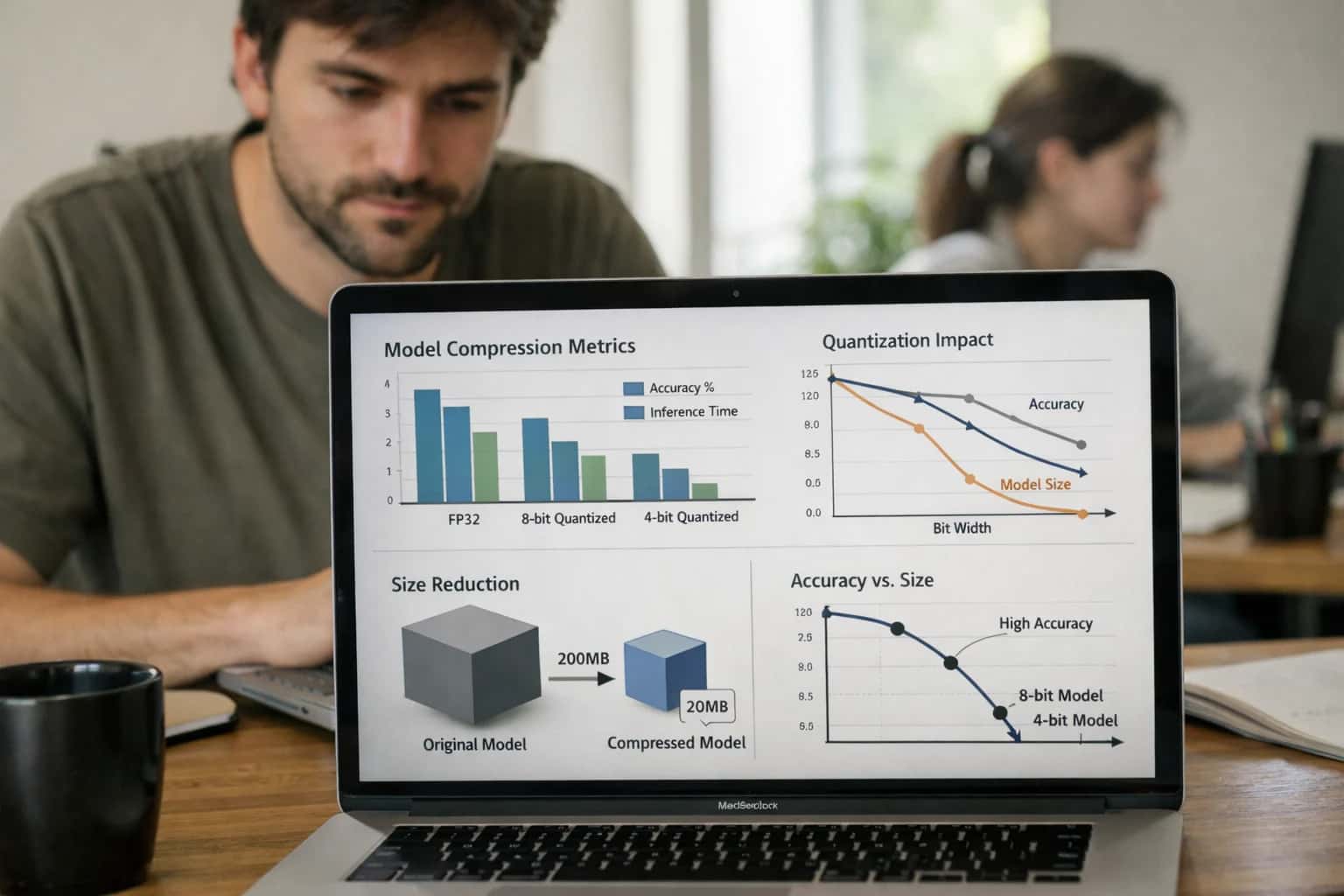
Model quantization is a compression technique that reduces the numerical precision of a model's parameters (weights) and intermediate calculations (activations) to decrease memory footprint and increase computational speed, often with minimal accuracy loss. Common precision reductions include moving from 32-bit floating-point (FP32) to 16-bit (FP16 or BF16), 8-bit integers (INT8), or even 4-bit integers. This process directly addresses key production constraints: it reduces the model size for storage and loading, lowers memory bandwidth pressure, and enables faster computation on hardware that has optimized support for lower-precision arithmetic, such as modern GPUs and NPUs.

Glossary
Model Quantization
Model quantization is a compression technique that reduces the numerical precision of a model's weights and activations to decrease memory footprint and increase computational speed with minimal accuracy loss.
INFERENCE OPTIMIZATION
What is Model Quantization?
A core technique for deploying efficient AI models in production.
Quantization is primarily applied through two methodologies. Post-training quantization (PTQ) statically converts a pre-trained model using a small calibration dataset, offering a quick path to deployment. Quantization-aware training (QAT) fine-tunes the model with simulated quantization, allowing it to learn to compensate for precision loss, typically yielding higher accuracy. The technique is foundational for on-device AI and edge deployment, enabling powerful models to run on resource-constrained hardware. It is often combined with other optimization methods like weight pruning and operator fusion within compilation frameworks such as TensorRT-LLM or ONNX Runtime.
MODEL QUANTIZATION
Key Quantization Methods
Quantization reduces the numerical precision of a model's parameters and activations to shrink its memory footprint and accelerate computation. The choice of method balances the trade-off between compression efficiency and accuracy preservation.
COMPARISON
Common Numerical Precision Formats
A comparison of numerical data types used in model quantization, detailing their bit-width, typical use cases, and hardware support.
| Format (Common Name) | Bit Width | Primary Use Case | Hardware Support | Key Trade-off |
|---|---|---|---|---|
FP32 (Full Precision) | 32-bit | Model training and high-accuracy baseline inference | Maximum accuracy at the cost of high memory and compute | |
BFLOAT16 (Brain Floating Point) | 16-bit | Training and inference of large models (especially LLMs) | Wide dynamic range similar to FP32, easier conversion, lower precision than FP16 | |
FP16 (Half Precision) | 16-bit | Inference and mixed-precision training | Good speed/memory gains but limited dynamic range, risk of overflow/underflow | |
INT8 (8-bit Integer) | 8-bit | Post-training quantization (PTQ) for production inference | ~4x memory reduction and ~2-4x speedup vs. FP32, requires calibration for accuracy | |
INT4 (4-bit Integer) | 4-bit | Extreme compression for memory-constrained deployment (e.g., on-device) | ~8x memory reduction vs. FP32, significant accuracy loss requires QAT or advanced methods | |
FP8 (8-bit Floating Point) | 8-bit | Emerging standard for efficient training and inference (E4M3, E5M2 variants) | Designed for better accuracy than INT8 for certain ops, not yet universally supported | |
Binary/Ternary (1-2 bit) | 1-2 bit | Research and extreme-edge computing (microcontrollers) | Maximum compression and energy efficiency, major accuracy challenges for general models |
IMPLEMENTATION ECOSYSTEM
Provider & Framework Support
Model quantization is supported across major machine learning frameworks and hardware platforms, each offering specialized toolchains for converting models to lower precision formats.
06
Hardware Vendor Libraries
Specialized libraries from hardware vendors enable quantization tuned for their specific silicon.
- Intel OpenVINO: Uses Neural Network Compression Framework (NNCF) for QAT and PTQ, optimizing for Intel CPUs, GPUs, and VPUs with INT8, INT4, and even INT1 (binary) quantization.
- Qualcomm AI Model Efficiency Toolkit (AIMET): Provides data-free quantization and AdaRound techniques for Snapdragon platforms.
- Xilinx Brevitas: A PyTorch library for quantization-aware training with arbitrary bit-widths, targeting FPGA and ACAP devices.
- Apple Core ML Tools: Quantizes models to 16-bit floating-point (FP16) or 8-bit integers (INT8) for deployment on Apple Silicon (Neural Engine).
INT1
Extreme Bit-Width (OpenVINO)
Data-Free
Quantization Method (AIMET)
MODEL QUANTIZATION
Frequently Asked Questions
Model quantization is a core technique for optimizing large language models for production. These questions address the fundamental how, why, and when of reducing numerical precision to cut costs and latency.
Model quantization is a compression technique that reduces the numerical precision of a model's weights and activations (e.g., from 32-bit floating-point to 8-bit integers) to decrease memory footprint and increase computational speed. It works by mapping the continuous range of values in high-precision tensors to a smaller, discrete set of values in a lower-precision format. This process involves:
- Calibration: Running a small, representative dataset through the model to observe the statistical range (min/max) of activations.
- Quantization: Applying a scaling factor and zero-point to transform float values into integers (e.g.,
FP32 -> INT8). - Dequantization (at runtime): Converting the low-precision integers back to floats for computation, though many hardware accelerators perform computations directly on the integers.
The core benefit is that integer operations are significantly faster and require less memory bandwidth than floating-point operations on most hardware, leading to faster inference and lower power consumption.
Enabling Efficiency, Speed & Accuracy
Intelligent Analysis, Decision & Execution
We build AI systems for teams that need search across company data, workflow automation across tools, or AI features inside products and internal software.
Talk to Us
Search across company data
Give teams answers from docs, tickets, runbooks, and product data with sources and permissions.
Useful when people spend too long searching or get different answers from different systems.
Enterprise searchRAGPermissions
Read more
Automate internal workflows
Use AI to route work, draft outputs, trigger actions, and keep approvals and logs in place.
Useful when repetitive work moves across multiple tools and teams.
AI agentsWorkflow automationGovernance
Read more
Add AI to products and internal tools
Build assistants, guided actions, or decision support into the software your team or customers already use.
Useful when AI needs to be part of the product, not a separate tool.
AI integrationDecision supportModel routing
Read more
About the author
Prasad Kumkar
CEO & MD, Inference Systems
Prasad Kumkar is the CEO & MD of Inference Systems and writes about AI systems architecture, LLM infrastructure, model serving, evaluation, and production deployment. Over 5+ years, he has worked across computer vision models, L5 autonomous vehicle systems, and LLM research, with a focus on taking complex AI ideas into real-world engineering systems.
His work and writing cover AI systems, large language models, AI agents, multimodal systems, autonomous systems, inference optimization, RAG, evaluation, and production AI engineering.
LinkedIn
Limited slotsGet a Free AI Consultation
Partnered with leading AI, data, and software stack.





How We Work
Custom AI workflows for your Business
One-fit-all AI don't work for modern businesses. At Inferensys, we aim to understand your business & custom requirements; which we use to define most efficient agentic workflows, the data, and the tools for your business.
01
Review the use case
We understand the task, the users, and where AI can actually help.
Read more02
Pick the right approach
We define what needs search, automation, or product integration.
Read more03
Build the first useful version
We implement the part that proves the value first.
Read more04
Improve from there
We add the checks and visibility needed to keep it useful.
Read moreThe first call is a practical review of your use case and the right next step.
Talk to Us