Quantization-Aware Training (QAT) is a model compression technique where the effects of quantization—reducing numerical precision from 32-bit floating-point to integers like INT8 or INT4—are simulated during the training or fine-tuning process. This allows the model's weights and activations to adapt to the expected precision loss, typically yielding higher accuracy than applying Post-Training Quantization (PTQ) after training is complete. The process involves inserting fake quantization nodes into the computational graph that mimic the rounding and clipping behavior of the target hardware during the forward pass, while maintaining full precision gradients during the backward pass for stable learning.

Glossary
Quantization-Aware Training (QAT)
Quantization-Aware Training (QAT) is a model compression technique where quantization is simulated during training, allowing the model to learn parameters robust to precision loss for higher accuracy deployment.
MODEL COMPRESSION
What is Quantization-Aware Training (QAT)?
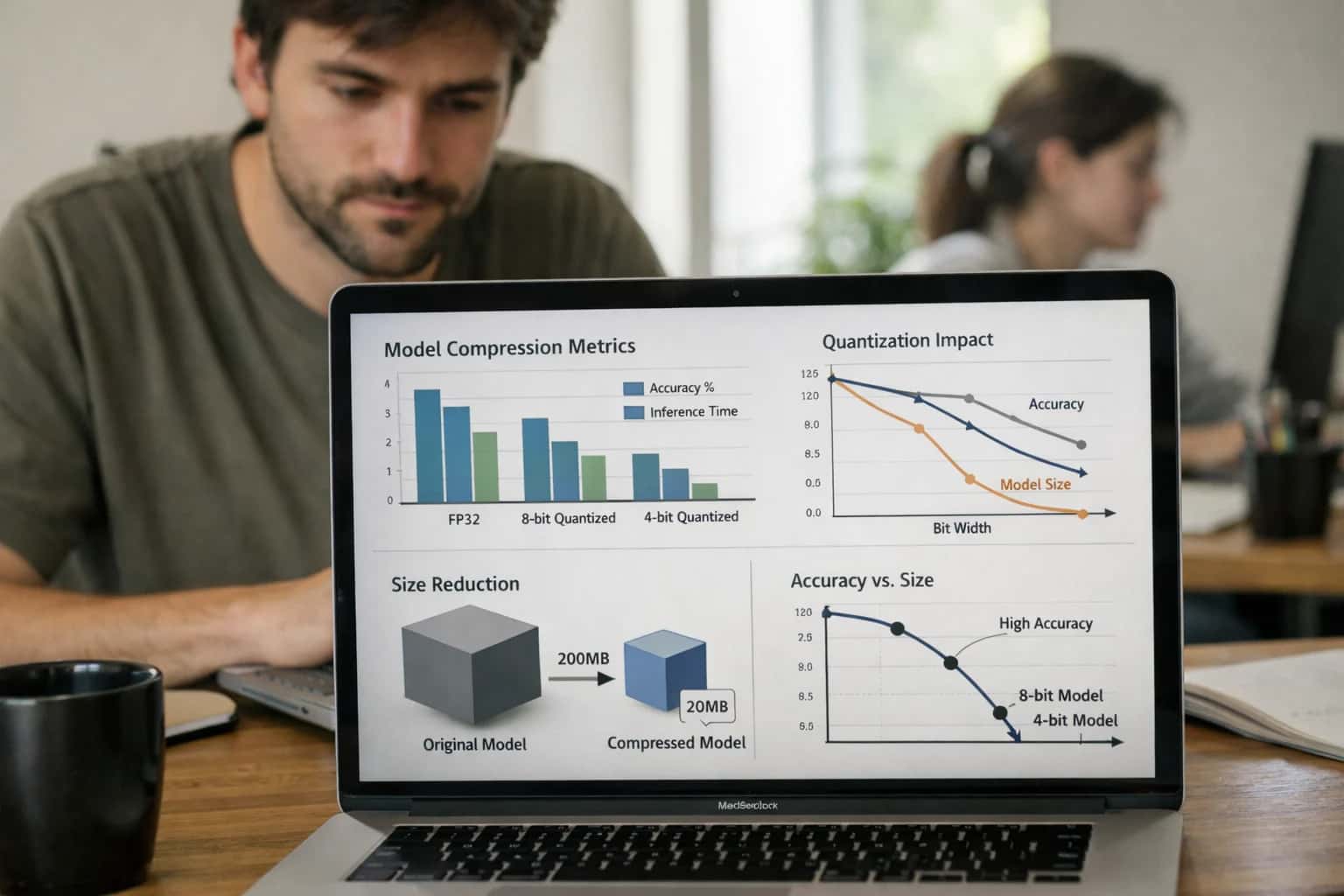
Quantization-Aware Training (QAT) is a model compression technique that simulates lower numerical precision during the training process, allowing a neural network to learn parameters robust to the precision loss inherent in deployment.
The primary goal of QAT is to produce a model whose inference is efficient on hardware with optimized integer arithmetic units, such as NPUs or certain GPUs, while minimizing accuracy degradation. It is a key technique within Cost and Resource Management for deploying large models, as it directly reduces memory footprint and accelerates computation, lowering inference cost and latency. QAT is often contrasted with PTQ, which is faster but less accurate, and is frequently used in conjunction with other compression methods like pruning and distillation for maximum efficiency in production systems.
QUANTIZATION-AWARE TRAINING
Key Characteristics of QAT
Quantization-Aware Training (QAT) is a model compression technique where quantization is simulated during the training process, allowing the model to learn parameters that are robust to the precision loss, typically yielding higher accuracy than post-training quantization.
01
Simulated Quantization During Training
The core mechanism of QAT is the insertion of fake quantization nodes (also called Q/DQ nodes) into the model's computational graph during the forward pass. These nodes simulate the effects of lower-precision arithmetic (e.g., converting FP32 to INT8 and back) by rounding and clipping values. This allows the model's weights and activations to adapt to the noise introduced by quantization through standard backpropagation and gradient descent.
- Forward Pass: Values are quantized and de-quantized, simulating inference precision.
- Backward Pass (Straight-Through Estimator): Gradients are passed through the quantization nodes as if the rounding operation had a gradient of 1, enabling effective learning.
- Result: The model learns a more robust representation that minimizes the accuracy degradation caused by the final, true quantization applied after training.
02
Superior Accuracy vs. Post-Training Quantization
QAT generally achieves higher accuracy than Post-Training Quantization (PTQ) because it allows the model to actively compensate for quantization error. PTQ is a static calibration process applied to a fixed, pre-trained model. In contrast, QAT is a form of fine-tuning where the optimization loop can adjust parameters to find a minima that is stable under low-precision conditions.
Key Comparison:
- PTQ: Fast, no retraining required. Accuracy loss can be significant for complex models or lower bit-widths (e.g., INT4).
- QAT: Requires retraining (fine-tuning) with labeled data. Typically recovers near-FP32 accuracy, even at aggressive bit-widths like INT4 or INT8, making it essential for production deployments where accuracy is critical.
03
Integration with Training Frameworks
QAT is implemented through specialized APIs and libraries within major deep learning frameworks. These tools automatically modify the model graph and manage the fake quantization process.
Primary Framework Support:
- PyTorch:
torch.ao.quantization(formerlytorch.quantization) provides aQuantStub,DeQuantStub, andprepare_qatfunctions to convert models for QAT. - TensorFlow:
tf.quantizationand the TensorFlow Model Optimization Toolkit offerquantize_modelandQuantizeConfigAPIs for QAT. - NVIDIA TensorRT: Provides a Quantization Toolkit for PyTorch that includes QAT utilities for models destined for TensorRT deployment.
These frameworks handle the complex details of gradient propagation through discretization, allowing developers to apply QAT with high-level commands.
04
Calibration and Range Estimation
A critical component of QAT is determining the clipping ranges (scale and zero-point) for quantization. During training, these ranges can be learned or estimated dynamically.
Common Strategies:
- Moving Average: Track min/max or mean/std of activations across training batches using exponential moving averages to smooth range estimates.
- Learnable Scale Parameters: Treat the quantization scale factor as a trainable parameter, allowing the model to optimize the range itself via gradient descent.
- Symmetric vs. Asymmetric Quantization: QAT can simulate both schemes. Symmetric quantization (range centered on zero) is simpler for hardware; asymmetric can better capture skewed data distributions.
Proper range estimation during QAT ensures the low-precision format efficiently uses its limited numerical space, minimizing quantization error.
05
Deployment to Quantized Runtimes
After QAT, the model with fake quantization nodes is converted into a truly quantized model where weights and activations are stored as integers (e.g., INT8). This model is then deployed to inference runtimes optimized for low-precision arithmetic.
Deployment Pipeline:
- QAT Fine-Tuning: Train model with fake quantization nodes.
- Conversion/Export: Replace fake nodes with integer operations. In PyTorch, this is done via
convert. The result is a model with integer weights and quantization parameters embedded. - Runtime Deployment: Execute the quantized model on hardware with optimized integer kernels, such as:
- NVIDIA TensorRT
- Intel OpenVINO
- Qualcomm SNPE
- ARM Compute Library
This pipeline delivers the core benefits: reduced memory bandwidth, faster compute, and lower power consumption on target hardware.
06
Trade-offs: Compute Cost vs. Inference Efficiency
QAT involves a fundamental trade-off between upfront training cost and long-term inference efficiency.
Costs of QAT:
- Compute Overhead: Requires a full or partial fine-tuning cycle, consuming significant GPU hours and energy.
- Data Dependency: Needs a labeled calibration/training dataset, which may not be available in all scenarios.
- Pipeline Complexity: Introduces additional steps (preparation, QAT training, conversion) to the ML lifecycle.
Benefits of QAT:
- Higher Accuracy: Enables the use of more aggressive quantization (e.g., 4-bit) with acceptable accuracy loss, unlocking deployment on more constrained devices.
- Predictable Performance: Delivers consistent, production-grade accuracy compared to PTQ, which can have variable results.
- Total Cost of Ownership (TCO): The upfront training cost is often justified by drastically reduced inference costs over the model's operational lifetime, especially at high query volumes.
QUANTIZATION METHOD COMPARISON
QAT vs. Post-Training Quantization (PTQ)
A technical comparison of the two primary approaches to model quantization, highlighting trade-offs between accuracy, development effort, and deployment readiness.
| Feature / Metric | Quantization-Aware Training (QAT) | Post-Training Quantization (PTQ) |
|---|---|---|
Core Methodology | Quantization is simulated during the final training or fine-tuning phase, allowing the model to learn robust parameters. | Quantization is applied to a pre-trained model after training is complete, using a small calibration dataset. |
Primary Goal | Maximize accuracy recovery by adapting model parameters to the quantization error. | Provide a fast, low-effort path to a smaller, faster model with acceptable accuracy loss. |
Typical Accuracy Loss | < 1% relative to FP32 baseline | 1-5% relative to FP32 baseline (highly model and data dependent) |
Development Workflow Complexity | High. Requires integration into training loop, hyperparameter tuning, and full training cycle. | Low. A calibration step (forward passes) is appended to the standard training pipeline. |
Required Compute & Time | High. Equivalent to a full fine-tuning cycle (hours to days). | Very Low. Calibration requires only a few hundred forward passes (minutes). |
Data Requirement | Requires access to the original training dataset or a representative subset for retraining. | Requires only a small, unlabeled calibration dataset (100-1000 samples). |
Integration with Other Compression | Can be combined with pruning and distillation during the training phase for compounded compression. | Typically applied after pruning. Can be combined with distillation, but order matters. |
Hardware Support & Tooling | Full support in frameworks (PyTorch's FX Graph Mode, TensorFlow). Requires QAT-compatible kernels. | Universal support. Broadly compatible with all inference engines and integer hardware. |
Best For | Production deployments where maximum accuracy is critical and model retraining is feasible. | Rapid prototyping, edge deployment, and scenarios where retraining is prohibitively expensive or impossible. |
Typical Use Case | Quantizing a proprietary model for a latency-sensitive mobile application where every 0.1% accuracy matters. | Quickly reducing the size of a downloaded foundation model (e.g., Llama 3) for local inference on a laptop. |
IMPLEMENTATION LANDSCAPE
Frameworks and Tools for QAT
Quantization-Aware Training (QAT) is implemented through specialized frameworks that simulate lower precision during the forward pass, enabling the model to adapt its parameters. These tools integrate fake quantization nodes and provide gradient estimators for the backward pass.
06
QAT vs. Post-Training Quantization (PTQ)
QAT is often compared to its faster, less accurate counterpart, Post-Training Quantization (PTQ).
- QAT Process: Involves fine-tuning with simulated quantization. It is computationally expensive but typically yields higher accuracy, especially for models with narrow weight distributions or non-linear activations.
- PTQ Process: Uses a small calibration dataset to determine quantization ranges statically, with no retraining. It's fast but can suffer from significant accuracy degradation.
- Decision Factor: Use QAT when PTQ causes unacceptable accuracy loss (>1-2%) or when targeting very low precision (e.g., INT4). Use PTQ for rapid deployment where minor accuracy loss is acceptable.
QUANTIZATION-AWARE TRAINING
Frequently Asked Questions
Quantization-Aware Training (QAT) is a critical technique for deploying efficient neural networks. These questions address its core mechanisms, trade-offs, and practical implementation for cost-effective AI.
Quantization-Aware Training (QAT) is a model compression technique where the effects of lower numerical precision (quantization) are simulated during the training process, allowing the model to learn parameters robust to this precision loss. It works by inserting fake quantization nodes into the model's computational graph. During the forward pass, these nodes simulate the rounding and clamping operations of integer quantization. During the backward pass, the Straight-Through Estimator (STE) is used to approximate gradients through these non-differentiable operations, enabling the optimizer to adjust weights to compensate for quantization error. The final trained model has weights already adapted for low-precision deployment, typically yielding higher accuracy than applying quantization after training (Post-Training Quantization).
Enabling Efficiency, Speed & Accuracy
Intelligent Analysis, Decision & Execution
We build AI systems for teams that need search across company data, workflow automation across tools, or AI features inside products and internal software.
Talk to Us
Search across company data
Give teams answers from docs, tickets, runbooks, and product data with sources and permissions.
Useful when people spend too long searching or get different answers from different systems.
Enterprise searchRAGPermissions
Read more
Automate internal workflows
Use AI to route work, draft outputs, trigger actions, and keep approvals and logs in place.
Useful when repetitive work moves across multiple tools and teams.
AI agentsWorkflow automationGovernance
Read more
Add AI to products and internal tools
Build assistants, guided actions, or decision support into the software your team or customers already use.
Useful when AI needs to be part of the product, not a separate tool.
AI integrationDecision supportModel routing
Read more
About the author
Prasad Kumkar
CEO & MD, Inference Systems
Prasad Kumkar is the CEO & MD of Inference Systems and writes about AI systems architecture, LLM infrastructure, model serving, evaluation, and production deployment. Over 5+ years, he has worked across computer vision models, L5 autonomous vehicle systems, and LLM research, with a focus on taking complex AI ideas into real-world engineering systems.
His work and writing cover AI systems, large language models, AI agents, multimodal systems, autonomous systems, inference optimization, RAG, evaluation, and production AI engineering.
LinkedIn
Limited slotsGet a Free AI Consultation
Partnered with leading AI, data, and software stack.





How We Work
Custom AI workflows for your Business
One-fit-all AI don't work for modern businesses. At Inferensys, we aim to understand your business & custom requirements; which we use to define most efficient agentic workflows, the data, and the tools for your business.
01
Review the use case
We understand the task, the users, and where AI can actually help.
Read more02
Pick the right approach
We define what needs search, automation, or product integration.
Read more03
Build the first useful version
We implement the part that proves the value first.
Read more04
Improve from there
We add the checks and visibility needed to keep it useful.
Read moreThe first call is a practical review of your use case and the right next step.
Talk to Us