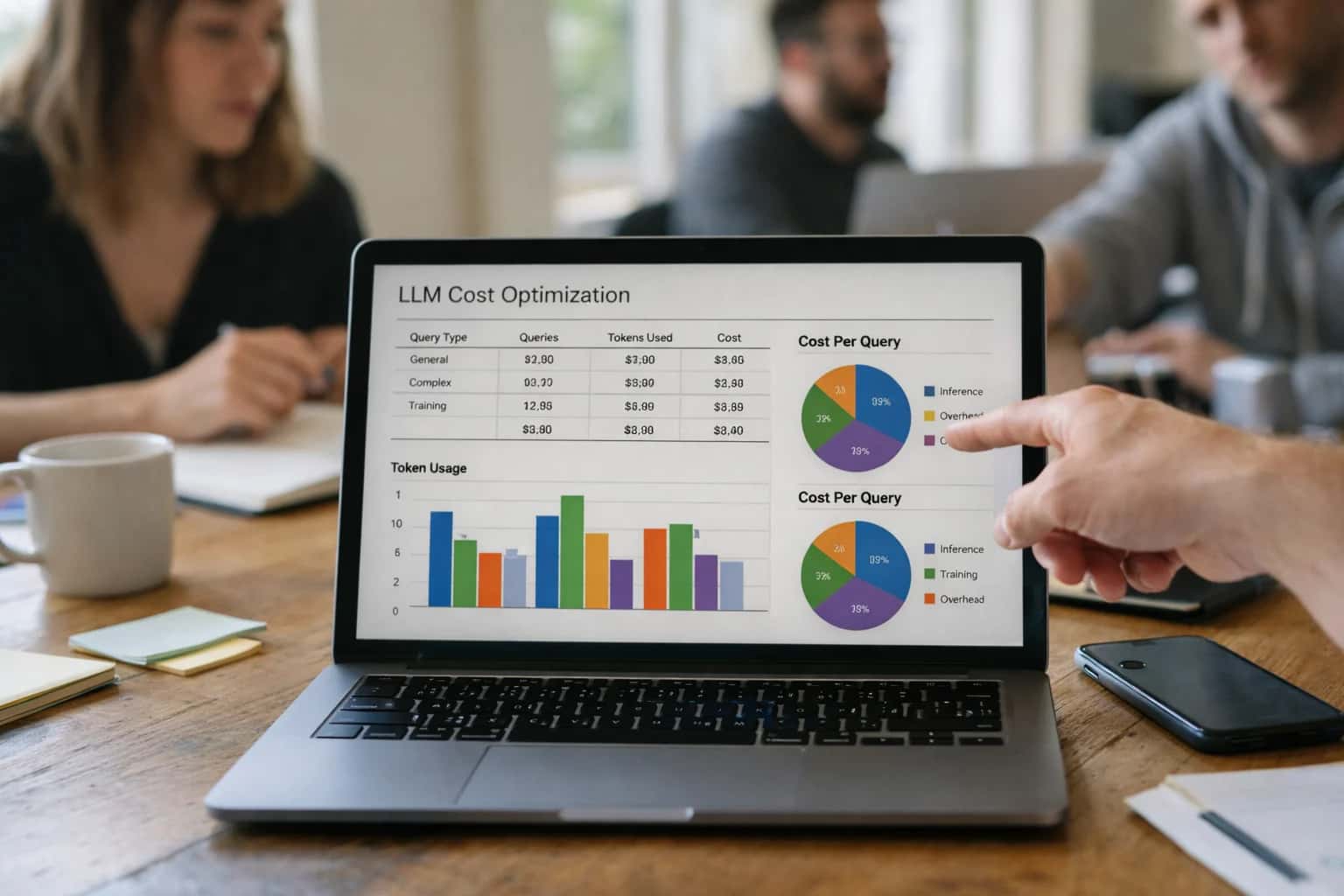
Cost per token is a unit economics metric that calculates the average expense of generating or processing a single token by a large language model (LLM). It is the primary variable for forecasting, budgeting, and optimizing the financial efficiency of inference workloads at scale. This metric directly translates raw computational consumption—measured in GPU-seconds and memory—into a predictable financial variable, enabling precise cost attribution per user, feature, or API call.

Glossary
Cost Per Token
Cost per token is a unit economics metric that calculates the average expense of generating or processing a single token by a Large Language Model (LLM).
UNIT ECONOMICS
What is Cost Per Token?
Cost per token is the fundamental unit economics metric for forecasting and budgeting large language model inference.
Calculating cost per token requires analyzing the total inference cost—encompassing cloud compute, memory, and serving overhead—divided by the total tokens processed. This figure is heavily influenced by model architecture, serving optimizations like continuous batching and KV cache, and cloud instance pricing. For engineering leaders, monitoring this metric is essential for FinOps practices, enabling data-driven decisions on model selection, autoscaling policies, and instance right-sizing to control infrastructure expenditure.
UNIT ECONOMICS
Key Components of Cost Per Token
Cost per token is a foundational metric for forecasting and optimizing LLM inference spend. It is determined by the interplay of several technical and financial factors.
01
Model Architecture & Size
The foundational driver of cost. Larger models with more parameters (e.g., 70B vs. 7B) require more memory and compute per token.
- Key Factor: The number of parameters directly correlates with the FLOPs (floating-point operations) required for a single forward pass.
- Example: Generating a token with a 70B parameter model is inherently more computationally expensive than with a 7B model, leading to a higher base cost per token.
02
Precision Format (Quantization)
The numerical format of model weights dramatically impacts memory bandwidth and compute efficiency.
- FP16/BF16: Higher precision, standard for training and high-accuracy inference.
- INT8/FP8: Quantized formats that reduce memory footprint and can accelerate compute on supported hardware, lowering cost per token.
- GPTQ/AWQ (4-bit): Advanced post-training quantization methods that enable running very large models on consumer GPUs, offering the lowest cost per token but with potential accuracy trade-offs.
03
Hardware & Instance Cost
The unit economics of the underlying cloud or on-premises infrastructure.
- GPU Type: An NVIDIA H100 provides vastly higher throughput (tokens/sec) than an A10G, affecting the cost allocated to each token.
- Memory Bandwidth: A critical bottleneck for inference; higher bandwidth (e.g., HBM3) allows for faster data loading, improving tokens/sec.
- Cloud Pricing: The hourly rate of the chosen instance (e.g.,
g5.48xlarge) is divided by its throughput to determine a baseline hardware cost per token.
04
Inference Optimization
Serving techniques that maximize hardware utilization, directly reducing the effective cost per token.
- Continuous Batching: Groups multiple user requests (sequences) into a single batch, dramatically improving GPU utilization and throughput.
- PagedAttention (vLLM): Eliminates memory waste in the KV Cache, allowing for higher concurrency and more requests served per GPU.
- Speculative Decoding: Uses a small draft model to propose tokens, verified in parallel by the larger model, increasing overall tokens/sec.
05
Sequence Characteristics
The nature of the input and output directly influences computational work.
- Context Length: Longer input prompts require more initial computation to process the full context, amortized over the generated tokens.
- Output Length: Generating a 1000-token response incurs roughly 1000x the cost of a 1-token response, as each new token requires an autoregressive step.
- Cache Hit Rate: For repeated or similar prompts, a warm KV Cache can skip recomputation, lowering the cost for subsequent tokens.
06
Operational & Overhead Factors
The real-world costs of running a production service beyond raw computation.
- Load Patterns: Variable traffic leads to idle GPU time or queueing, affecting average utilization and effective cost.
- Cold Starts: The cost of loading a model into memory for the first request, which must be amortized across subsequent tokens.
- Networking & Orchestration: Overhead from load balancers, API gateways, and container orchestration (e.g., Kubernetes) adds to the total cost of service.
UNIT ECONOMICS
How is Cost Per Token Calculated?
A breakdown of the fundamental formula and variables that determine the unit cost of LLM inference.
Cost per token is calculated by dividing the total inference cost for a given workload by the total number of tokens processed. The foundational formula is: (Compute Instance Cost per Second * Inference Time in Seconds) / Total Tokens. This unit economics metric is essential for forecasting, budgeting, and comparing the efficiency of different models and deployment configurations. Key variables include the model's architecture, the chosen cloud instance type, and the achieved tokens per second (TPS) throughput.
The calculation must account for both input (prompt) and output (completion) tokens, as both consume compute resources. Dynamic batching and KV cache utilization directly impact throughput and thus the effective cost. For accurate forecasting, engineers must also factor in overhead costs like networking, load balancing, and idle time, often using FinOps practices for cloud cost allocation. This metric enables precise trade-off analysis between model performance, latency, and expenditure.
INFERENCE PRICING
Cost Per Token Comparison Across Major Providers
A comparison of the unit economics for generating output tokens using popular cloud-hosted LLM APIs, based on publicly listed pricing as of Q2 2024. Costs are for standard, on-demand inference and exclude input token costs, fine-tuned models, or long-context windows.
| Model / Provider | OpenAI (GPT-4) | Anthropic (Claude 3) | Google (Gemini 1.5 Pro) | Meta (Llama 3 via Groq) | Mistral AI (via Mistral Platform) |
|---|---|---|---|---|---|
Primary Model for Comparison | gpt-4-turbo | claude-3-opus-20240229 | gemini-1.5-pro | llama-3-70b-8192 | mistral-large |
Output Cost per 1M Tokens | $30.00 | $75.00 | $7.50 | $0.79 | $8.00 |
Context Window (Tokens) | 128k | 200k | 1M | 8k | 32k |
Typical Latency (Time to First Token) | < 2 sec | 2-4 sec | < 1 sec | < 0.1 sec | < 1 sec |
Throughput-Optimized Variant Available | |||||
Programmatic Volume Discounts | |||||
Commitment-Based Discounts (CUDs) |
COST AND RESOURCE MANAGEMENT
Strategies for Optimizing Cost Per Token
Cost per token is the fundamental unit economics metric for LLM inference. Optimizing it requires a multi-layered approach targeting model selection, serving infrastructure, and workload management.
01
Select Efficient Model Architectures
The choice of base model is the primary determinant of cost per token. Small Language Models (SLMs) like Llama 3.1 8B or Phi-3-mini offer dramatically lower inference costs than larger counterparts with minimal performance loss for many enterprise tasks. For specialized domains, consider Parameter-Efficient Fine-Tuning (PEFT) methods like LoRA to adapt a smaller, general model instead of deploying a massive, underutilized one. Architectures with optimized attention mechanisms, such as Grouped-Query Attention (GQA) or Sliding Window Attention, reduce memory bandwidth pressure, directly lowering compute cost.
02
Apply Model Compression
Compression reduces the computational footprint of a model, directly lowering the cost per token. Key techniques include:
- Model Quantization: Reducing numerical precision from FP32 to INT8 or FP8 cuts memory use and accelerates computation on supported hardware. GPTQ and AWQ are advanced algorithms for high-accuracy 4-bit quantization.
- Model Pruning: Removing redundant neurons or weights shrinks the model size, decreasing the FLOPs required per token.
- Knowledge Distillation: Training a compact student model to mimic a larger teacher model achieves comparable quality with far fewer parameters. These techniques are often combined for maximum effect.
03
Optimize Inference Serving
Serving infrastructure efficiency dictates how many tokens you generate per dollar of compute. Implement:
- Continuous Batching (In-flight Batching): Dynamically batches incoming requests of different lengths, eliminating GPU idle time and maximizing throughput.
- PagedAttention & vLLM: The vLLM serving engine uses the PagedAttention algorithm to manage the KV Cache with minimal memory waste, allowing higher concurrency on the same hardware.
- Speculative Decoding: Uses a small, fast draft model to propose token sequences, which are then verified in parallel by the main model, reducing latency and effective compute time per output token.
04
Implement Intelligent Traffic Management
Operational policies prevent resource waste and smooth demand. Key strategies are:
- Autoscaling: Dynamically scales the serving cluster up or down based on request queue depth, preventing costly over-provisioning during low-traffic periods.
- Rate Limiting & Load Shedding: Protects the system from traffic spikes. Load shedding rejects low-priority requests under extreme load to maintain Service Level Agreements (SLAs) for critical users.
- Request Optimization: Encourage users to employ system prompts and few-shot examples to reduce output token length and retries. Implement caching for frequent, deterministic queries.
05
Adopt FinOps & Cost Allocation
Financial operations practices bring accountability to cloud spend. Essential activities include:
- Cloud Cost Allocation: Use resource tagging to attribute GPU instance costs to specific projects, teams, or API keys. This creates visibility into which workloads drive the highest inference cost.
- Instance Right-Sizing: Continuously analyze metrics like Tokens Per Second (TPS) and GPU utilization to select the most cost-effective instance type (e.g., comparing A100, H100, L4).
- Budget Alerts & Forecasting: Set alerts based on cost-per-token trends and use historical token consumption to forecast future spend, enabling proactive budget management.
06
Monitor & Analyze Unit Metrics
You cannot optimize what you do not measure. Establish granular monitoring:
- Track cost per token segmented by model, endpoint, and user. Correlate it with quality metrics (e.g., evaluation scores) to avoid optimizing cost at the expense of value.
- Monitor Tail Latency (P95/P99) alongside throughput. A strategy that lowers cost but increases latency variance may degrade user experience.
- Analyze the ratio of input to output tokens, as some providers charge for both. Optimizing prompts to be concise can have a direct cost impact.
COST PER TOKEN
Frequently Asked Questions
Cost per token is the fundamental unit economics metric for forecasting and managing the financial expenditure of large language model inference. These questions address how it's calculated, optimized, and integrated into broader financial operations.
Cost per token is a unit economics metric that calculates the average expense of generating or processing a single token by a large language model (LLM). It is calculated by dividing the total cost of an inference workload by the total number of tokens processed (input + output). The formula is: Total Inference Cost / (Input Tokens + Output Tokens). Total cost factors in cloud compute (GPU/CPU instance time), memory, networking, and serving infrastructure overhead. For accurate forecasting, this metric is often analyzed alongside throughput (Tokens Per Second) and utilization rates to understand the relationship between speed, efficiency, and expense.
Enabling Efficiency, Speed & Accuracy
Intelligent Analysis, Decision & Execution
We build AI systems for teams that need search across company data, workflow automation across tools, or AI features inside products and internal software.
Talk to Us
Search across company data
Give teams answers from docs, tickets, runbooks, and product data with sources and permissions.
Useful when people spend too long searching or get different answers from different systems.
Enterprise searchRAGPermissions
Read more
Automate internal workflows
Use AI to route work, draft outputs, trigger actions, and keep approvals and logs in place.
Useful when repetitive work moves across multiple tools and teams.
AI agentsWorkflow automationGovernance
Read more
Add AI to products and internal tools
Build assistants, guided actions, or decision support into the software your team or customers already use.
Useful when AI needs to be part of the product, not a separate tool.
AI integrationDecision supportModel routing
Read more
About the author
Prasad Kumkar
CEO & MD, Inference Systems
Prasad Kumkar is the CEO & MD of Inference Systems and writes about AI systems architecture, LLM infrastructure, model serving, evaluation, and production deployment. Over 5+ years, he has worked across computer vision models, L5 autonomous vehicle systems, and LLM research, with a focus on taking complex AI ideas into real-world engineering systems.
His work and writing cover AI systems, large language models, AI agents, multimodal systems, autonomous systems, inference optimization, RAG, evaluation, and production AI engineering.
LinkedIn
Limited slotsGet a Free AI Consultation
Partnered with leading AI, data, and software stack.





How We Work
Custom AI workflows for your Business
One-fit-all AI don't work for modern businesses. At Inferensys, we aim to understand your business & custom requirements; which we use to define most efficient agentic workflows, the data, and the tools for your business.
01
Review the use case
We understand the task, the users, and where AI can actually help.
Read more02
Pick the right approach
We define what needs search, automation, or product integration.
Read more03
Build the first useful version
We implement the part that proves the value first.
Read more04
Improve from there
We add the checks and visibility needed to keep it useful.
Read moreThe first call is a practical review of your use case and the right next step.
Talk to Us