On-device inference is the process where a trained machine learning model executes locally on an end-user hardware device—such as a smartphone, IoT sensor, or embedded system—to generate predictions from input data. This approach eliminates the need to send data to a remote server, enabling immediate processing. It is a core component of Edge AI, directly addressing critical constraints like latency, bandwidth, privacy, and operational reliability in disconnected environments.

Glossary
On-Device Inference
On-device inference is the process of executing a trained machine learning model locally on an end-user hardware device, such as a phone or embedded system, eliminating the need to send data to a remote server for processing.
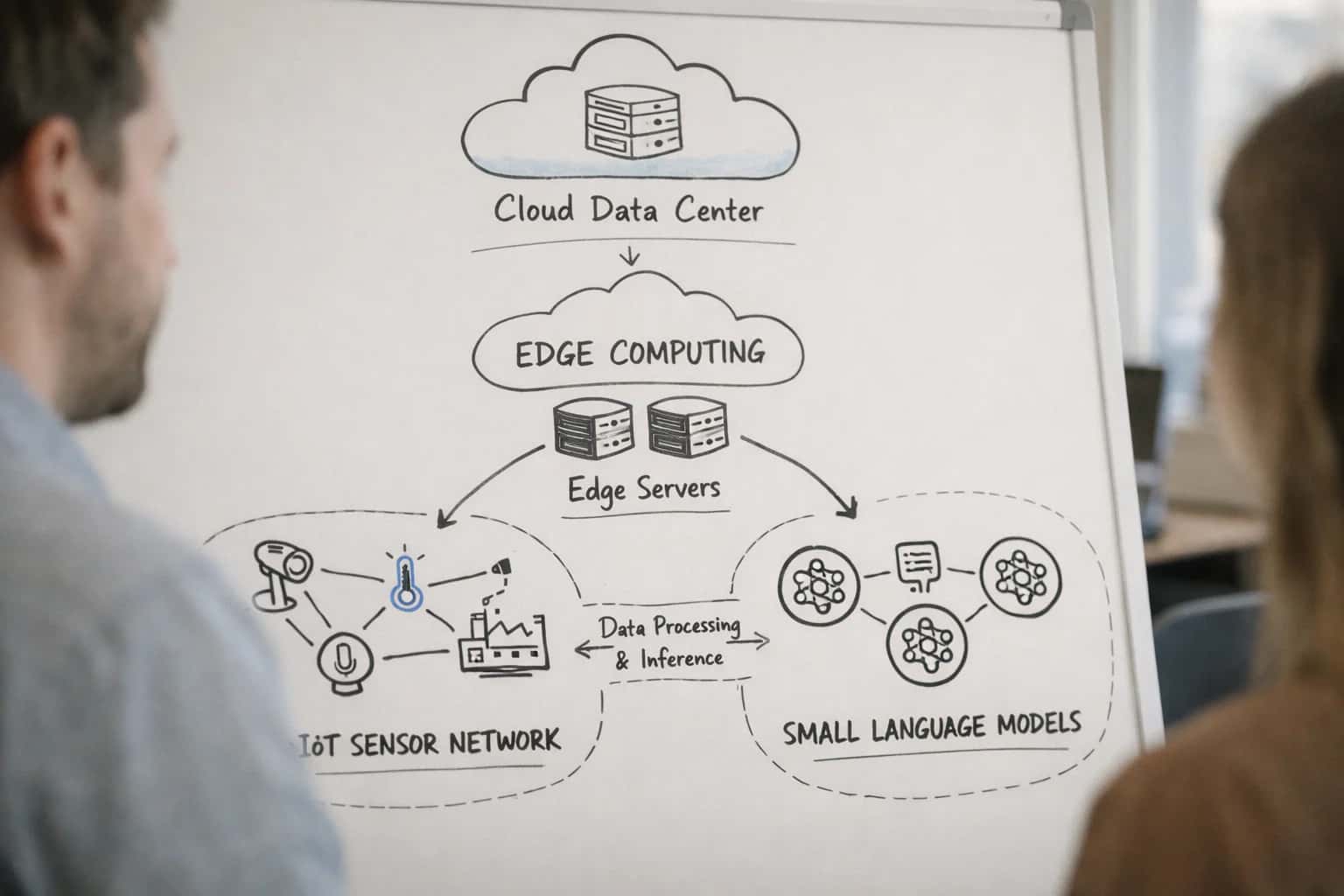
INFERENCE OPTIMIZATION
What is On-Device Inference?
On-device inference is the local execution of a trained machine learning model on end-user hardware, eliminating the need for cloud connectivity.
Deploying models on-device requires significant model compression and optimization. Techniques like post-training quantization, weight pruning, and knowledge distillation are used to reduce a model's computational footprint and memory requirements to fit within the limited resources of local hardware. Execution is often accelerated by specialized Neural Processing Units (NPUs) or via frameworks like TensorFlow Lite and PyTorch Mobile, which provide lightweight runtimes for diverse edge platforms.
ON-DEVICE INFERENCE
Key Technical Drivers and Benefits
On-device inference is driven by fundamental engineering constraints and delivers distinct advantages over cloud-based processing. These cards detail the core technical imperatives and resulting benefits.
01
Latency Elimination
The primary driver for on-device inference is the elimination of network round-trip time. By processing data locally, applications achieve deterministic, sub-100 millisecond response times critical for interactive use cases.
- Real-time interaction: Enables instant voice assistants, live camera filters, and responsive AR/VR.
- Predictable performance: Removes variability caused by network congestion or server load.
- Use Case: A live translation app must process audio and display text with near-zero delay to be usable in conversation.
< 100ms
Target Latency
02
Data Privacy & Sovereignty
On-device execution ensures sensitive user data—such as personal photos, health metrics, or private conversations—never leaves the physical device. This addresses stringent regulatory requirements and builds user trust.
- Local processing: Raw biometric, audio, and visual data is processed in memory without transmission.
- Regulatory compliance: Directly supports mandates like GDPR and HIPAA by design.
- Architecture: Models are deployed as part of the application binary, with inference occurring within the app's sandbox.
03
Operational Resilience
Devices must function reliably without dependency on external network connectivity or remote service availability. On-device inference provides full functionality in offline or bandwidth-constrained environments.
- Offline capability: Enables core features on airplanes, in remote areas, or during network outages.
- Reduced outage risk: Eliminates single points of failure associated with cloud API endpoints.
- Example: An industrial IoT sensor in a factory must perform anomaly detection continuously, regardless of Wi-Fi status.
04
Cost & Scalability
Shifting compute from centralized cloud infrastructure to distributed edge devices transforms operational economics. It removes per-API-call fees and scales inherently with device deployment.
- Zero marginal cost: After model deployment, individual inferences incur no additional cloud compute cost.
- Predictable TCO: Shifts expense from variable operational expenditure (OpEx) to fixed capital expenditure (CapEx) in device hardware.
- Scalability: System capacity grows linearly with each new device added, without backend scaling.
05
Bandwidth Conservation
Transmitting high-volume raw sensor data (e.g., video streams, lidar point clouds) to the cloud is often impractical. On-device inference compresses this data into lightweight insights or decisions before transmission.
- Data reduction: A security camera sends 'intruder detected' alerts instead of streaming 24/7 HD video.
- Network efficiency: Critical for satellite, cellular (IoT), or congested enterprise networks.
- Metric: Can reduce upstream data requirements by over 99% for continuous sensing applications.
> 99%
Upstream Data Reduction
06
Hardware Acceleration
Modern System-on-Chips (SoCs) integrate dedicated Neural Processing Units (NPUs), GPUs, and DSPs optimized for low-power matrix math. On-device frameworks leverage these to achieve efficient performance.
- Specialized silicon: NPUs like the Apple Neural Engine or Qualcomm Hexagon Tensor Accelerator deliver 10-100x better performance-per-watt than CPUs for inference.
- Framework support: TensorFlow Lite, PyTorch Mobile, and ONNX Runtime provide delegate APIs to target these accelerators.
- Result: Enables complex models (e.g., image segmentation) to run on a smartphone battery for hours.
SYSTEMS ARCHITECTURE
The On-Device Inference Technical Stack
The technical stack for on-device inference is a layered architecture of specialized software and hardware designed to execute trained machine learning models efficiently on resource-constrained local devices.
The software layer begins with a model format converter (e.g., for TensorFlow Lite, PyTorch Mobile, or ONNX) that optimizes a cloud-trained model for edge deployment. This feeds into a lightweight inference runtime or engine, which manages memory, schedules operations, and interfaces with underlying hardware via optimized kernels and operators. Frameworks like Apache TVM further compile models to generate highly efficient, hardware-specific code.
The hardware layer is anchored by the device's main processor (CPU), but performance and energy efficiency are unlocked by specialized accelerators. These include GPUs for parallel compute, Neural Processing Units (NPUs) for dedicated matrix math, and Digital Signal Processors (DSPs). The stack is completed by system software like drivers and a Trusted Execution Environment (TEE) for secure model execution, ensuring deterministic performance within strict power, thermal, and memory budgets.
ON-DEVICE INFERENCE
Common Use Cases and Applications
On-device inference enables a new class of applications by moving computation to the data source. This shift unlocks capabilities defined by low latency, data privacy, operational resilience, and cost efficiency.
01
Mobile & Consumer Applications
Smartphones and tablets are the most common platforms for on-device inference, powering features that demand instant response and user privacy.
- Real-time camera processing for features like portrait mode, night photography, and live translation overlays.
- Voice assistants and keyword spotting for always-on, low-power wake-word detection (e.g., 'Hey Siri').
- Predictive text and next-word prediction on virtual keyboards.
- Augmented Reality (AR) filters and object recognition that require sub-30ms latency for immersion.
- Health and fitness tracking using sensor data from wearables, processed locally to preserve sensitive biometric information.
02
Industrial IoT & Predictive Maintenance
Factories, energy grids, and heavy machinery use on-device models to monitor equipment in real-time, preventing failures without relying on cloud connectivity.
- Vibration and acoustic anomaly detection on motors, pumps, and turbines to predict mechanical failures.
- Visual inspection systems on production lines that identify product defects at high speed.
- Condition monitoring in remote locations (e.g., oil rigs, wind farms) where network access is unreliable or expensive.
- Process optimization models that adjust parameters (temperature, pressure) in real-time based on sensor fusion.
- These systems reduce unplanned downtime, lower bandwidth costs, and keep proprietary operational data on-premises.
03
Autonomous Systems & Robotics
Self-driving cars, drones, and autonomous mobile robots (AMRs) require split-second decisions that cannot tolerate network latency or dropouts.
- Perception stacks for object detection, lane tracking, and semantic segmentation from camera, LiDAR, and radar data.
- Path planning and obstacle avoidance that must react to dynamic environments in milliseconds.
- Gesture and intent recognition for human-robot collaboration in warehouses and manufacturing.
- Visual odometry and SLAM (Simultaneous Localization and Mapping) for navigation in GPS-denied environments.
- On-device processing is non-negotiable for functional safety and operational continuity.
04
Healthcare & Medical Devices
Medical applications leverage on-device inference to ensure patient privacy (HIPAA/GDPR compliance), provide instant diagnostics, and enable operation in low-connectivity settings.
- Portable ultrasound and ECG devices that provide real-time analysis and flag abnormalities.
- Continuous glucose monitors and insulin pumps that make autonomous, life-critical dosing decisions.
- Digital pathology on slide scanners for rapid cancer detection.
- Fall detection and health monitoring for elderly care in smart homes.
- Federated learning setups where hospitals collaboratively improve a diagnostic model without sharing patient data, with inference performed locally at each site.
05
Privacy-Sensitive & Regulated Environments
Industries with strict data sovereignty and privacy regulations use on-device inference as a foundational architectural principle to avoid data egress.
- Financial services for fraud detection on transaction data that cannot leave the branch or device.
- Defense and intelligence for analyzing sensor and signal data in the field.
- Legal and compliance document review on confidential client materials.
- Retail analytics that process in-store video for customer behavior insights without streaming footage to the cloud.
- This approach aligns with regulations like GDPR (data minimization), the EU AI Act, and corporate data sovereignty mandates.
06
Smart Cities & Ambient Intelligence
Distributed sensor networks in urban environments use edge inference to manage infrastructure efficiently and responsively while reducing central data center load.
- Intelligent traffic management systems that optimize signal timing based on real-time vehicle and pedestrian flow.
- Public safety cameras with on-board person and vehicle detection for immediate alerts, processing video locally to protect citizen privacy.
- Environmental monitoring for air quality, noise pollution, and water management using distributed sensor pods.
- Smart building management for occupancy-based HVAC and lighting control.
- These systems enable scalable, real-time city management without creating massive, centralized data pipelines.
ARCHITECTURAL DECISION
Cloud Inference vs. On-Device Inference: A Technical Comparison
A feature-by-feature comparison of the two primary paradigms for executing machine learning models, highlighting trade-offs in latency, cost, privacy, and operational resilience.
| Feature / Metric | Cloud Inference | On-Device Inference |
|---|---|---|
Primary Execution Location | Remote data center servers | Local end-user hardware (phone, IoT device, embedded system) |
Typical Latency | 100ms - 2s (network-dependent) | < 10ms - 100ms (deterministic, local compute) |
Network Dependency | Mandatory for every request | Optional or not required |
Data Privacy & Sovereignty | Data leaves the device; subject to provider policies & jurisdictions | Data never leaves the device; absolute local control |
Operational Cost Model | Recurring pay-per-API-call or reserved instance fees | High upfront model optimization cost; marginal per-device runtime cost ~$0 |
Scalability & Throughput | Effectively infinite, elastic scaling via provider infrastructure | Fixed by local hardware capabilities; scales with device fleet |
Hardware Utilization | Maximized via batching on high-end GPUs/TPUs | Must fit within strict device memory, power, and thermal budgets |
Model Update & Deployment | Centralized, instantaneous server-side rollout | Requires firmware/OTA updates; fragmented device fleet management |
Optimal Use Case | Large, complex models (e.g., GPT-4), batch processing, infrequent requests | Real-time applications (e.g., camera, audio), privacy-critical tasks, offline operation |
ON-DEVICE INFERENCE
Frequently Asked Questions
On-device inference is the local execution of trained machine learning models on end-user hardware, eliminating the need for cloud connectivity. This FAQ addresses the core techniques, trade-offs, and implementation challenges for developers and engineers.
On-device inference is the process of executing a trained machine learning model locally on an end-user's hardware device—such as a smartphone, IoT sensor, or embedded system—without sending data to a remote server. It works by deploying a pre-trained, optimized model (e.g., in TensorFlow Lite or ONNX Runtime format) onto the device's storage. When an input (like an image or audio clip) is presented, the local inference engine loads the model into memory and performs the forward pass using the device's available compute units (CPU, GPU, or a dedicated Neural Processing Unit (NPU)), producing a prediction entirely offline. This architecture prioritizes low latency, data privacy, and operational reliability in bandwidth-constrained or disconnected environments.
Enabling Efficiency, Speed & Accuracy
Intelligent Analysis, Decision & Execution
We build AI systems for teams that need search across company data, workflow automation across tools, or AI features inside products and internal software.
Talk to Us
Search across company data
Give teams answers from docs, tickets, runbooks, and product data with sources and permissions.
Useful when people spend too long searching or get different answers from different systems.
Enterprise searchRAGPermissions
Read more
Automate internal workflows
Use AI to route work, draft outputs, trigger actions, and keep approvals and logs in place.
Useful when repetitive work moves across multiple tools and teams.
AI agentsWorkflow automationGovernance
Read more
Add AI to products and internal tools
Build assistants, guided actions, or decision support into the software your team or customers already use.
Useful when AI needs to be part of the product, not a separate tool.
AI integrationDecision supportModel routing
Read more
About the author
Prasad Kumkar
CEO & MD, Inference Systems
Prasad Kumkar is the CEO & MD of Inference Systems and writes about AI systems architecture, LLM infrastructure, model serving, evaluation, and production deployment. Over 5+ years, he has worked across computer vision models, L5 autonomous vehicle systems, and LLM research, with a focus on taking complex AI ideas into real-world engineering systems.
His work and writing cover AI systems, large language models, AI agents, multimodal systems, autonomous systems, inference optimization, RAG, evaluation, and production AI engineering.
LinkedIn
Limited slotsGet a Free AI Consultation
Partnered with leading AI, data, and software stack.





How We Work
Custom AI workflows for your Business
One-fit-all AI don't work for modern businesses. At Inferensys, we aim to understand your business & custom requirements; which we use to define most efficient agentic workflows, the data, and the tools for your business.
01
Review the use case
We understand the task, the users, and where AI can actually help.
Read more02
Pick the right approach
We define what needs search, automation, or product integration.
Read more03
Build the first useful version
We implement the part that proves the value first.
Read more04
Improve from there
We add the checks and visibility needed to keep it useful.
Read moreThe first call is a practical review of your use case and the right next step.
Talk to Us