Model pipelining is an inference optimization technique that partitions a single neural network across multiple hardware stages or devices, enabling different parts of the model to process different data samples concurrently to maximize system throughput. This approach treats the model's layers as a pipeline, where data flows sequentially through stages, but multiple requests are processed in an overlapping, assembly-line fashion. It is a core strategy for latency hiding, particularly effective in on-device and edge inference scenarios where balancing compute load across heterogeneous components (e.g., CPU, GPU, NPU) is critical.

Glossary
Model Pipelining
Model pipelining is an inference optimization technique that splits a single neural network across multiple hardware stages or devices, allowing different parts of the model to process different data samples concurrently to improve throughput.
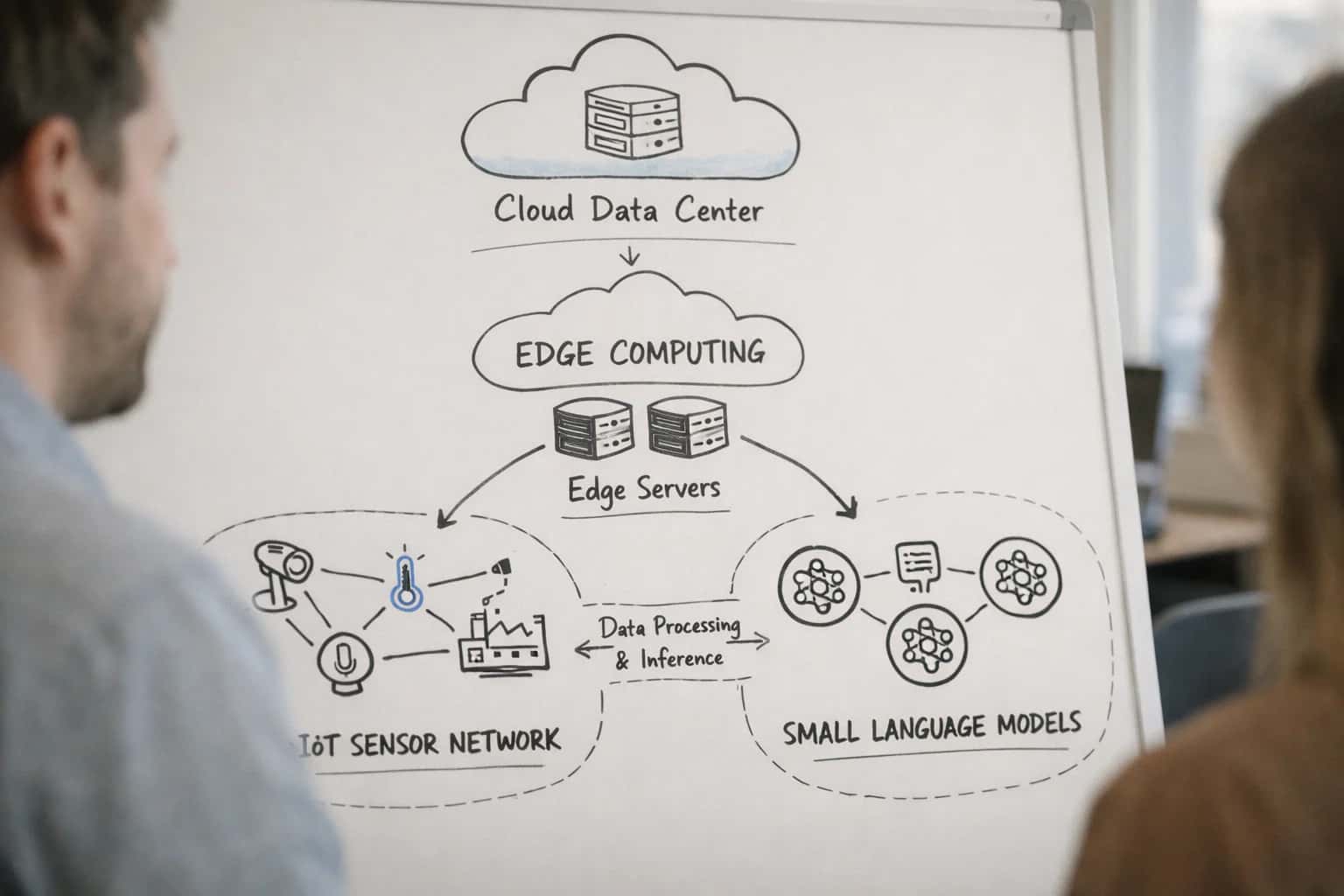
INFERENCE OPTIMIZATION
What is Model Pipelining?
Model pipelining is a throughput optimization technique for deploying neural networks across multiple hardware stages.
The technique is analogous to CPU instruction pipelining and is distinct from simple model parallelism. Effective implementation requires careful stage balancing to minimize idle time (bubble) and manage the inter-stage communication overhead. It is frequently combined with continuous batching to keep the pipeline full. While it primarily optimizes for throughput, it can also reduce peak memory pressure per device by distributing layer weights, making it valuable for deploying large models on resource-constrained edge hardware.
INFERENCE OPTIMIZATION
Key Characteristics of Model Pipelining
Model pipelining is an inference optimization technique that splits a single neural network across multiple hardware stages or devices, allowing different parts of the model to process different data samples concurrently to improve throughput.
01
Pipeline Parallelism
Model pipelining implements pipeline parallelism, a form of model parallelism where the layers of a neural network are partitioned across multiple devices (e.g., GPUs). Each device holds a different stage of the model. Data samples (micro-batches) are fed into the pipeline sequentially, with each stage processing a different sample concurrently, analogous to an assembly line. This maximizes hardware utilization and increases overall system throughput, though it can introduce pipeline bubbles during the fill and drain phases.
02
Micro-Batching
To keep the pipeline stages saturated with work, inputs are grouped into micro-batches. A micro-batch is a small, fixed-size group of samples that moves through the pipeline as a single unit.
- Enables concurrent processing across stages.
- Balances the trade-off between latency (smaller batches) and throughput (larger batches).
- The optimal micro-batch size is determined by hardware memory constraints and the desire to minimize pipeline bubbles.
03
Inter-Stage Communication
Efficient inter-stage communication is critical for pipeline performance. As activations and gradients are passed between devices, the bandwidth and latency of the interconnect (e.g., NVLink, PCIe, network) become a key bottleneck.
- Techniques like activation recomputation (or checkpointing) trade compute for memory by re-calculating activations during the backward pass to reduce the volume of data that must be stored and communicated.
- Overlapping communication with computation is a common optimization to hide transfer latency.
04
Pipeline Scheduling
The order in which micro-batches are processed by stages is governed by a pipeline schedule. Common schedules include:
- GPipe (Synchronous): Uses a simple fill-compute-drain schedule. Easy to implement but suffers from significant pipeline bubbles.
- 1F1B (One-Forward-One-Backward): Interleaves forward and backward passes to reduce memory footprint and bubbles, improving efficiency.
- Interleaved Scheduling: Further partitions model stages across more devices, allowing finer-grained interleaving and higher throughput at the cost of increased communication.
05
Memory Efficiency
Pipelining improves memory efficiency compared to standard data parallelism. In data parallelism, each device must hold a full copy of the model. In pipeline parallelism:
- Each device only stores the weights for its assigned stages, reducing per-device memory footprint.
- This enables the execution of models that are too large to fit on a single device's memory (model-scale-out).
- Memory for activations is managed carefully across the pipeline, often using the aforementioned techniques like activation checkpointing.
06
Use Cases & Trade-offs
Primary Use Case: Running massive models that exceed the memory of a single accelerator.
Key Trade-offs:
- Increased Throughput: Excellent for high-volume inference serving where request latency is less critical than total requests per second.
- Latency Penalty: The end-to-end latency for a single sample increases due to the time spent waiting in the pipeline (pipeline latency).
- Implementation Complexity: Requires careful balancing of stage workloads, scheduling, and communication optimization. It is often combined with data parallelism (creating a hybrid parallel strategy) to scale further.
INFERENCE OPTIMIZATION
How Model Pipelining Works
Model pipelining is a throughput-optimization technique that splits a single neural network across multiple hardware stages, enabling concurrent processing of different data samples.
Model pipelining is an inference optimization technique that partitions a neural network's computational graph across multiple hardware stages or devices. Each stage processes a different layer group, allowing multiple data samples (a micro-batch) to be processed concurrently in an assembly-line fashion. This inter-stage parallelism maximizes hardware utilization by keeping all accelerators (e.g., GPUs, NPUs) continuously active, significantly increasing overall system throughput compared to sequential execution, though it may introduce minimal pipeline flush latency.
The technique is governed by a pipeline schedule, such as GPipe or PipeDream, which manages the forward and backward passes for training or the forward pass for inference. Key challenges include balancing computational load across stages to avoid bottlenecks and managing the activation memory stored between stages. For edge and on-device inference, pipelining can split a model across heterogeneous cores (e.g., NPU, CPU, DSP) within a single System-on-a-Chip, optimizing for the unique capabilities of each processor to meet strict latency and power budgets.
MODEL PIPELINING
Use Cases and Applications
Model pipelining is a core inference optimization technique that segments a neural network across multiple hardware stages to enable concurrent processing of different data samples, dramatically improving throughput. Its applications are critical in latency-sensitive and resource-constrained environments.
01
High-Throughput Cloud Serving
In cloud inference services, pipelining is used to maximize GPU utilization and serve thousands of concurrent requests. By splitting a large model (e.g., a 70B parameter LLM) across multiple GPUs in a pipeline parallel fashion, different GPUs can process different requests or micro-batches simultaneously.
- Key Benefit: Achieves near-linear scaling in throughput with the number of pipeline stages, making large model serving economically viable.
- Example: A service using NVIDIA's TensorRT-LLM or Hugging Face's Text Generation Inference (TGI) can pipeline layers of Llama 3 across 4 GPUs, allowing Stage 1 GPU to process the forward pass for request N+1 while Stage 2 GPU processes request N.
02
Real-Time Video Analytics
For continuous video streams from security cameras or autonomous vehicles, a single deep vision model (e.g., YOLO for object detection) can become a bottleneck. Pipelining splits the model into stages like preprocessing, feature extraction, and classification.
- Key Benefit: Enables real-time frame rates by ensuring the GPU is never idle; while one frame is being classified, the next is undergoing feature extraction.
- Implementation: Using a framework like NVIDIA DeepStream, pipelines are constructed as graphs of plugins. This allows different hardware (CPU, GPU, DSP) to handle specific stages, optimizing for the overall system's latency and throughput requirements.
03
Split Computing for Edge-Cloud Collaboration
In split inference, the model pipeline is partitioned between an edge device and a cloud server. Early, lightweight layers run on the edge for initial processing and privacy filtering, while computationally intensive later layers are offloaded.
- Key Benefit: Balances low latency, bandwidth usage, and data privacy. Sensitive raw data (e.g., video) never leaves the device.
- Example: A smartphone running a face recognition app processes the initial convolutional layers locally to create a compact feature vector. Only this vector, not the raw image, is sent to the cloud for final identity matching, reducing latency and preserving privacy.
04
Multi-Modal Processing Pipelines
Complex AI applications like robotics or augmented reality require fusing data from multiple sensors (camera, LiDAR, microphone). A heterogeneous pipeline processes each modality through its own specialized model sub-pipeline before a fusion stage.
- Key Benefit: Enables parallel processing of independent data streams, reducing end-to-end latency for multi-modal decisions.
- Architecture: A vision transformer pipeline for camera feed and a speech recognition pipeline for audio run concurrently. Their outputs are synchronized and fed into a final fusion model (e.g., a vision-language-action model) for a unified command or perception.
05
Overlapping I/O with Compute
A fundamental use of pipelining is to hide the latency of data movement. In deep learning inference, the stages of loading data, preprocessing, model execution, and post-processing can be orchestrated as a pipeline.
- Key Benefit: Eliminates GPU idle time. While the GPU executes the model on batch N, the CPU is simultaneously loading and preprocessing batch N+1 in host memory.
- Mechanism: This is often implemented using double-buffering or triple-buffering techniques in inference servers like Triton Inference Server, where separate threads or processes manage each stage, passing data via queues.
06
Hardware-Accelerated Stage Specialization
Modern systems contain diverse accelerators (CPU, GPU, NPU, DSP). Pipelining allows different stages of a model to be compiled and executed on the most optimal hardware for that operation.
- Key Benefit: Maximizes overall system efficiency and energy-per-inference. Pre/post-processing stays on CPU, matrix-heavy layers run on NPU/GPU, and signal processing uses a DSP.
- Tooling: Compilers like Apache TVM or ONNX Runtime with execution providers can automatically partition a model graph and assign subgraphs to specific hardware backends, creating an optimized execution pipeline.
INFERENCE OPTIMIZATION COMPARISON
Model Pipelining vs. Related Techniques
A comparison of model pipelining with other key inference optimization and deployment strategies, highlighting their primary mechanisms, latency characteristics, and hardware targets.
| Feature / Mechanism | Model Pipelining | Split Inference | Model Parallelism | Continuous Batching |
|---|---|---|---|---|
Primary Objective | Maximize throughput by concurrent sample processing across pipeline stages | Balance latency, privacy, and compute by splitting model between device and server | Fit a single model that is too large for one device's memory across multiple devices | Maximize GPU utilization by dynamically batching requests with different sequence lengths |
Execution Granularity | Per-layer or per-stage across different data samples | Per-layer, typically at a designated partition point | Per-layer or per-tensor across a single data sample | Per-request within a dynamic batch |
Typical Latency Profile | Low per-sample latency, optimized for high throughput | Variable, depends on network round-trip for the server segment | High, due to sequential dependencies and communication overhead | Optimized for overall system throughput, individual request latency can increase |
Hardware Target | Multi-stage inference accelerators, edge server clusters | Edge device + cloud/edge server pair | Multiple high-end GPUs or AI accelerators | Single, powerful GPU or AI accelerator |
Communication Overhead | Inter-stage data transfer (on-chip or high-speed link) | Network transmission of intermediate activations | High-bandwidth inter-device communication (e.g., NVLink) | Minimal; coordination within a single device's memory |
Use Case Context | High-throughput video processing, sensor fusion pipelines | Privacy-sensitive applications (e.g., offloading part of a model from a phone) | Inference with extremely large models (e.g., 100B+ parameters) | Online serving of LLMs or diffusion models to multiple users |
Model Modification Required | Yes, model must be explicitly partitioned into pipeline stages | Yes, model must be split at a designated cut layer | Yes, model graph must be split across devices | No, works with standard model implementations |
Suitable for On-Device/Edge |
MODEL PIPELINING
Frequently Asked Questions
Model pipelining is a core technique for optimizing inference throughput by splitting a neural network across multiple hardware stages. These questions address its implementation, trade-offs, and role in modern edge and cloud deployments.
Model pipelining is an inference optimization technique that partitions a single neural network across multiple hardware stages or devices, enabling different parts of the model to process different data samples concurrently to maximize hardware utilization and throughput.
It works by splitting the model's computational graph into distinct stages, each assigned to a specific processor (e.g., GPU, NPU, or CPU core). A stream of input requests is fed into the pipeline. While Stage 1 processes request N, Stage 2 processes request N-1, and Stage 3 processes request N-2, and so on. This overlapping execution, analogous to an assembly line, hides the latency of individual layers and amortizes memory transfer costs. The key mechanism is the inter-stage buffer, which holds intermediate activations passed between pipeline stages. Frameworks like DeepSpeed and NVIDIA Triton Inference Server implement sophisticated pipelining schedulers to manage this data flow and minimize pipeline bubbles (idle time where a stage waits for data).
Enabling Efficiency, Speed & Accuracy
Intelligent Analysis, Decision & Execution
We build AI systems for teams that need search across company data, workflow automation across tools, or AI features inside products and internal software.
Talk to Us
Search across company data
Give teams answers from docs, tickets, runbooks, and product data with sources and permissions.
Useful when people spend too long searching or get different answers from different systems.
Enterprise searchRAGPermissions
Read more
Automate internal workflows
Use AI to route work, draft outputs, trigger actions, and keep approvals and logs in place.
Useful when repetitive work moves across multiple tools and teams.
AI agentsWorkflow automationGovernance
Read more
Add AI to products and internal tools
Build assistants, guided actions, or decision support into the software your team or customers already use.
Useful when AI needs to be part of the product, not a separate tool.
AI integrationDecision supportModel routing
Read more
About the author
Prasad Kumkar
CEO & MD, Inference Systems
Prasad Kumkar is the CEO & MD of Inference Systems and writes about AI systems architecture, LLM infrastructure, model serving, evaluation, and production deployment. Over 5+ years, he has worked across computer vision models, L5 autonomous vehicle systems, and LLM research, with a focus on taking complex AI ideas into real-world engineering systems.
His work and writing cover AI systems, large language models, AI agents, multimodal systems, autonomous systems, inference optimization, RAG, evaluation, and production AI engineering.
LinkedIn
Limited slotsGet a Free AI Consultation
Partnered with leading AI, data, and software stack.





How We Work
Custom AI workflows for your Business
One-fit-all AI don't work for modern businesses. At Inferensys, we aim to understand your business & custom requirements; which we use to define most efficient agentic workflows, the data, and the tools for your business.
01
Review the use case
We understand the task, the users, and where AI can actually help.
Read more02
Pick the right approach
We define what needs search, automation, or product integration.
Read more03
Build the first useful version
We implement the part that proves the value first.
Read more04
Improve from there
We add the checks and visibility needed to keep it useful.
Read moreThe first call is a practical review of your use case and the right next step.
Talk to Us