Edge AI shifts computation from centralized data centers to the source of data generation. This architectural paradigm is defined by executing on-device inference on resource-constrained hardware like Neural Processing Units (NPUs), microcontrollers, and smartphones. The primary technical drivers are inference latency reduction, bandwidth conservation, operational resilience without connectivity, and enhanced data privacy by keeping sensitive information local. It is a cornerstone of modern embodied intelligence systems and the Internet of Things (IoT).

Glossary
Edge AI
Edge AI is the deployment of machine learning models directly on local hardware devices, such as smartphones, IoT sensors, or gateways, to process data and perform inference without requiring a constant connection to a central cloud server.
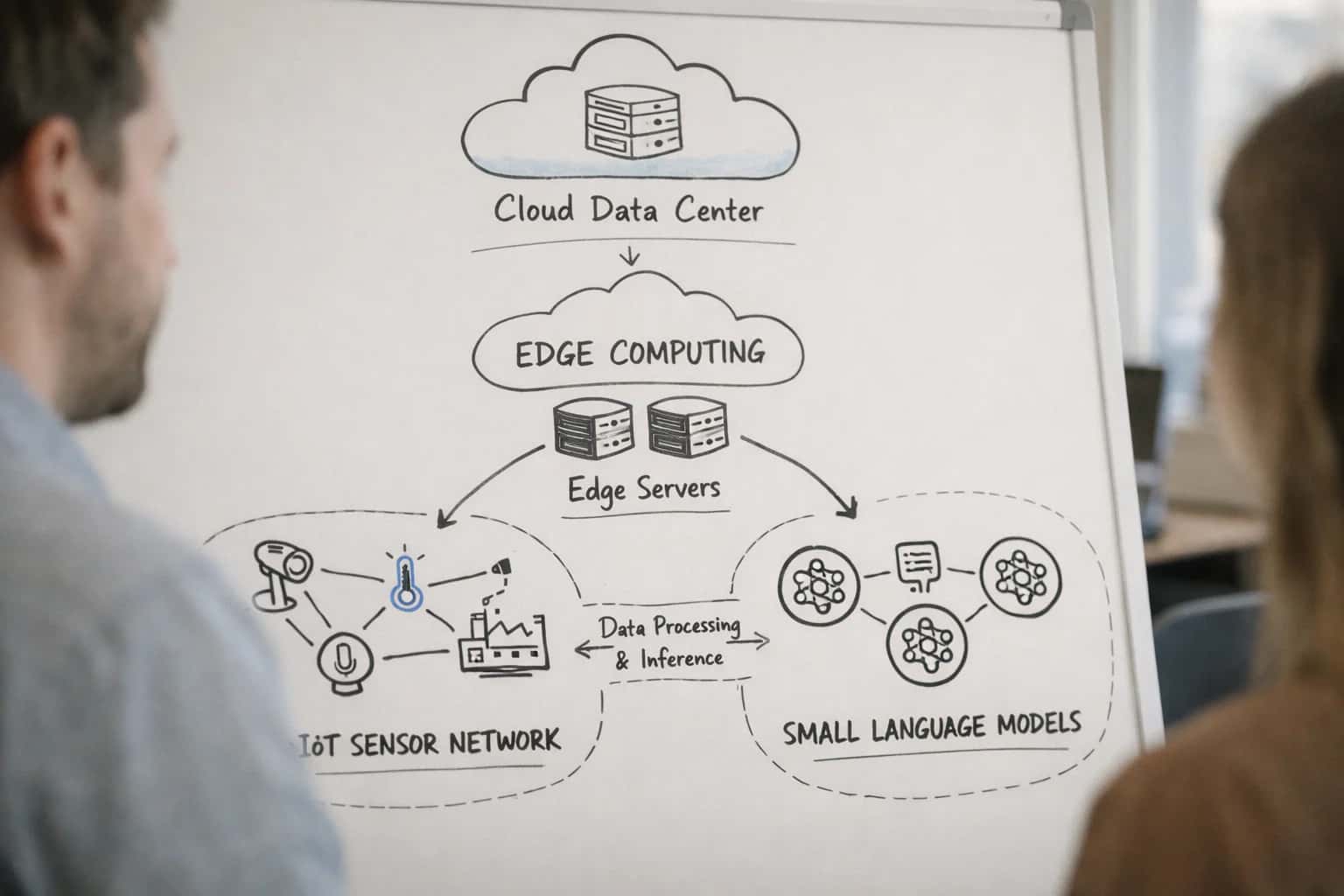
INFERENCE OPTIMIZATION AND LATENCY REDUCTION
What is Edge AI?
Edge AI is the deployment of machine learning models directly on local hardware devices, such as smartphones, IoT sensors, or gateways, to process data and perform inference without requiring a constant connection to a central cloud server.
Deploying models at the edge necessitates rigorous inference optimization. This involves techniques like model quantization, weight pruning, and knowledge distillation to create compact models such as MobileNet or EfficientNet. Frameworks like TensorFlow Lite, PyTorch Mobile, and compilers like Apache TVM are essential for cross-platform deployment. Related paradigms include Federated Learning for decentralized training and split inference for hybrid cloud-edge execution, balancing system constraints.
DEFINING ATTRIBUTES
Key Characteristics of Edge AI
Edge AI is defined by a set of core technical and operational attributes that differentiate it from cloud-centric AI. These characteristics directly address the constraints and opportunities of decentralized, local compute.
01
Low Latency & Real-Time Response
The primary technical driver for Edge AI is the drastic reduction in inference latency. By processing data locally, it eliminates the network round-trip time to a distant cloud server. This is critical for applications where milliseconds matter.
- Examples: Autonomous vehicle obstacle avoidance, industrial robotic control, real-time video analytics for security.
- Typical Latency: Often targets < 10 milliseconds, compared to 100+ ms for cloud round trips.
- Mechanism: Eliminates serialization/deserialization and network hop delays.
02
Bandwidth & Cost Efficiency
Edge AI minimizes the volume of data that must be transmitted to the cloud, conserving network bandwidth and reducing associated data transfer costs. Only essential insights or aggregated metadata are sent upstream, not raw sensor streams.
- Example: A smart camera sends 'Person detected at Entrance B' instead of streaming 24/7 HD video.
- Impact: Can reduce upstream bandwidth requirements by over 95% for high-frequency sensor data.
- Economic Driver: Critical for scaling IoT deployments where per-device cellular data costs are prohibitive.
03
Enhanced Privacy & Data Sovereignty
Sensitive data (e.g., video, audio, health metrics) can be processed locally, never leaving the device. This supports data sovereignty regulations (like GDPR) and reduces the attack surface for data breaches.
- Key Techniques: On-device anonymization, local model execution, federated learning updates.
- Use Cases: Healthcare diagnostics on medical devices, facial recognition in private spaces, confidential industrial inspection.
- Trust Boundary: Data remains within the user's or organization's physical control.
04
Operational Resilience & Offline Functionality
Edge AI systems maintain core functionality despite intermittent or absent cloud connectivity. This resilience is vital for applications in remote locations or critical infrastructure.
- Dependency: Removes the single point of failure of a central cloud API.
- Offline Modes: Devices operate in a degraded but functional state, caching insights for later sync.
- Industries: Agriculture, mining, maritime, disaster response, and defense.
05
Severe Resource Constraints
Edge devices operate under strict SWaP-C (Size, Weight, Power, and Cost) limits. This demands extreme model and system optimization.
- Typical Constraints: Power budgets in milliwatts to watts, memory in kilobytes to gigabytes, and no active cooling.
- Enabling Technologies: Model quantization, pruning, efficient architectures (e.g., MobileNet), and hardware accelerators (NPUs).
- Spectrum: Ranges from microcontrollers (MCUs) to powerful gateways and smartphones.
06
Hardware & Software Heterogeneity
The edge ecosystem is fragmented across countless device types, chipsets (ARM, x86, RISC-V), accelerators (NPU, GPU, DSP), and operating systems. This requires portable, optimized software runtimes.
- Challenge: A single model must often be compiled and optimized for dozens of target platforms.
- Key Frameworks: TensorFlow Lite, PyTorch Mobile, ONNX Runtime, and compilers like Apache TVM.
- Deployment Reality: 'Write once, deploy everywhere' is replaced by 'train once, optimize everywhere'.
ARCHITECTURE
How Edge AI Works
Edge AI is the deployment of machine learning models directly on local hardware devices, such as smartphones, IoT sensors, or gateways, to process data and perform inference without requiring a constant connection to a central cloud server.
Edge AI fundamentally shifts computation from centralized data centers to the network periphery. This architecture relies on on-device inference, where a pre-trained and optimized model executes locally on an edge device. The core workflow involves data capture by local sensors, immediate processing by the embedded model, and generation of a prediction or action. This eliminates the latency of round-trip cloud communication and operates independently of network connectivity, enabling real-time responsiveness and enhanced data privacy.
Deploying models at the edge requires significant model compression via techniques like quantization and pruning to fit within strict memory and power constraints. Execution is often accelerated by specialized hardware like Neural Processing Units (NPUs). The system design must also account for concept drift and model updates, which may be handled through federated learning paradigms. This creates a resilient, low-latency computing layer critical for applications from autonomous vehicles to industrial IoT.
APPLICATIONS
Common Edge AI Use Cases
Edge AI enables real-time, private, and resilient intelligence by processing data directly on local hardware. These are the primary domains where it delivers transformative value.
01
Industrial Predictive Maintenance
Sensors on factory equipment (e.g., motors, pumps) run vibration analysis and anomaly detection models locally to predict failures. This enables:
- Real-time alerts for immediate shutdown, preventing catastrophic damage.
- Reduced bandwidth costs by processing high-frequency sensor data on-site instead of streaming it to the cloud.
- Operational continuity in facilities with poor or no internet connectivity. Example: An oil refinery uses edge-based acoustic models to detect subtle changes in pump bearing wear, scheduling maintenance weeks before a failure.
02
Autonomous Vehicles & Robotics
Self-driving cars, drones, and autonomous mobile robots (AMRs) require sub-100 millisecond latency for perception and decision-making, which is impossible with cloud round-trips. Edge AI enables:
- Real-time sensor fusion: Combining LiDAR, radar, and camera feeds instantly for object detection and path planning.
- Functional safety: Operation continues even if cellular connection is lost.
- Bandwidth reduction: Only sending critical event summaries to the cloud, not continuous raw video. Core tasks include simultaneous localization and mapping (SLAM), obstacle avoidance, and trajectory prediction.
03
Smart Surveillance & Video Analytics
Security cameras and doorbells process video streams locally to identify events, preserving privacy and reducing cost. Use cases include:
- People/Vehicle Counting: Retail stores count foot traffic in real-time.
- Intrusion Detection: Factories or warehouses detect unauthorized entry after hours.
- Behavioral Analytics: Identifying loitering, falls, or fighting in public spaces.
- License Plate & Facial Recognition (with on-device databases for privacy). The key advantage is bandwidth efficiency: only metadata or thumbnail alerts are transmitted, not 24/7 HD video streams.
04
Healthcare & Medical Devices
Edge AI brings diagnostic and monitoring capabilities to point-of-care, ensuring patient data privacy and immediacy. Applications include:
- Wearable Health Monitors: Smartwatches that perform real-time atrial fibrillation detection via ECG analysis.
- Medical Imaging: Portable ultrasound or X-ray devices that provide instant, AI-assisted preliminary readings in remote clinics.
- Surgical Robotics: Providing haptic feedback and guidance by processing visual data within the sterile field.
- Continuous Patient Monitoring: In-hospital sensors that predict adverse events (e.g., sepsis) from vital signs without sending sensitive data off-premises.
05
Consumer Electronics & Smart Assistants
Smartphones, tablets, and home devices run models on-device for responsive, private user experiences. This includes:
- On-Device Speech Recognition & Synthesis: Voice assistants that work offline with keyword spotting to wake.
- Computational Photography: Phones using neural image signal processors (ISPs) for real-time HDR, night mode, and portrait effects.
- Augmented Reality (AR): Overlaying digital objects in real-time using pose estimation and object tracking.
- Predictive Text & Live Translation: Keyboard suggestions and language translation that do not leak typed content. The driver is user latency expectations (<1 second response) and growing data privacy regulations.
06
Agriculture & Environmental Monitoring
Deployed in remote fields, greenhouses, and wildlife areas, edge AI systems operate autonomously without reliable connectivity. Examples are:
- Precision Agriculture: Drones or ground robots that perform real-time weed detection and targeted spraying, reducing herbicide use by over 70%.
- Livestock Monitoring: Collars with cameras that detect signs of disease or distress in individual animals.
- Water & Soil Management: Sensors that analyze moisture and nutrient levels, controlling irrigation valves automatically.
- Wildlife Conservation: Acoustic sensors in forests that identify specific animal calls or the sound of illegal logging activity. The primary benefit is operational autonomy in harsh, disconnected environments.
ARCHITECTURAL COMPARISON
Edge AI vs. Cloud AI: Key Differences
A technical comparison of the two primary deployment paradigms for machine learning inference, focusing on operational characteristics critical for system design.
| Feature / Metric | Edge AI | Cloud AI |
|---|---|---|
Primary Compute Location | Local device (e.g., phone, IoT sensor, gateway) | Remote data center |
Network Dependency for Inference | ||
Typical Inference Latency | < 10-100 milliseconds | 100-1000+ milliseconds (varies with network) |
Data Privacy & Sovereignty | Data processed locally; no raw data transmission | Raw data transmitted to and processed in cloud |
Operational Resilience | Functions fully during network outages | Inference fails during network/service outages |
Upfront Hardware Cost | Higher (requires capable local silicon) | Lower (uses shared, rented infrastructure) |
Ongoing Operational Cost | Primarily power; no per-query cloud fees | Recurring fees based on compute, storage, and data transfer |
Scalability (Compute Power) | Fixed by local hardware; vertical scaling limited | Effectively infinite; elastic horizontal scaling |
Model Update & Deployment | Complex; requires orchestrated OTA updates to fleet | Trivial; single update to centralized service |
Typical Model Size/Complexity | Highly optimized, compressed (e.g., INT8, pruned) | Large, full-precision models (e.g., FP16/BF16) |
Energy Efficiency Profile | Optimized for milliwatt-to-watt power budgets | Optimized for throughput, not per-query energy use |
Use Case Examples | Real-time object detection, keyword spotting, predictive maintenance on machinery | Batch data analysis, large language model queries, training massive models |
KEY TECHNOLOGIES & FRAMEWORKS
Edge AI
Edge AI is the deployment of machine learning models directly on local hardware devices, such as smartphones, IoT sensors, or gateways, to process data and perform inference without requiring a constant connection to a central cloud server.
01
Core Architecture: On-Device Inference
The fundamental execution pattern of Edge AI, where a trained model runs locally on the end-user hardware. This eliminates the latency of network round-trips, reduces bandwidth costs, and enhances data privacy by keeping sensitive information on the device.
- Key Benefit: Enables real-time applications like live object detection and instant voice commands.
- Primary Constraint: Must operate within the device's limited compute, memory, and power budget.
02
Enabling Technology: Model Compression
A suite of techniques essential for fitting performant models onto resource-constrained edge hardware.
- Model Quantization: Reduces the numerical precision of weights and activations (e.g., from FP32 to INT8), slashing memory use and accelerating computation.
- Weight Pruning: Systematically removes redundant parameters to create a sparse, smaller network.
- Knowledge Distillation: Trains a compact student model to replicate the behavior of a larger teacher model.
03
Hardware Accelerators: NPUs & MCUs
Specialized silicon designed for efficient neural network execution at the edge.
- Neural Processing Unit (NPU): A dedicated accelerator integrated into modern SoCs (e.g., in smartphones) that executes matrix operations with extreme energy efficiency.
- Microcontroller Unit (MCU): Ultra-low-power chips (with KB of RAM/Flash) that run TinyML models for always-on sensing in wearables and IoT sensors.
- Trade-off: NPUs offer higher performance; MCUs enable the lowest power consumption and cost.
05
Advanced Paradigm: Federated Learning
A privacy-preserving, decentralized training method aligned with Edge AI principles. The model is improved collaboratively across edge devices.
- Process: Each device trains on its local data, then sends only encrypted model updates (not raw data) to a central server for aggregation into an improved global model.
- Key Use: Enables continuous model learning from user behavior (e.g., next-word prediction) while maintaining strict data sovereignty and compliance.
- Enhancement: Often combined with Differential Privacy to provide mathematical guarantees against data leakage.
06
Use Cases & Applications
Edge AI enables a wide range of responsive, private, and robust applications.
- Industrial IoT: Predictive maintenance on factory equipment using vibration and thermal sensors.
- Autonomous Vehicles: Real-time perception (object detection, lane keeping) requiring sub-100ms latency.
- Smartphones: Live photo segmentation, offline translation, and personalized on-device recommendations.
- Healthcare: Wearables for real-time heart anomaly detection and fall prediction.
- Retail: Smart cameras for inventory management and loss prevention without streaming video to the cloud.
EDGE AI
Frequently Asked Questions
Edge AI involves running machine learning models directly on local hardware devices, such as smartphones, IoT sensors, or industrial gateways, to process data and perform inference without a constant cloud connection. This glossary addresses key technical questions for developers and engineers implementing these systems.
Edge AI is the deployment and execution of machine learning models directly on local hardware devices—such as smartphones, IoT sensors, cameras, or embedded systems—instead of in a centralized cloud data center. It works by taking a trained model, optimizing it for the target hardware's constraints (e.g., via quantization or pruning), and deploying it within an on-device inference runtime like TensorFlow Lite or ONNX Runtime. The device captures sensor data (images, audio, telemetry), processes it locally through the model to generate a prediction (e.g., object detection, anomaly classification), and can act on that result immediately, often without any network transmission.
Enabling Efficiency, Speed & Accuracy
Intelligent Analysis, Decision & Execution
We build AI systems for teams that need search across company data, workflow automation across tools, or AI features inside products and internal software.
Talk to Us
Search across company data
Give teams answers from docs, tickets, runbooks, and product data with sources and permissions.
Useful when people spend too long searching or get different answers from different systems.
Enterprise searchRAGPermissions
Read more
Automate internal workflows
Use AI to route work, draft outputs, trigger actions, and keep approvals and logs in place.
Useful when repetitive work moves across multiple tools and teams.
AI agentsWorkflow automationGovernance
Read more
Add AI to products and internal tools
Build assistants, guided actions, or decision support into the software your team or customers already use.
Useful when AI needs to be part of the product, not a separate tool.
AI integrationDecision supportModel routing
Read more
About the author
Prasad Kumkar
CEO & MD, Inference Systems
Prasad Kumkar is the CEO & MD of Inference Systems and writes about AI systems architecture, LLM infrastructure, model serving, evaluation, and production deployment. Over 5+ years, he has worked across computer vision models, L5 autonomous vehicle systems, and LLM research, with a focus on taking complex AI ideas into real-world engineering systems.
His work and writing cover AI systems, large language models, AI agents, multimodal systems, autonomous systems, inference optimization, RAG, evaluation, and production AI engineering.
LinkedIn
Limited slotsGet a Free AI Consultation
Partnered with leading AI, data, and software stack.





How We Work
Custom AI workflows for your Business
One-fit-all AI don't work for modern businesses. At Inferensys, we aim to understand your business & custom requirements; which we use to define most efficient agentic workflows, the data, and the tools for your business.
01
Review the use case
We understand the task, the users, and where AI can actually help.
Read more02
Pick the right approach
We define what needs search, automation, or product integration.
Read more03
Build the first useful version
We implement the part that proves the value first.
Read more04
Improve from there
We add the checks and visibility needed to keep it useful.
Read moreThe first call is a practical review of your use case and the right next step.
Talk to Us