Model deployment is the process of integrating a trained machine learning model into a live production environment, making its predictive capabilities available to end-users or downstream software systems via a defined interface. This phase transitions the model from a development artifact to a live service, involving containerization, serving infrastructure setup, and the creation of API endpoints. It is a core component of MLOps, bridging the gap between data science experimentation and reliable, scalable software engineering.

Glossary
Model Deployment
Model deployment is the phase of the machine learning lifecycle where a trained model is integrated into a live production environment, making its predictive capabilities available to end-users or other software systems.
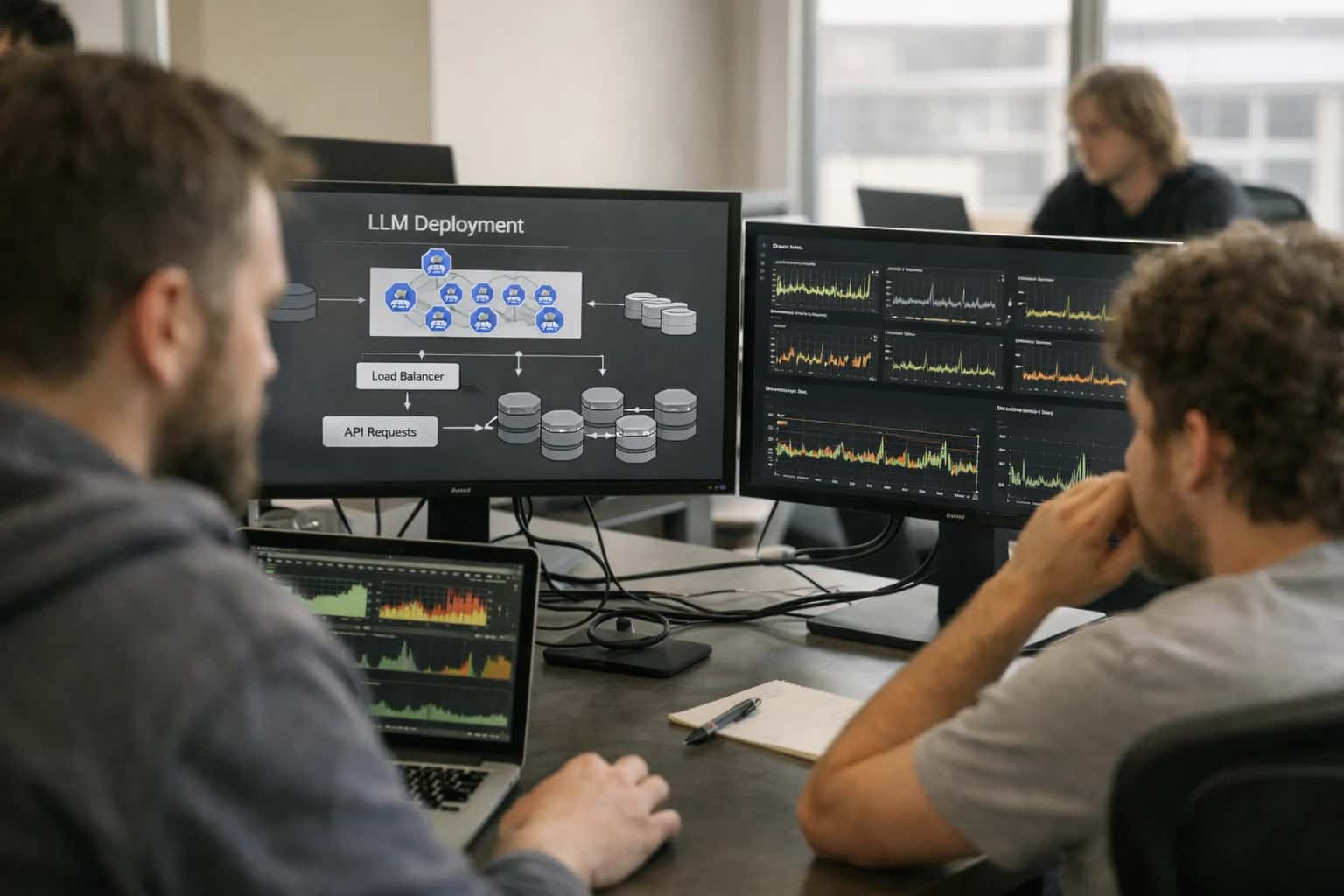
INFERENCE OPTIMIZATION AND LATENCY REDUCTION
What is Model Deployment?
Model deployment is the critical operational phase where a trained machine learning model is integrated into a live production environment to serve predictions.
The deployment architecture must address key production concerns including latency, throughput, scalability, and reliability. This involves selecting appropriate model serving patterns like online inference for real-time requests or batch inference for high-volume processing. Techniques such as canary deployments and blue-green deployments are used to manage releases with minimal risk. Effective deployment ensures the model delivers consistent, low-latency predictions while integrating with monitoring systems for model performance and drift detection.
MODEL SERVING ARCHITECTURES
Key Components of a Deployment System
A production-grade model deployment system is a complex orchestration of software and infrastructure designed for reliability, scalability, and observability. These are its core architectural components.
02
API Gateway & Load Balancer
The entry point and traffic manager for all inference requests. This component routes client requests to available backend servers and enforces system-wide policies.
- Load Balancing: Distributes requests across multiple inference server instances using algorithms like round-robin or least connections.
- Cross-Cutting Concerns: Handles authentication, authorization, rate limiting, SSL termination, and request logging.
- Health Checks: Probes backend servers to route traffic only to healthy instances. Tools like NGINX, Envoy, and cloud-native load balancers (AWS ALB, GCP Cloud Load Balancing) fulfill this role.
03
Orchestrator & Scheduler
The control plane that manages the lifecycle of containerized inference services. It automates deployment, scaling, and recovery.
- Kubernetes is the de facto standard, using objects like Deployments and StatefulSets to declare the desired state.
- Scheduling: Places pods (containers) onto nodes based on resource constraints (GPU memory, CPU).
- Auto-scaling: Horizontally scales the number of inference server pods up or down based on metrics like CPU utilization or requests per second using the Horizontal Pod Autoscaler (HPA).
04
Model Registry & Artifact Store
A versioned, centralized repository for trained model artifacts and their metadata. It is the single source of truth for models promoted to production.
- Stores model files (
.pt,.pb,.onnx), code, and dependencies. - Tracks Metadata: Training metrics, dataset version, hyperparameters, and lineage.
- Enables Governance: Access control, approval workflows, and audit trails. Examples include MLflow Model Registry, Weights & Biases Model Registry, and cloud-native solutions like Azure ML Model Registry.
05
Observability Stack
The integrated suite of tools for monitoring, logging, and tracing the health and performance of the deployment.
- Metrics: Collects system (CPU, memory, GPU utilization) and business metrics (latency, throughput, error rate) via Prometheus.
- Logging: Aggregates structured logs from all components using the ELK Stack (Elasticsearch, Logstash, Kibana) or Loki.
- Distributed Tracing: Tracks a single request's path through the gateway, load balancer, and inference server using Jaeger or Zipkin to diagnose latency bottlenecks.
06
Continuous Deployment Pipeline
The automated workflow that tests, packages, and deploys a new model version into production. It bridges the gap between model development and serving.
- Stages typically include:
- Validation: Unit tests, model performance evaluation on a holdout set.
- Packaging: Containerizing the model and its runtime environment into a Docker image.
- Staging Deployment: Canary or blue-green deployment to a small percentage of traffic.
- Promotion: Full rollout upon validation of performance and stability. Tools like GitLab CI/CD, GitHub Actions, and Argo CD automate this pipeline.
MODEL SERVING ARCHITECTURES
Common Deployment Patterns and Strategies
Model deployment strategies define the architectural blueprints and operational procedures for transitioning a trained machine learning model from a development artifact into a reliable, scalable production service.
Model deployment is the phase of the machine learning lifecycle where a trained model is integrated into a live production environment, making its predictive capabilities available via defined interfaces. Core strategies include online inference for low-latency, synchronous requests and batch inference for high-throughput, asynchronous processing of large datasets. The choice between these patterns is dictated by business latency requirements and computational efficiency.
Advanced operational patterns ensure reliability and scalability. Blue-green deployments and canary deployments facilitate safe, zero-downtime model updates. Multi-tenancy and serverless inference architectures optimize infrastructure cost and utilization. These strategies are typically implemented using specialized inference servers like Triton or KServe, managed within Kubernetes clusters with auto-scaling and load balancers to handle variable traffic.
ARCHITECTURAL COMPARISON
Deployment Challenges and Technical Solutions
A comparison of core model serving architectures, highlighting their trade-offs in scalability, resource management, and operational complexity for production deployment.
| Architectural Feature | Monolithic Server | Microservices | Serverless Functions |
|---|---|---|---|
Cold Start Latency | < 1 sec | 2-10 sec | 1-10 sec (varies) |
Per-Request Cost Efficiency | |||
Stateful Session Support | |||
Fine-Grained Autoscaling | |||
Multi-Tenancy Isolation | |||
Operational Overhead | Low | High | Managed |
Optimal Request Pattern | Steady, high throughput | Variable, mixed workloads | Sporadic, unpredictable |
MODEL DEPLOYMENT
Frequently Asked Questions
Essential questions on deploying machine learning models into production, covering architectures, scaling, and operational patterns for ML Ops and DevOps engineers.
Model deployment is the phase of the machine learning lifecycle where a trained model is integrated into a live production environment, making its predictive capabilities available to end-users or other software systems via a defined interface. This involves packaging the model, its dependencies, and runtime into a servable artifact, exposing it through an API endpoint, and managing the underlying compute infrastructure for scalability, reliability, and observability. The goal is to transition from experimental validation to a stable service that delivers business value, requiring careful consideration of latency, throughput, cost, and monitoring.
Enabling Efficiency, Speed & Accuracy
Intelligent Analysis, Decision & Execution
We build AI systems for teams that need search across company data, workflow automation across tools, or AI features inside products and internal software.
Talk to Us
Search across company data
Give teams answers from docs, tickets, runbooks, and product data with sources and permissions.
Useful when people spend too long searching or get different answers from different systems.
Enterprise searchRAGPermissions
Read more
Automate internal workflows
Use AI to route work, draft outputs, trigger actions, and keep approvals and logs in place.
Useful when repetitive work moves across multiple tools and teams.
AI agentsWorkflow automationGovernance
Read more
Add AI to products and internal tools
Build assistants, guided actions, or decision support into the software your team or customers already use.
Useful when AI needs to be part of the product, not a separate tool.
AI integrationDecision supportModel routing
Read more
About the author
Prasad Kumkar
CEO & MD, Inference Systems
Prasad Kumkar is the CEO & MD of Inference Systems and writes about AI systems architecture, LLM infrastructure, model serving, evaluation, and production deployment. Over 5+ years, he has worked across computer vision models, L5 autonomous vehicle systems, and LLM research, with a focus on taking complex AI ideas into real-world engineering systems.
His work and writing cover AI systems, large language models, AI agents, multimodal systems, autonomous systems, inference optimization, RAG, evaluation, and production AI engineering.
LinkedIn
Limited slotsGet a Free AI Consultation
Partnered with leading AI, data, and software stack.





How We Work
Custom AI workflows for your Business
One-fit-all AI don't work for modern businesses. At Inferensys, we aim to understand your business & custom requirements; which we use to define most efficient agentic workflows, the data, and the tools for your business.
01
Review the use case
We understand the task, the users, and where AI can actually help.
Read more02
Pick the right approach
We define what needs search, automation, or product integration.
Read more03
Build the first useful version
We implement the part that proves the value first.
Read more04
Improve from there
We add the checks and visibility needed to keep it useful.
Read moreThe first call is a practical review of your use case and the right next step.
Talk to Us