Symmetric Quantization is a model compression technique that maps floating-point values to a lower-bit integer representation using a quantization range centered symmetrically around zero. This scheme simplifies the quantization and dequantization formulas by fixing the quantization zero-point to 0, which reduces computational overhead during inference. It is a foundational method within Post-Training Quantization (PTQ) and Quantization-Aware Training (QAT) workflows aimed at enabling efficient INT8 inference.

Glossary
Symmetric Quantization
Symmetric quantization is a neural network compression scheme where the quantization range is centered on zero, eliminating the zero-point parameter to simplify integer arithmetic during inference.
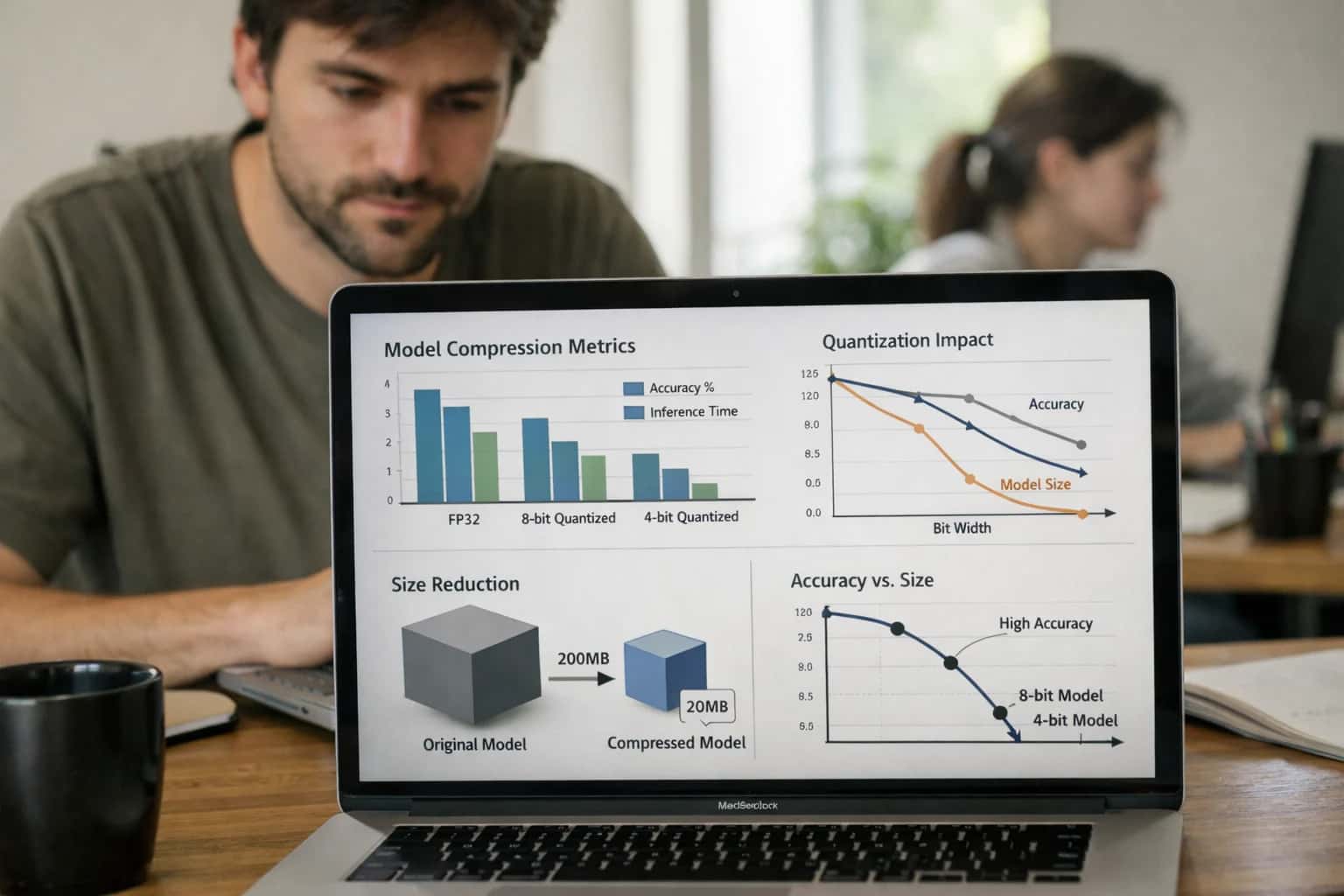
MODEL QUANTIZATION
What is Symmetric Quantization?
A core technique for deploying efficient neural networks on resource-constrained hardware.
The primary advantage over Asymmetric Quantization is computational simplicity, as symmetric operations eliminate the need for zero-point corrections during integer matrix multiplication. However, it can be less efficient if the original tensor's value distribution is not symmetric, potentially wasting part of the quantized range and increasing quantization error. It is commonly used for weight tensors and is a standard option in frameworks like TensorRT Quantization and TFLite Quantization.
MECHANISM
Core Mechanism and Mathematical Formulation
Symmetric quantization simplifies the mapping from floating-point to integer values by centering the quantization range on zero. This core mechanism eliminates the need for a separate zero-point parameter.
01
The Symmetric Range
The defining characteristic of symmetric quantization is that the representable range is symmetric around zero. This is expressed as [-α, +α], where α is the absolute maximum value (or a calibrated scale factor) to be represented. This contrasts with asymmetric quantization, which uses a range [β, γ] not centered on zero.
- Key Property: The real-valued zero maps directly to the integer zero.
- Consequence: The zero-point parameter (z) is fixed at 0, simplifying the quantization and dequantization formulas significantly.
02
Quantization Formula
The process of converting a floating-point value x (within the range [-α, +α]) to an integer q is governed by a single scale factor (S).
Formula: q = clamp(round(x / S), -Q_max, Q_max)
Where:
S(Scale):α / Q_max. This is the step size between integer values.Q_max: The maximum positive integer representable. For INT8,Q_max = 2^(8-1) - 1 = 127.clampandround: Ensure the result is a valid integer within the symmetric range.
The absence of a zero-point term (z) is what makes this formula simpler than its asymmetric counterpart.
03
Dequantization Formula
To recover an approximate floating-point value x' from the quantized integer q, a single multiplication is performed.
Formula: x' = q * S
This operation is computationally cheap, often just an integer multiplication or a bit shift. The simplicity of this dequantization step is a major advantage for high-performance inference kernels on hardware like NPUs and GPUs, where fused multiply-add operations are optimized.
Quantization Error: The error introduced is x - x' = x - (q * S). Because the range is symmetric, this error is uniformly distributed around zero for data that is also symmetrically distributed.
04
Scale Factor Calculation
The accuracy of symmetric quantization hinges on choosing an appropriate scale S. The scale is derived from the range α.
Common Methods:
- Max:
α = max(abs(min(X)), abs(max(X))). Uses the absolute maximum value from tensorX. Simple but can be sensitive to outliers. - Calibrated (e.g., Percentile):
αis set to the 99.99th percentile ofabs(X)observed on a calibration dataset. This clips extreme outliers, reducing the range and improving precision for most common values.
For weights, the range is static. For activations in static quantization, this range is determined once during calibration.
05
Hardware and Performance Advantages
The mathematical simplicity of symmetric quantization translates directly to hardware efficiency.
- Simplified Kernels: Integer matrix multiplication kernels (e.g., INT8 GEMM) do not need to account for a zero-point offset, leading to cleaner, faster code.
- Zero-Point Free: Eliminating the zero-point removes a broadcast addition operation in the compute graph, reducing instruction count.
- Wide Support: This scheme is natively and optimally supported by inference engines like TensorRT, ONNX Runtime, and TFLite for INT8 inference on CPUs, GPUs, and NPUs.
It is the preferred scheme for linear layers (Conv, MatMul) where the data distribution is roughly symmetric.
06
Limitations and Asymmetric Contrast
Symmetric quantization is not optimal for all data distributions.
Key Limitation: It wastes representational capacity if the data is not centered on zero. For example, an activation function like ReLU, which produces only non-negative values, has an effective range of [0, γ]. Using a symmetric range [-γ, γ] dedicates half the quantization bins to negative values that never occur.
Contrast with Asymmetric Quantization:
- Asymmetric uses:
q = round(x / S) + zandx' = (q - z) * S. - The zero-point
zallows the quantized range[0, 255]for INT8 to map to any real range[β, γ], providing higher precision for asymmetric data at the cost of slightly more complex computation.
QUANTIZATION SCHEMES
Symmetric vs. Asymmetric Quantization
A comparison of the two fundamental schemes for mapping floating-point values to integers, detailing their mathematical properties, hardware implications, and typical use cases in model deployment.
| Feature / Metric | Symmetric Quantization | Asymmetric Quantization |
|---|---|---|
Mathematical Definition | Quantization range is symmetric around zero ([-α, +α]). Zero-point (z) is fixed at 0. | Quantization range is asymmetric ([β, γ]). Zero-point (z) is an integer mapping the real zero. |
Quantization Formula (float to int) | q = round(r / s) | q = round(r / s) + z |
Dequantization Formula (int to float) | r ≈ q * s | r ≈ (q - z) * s |
Zero-Point Value | 0 | Integer (often non-zero) |
Representation of Asymmetric Data | ||
Computational Overhead | Lower (no zero-point subtraction in integer matmul) | Higher (requires zero-point subtraction in integer matmul) |
Typical Hardware Support | Widely supported by integer units (e.g., NVIDIA Tensor Cores, ARM NEON) | Supported, but may require extra instructions for zero-point handling |
Common Calibration Method | Max absolute value (absmax) of tensor values. | Min-max range observation from calibration data. |
Quantization Error for Non-Zero-Centric Data | Higher (wasted quantization bins) | Lower (full use of integer range) |
Primary Use Case | Weights and activations with symmetric distributions (e.g., after LayerNorm/ReLU). Common for CNN/Transformer weights. | Activations with asymmetric distributions (e.g., ReLU outputs which are all ≥0). Common for model inputs or post-activation tensors. |
Example Framework Implementation | TensorRT for GPUs, TFLite (full integer for symmetric activations) | TFLite (default for activations), ONNX Runtime |
SYMMETRIC QUANTIZATION
Implementation and Framework Usage
Symmetric quantization is implemented across major ML frameworks and hardware backends to enable efficient integer arithmetic. Its core advantage is computational simplicity, achieved by centering the quantization range on zero.
01
Core Mathematical Formulation
The symmetric scheme is defined by a scale factor (S) and a zero-point (z) fixed at 0. The quantization and dequantization formulas simplify dramatically:
- Quantize:
q = round(r / S) - Dequantize:
r' = q * SBecausez = 0, there is no additive term. The scale is calculated asS = |max(abs(r_min), abs(r_max))| / (2^(b-1) - 1), wherebis the bit-width (e.g., 8). This ensures the range[-max_abs, max_abs]maps symmetrically to integer values like[-127, 127]for INT8.
02
TensorFlow & TFLite Implementation
TensorFlow Lite provides built-in symmetric quantization for INT8 inference. Key components:
- TFLite Converter: The
tf.lite.TFLiteConvertercan apply post-training integer quantization using a representative dataset for calibration. - Full Integer Deployment: Weights and activations are converted to INT8. The
inference_input_typeandinference_output_typeare set totf.int8. - Kernel Support: TFLite includes optimized kernels for symmetric INT8 operations like convolutions and fully connected layers, leveraging hardware acceleration on mobile and edge devices.
- Model Compatibility: Primarily applied to convolutional and dense layers. Dynamic-range quantization may be used for layers with highly variable activation ranges.
03
PyTorch: Torch.ao.quantization
PyTorch's quantization API supports symmetric quantization through its QConfig settings.
- QConfig Selection: A symmetric configuration is defined using
torch.ao.quantization.qconfig.QConfigwith a symmetricactivationobserver (e.g.,MinMaxObserverwithqscheme=torch.per_tensor_symmetric). - Observer for Calibration: Observers like
MinMaxObserverorHistogramObservercollect tensor statistics to determine thescalefactor. - Fusion and Preparation: Common patterns like Conv+ReLU are fused before inserting fake quantization modules (
prepare_qat). - Integer Model Export: The
convertfunction produces a model where weights and activations are represented as quantized integers, with floating-point scales stored for dequantization at specific points in the graph.
05
ONNX Runtime & Hardware Abstraction
ONNX Runtime (ORT) uses symmetric quantization for cross-platform performance.
- Quantization Tool: The
onnxruntime.quantizationmodule provides aQuantFormat.QOperatorpath for symmetric quantization, generating an ONNX model withQuantizeLinearandDequantizeLinearnodes. - Static Quantization: The
quantize_staticfunction requires a calibration dataset to determine the symmetric ranges for activations. - Execution Provider Support: Quantized models run efficiently across providers like CPU, CUDA, and TensorRT via ORT, as the symmetric integer operations are a standard target for hardware accelerators.
- Model Portability: The quantized ONNX model serves as an interchange format between training frameworks and diverse inference runtimes.
06
Hardware Advantages & Limitations
Symmetric quantization is favored in hardware design due to its efficiency but has specific constraints.
- Computational Benefit: With
z=0, the core operationr' = q * Sis a simple integer multiplication, avoiding an extra addition. This simplifies hardware datapaths and reduces circuit complexity. - Efficient Matrix Multiplication: For a layer operation
Y = XW, symmetric quantization allows the integer computationY_q = X_q * W_q, followed by a fused dequantization scaling, which is highly optimized. - Range Limitation: It is less efficient for tensors where the data distribution is not symmetric around zero (e.g., ReLU outputs which are all non-negative). Here, asymmetric quantization can use the available integer range more precisely.
- Common Use Case: It is predominantly used for weight tensors, which often have a symmetric distribution, and for activations following layers like
nn.Linearornn.Conv2dwithout a subsequent ReLU.
SYMMETRIC QUANTIZATION
Frequently Asked Questions
Symmetric quantization is a core technique in model compression, simplifying the conversion of model parameters to lower-precision integers. These questions address its mechanics, trade-offs, and practical applications.
Symmetric quantization is a scheme for reducing the numerical precision of neural network parameters where the quantization range is symmetric around zero, meaning the representable integer values are distributed equally above and below zero, which simplifies the quantization and dequantization formulas by setting the zero-point to 0.
This symmetry leads to a simpler mathematical transformation. The quantization formula becomes Q(x) = round(x / scale), and dequantization is x' = scale * Q(x). Because the zero-point is fixed at 0, the computational overhead of adding it during integer matrix multiplication is eliminated, leading to more efficient inference kernels on hardware that natively supports integer arithmetic, such as INT8 on GPUs or NPUs.
Enabling Efficiency, Speed & Accuracy
Intelligent Analysis, Decision & Execution
We build AI systems for teams that need search across company data, workflow automation across tools, or AI features inside products and internal software.
Talk to Us
Search across company data
Give teams answers from docs, tickets, runbooks, and product data with sources and permissions.
Useful when people spend too long searching or get different answers from different systems.
Enterprise searchRAGPermissions
Read more
Automate internal workflows
Use AI to route work, draft outputs, trigger actions, and keep approvals and logs in place.
Useful when repetitive work moves across multiple tools and teams.
AI agentsWorkflow automationGovernance
Read more
Add AI to products and internal tools
Build assistants, guided actions, or decision support into the software your team or customers already use.
Useful when AI needs to be part of the product, not a separate tool.
AI integrationDecision supportModel routing
Read more
About the author
Prasad Kumkar
CEO & MD, Inference Systems
Prasad Kumkar is the CEO & MD of Inference Systems and writes about AI systems architecture, LLM infrastructure, model serving, evaluation, and production deployment. Over 5+ years, he has worked across computer vision models, L5 autonomous vehicle systems, and LLM research, with a focus on taking complex AI ideas into real-world engineering systems.
His work and writing cover AI systems, large language models, AI agents, multimodal systems, autonomous systems, inference optimization, RAG, evaluation, and production AI engineering.
LinkedIn
Limited slotsGet a Free AI Consultation
Partnered with leading AI, data, and software stack.





How We Work
Custom AI workflows for your Business
One-fit-all AI don't work for modern businesses. At Inferensys, we aim to understand your business & custom requirements; which we use to define most efficient agentic workflows, the data, and the tools for your business.
01
Review the use case
We understand the task, the users, and where AI can actually help.
Read more02
Pick the right approach
We define what needs search, automation, or product integration.
Read more03
Build the first useful version
We implement the part that proves the value first.
Read more04
Improve from there
We add the checks and visibility needed to keep it useful.
Read moreThe first call is a practical review of your use case and the right next step.
Talk to Us