An Access Control List (ACL) is a data structure that enumerates the permissions granted to specific agents, roles, or tasks for accessing defined geographic zones or resources within a fleet orchestration system. In the context of heterogeneous fleet orchestration, an ACL functions as the definitive rulebook for a zone, specifying which autonomous mobile robots, manual vehicles, or human operators are allowed to enter, traverse, or perform work. It is a fundamental component of spatial authorization policies, translating high-level safety and operational rules into enforceable machine instructions.

Glossary
Access Control List (ACL)
An Access Control List (ACL) is a data structure that enumerates the permissions granted to specific agents or roles for accessing defined zones or resources within a fleet orchestration system.
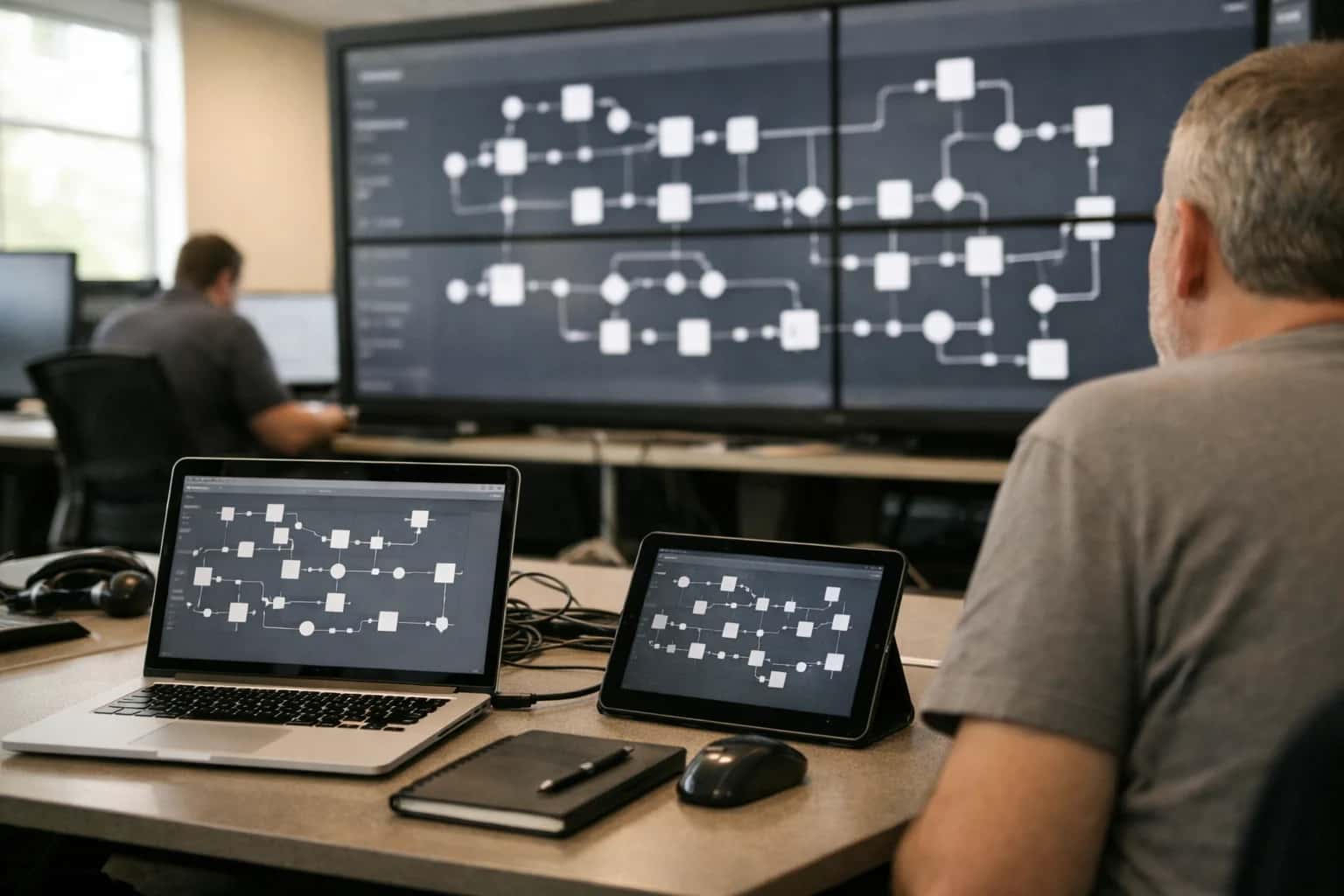
ZONE MANAGEMENT PROTOCOLS
What is Access Control List (ACL)?
A core data structure for enforcing spatial access rules in automated environments.
ACLs are evaluated by a Policy Decision Point (PDP) when an agent requests zone entry. The list is typically attached to a zone object and can implement models like Role-Based Access Control (RBAC) or Attribute-Based Access Control (ABAC). This enables dynamic, state-aware permissions, such as only allowing a high-priority robot into a congested area. Effective ACL management is critical for collision avoidance, deadlock prevention, and maintaining the integrity of mutual exclusion zones within a shared workspace.
ACCESS CONTROL FUNDAMENTALS
Core Characteristics of an ACL
An Access Control List (ACL) is a fundamental data structure for authorization. In heterogeneous fleet orchestration, it explicitly defines which agents can perform what actions within specific geographic zones.
01
Explicit Permission Enumeration
An ACL is an explicit list that enumerates permissions for specific subjects (agents, roles) on specific objects (zones, resources). Unlike implicit rules, each entry directly states a subject-object-action relationship (e.g., Agent_123 -> Zone_A -> TRAVERSE). This provides deterministic, auditable control but can become verbose for large systems. It is the foundational model for implementing discretionary access control within a zone management system.
02
Subject-Centric vs. Object-Centric
ACLs can be structured in two primary ways:
- Access Control List (ACL): Object-centric. The list is attached to the zone (object) and specifies which subjects can access it. This answers "Who can access this zone?"
- Capability List: Subject-centric. The list is attached to the agent (subject) and specifies which zones it can access. This answers "What zones can this agent enter?" In fleet orchestration, object-centric ACLs are more common for zone management, as the primary concern is controlling access to a location. The zone's ACL is evaluated when any agent requests entry.
03
Fine-Grained Authorization
ACLs support fine-grained permissions beyond simple entry/exit. For a mobile robot or vehicle, typical actions in an ACL entry may include:
- TRAVERSE: Permission to move through the zone.
- OCCUPY: Permission to stop and perform work within the zone.
- PICKUP/DROPOFF: Permission to interact with inventory in the zone.
- ADMINISTER: Permission to modify the zone's own ACL or properties. This granularity allows a single zone to have different rules for different agent types (e.g., AMRs can OCCUPY, while manual forklifts can only TRAVERSE).
04
Static vs. Dynamic Evaluation
ACL entries can be statically defined during system configuration or dynamically evaluated at runtime.
- Static ACLs: Permissions are fixed in a configuration file. Simple but inflexible.
- Dynamic ACLs: The ACL system queries external contextual attributes (e.g., agent's battery level, current task priority, time of day) to make a real-time decision. This bridges the gap between simple ACLs and Attribute-Based Access Control (ABAC). For example, an ACL rule might grant access only if
agent.battery > 20%ANDtask.priority == HIGH.
05
Default-Deny Security Posture
A core security principle of ACL implementation is default-deny. If an agent's request for zone access does not match any explicit ALLOW entry in the relevant ACL, the request is implicitly DENIED. This "whitelist" approach is more secure than "blacklisting" bad actors. The ACL must be comprehensive, as any omission becomes a denial. This posture is critical for safety in physical environments where unauthorized access could cause collisions.
06
Integration with Policy Enforcement
An ACL is a data structure, not an enforcement mechanism. It integrates with the Zone Policy Decision Point (PDP) and Policy Enforcement Point (PEP).
- PEP intercepts an agent's zone entry request.
- PDP retrieves and evaluates the zone's ACL against the agent's identity and requested action.
- PDP returns an ALLOW/DENY decision.
- PEP executes the decision, physically controlling access via signals to the agent or zone infrastructure (e.g., traffic lights, virtual gates). The ACL is the authoritative source the PDP consults.
ZONE MANAGEMENT PROTOCOLS
How an ACL Works in Fleet Orchestration
An Access Control List (ACL) is the fundamental data structure that enforces spatial permissions in a multi-agent system, dictating which agents can enter, occupy, or perform actions within specific geographic zones.
An Access Control List (ACL) is a data structure that enumerates the permissions granted to specific agents, roles, or attributes for accessing defined zones or resources within a fleet orchestration system. It functions as the definitive rulebook for spatial authorization, answering the core question of "who can go where and do what." Each entry in the list typically maps an entity identifier to a set of permitted actions—such as TRAVERSE, OCCUPY, or LOAD—for a particular zone, forming the basis for all automated access decisions.
In operation, the ACL is consulted by a Policy Decision Point (PDP) when an agent requests zone entry. The system evaluates the agent's identity and context against the list to render an Allow or Deny decision, which is then enforced by a Policy Enforcement Point (PEP). This mechanism is distinct from broader models like Role-Based Access Control (RBAC) or Attribute-Based Access Control (ABAC), which can inform the ACL's contents but are not the enforcement list itself. The ACL provides a granular, auditable record of permissions essential for safe deconfliction and operational control in dynamic environments.
COMPARISON
ACL vs. Other Access Control Models
A feature comparison of Access Control Lists (ACLs) against other common authorization models used in heterogeneous fleet orchestration for zone management.
| Feature / Attribute | Access Control List (ACL) | Role-Based Access Control (RBAC) | Attribute-Based Access Control (ABAC) |
|---|---|---|---|
Primary Control Unit | Individual Agent / Identity | Pre-defined Role | Dynamic Attributes & Environment |
Policy Definition Complexity | Low to Medium | Medium | High |
Granularity of Control | High (per-agent, per-zone) | Medium (per-role, per-zone) | Very High (context-aware) |
Dynamic Adaptation to State | |||
Administrative Overhead | High (scales with agents) | Low (scales with roles) | Medium (scales with policies) |
Real-Time Evaluation Speed | < 1 ms | < 1 ms | 1-10 ms |
Inherent Support for Mutual Exclusion | |||
Spatial-Temporal Context Awareness | |||
Typical Use Case in Fleet Orchestration | Static zone access for known agents | Access based on agent class (e.g., AMR, Forklift) | Dynamic access based on battery, priority, congestion |
HETEROGENEOUS FLEET ORCHESTRATION
ACL Use Cases in Autonomous Fleets
An Access Control List (ACL) is a foundational data structure for zone management, explicitly defining which agents or roles have permission to enter or perform actions within specific geographic areas of a workspace. In autonomous fleets, ACLs enforce spatial safety, operational efficiency, and security by codifying granular access rules.
01
Dynamic Task-Based Access
ACLs are dynamically updated to grant temporary access based on an agent's active task assignment. For example, a mobile robot assigned to retrieve a pallet in Zone A-12 would receive an ACL entry permitting entry only to that zone for the duration of the task. This principle of least privilege minimizes spatial conflicts and enhances security by ensuring agents only access areas necessary for their immediate work.
- Mechanism: The orchestration engine pushes a new ACL to the agent or the Zone Policy Enforcement Point (PEP) upon task dispatch.
- Revocation: Access is automatically revoked upon task completion, failure, or reassignment.
02
Heterogeneous Agent Type Filtering
ACLs enforce segregation between different agent types within a shared environment. A single zone's ACL may permit autonomous forklifts but explicitly deny manual pallet jacks or human workers to prevent unsafe interactions.
- Example Rule:
Zone: High-Speed Conveyor Adjacency | Allow: AMR Class 3 | Deny: Manual Vehicle, Pedestrian - Implementation: The ACL evaluates the agent's declared type attribute against the list. This is a core use case for integrating ACLs with Attribute-Based Access Control (ABAC) models, where agent type is a key decision attribute.
03
Priority-Based Preemption & Overrides
ACLs manage concurrency control and priority-based access in congested zones. While a zone may allow multiple agents, a high-priority agent (e.g., one responding to a line-down exception) can be granted an overriding permission that triggers a graceful preemption.
- Process: The high-priority agent's ACL entry includes a preemption flag. The Zone Orchestration Engine instructs lower-priority occupants to vacate via their real-time replanning engine.
- Safety: Preemption protocols are coupled with deadlock detection algorithms to ensure safe evacuation without creating gridlock.
04
Temporal Access Windows
ACLs incorporate time-based constraints to manage workflow phases and scheduled maintenance. Access permissions are only valid within defined temporal windows.
- Use Cases:
- Allowing cleaning robots access only during shift changeovers.
- Restricting all traffic in a zone during a pre-scheduled human maintenance window.
- Enforcing quiet hours in certain areas.
- Technical Implementation: Each ACL entry has valid_from and valid_until timestamp fields. The Zone Policy Decision Point (PDP) evaluates these in real-time against the fleet's synchronized clock.
05
Emergency Response & Zone Quarantine
ACLs are instrumental in emergency protocols. In response to a safety sensor trigger (e.g., a spilled liquid), the system can instantly reconfigure ACLs to implement a zone quarantine.
- Action: The ACL for the affected zone is updated to DENY ALL ingress. ACLs for surrounding zones may be updated to facilitate emergency zone clearance.
- Integration: This is tightly coupled with exception handling frameworks and fleet health monitoring. The zone state machine transitions to
QUARANTINE, and this state is a primary input for ACL policy decisions.
06
Audit Trail for Compliance & Diagnostics
Every ACL check generates an immutable audit log entry. This is critical for post-incident analysis, regulatory compliance, and system diagnostics.
- Logged Data: Timestamp, agent ID, zone ID, requested action, policy decision (Allow/Deny), and the specific ACL rule that was matched.
- Value:
- Proves adherence to safety protocols (e.g., "no forklifts in pedestrian areas").
- Diagnoses boundary violation detection events by showing the ACL state at the time of violation.
- Feeds into algorithmic explainability efforts for the orchestration system's decisions.
ACCESS CONTROL LIST (ACL)
Frequently Asked Questions
An Access Control List (ACL) is a fundamental data structure for authorization in heterogeneous fleet orchestration. It explicitly defines which agents or roles have permission to perform specific actions within defined geographic zones or on system resources.
An Access Control List (ACL) is a data structure that enumerates the permissions granted to specific agents, roles, or identities for accessing defined zones or resources within a fleet orchestration system. In robotics and warehouse automation, an ACL functions as the definitive rulebook for spatial authorization, dictating which autonomous mobile robot (AMR), automated guided vehicle (AGV), or manual vehicle can enter, work within, or traverse a specific geographic area (zone) at a given time. It is a core component of zone management protocols, translating high-level safety and operational policies into enforceable, machine-readable instructions. Each entry in an ACL typically specifies a subject (e.g., 'Forklift_Agent_12', 'Maintenance_Role'), an object (e.g., 'HighBay_Storage_Aisle_3', 'Charging_Station_5'), and the permissions granted (e.g., ENTER, OCCUPY, TRAVERSE, EXIT).
Enabling Efficiency, Speed & Accuracy
Intelligent Analysis, Decision & Execution
We build AI systems for teams that need search across company data, workflow automation across tools, or AI features inside products and internal software.
Talk to Us
Search across company data
Give teams answers from docs, tickets, runbooks, and product data with sources and permissions.
Useful when people spend too long searching or get different answers from different systems.
Enterprise searchRAGPermissions
Read more
Automate internal workflows
Use AI to route work, draft outputs, trigger actions, and keep approvals and logs in place.
Useful when repetitive work moves across multiple tools and teams.
AI agentsWorkflow automationGovernance
Read more
Add AI to products and internal tools
Build assistants, guided actions, or decision support into the software your team or customers already use.
Useful when AI needs to be part of the product, not a separate tool.
AI integrationDecision supportModel routing
Read more
About the author
Prasad Kumkar
CEO & MD, Inference Systems
Prasad Kumkar is the CEO & MD of Inference Systems and writes about AI systems architecture, LLM infrastructure, model serving, evaluation, and production deployment. Over 5+ years, he has worked across computer vision models, L5 autonomous vehicle systems, and LLM research, with a focus on taking complex AI ideas into real-world engineering systems.
His work and writing cover AI systems, large language models, AI agents, multimodal systems, autonomous systems, inference optimization, RAG, evaluation, and production AI engineering.
LinkedIn
Limited slotsGet a Free AI Consultation
Partnered with leading AI, data, and software stack.





How We Work
Custom AI workflows for your Business
One-fit-all AI don't work for modern businesses. At Inferensys, we aim to understand your business & custom requirements; which we use to define most efficient agentic workflows, the data, and the tools for your business.
01
Review the use case
We understand the task, the users, and where AI can actually help.
Read more02
Pick the right approach
We define what needs search, automation, or product integration.
Read more03
Build the first useful version
We implement the part that proves the value first.
Read more04
Improve from there
We add the checks and visibility needed to keep it useful.
Read moreThe first call is a practical review of your use case and the right next step.
Talk to Us