Event Sourcing is a software architecture pattern where every change to an application's state is captured as an immutable event object and stored in an append-only log, rather than simply updating the current state in place. The current state is derived by replaying this sequence of events in order, providing a complete, auditable history of every state transition.

Glossary
Event Sourcing
An architectural pattern where all changes to an application's state are stored as a sequence of immutable events, providing a complete and auditable transaction log that can be replayed to reconstruct the current fleet state.
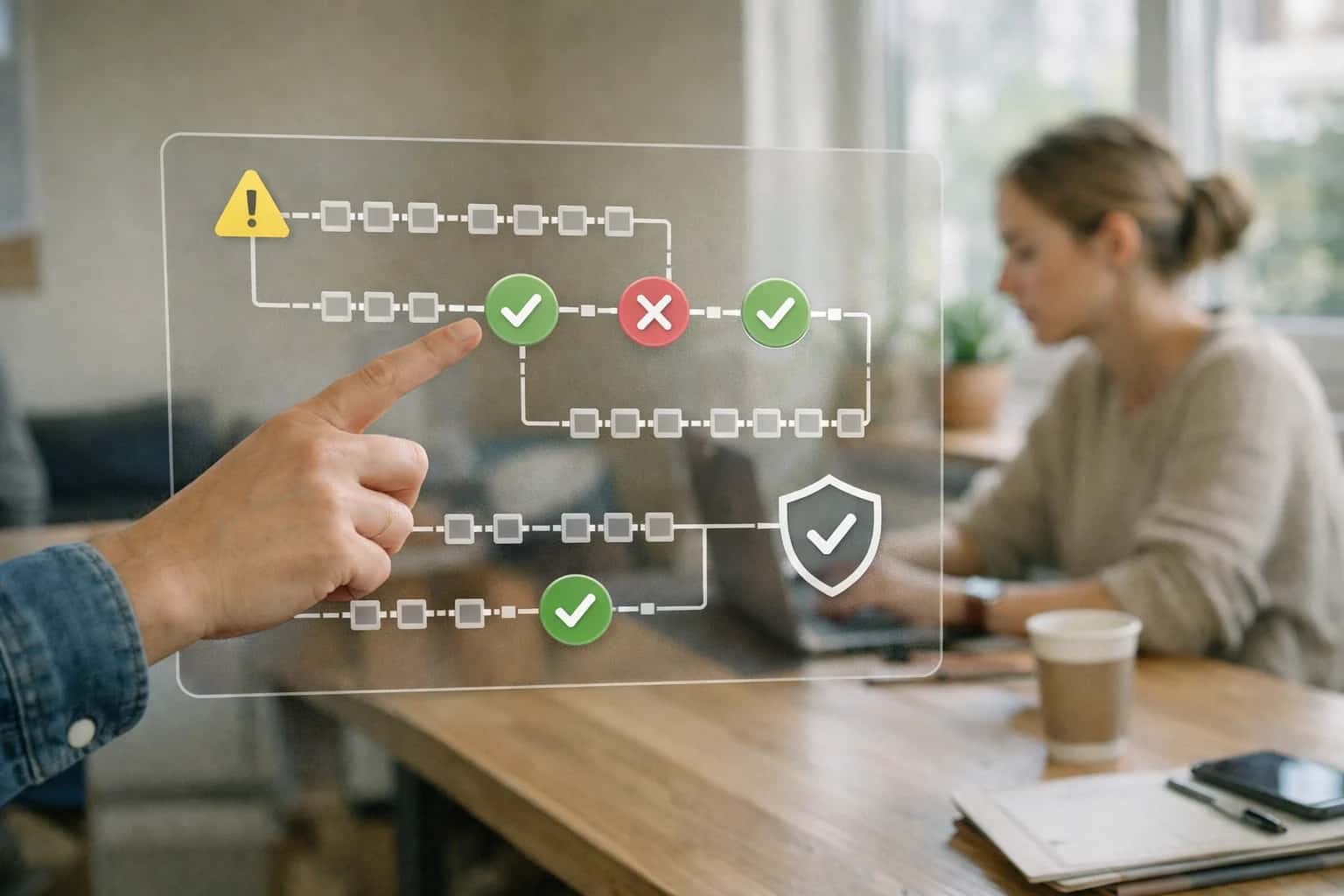
ARCHITECTURAL PATTERN
What is Event Sourcing?
Event Sourcing is an architectural pattern that persists the state of an application as an append-only sequence of immutable events, providing a complete and auditable transaction log.
In a heterogeneous fleet orchestration context, this pattern records every agent command, task assignment, and status change as a discrete event. The orchestrator can reconstruct the exact fleet state at any point in time by replaying the event log, enabling powerful debugging, temporal querying, and integration with CQRS architectures.
ARCHITECTURAL FOUNDATIONS
Key Features of Event Sourcing
Event Sourcing is a fundamental architectural pattern for building reliable, auditable, and reconstructable fleet orchestration systems. It captures every state change as an immutable event, providing a complete transaction log that serves as the single source of truth.
01
Immutable Append-Only Log
All state changes are stored as a sequence of immutable events in an append-only log. Events are never modified or deleted; corrections are made by appending compensating events. This provides a complete audit trail of every decision made by the orchestration middleware, from task assignments to agent state transitions. The log serves as the system of record, enabling full historical reconstruction of fleet activity for compliance and debugging.
02
Event Replay and State Reconstruction
The current state of any entity—such as an agent's position, a task's status, or a zone's occupancy—is derived by replaying all events in sequence from the beginning of time. This eliminates the need for separate state databases and ensures that any materialized view can be rebuilt from the event stream. Key benefits include:
- Temporal queries: Reconstruct fleet state at any point in time
- Debugging: Replay events to reproduce and diagnose failures
- Migration: Rebuild projections with new business logic without data loss
03
CQRS Pattern Integration
Event Sourcing is commonly paired with Command Query Responsibility Segregation (CQRS) , separating write operations (commands that produce events) from read operations (queries against materialized views). In fleet orchestration, this means:
- Command side: Validates and processes commands like
AssignTaskorRerouteAgent, producing events - Query side: Maintains optimized read models for dashboards, state estimation, and real-time monitoring This separation allows independent scaling of read and write workloads, critical for high-throughput fleet operations.
04
Event-Driven Communication
Events serve as the primary communication mechanism between microservices in the orchestration platform. When a new event is persisted, it is published to subscribers via the Message Bus. Downstream services—such as the Fleet State Estimation engine, Deadlock Detection module, or Human-in-the-Loop Interface—react to events asynchronously. This decouples producers from consumers, enabling:
- Loose coupling between orchestration components
- Independent deployability of services
- Natural integration with the Saga Pattern for distributed transactions
05
Snapshots for Performance
Replaying thousands of events to reconstruct state becomes computationally expensive over time. Snapshots capture the aggregate state at a specific event version, allowing replay to start from the snapshot rather than from event zero. The orchestration middleware periodically creates snapshots for each aggregate—such as an agent's full state or a task's lifecycle—balancing replay performance with storage efficiency. Snapshots are purely an optimization; they can be discarded and regenerated from the event log at any time.
06
Event Schema Evolution
As fleet orchestration requirements evolve, event schemas must change without breaking existing event streams. Strategies include:
- Upcasting: Transform old events to new schemas during replay using versioned mappers
- Schema Registry integration: Validate event compatibility at publish time, preventing breaking changes
- Weakly-typed payloads: Store event data in flexible formats like JSON with semantic versioning This ensures that events recorded months ago remain replayable even as the Unified Control API and agent drivers evolve.
EVENT SOURCING IN FLEET ORCHESTRATION
Frequently Asked Questions
Clear, technical answers to the most common questions about applying event sourcing to heterogeneous fleet orchestration, covering core concepts, implementation details, and architectural trade-offs.
Event sourcing is an architectural pattern where every change to a fleet's application state is captured as an immutable, append-only event record, rather than simply updating the current state in place. In fleet orchestration, this means that instead of a database row showing an AGV's current position as 'Docking Bay 4', the system stores a sequence of events: AGV-42 Departed Waypoint A, AGV-42 Entered Corridor 7, AGV-42 Arrived Docking Bay 4. The current state is derived by replaying this event log from the beginning. This provides a complete, auditable transaction log that is invaluable for debugging complex multi-agent interactions, reconstructing the exact sequence of events leading to a collision or deadlock, and performing time-travel queries to analyze fleet behavior at any historical moment. The core mechanism involves an event store—an append-only database optimized for sequential writes—and projections, which are read models built by processing the event stream into a queryable format for real-time dashboards and APIs.
Enabling Efficiency, Speed & Accuracy
Intelligent Analysis, Decision & Execution
We build AI systems for teams that need search across company data, workflow automation across tools, or AI features inside products and internal software.
Talk to Us
Search across company data
Give teams answers from docs, tickets, runbooks, and product data with sources and permissions.
Useful when people spend too long searching or get different answers from different systems.
Enterprise searchRAGPermissions
Read more
Automate internal workflows
Use AI to route work, draft outputs, trigger actions, and keep approvals and logs in place.
Useful when repetitive work moves across multiple tools and teams.
AI agentsWorkflow automationGovernance
Read more
Add AI to products and internal tools
Build assistants, guided actions, or decision support into the software your team or customers already use.
Useful when AI needs to be part of the product, not a separate tool.
AI integrationDecision supportModel routing
Read moreDATA ARCHITECTURE COMPARISON
Event Sourcing vs. Traditional State Persistence
A technical comparison of event sourcing against traditional CRUD-based state persistence for fleet orchestration systems.
| Feature | Event Sourcing | Traditional CRUD | Change Data Capture |
|---|---|---|---|
Primary Storage Model | Immutable event stream | Current state snapshot | Transaction log + snapshot |
Complete Audit Trail | |||
Temporal Query Capability | |||
State Reconstruction | Replay events from genesis | Restore from latest backup | Replay from log + snapshot |
Write Complexity | Append-only | Read-modify-write | Append-only log |
Storage Volume Growth | High (every event retained) | Low (overwrites in place) | Medium (log rotation) |
Eventual Consistency Support | |||
Schema Evolution Difficulty | Low (events are additive) | High (migrations required) | Medium (log schema changes) |

About the author
Prasad Kumkar
CEO & MD, Inference Systems
Prasad Kumkar is the CEO & MD of Inference Systems and writes about AI systems architecture, LLM infrastructure, model serving, evaluation, and production deployment. Over 5+ years, he has worked across computer vision models, L5 autonomous vehicle systems, and LLM research, with a focus on taking complex AI ideas into real-world engineering systems.
His work and writing cover AI systems, large language models, AI agents, multimodal systems, autonomous systems, inference optimization, RAG, evaluation, and production AI engineering.
LinkedIn
Limited slotsGet a Free AI Consultation
Partnered with leading AI, data, and software stack.





How We Work
Custom AI workflows for your Business
One-fit-all AI don't work for modern businesses. At Inferensys, we aim to understand your business & custom requirements; which we use to define most efficient agentic workflows, the data, and the tools for your business.
01
Review the use case
We understand the task, the users, and where AI can actually help.
Read more02
Pick the right approach
We define what needs search, automation, or product integration.
Read more03
Build the first useful version
We implement the part that proves the value first.
Read more04
Improve from there
We add the checks and visibility needed to keep it useful.
Read moreThe first call is a practical review of your use case and the right next step.
Talk to Us