In a heterogeneous fleet orchestration system, the control plane functions as the system's brain, making all strategic decisions about task assignment, route planning, and resource allocation. It maintains the global state of the fleet, processes incoming work requests, and applies business rules and safety policies to determine which agent should execute which task. The control plane pushes these decisions down to the data plane, which handles the physical execution and real-time data transfer.

Glossary
Control Plane
The control plane is the architectural layer in a distributed orchestration system responsible for making high-level decisions about routing, configuration, and policy enforcement, logically separated from the data plane that executes the actual data transfer and agent commands.
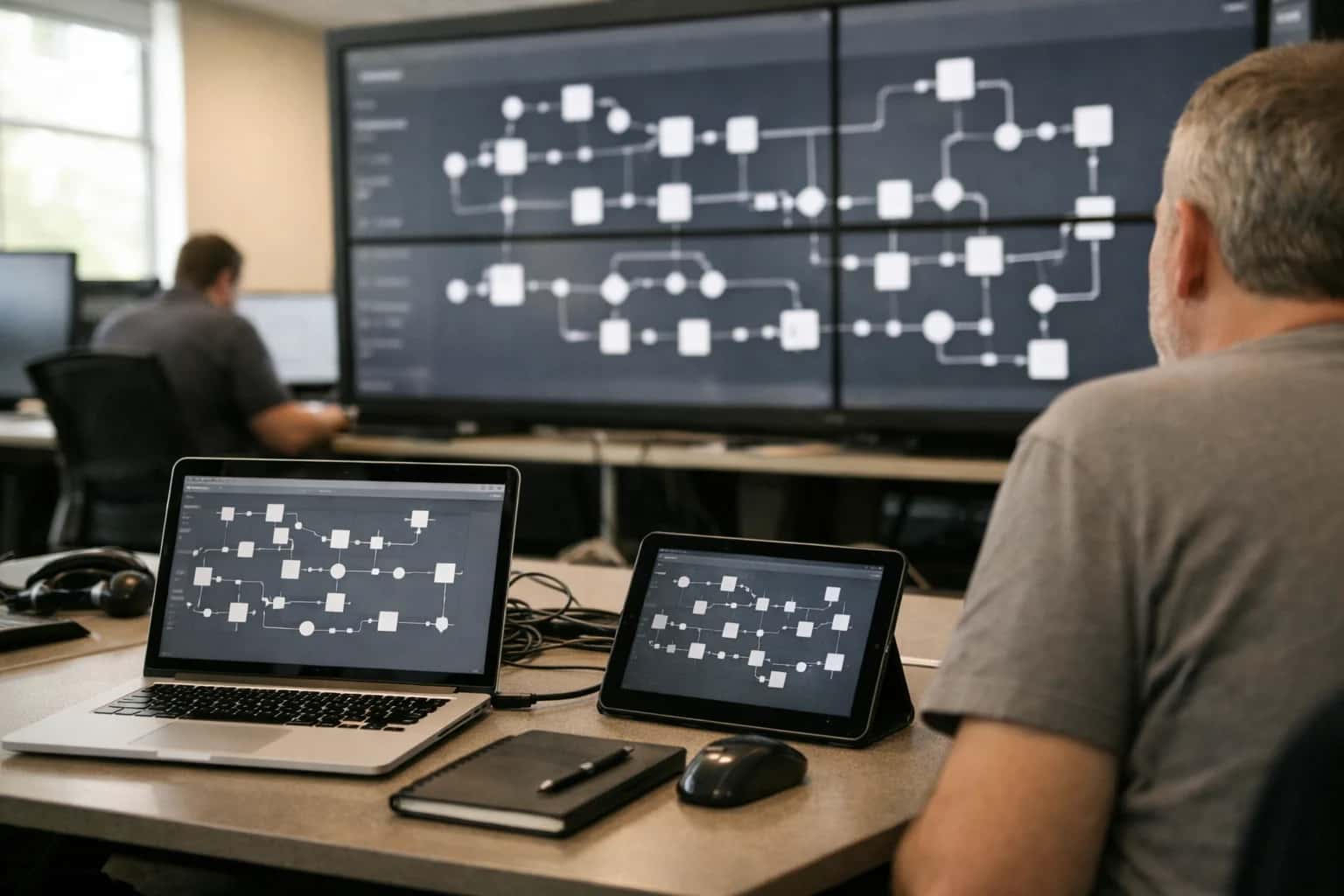
ORCHESTRATION ARCHITECTURE
What is Control Plane?
The control plane is the part of a distributed orchestration system responsible for high-level decision-making, including routing logic, policy enforcement, and system configuration, operating independently from the data plane that executes the actual work.
This architectural separation allows the control plane to operate on a logically centralized, consistent view of the world without being burdened by the high-frequency sensor data and low-latency motor commands handled by individual agent drivers. By decoupling decision logic from execution mechanics, the control plane enables fleet-wide optimization, simplifies policy enforcement through a single policy engine, and allows the system to scale horizontally as new agents are added to the agent registry.
ARCHITECTURAL FOUNDATIONS
Key Characteristics of a Control Plane
The control plane is the 'brain' of a distributed orchestration system, making high-level decisions about routing, configuration, and policy enforcement. It is logically separated from the data plane, which executes the actual data transfer and physical work.
01
Logical Separation from Data Plane
The control plane's defining characteristic is its separation of concerns from the data plane. The control plane computes routing tables, access control lists, and task assignments, while the data plane performs the low-latency execution of those decisions. This decoupling allows each plane to be scaled, secured, and failed-over independently, preventing a traffic spike from overwhelming the decision-making logic.
02
Global State Management
The control plane maintains a single source of truth for the entire fleet's desired and current state. It aggregates telemetry from the data plane—agent positions, battery levels, task statuses—into a unified model. This global view is essential for making optimal, conflict-free decisions. Technologies like etcd or Consul are often used to implement this consistent, highly-available state store.
03
Declarative Intent
Users and higher-level systems interact with the control plane by declaring the desired end state, not the specific steps to get there. For example, a command states 'Move Pallet A to Zone 7,' not 'Agent 4, turn left, go 10 meters.' The control plane's reconciliation loop continuously compares the desired state with the current state and calculates the necessary actions to close the gap.
04
Policy-Driven Decision Making
All decisions are governed by a centralized Policy Engine. This component evaluates declarative rules against the global state to enforce constraints automatically. Examples include:
- Safety: 'No two agents within 1 meter of each other.'
- Zoning: 'AMRs cannot enter the manual forklift zone during peak hours.'
- Prioritization: 'Charging tasks have lower priority than order fulfillment tasks.'
05
Reconciliation Loop
The control plane operates on a continuous reconciliation loop, not a one-time command. It constantly observes the actual state of the fleet, compares it against the desired state, and takes corrective action. If an agent fails mid-task or a path becomes blocked, the loop detects the deviation and replans automatically, ensuring the system is self-healing and converges toward the intended outcome.
06
Abstraction of Heterogeneity
A core function of the control plane is to abstract away the differences between diverse agents. It operates on a unified representation of capabilities provided by the Agent Abstraction Layer. The control plane doesn't need to know the proprietary protocol of a specific AMR; it simply assigns a 'transport' task to an agent with the required payload capacity, and the underlying driver handles the translation.
ARCHITECTURAL SEPARATION
Control Plane vs. Data Plane
Distinction between the decision-making layer and the execution layer in distributed orchestration systems
| Feature | Control Plane | Data Plane | Management Plane |
|---|---|---|---|
Primary Function | Makes high-level routing, policy, and configuration decisions | Executes actual data transfer and packet forwarding based on control plane directives | Provides administrative interfaces for human operators to configure and monitor the system |
Latency Sensitivity | Moderate; decisions must be timely but tolerate milliseconds of processing | Extreme; operates at line rate with microsecond-level forwarding requirements | Low; human-scale interactions tolerate seconds of delay |
State Management | Maintains global topology, routing tables, and policy state | Maintains minimal local forwarding state only | Maintains configuration history, audit logs, and user credentials |
Failure Impact | Degrades ability to adapt to changes; existing flows may persist temporarily | Immediate traffic loss and service disruption | Prevents configuration changes but does not affect active operations |
Scaling Model | Vertical scaling with horizontal redundancy for high availability | Horizontal scaling across distributed nodes for throughput | Centralized or federated with low scaling demands |
Protocol Examples | BGP, OSPF, VDA 5050 Master Control, Raft consensus | TCP/IP forwarding, ROS 2 DDS data writers, MQTT message routing | SNMP, NETCONF, REST management APIs, gRPC admin services |
Security Model | Authenticated peer relationships and policy integrity verification | Packet filtering, encryption in transit, and access control lists | Role-based access control, TLS-secured sessions, and audit trails |
Typical Location | Centralized controller or replicated cluster with consensus | Distributed across every agent, switch, and router in the fabric | Dedicated admin nodes or cloud-hosted dashboards |
Enabling Efficiency, Speed & Accuracy
Intelligent Analysis, Decision & Execution
We build AI systems for teams that need search across company data, workflow automation across tools, or AI features inside products and internal software.
Talk to Us
Search across company data
Give teams answers from docs, tickets, runbooks, and product data with sources and permissions.
Useful when people spend too long searching or get different answers from different systems.
Enterprise searchRAGPermissions
Read more
Automate internal workflows
Use AI to route work, draft outputs, trigger actions, and keep approvals and logs in place.
Useful when repetitive work moves across multiple tools and teams.
AI agentsWorkflow automationGovernance
Read more
Add AI to products and internal tools
Build assistants, guided actions, or decision support into the software your team or customers already use.
Useful when AI needs to be part of the product, not a separate tool.
AI integrationDecision supportModel routing
Read moreCONTROL PLANE CLARIFIED
Frequently Asked Questions
The control plane is the strategic brain of a distributed orchestration system, making high-level decisions about routing, configuration, and policy enforcement. These FAQs dissect its core mechanisms, architectural patterns, and operational significance for heterogeneous fleet management.
A control plane is the architectural layer in a distributed system responsible for making high-level decisions about routing, configuration, and policy enforcement, logically separated from the data plane which executes the actual data transfer or physical work. In heterogeneous fleet orchestration, the control plane functions as the centralized decision-making brain. It ingests real-time state data from the agent registry and fleet state estimation modules, computes optimal plans using algorithms like multi-agent path planning and dynamic task allocation, and then pushes commands down to individual agents via the unified control API. This separation of concern allows system architects to scale decision logic independently from execution hardware, ensuring a single point of policy control over a diverse mix of manual vehicles and autonomous mobile robots (AMRs).

About the author
Prasad Kumkar
CEO & MD, Inference Systems
Prasad Kumkar is the CEO & MD of Inference Systems and writes about AI systems architecture, LLM infrastructure, model serving, evaluation, and production deployment. Over 5+ years, he has worked across computer vision models, L5 autonomous vehicle systems, and LLM research, with a focus on taking complex AI ideas into real-world engineering systems.
His work and writing cover AI systems, large language models, AI agents, multimodal systems, autonomous systems, inference optimization, RAG, evaluation, and production AI engineering.
LinkedIn
Limited slotsGet a Free AI Consultation
Partnered with leading AI, data, and software stack.





How We Work
Custom AI workflows for your Business
One-fit-all AI don't work for modern businesses. At Inferensys, we aim to understand your business & custom requirements; which we use to define most efficient agentic workflows, the data, and the tools for your business.
01
Review the use case
We understand the task, the users, and where AI can actually help.
Read more02
Pick the right approach
We define what needs search, automation, or product integration.
Read more03
Build the first useful version
We implement the part that proves the value first.
Read more04
Improve from there
We add the checks and visibility needed to keep it useful.
Read moreThe first call is a practical review of your use case and the right next step.
Talk to Us