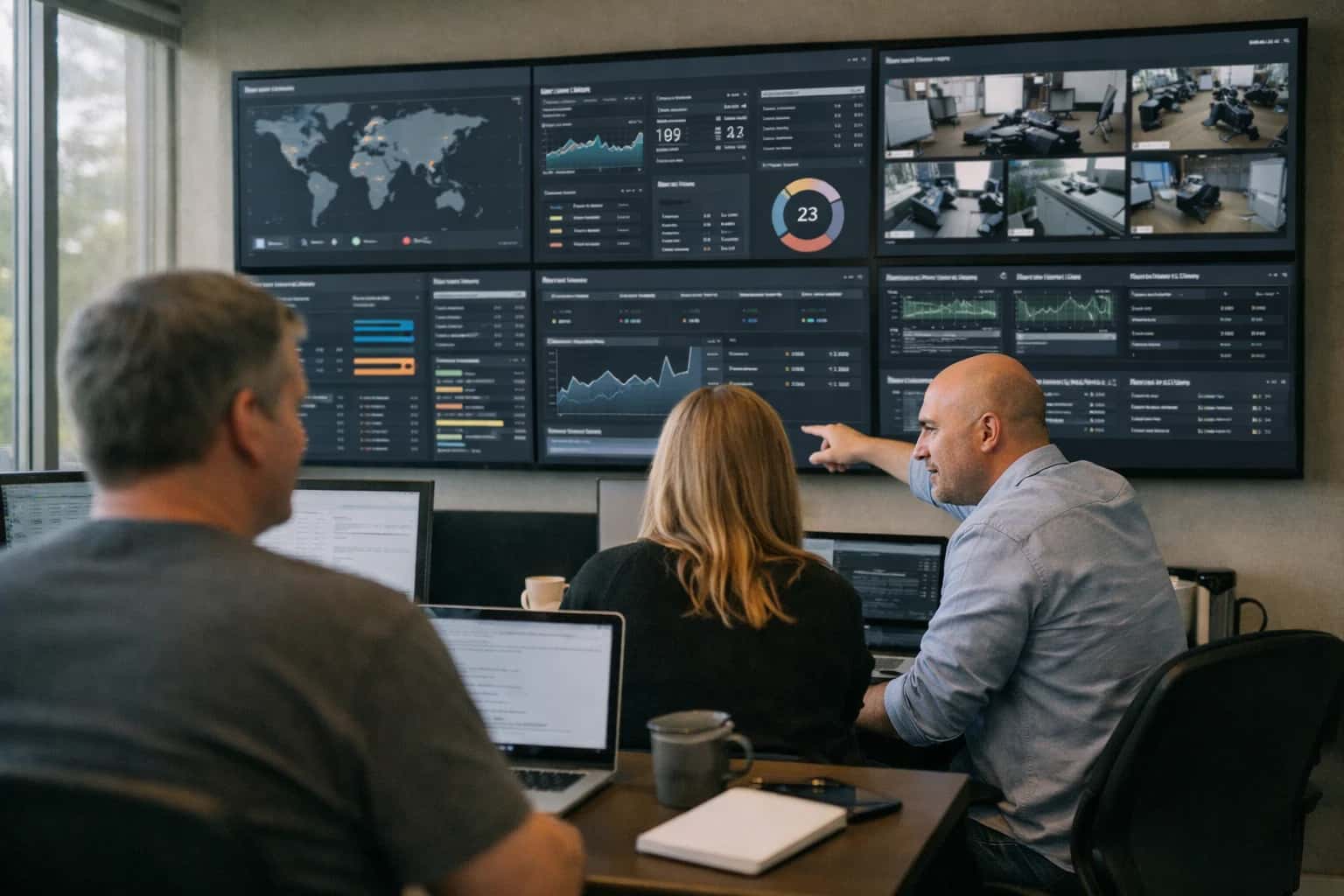
Supervisory control is a control architecture in which a human operator acts as a goal-setter and monitor for a largely autonomous system, intervening only when the system encounters an edge case, uncertainty, or a predefined takeover request. Unlike direct manual control, the operator issues high-level commands—such as destination waypoints or task priorities—while the machine handles the moment-to-moment execution, including path planning and collision avoidance.

Glossary
Supervisory Control
A human-machine interaction paradigm where an operator monitors and intermittently adjusts an otherwise autonomous system, setting high-level goals rather than directly controlling every action.
HUMAN-MACHINE INTERACTION PARADIGM
What is Supervisory Control?
Supervisory control is a human-machine interaction paradigm where an operator monitors and intermittently adjusts an otherwise autonomous system, setting high-level goals rather than directly controlling every action.
This paradigm is foundational to heterogeneous fleet orchestration, where a single operator must oversee dozens of autonomous mobile robots and manual vehicles simultaneously. Effective supervisory control relies on situation awareness displays, notification throttling to prevent alert fatigue, and clear escalation policies that define when the system must cede authority back to the human for critical decisions.
HUMAN-MACHINE INTERACTION PARADIGM
Core Characteristics of Supervisory Control
Supervisory control is a closed-loop architecture where a human operator monitors an autonomous system's performance and intermittently adjusts high-level goals, rather than directly controlling every actuator. The following characteristics define effective supervisory interfaces.
01
Intermittent Command Issuance
The operator does not engage in continuous manual control. Instead, they issue high-level goals or setpoint adjustments and then disengage to monitor outcomes. This contrasts with direct teleoperation, where every motor command originates from the human. The autonomous system executes the plan until it encounters an edge case, reaches a goal state, or detects a deviation requiring human judgment. This intermittent loop reduces cognitive load and allows a single operator to supervise multiple agents simultaneously.
02
Closed-Loop Feedback
Effective supervisory control relies on a continuous feedback loop:
- Perception: The system presents a synthesized view of the environment via a digital twin interface or dashboard.
- Comparison: The operator compares the system's actual state against the intended goal.
- Correction: If a deviation is detected, the operator issues a corrective command or a takeover request is triggered. This loop ensures the human remains the ultimate authority while the machine handles execution.
03
Attention Management
A core design challenge is preventing alert fatigue while ensuring critical signals are not missed. Supervisory interfaces employ notification throttling to suppress, group, or delay non-critical alerts. When a system encounters an edge case outside its Operational Design Domain (ODD), it escalates via a defined escalation policy. The interface visually prioritizes anomalies using confidence score displays, allowing the operator to quickly triage which agents need immediate attention.
04
Sliding Autonomy Spectrum
Supervisory control is not a binary state. The sliding autonomy model allows the level of machine independence to shift dynamically along a spectrum:
- Full Manual: Direct teleoperation via joystick or keyboard.
- Shared Autonomy: The human provides intent (e.g., a goal point) while the machine handles low-level navigation and collision avoidance.
- Full Autonomy: The system operates independently within its ODD, only alerting the human for exceptions. This flexibility allows the system to adapt to task complexity and operator trust levels.
05
Run-Time Assurance Envelope
A safety-critical characteristic where a separate, formally verified monitor continuously checks the autonomous system's actions against a set of safety invariants. If the system is about to violate a boundary—such as exceeding a speed limit or crossing a geofence—the run-time assurance layer intervenes independently of the main autonomy stack. This creates a deterministic safety net that does not rely on the operator's reaction time, transitioning the agent to a minimal risk condition (e.g., a controlled stop) if necessary.
06
Forensic Auditability
Every supervisory action must be recorded for post-incident analysis and regulatory compliance. The system maintains an immutable audit trail that chronologically logs:
- All operator commands and manual overrides.
- The system's internal state and confidence scores at the time of each decision.
- The context and reason for every intervention logging event. This dataset is critical for improving the autonomy stack's edge-case handling and for legal liability attribution.
SUPERVISORY CONTROL
Frequently Asked Questions
Clear answers to common questions about the human-machine interaction paradigm where operators monitor and intermittently adjust otherwise autonomous systems.
Supervisory control is a human-machine interaction paradigm where a human operator monitors an otherwise autonomous system and intermittently adjusts its high-level goals, rather than directly controlling every action. The operator sets objectives, constraints, and priorities, while the automated system executes the low-level sensorimotor loops. This architecture is fundamental to managing heterogeneous fleets of autonomous mobile robots (AMRs) and automated guided vehicles (AGVs) in modern logistics environments. The operator interacts through a human-in-the-loop interface, typically a centralized dashboard displaying fleet telemetry, task status, and environmental data. When the system encounters an edge case outside its operational design domain (ODD)—such as an obstructed path or an unregistered pallet—it escalates via a takeover request, prompting the operator to provide a new directive or manual guidance. The core loop follows a monitor-evaluate-intervene cycle: the human maintains situation awareness through telemetry streams, assesses system confidence via confidence score displays, and issues commands only when necessary, dramatically reducing cognitive load compared to direct teleoperation.
Enabling Efficiency, Speed & Accuracy
Intelligent Analysis, Decision & Execution
We build AI systems for teams that need search across company data, workflow automation across tools, or AI features inside products and internal software.
Talk to Us
Search across company data
Give teams answers from docs, tickets, runbooks, and product data with sources and permissions.
Useful when people spend too long searching or get different answers from different systems.
Enterprise searchRAGPermissions
Read more
Automate internal workflows
Use AI to route work, draft outputs, trigger actions, and keep approvals and logs in place.
Useful when repetitive work moves across multiple tools and teams.
AI agentsWorkflow automationGovernance
Read more
Add AI to products and internal tools
Build assistants, guided actions, or decision support into the software your team or customers already use.
Useful when AI needs to be part of the product, not a separate tool.
AI integrationDecision supportModel routing
Read more
About the author
Prasad Kumkar
CEO & MD, Inference Systems
Prasad Kumkar is the CEO & MD of Inference Systems and writes about AI systems architecture, LLM infrastructure, model serving, evaluation, and production deployment. Over 5+ years, he has worked across computer vision models, L5 autonomous vehicle systems, and LLM research, with a focus on taking complex AI ideas into real-world engineering systems.
His work and writing cover AI systems, large language models, AI agents, multimodal systems, autonomous systems, inference optimization, RAG, evaluation, and production AI engineering.
LinkedIn
Limited slotsGet a Free AI Consultation
Partnered with leading AI, data, and software stack.





How We Work
Custom AI workflows for your Business
One-fit-all AI don't work for modern businesses. At Inferensys, we aim to understand your business & custom requirements; which we use to define most efficient agentic workflows, the data, and the tools for your business.
01
Review the use case
We understand the task, the users, and where AI can actually help.
Read more02
Pick the right approach
We define what needs search, automation, or product integration.
Read more03
Build the first useful version
We implement the part that proves the value first.
Read more04
Improve from there
We add the checks and visibility needed to keep it useful.
Read moreThe first call is a practical review of your use case and the right next step.
Talk to Us