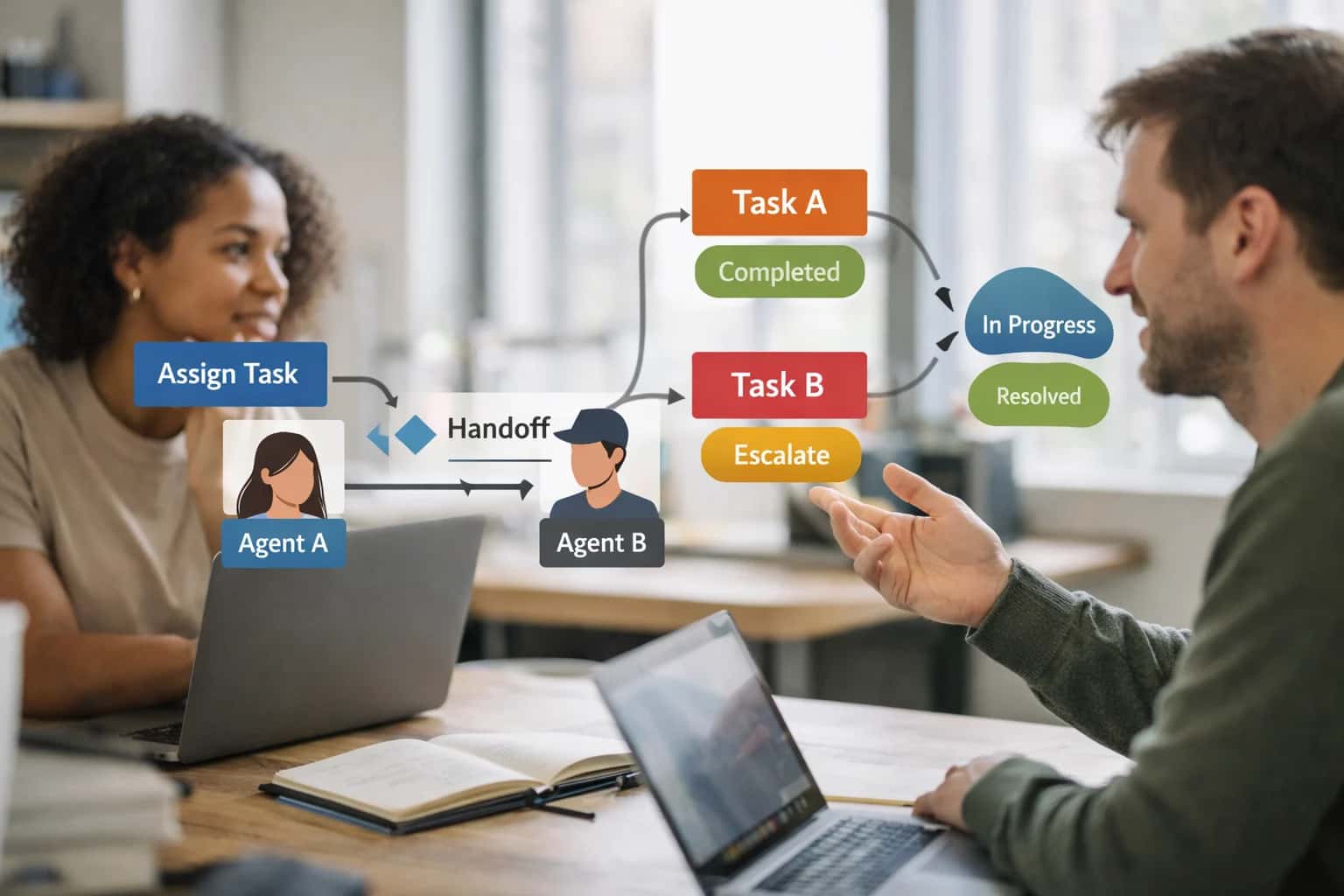
Human-Robot Handoff is the formalized protocol for transferring control authority and full task context between an autonomous system and a human operator. This process ensures a seamless transition where the receiving party instantly understands the current state, pending actions, and environmental constraints, preventing any operational discontinuity or safety gap during the shift in control.

Glossary
Human-Robot Handoff
The structured process of transferring control authority and task context between an autonomous agent and a human operator, ensuring a seamless transition without loss of state.
CONTROL TRANSFER PROTOCOL
What is Human-Robot Handoff?
The structured process of transferring control authority and task context between an autonomous agent and a human operator, ensuring a seamless transition without loss of state.
A robust handoff mechanism relies on a shared mental model maintained by the orchestration middleware, which serializes the agent's intent, world model, and active goals. This context is presented through a digital twin interface or operator workstation, allowing the human to immediately assume supervision or direct teleoperation. The inverse process, handing control back to the agent, requires the system to verify it has reacquired full situation awareness before resuming autonomous execution.
SEAMLESS CONTROL TRANSFER
Core Characteristics of a Robust Handoff
A robust human-robot handoff is defined by more than just stopping and starting. It requires a structured transfer of task context, authority, and safety state to prevent operational gaps.
01
Explicit Authority Transfer
The handoff must involve a formal, acknowledged transfer of control using a consent gateway or explicit acknowledgment protocol. This prevents ambiguity where both the human and the robot believe they are in control, or worse, neither is. The system must clearly define the locus of control at every millisecond.
- Hard Handoff: Immediate, full transfer of all control axes.
- Soft Handoff: A brief period of shared control where the human's input is blended with the autonomous policy before the robot fully disengages.
02
Complete State Context Handoff
Transferring control is useless without transferring the situational context. The human operator must instantly understand the agent's current state, active goal, and environmental understanding. This requires the system to serialize and transmit the agent's world model.
- Goal Transparency: The specific task objective and its priority must be displayed.
- Intent Projection: The robot's planned trajectory or next action must be visualized.
- Uncertainty Visualization: The agent's confidence score for its current perception and plan must be clearly shown to guide the operator's trust.
03
Bumpless Transfer
The physical transition of control must be smooth, avoiding sudden stops, jerks, or velocity discontinuities that could destabilize the system or the payload. This is a core requirement for shared autonomy and sliding autonomy architectures.
- State Matching: The human's input device (e.g., joystick) must be matched to the robot's current actuator state to prevent a jump on takeover.
- Command Blending: During a soft handoff, a weighted sum of the human command and the autonomous policy is executed, with the weight shifting smoothly from 0 to 1.
04
Fail-Safe on Handoff Failure
A handoff is a critical operational moment with a high risk of failure due to network issues or operator unavailability. The system must have a defined minimal risk condition (MRC) that is triggered if the handoff is not completed within a strict time window.
- Watchdog Timer: A timer starts at the initiation of a takeover request. If the human does not acknowledge and assume control before expiry, the agent must autonomously execute its MRC, such as a safe stop.
- Heartbeat Continuity: The agent must continue to monitor the heartbeat signal from the control station throughout the handoff process.
05
Immutable Audit Trail
Every handoff event must be recorded as a cryptographically verifiable entry in the system's audit trail. This log is essential for post-incident analysis, regulatory compliance, and improving the autonomy system's operational design domain (ODD).
- Intervention Logging: The log must capture the timestamp, initiating reason (e.g., low confidence, ODD exit), the agent's full state vector, and the operator's identity.
- Non-Repudiation: The record must prove which entity—human or autonomous policy—was in control at any given moment.
06
Latency-Compensated Teleoperation
For remote handoffs, intervention latency can make direct control impossible. A robust handoff system must incorporate a predictive display to mask this delay. The operator interacts with a local, simulated ghost of the robot that responds instantly, while the real robot follows after the network delay.
- Forward Simulation: The local interface runs a lightweight physics model of the robot to predict its state.
- Command Validation: The system can use run-time assurance to check the operator's commands against safety constraints before they are transmitted to the physical agent.
HUMAN-ROBOT HANDOFF
Frequently Asked Questions
Clear answers to the most common questions about transferring control authority between autonomous agents and human operators.
A human-robot handoff is the structured process of transferring control authority and full task context from an autonomous agent to a human operator, ensuring a seamless transition without loss of state. The mechanism begins when an agent encounters an edge case, exceeds its operational design domain, or reaches a predefined confidence threshold. The agent then issues a takeover request that bundles the current task state, sensor telemetry, environmental context, and a reason code into a structured payload. The operator's interface receives this bundle, reconstructs the situational picture, and presents a predictive display to mask any network latency. Upon acknowledgment, control authority shifts atomically—the agent transitions to a safe holding pattern or minimal risk condition while the operator assumes direct command. The entire sequence is logged in an audit trail for post-incident analysis and continuous improvement of the autonomy stack.
Enabling Efficiency, Speed & Accuracy
Intelligent Analysis, Decision & Execution
We build AI systems for teams that need search across company data, workflow automation across tools, or AI features inside products and internal software.
Talk to Us
Search across company data
Give teams answers from docs, tickets, runbooks, and product data with sources and permissions.
Useful when people spend too long searching or get different answers from different systems.
Enterprise searchRAGPermissions
Read more
Automate internal workflows
Use AI to route work, draft outputs, trigger actions, and keep approvals and logs in place.
Useful when repetitive work moves across multiple tools and teams.
AI agentsWorkflow automationGovernance
Read more
Add AI to products and internal tools
Build assistants, guided actions, or decision support into the software your team or customers already use.
Useful when AI needs to be part of the product, not a separate tool.
AI integrationDecision supportModel routing
Read moreCONTROL AUTHORITY COMPARISON
Handoff vs. Related Control Mechanisms
Distinguishing the structured transfer of task context and authority from other human-machine interaction paradigms in autonomous fleet operations.
| Feature | Human-Robot Handoff | Manual Override | Takeover Request |
|---|---|---|---|
Initiating Party | Bidirectional (agent or human) | Human operator only | Autonomous agent only |
Task Context Transfer | |||
State Preservation | Full state and intent transferred | Current state discarded | Current state and uncertainty passed |
Typical Trigger | Operational design domain boundary or task completion | Operator-observed error or preference | Edge case, low confidence, or system uncertainty |
Control Transition Type | Structured, negotiated handshake | Immediate, unilateral seizure | Agent-initiated request for intervention |
Post-Transition Autonomy | Agent may resume autonomously after handoff | System remains in manual mode until released | Agent awaits operator command or resolution |
Latency Sensitivity | Moderate (planned transition) | Low (must be near-instantaneous) | Variable (depends on time-to-collision) |

About the author
Prasad Kumkar
CEO & MD, Inference Systems
Prasad Kumkar is the CEO & MD of Inference Systems and writes about AI systems architecture, LLM infrastructure, model serving, evaluation, and production deployment. Over 5+ years, he has worked across computer vision models, L5 autonomous vehicle systems, and LLM research, with a focus on taking complex AI ideas into real-world engineering systems.
His work and writing cover AI systems, large language models, AI agents, multimodal systems, autonomous systems, inference optimization, RAG, evaluation, and production AI engineering.
LinkedIn
Limited slotsGet a Free AI Consultation
Partnered with leading AI, data, and software stack.





How We Work
Custom AI workflows for your Business
One-fit-all AI don't work for modern businesses. At Inferensys, we aim to understand your business & custom requirements; which we use to define most efficient agentic workflows, the data, and the tools for your business.
01
Review the use case
We understand the task, the users, and where AI can actually help.
Read more02
Pick the right approach
We define what needs search, automation, or product integration.
Read more03
Build the first useful version
We implement the part that proves the value first.
Read more04
Improve from there
We add the checks and visibility needed to keep it useful.
Read moreThe first call is a practical review of your use case and the right next step.
Talk to Us