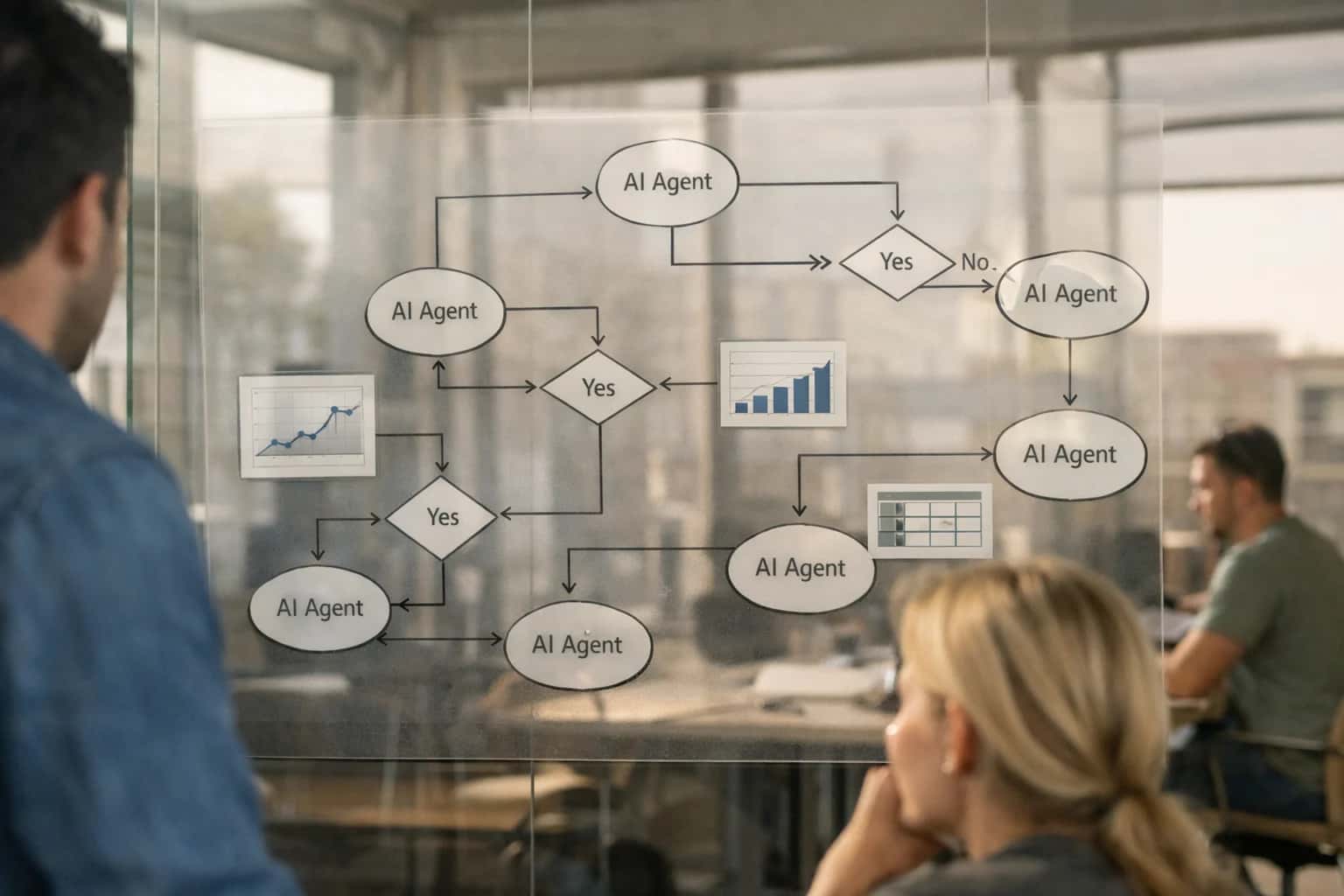
A task graph is a directed acyclic graph (DAG) that formally represents a workflow, where nodes are computational or physical tasks and directed edges define precedence constraints or data dependencies between them. This structure is central to dynamic task allocation systems, as it allows an orchestrator to analyze which tasks can be executed in parallel and which must wait for others to complete. The acyclic property ensures the workflow is logically sound and free of circular dependencies that could cause deadlock.

Glossary
Task Graph
A task graph is a directed acyclic graph (DAG) that models a workflow, with nodes representing individual tasks and edges defining precedence constraints or dependencies between them.
DYNAMIC TASK ALLOCATION
What is a Task Graph?
A task graph is a fundamental data structure in heterogeneous fleet orchestration and parallel computing, representing a workflow as a directed acyclic graph (DAG).
In heterogeneous fleet orchestration, a task graph enables intelligent scheduling by mapping abstract tasks onto the specific capabilities of available robots or vehicles. The orchestrator uses the graph to perform constraint satisfaction and multi-objective optimization, minimizing overall makespan while respecting dependencies. This model is essential for real-time replanning engines, which dynamically adjust task assignments and execution order in response to agent failures or new high-priority work arrivals.
CORE ARCHITECTURE
Key Characteristics of a Task Graph
A task graph is a formal, computational representation of a workflow. Its structure dictates execution order, parallelism, and resource dependencies, making it foundational for orchestrating complex operations in heterogeneous fleets.
01
Directed Acyclic Graph (DAG) Structure
The fundamental data structure of a task graph is a Directed Acyclic Graph (DAG). This means:
- Directed: Edges have a direction, representing a flow of dependency or data from one task (node) to another.
- Acyclic: The graph contains no cycles, ensuring tasks cannot depend on themselves either directly or indirectly. This property is critical for guaranteeing that the workflow can terminate and prevents infinite execution loops.
This structure explicitly defines precedence constraints, making the order of operations unambiguous and schedulable.
02
Nodes Represent Atomic Tasks
Each node in the graph corresponds to a single, atomic unit of work. In a heterogeneous fleet context, a task node is defined by:
- Action Specification: The specific operation to perform (e.g., 'navigate to location A', 'pick item SKU-123').
- Resource Requirements: The formal capabilities needed for execution (e.g., a robot with a gripper, a forklift with 2-ton capacity).
- Estimated Parameters: Metadata such as expected duration, energy cost, or priority.
Nodes are the assignable entities for dynamic task allocation algorithms.
03
Edges Define Dependencies & Data Flow
Edges (connections between nodes) encode the relationships that govern execution. There are two primary types of dependencies:
- Precedence/Control Dependency: A simple 'must-complete-before' relationship. Task B cannot start until Task A finishes.
- Data Dependency: Task B requires the output or product of Task A as an input. This is common in manufacturing or kitting workflows.
These edges create the partial order that allows a scheduler to identify which tasks are eligible for parallel execution (those with no unresolved dependencies).
04
Enables Parallelism & Concurrency Analysis
A primary function of the task graph is to expose opportunities for parallel execution. By analyzing the DAG, a scheduler can determine the critical path (the longest sequence of dependent tasks) and identify independent branches that can be assigned to different agents simultaneously.
This analysis is key for minimizing makespan (total workflow completion time) in a multi-agent system. The width of the graph at any point indicates the maximum theoretical parallelism required.
05
Formal Input for Scheduling Algorithms
The task graph serves as the definitive, machine-readable blueprint for schedulers and orchestrators. It allows algorithms to solve complex optimization problems, such as:
- Mapping tasks to heterogeneous agents based on capability matching.
- Ordering task execution to respect all dependencies.
- Allocating resources (like shared zones or charging stations) to avoid conflicts.
Algorithms like list scheduling or those based on the Hungarian algorithm for assignment operate directly on this graph structure.
06
Dynamic Updatability
While often constructed initially from a high-level plan, task graphs in real-world orchestration are not static. They must support dynamic modification to handle:
- Task Insertion: Adding new nodes for unexpected jobs or high-priority orders.
- Graph Pruning: Removing nodes associated with canceled tasks.
- Edge Rewiring: Adjusting dependencies in response to agent failure or task migration.
This requires the underlying orchestration middleware to manage graph versioning and propagate changes to all relevant agents in real-time.
DYNAMIC TASK ALLOCATION
How Task Graphs Work in Fleet Orchestration
A task graph is the computational blueprint that orchestrates complex workflows across a heterogeneous fleet of agents.
A task graph is a directed acyclic graph (DAG) that formally represents a workflow, where nodes are individual tasks and directed edges define precedence constraints or dependencies between them. In fleet orchestration, this model allows a central scheduler to decompose a high-level mission—like 'restock inventory'—into atomic actions such as 'navigate to bin,' 'pick item,' and 'deliver to station.' The graph's structure ensures tasks are executed in a valid order, preventing logical errors like an agent attempting to deliver an item before it has been picked.
The orchestrator uses the task graph for dynamic allocation by mapping each node to the most suitable agent based on real-time capability matching, location, and battery state. Dependencies are strictly enforced; a successor task is only dispatched once all its predecessors report completion. This enables sophisticated multi-agent coordination, where different robots or vehicles can work on independent branches of the graph in parallel, dramatically improving overall system throughput and resilience to individual agent delays or failures.
OPERATIONAL WORKFLOWS
Real-World Applications of Task Graphs
Task graphs are the computational backbone for orchestrating complex, multi-step processes in logistics, manufacturing, and software. They provide a formal model for dependency management, parallel execution, and fault recovery.
01
Warehouse Order Fulfillment
In automated warehouses, a single customer order decomposes into a task graph where nodes represent discrete actions and edges enforce critical dependencies. For example:
- Pick Item A (Node 1)
- Pick Item B (Node 2)
- Merge Items at Pack Station (Node 3, depends on 1 & 2)
- Label & Route to Dock (Node 4, depends on 3) This structure allows parallel picking by multiple robots (AMRs) or workers, while ensuring items are merged correctly before packing. The graph's acyclic property prevents logical deadlocks, such as a robot waiting for an item that hasn't been picked yet.
02
Manufacturing Assembly Lines
Complex product assembly is modeled as a task graph to coordinate a heterogeneous fleet of robotic arms, automated guided vehicles (AGVs), and human stations. Each assembly step is a node, with edges dictating the sequence. For instance, a car door assembly graph might specify that welding must complete before painting, and painting must finish before handle installation. This enables just-in-time part delivery by AGVs and optimal station utilization. If a robot fails, the graph allows the scheduler to dynamically reassign the dependent downstream tasks to other available resources.
04
Autonomous Vehicle Routing & Charging
For a fleet of electric autonomous mobile robots (AMRs), daily operations form a spatial-temporal task graph. Nodes represent location-based tasks: Transport Pallet from A to B, Recharge Battery, or Perform Self-Diagnosis. Edges encode constraints like:
- A robot must be at the charging station (Node X) before it can execute the Recharge task (Node Y).
- A Transport task cannot start until the destination bay is clear (a dependency on another agent's task). The orchestrator continuously solves this graph to maximize throughput while adhering to battery and traffic constraints.
TASK GRAPH
Frequently Asked Questions
A task graph is a foundational data structure for modeling workflows in heterogeneous fleet orchestration and dynamic task allocation. These questions address its core mechanics, applications, and relationship to scheduling systems.
A task graph is a directed acyclic graph (DAG) that formally represents a workflow, where nodes represent individual tasks and directed edges represent precedence constraints or dependencies between those tasks.
In the context of heterogeneous fleet orchestration, a task graph models a complex job—like 'retrieve and deliver an item'—by decomposing it into atomic operations (e.g., 'navigate to shelf A', 'pick item', 'navigate to station B', 'place item'). The edges enforce that 'place item' cannot begin until 'pick item' is complete. This structure is essential for dynamic task allocation systems to reason about valid execution orders and parallelization opportunities across a mixed fleet of robots and manual vehicles.
Enabling Efficiency, Speed & Accuracy
Intelligent Analysis, Decision & Execution
We build AI systems for teams that need search across company data, workflow automation across tools, or AI features inside products and internal software.
Talk to Us
Search across company data
Give teams answers from docs, tickets, runbooks, and product data with sources and permissions.
Useful when people spend too long searching or get different answers from different systems.
Enterprise searchRAGPermissions
Read more
Automate internal workflows
Use AI to route work, draft outputs, trigger actions, and keep approvals and logs in place.
Useful when repetitive work moves across multiple tools and teams.
AI agentsWorkflow automationGovernance
Read more
Add AI to products and internal tools
Build assistants, guided actions, or decision support into the software your team or customers already use.
Useful when AI needs to be part of the product, not a separate tool.
AI integrationDecision supportModel routing
Read more
About the author
Prasad Kumkar
CEO & MD, Inference Systems
Prasad Kumkar is the CEO & MD of Inference Systems and writes about AI systems architecture, LLM infrastructure, model serving, evaluation, and production deployment. Over 5+ years, he has worked across computer vision models, L5 autonomous vehicle systems, and LLM research, with a focus on taking complex AI ideas into real-world engineering systems.
His work and writing cover AI systems, large language models, AI agents, multimodal systems, autonomous systems, inference optimization, RAG, evaluation, and production AI engineering.
LinkedIn
Limited slotsGet a Free AI Consultation
Partnered with leading AI, data, and software stack.





How We Work
Custom AI workflows for your Business
One-fit-all AI don't work for modern businesses. At Inferensys, we aim to understand your business & custom requirements; which we use to define most efficient agentic workflows, the data, and the tools for your business.
01
Review the use case
We understand the task, the users, and where AI can actually help.
Read more02
Pick the right approach
We define what needs search, automation, or product integration.
Read more03
Build the first useful version
We implement the part that proves the value first.
Read more04
Improve from there
We add the checks and visibility needed to keep it useful.
Read moreThe first call is a practical review of your use case and the right next step.
Talk to Us