Service discovery is the automated process by which agents in a fleet dynamically advertise their capabilities, current status, and location, enabling a central orchestrator or peer agents to locate and assign tasks in real-time. This mechanism is critical for dynamic task allocation in systems comprising mixed fleets of autonomous mobile robots and manual vehicles. It replaces static configuration, allowing the system to adapt to agent failures, new agent onboarding, and fluctuating workloads without manual intervention.

Glossary
Service Discovery
Service discovery is the automated process by which agents in a fleet dynamically advertise their capabilities and current status, enabling a scheduler to locate agents that can perform a specific task.
DYNAMIC TASK ALLOCATION
What is Service Discovery?
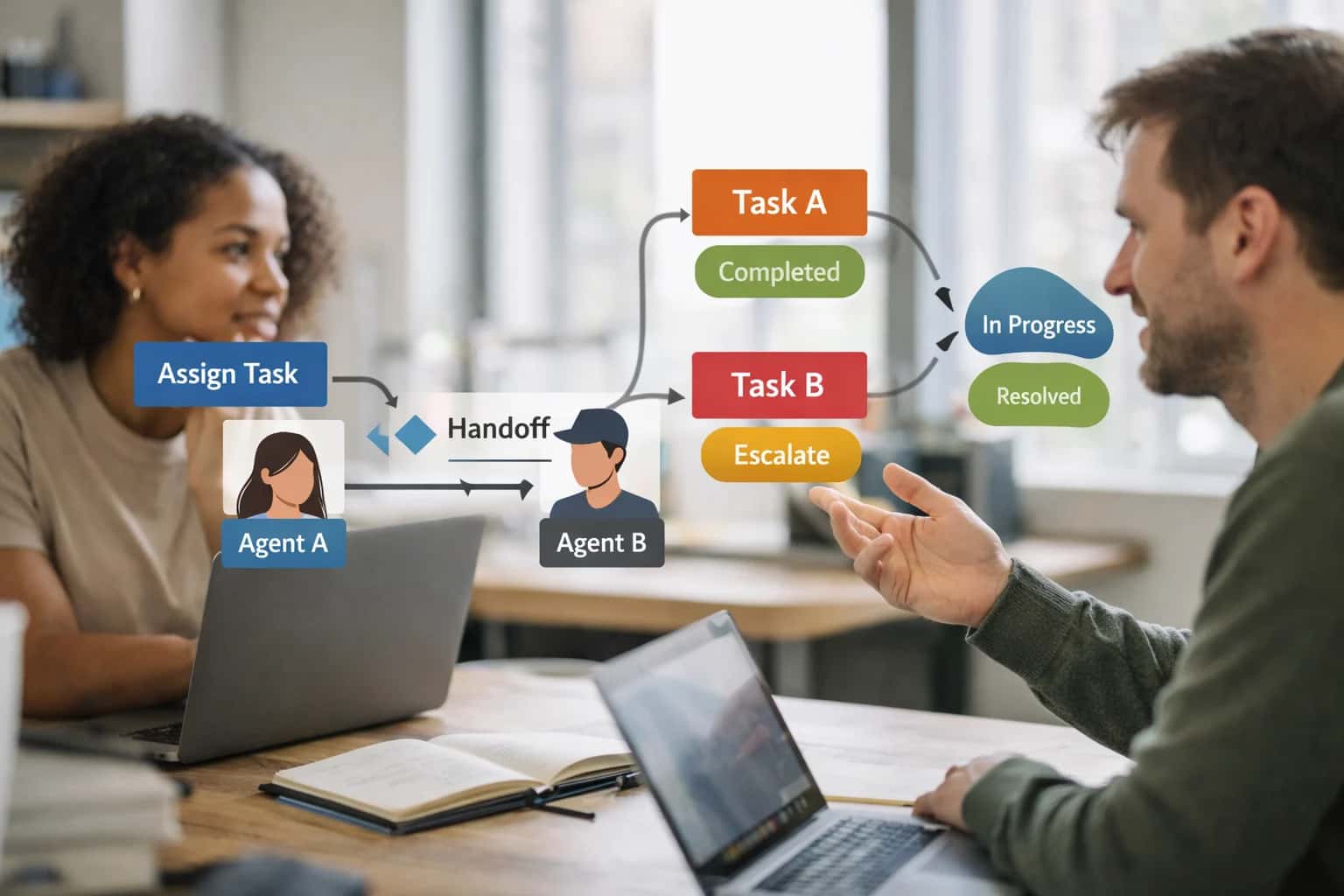
Service discovery is a foundational mechanism within heterogeneous fleet orchestration that enables dynamic task allocation.
In practice, agents broadcast or register their service descriptors—metadata detailing their skills, load, and network endpoint—to a registry. A task scheduler then queries this registry to find agents matching a task's requirements, such as specific tooling or location. This decouples task logic from agent identity, enabling fault-tolerant and scalable operations. Common patterns include client-side discovery, where agents query the registry directly, and server-side discovery, where a load balancer handles routing.
ARCHITECTURAL PRIMITIVES
Key Components of a Service Discovery System
A service discovery system is an automated registry and lookup mechanism that enables agents in a heterogeneous fleet to dynamically advertise their capabilities and status, allowing a central scheduler to locate suitable agents for task execution. Its core components form the foundational infrastructure for dynamic coordination.
01
Service Registry
The Service Registry is a centralized or distributed database that maintains a real-time directory of all active agents (services) in the fleet. Each agent registers its endpoint (e.g., IP address, port), capabilities, and current status upon startup and sends periodic heartbeats to indicate liveness. The registry is the single source of truth for the orchestrator, enabling it to query for agents matching specific task requirements. In distributed systems, this is often implemented as a key-value store like etcd, Consul, or Apache ZooKeeper.
02
Health Check & Heartbeat Mechanism
This component ensures the registry's data remains accurate by detecting agent failures. A Health Check is a probe (e.g., an HTTP endpoint, TCP ping) that the registry or a sidecar process executes to verify an agent's operational state. A Heartbeat is a regular, proactive signal sent by the agent to the registry to confirm it is alive. If heartbeats cease or a health check fails, the agent is marked as unhealthy or deregistered, preventing the scheduler from assigning tasks to a non-responsive resource. This is critical for maintaining system fault tolerance.
03
Service Discovery Client/Library
The Discovery Client is the software library integrated into each agent that handles interactions with the service registry. Its responsibilities include:
- Registration: Automatically registering the agent upon startup with its metadata.
- Deregistration: Gracefully removing the agent's entry during shutdown.
- Service Lookup: Querying the registry to discover other agents the client may need to communicate with directly in peer-to-peer architectures. This decouples the agent's logic from the underlying discovery infrastructure, simplifying development. Libraries like Netflix Eureka Client or HashiCorp Consul client are common examples.
04
Load Balancer & API Gateway
Often integrated with or sitting in front of the discovery system, the Load Balancer distributes incoming task requests or traffic across healthy instances of a service. It queries the service registry to obtain the current list of available agents. An API Gateway acts as a single entry point for all client requests, routing them to the appropriate backend service discovered via the registry. This pattern, central to microservices, is equally vital in robotics fleets where a central orchestrator dispatches tasks to the most suitable, available robot. Tools like NGINX, HAProxy, or Kubernetes Service objects fulfill this role.
05
Metadata & Tagging Schema
Beyond a simple address, effective discovery relies on rich metadata attached to each service entry. This structured data describes the agent's capabilities (e.g., can_lift: "heavy_payload", has_gripper: true), physical attributes (e.g., max_speed: 2.0), current load, and location zone. The scheduler uses this metadata for capability-based assignment. A well-defined schema is essential for precise queries, such as "find all agents with a vacuum attachment that are currently in Zone A and have battery > 40%."
06
DNS Integration (Service Mesh)
In advanced architectures, service discovery is integrated with the Domain Name System (DNS). When an agent or orchestrator looks up a service name (e.g., picker-robot.service.warehouse), a DNS query is resolved to the current IP addresses of healthy instances, provided by the service registry. This is a core feature of service meshes like Istio or Linkerd, which use a sidecar proxy (e.g., Envoy) to handle discovery and traffic routing transparently. For robotic fleets, this abstracts network location, allowing agents to communicate via stable names rather than volatile IP addresses.
DYNAMIC TASK ALLOCATION
How Service Discovery Works in a Heterogeneous Fleet
Service discovery is the automated mechanism enabling dynamic task allocation across a mixed fleet of manual and autonomous agents.
Service discovery is the automated process by which agents in a fleet dynamically advertise their capabilities and current operational status, enabling a central orchestrator or peer agents to locate which agents can perform a specific task. This mechanism is foundational to dynamic task allocation, as it provides the real-time inventory of available resources—such as a forklift's lift capacity or a robot's current battery level—required for intelligent scheduling decisions in logistics and warehousing environments.
In a heterogeneous fleet, service discovery must abstract differences between agent types (e.g., autonomous mobile robots, manual vehicles) into a unified capability model. Agents periodically broadcast heartbeat messages containing their ID, location, status, and a list of supported task types. The orchestrator maintains a live registry, continuously pruning offline agents. When a new task arrives, the scheduler queries this registry using the task's required capability profile to generate a candidate list for assignment, enabling resilient, real-time operations without manual configuration.
ARCHITECTURAL COMPARISON
Service Discovery Patterns: Centralized vs. Decentralized
A comparison of the two primary architectural patterns for enabling agents in a heterogeneous fleet to locate and communicate with each other.
| Feature / Characteristic | Centralized Pattern | Decentralized Pattern |
|---|---|---|
Architectural Model | Client-Server | Peer-to-Peer (P2P) |
Core Component | Central Registry / Directory Service | Distributed Hash Table (DHT) or Gossip Protocol |
Fault Tolerance | ||
Scalability Limit | Limited by registry capacity (< 10k agents) | Theoretically unlimited, scales with fleet size |
Latency for Lookup | Low (< 100 ms), single query to registry | Variable (100-500 ms), requires multi-hop queries |
Consistency Guarantee | Strong, single source of truth | Eventual, based on propagation delay |
Implementation Complexity | Low to Moderate | High |
Example Technologies | Consul, etcd, ZooKeeper | Serf, memberlist, custom P2P overlay |
IN HETEROGENEOUS FLEETS
Real-World Applications of Service Discovery
Service discovery is the foundational mechanism that enables dynamic coordination in modern logistics and warehousing. These cards illustrate its critical applications in heterogeneous fleets of manual vehicles and autonomous mobile robots.
01
Dynamic Agent Registration
When a new autonomous mobile robot (AMR) or a manual forklift with a telematics unit joins the network, it automatically advertises its capabilities and current state to the orchestration platform. This includes:
- Capability Vector: Payload capacity, attachment types (fork, clamp, conveyor), and special skills (e.g., pallet stacking).
- Dynamic State: Current battery level, location, and operational status (idle, charging, in-error).
- Network Endpoint: The IP address and port where the agent's control API can be reached for task assignment. This automated registration eliminates manual configuration, allowing the fleet to scale and adapt instantly.
02
Capability-Based Task Matching
The centralized scheduler uses the service registry to match incoming tasks with qualified agents in real-time. For a task like "Retrieve a 500kg pallet from Zone A," the discovery system filters the fleet to identify agents that satisfy the hard constraints:
- Load Capacity: Agents rated for ≥500kg.
- Attachment Type: Agents equipped with forks.
- Location Proximity: Agents currently in or near Zone A.
- Availability: Agents with status 'idle' and sufficient battery for the operation. This precise matching is the core of dynamic task allocation, ensuring tasks are only assigned to capable agents.
03
Fault Tolerance & Health-Based Routing
Service discovery provides continuous health checks (heartbeats) to monitor agent liveness. If an agent fails to respond—due to a mechanical fault, network dropout, or battery exhaustion—it is immediately marked as unavailable in the registry. The scheduler then:
- Reassigns In-Progress Tasks: Tasks assigned to the failed agent are put back into the queue for rediscovery and assignment to a healthy agent.
- Adjusts Load Balancing: The overall workload is redistributed among the remaining healthy agents.
- Triggers Alerts: Notifies maintenance systems of the agent failure. This creates a self-healing fleet that maintains operational continuity despite individual agent failures.
04
Integration with Heterogeneous Systems
In a mixed fleet, service discovery acts as the universal translator. It enables a unified orchestration layer to communicate with diverse hardware and software platforms:
- Legacy Systems: Manual vehicles report status via IoT gateways that register as a service.
- Multiple AMR Brands: Different manufacturers' robots (e.g., from MiR, OTTO, Fetch) each expose a standardized API endpoint discovered by the platform.
- Warehouse Management System (WMS): The WMS itself can be discovered as a service, providing task streams and inventory data. This abstraction is critical for orchestration middleware, allowing a single scheduler to command a heterogeneous fleet.
05
Real-Time State Propagation for Replanning
Service discovery is not a one-time lookup; it's a continuous stream of state updates. This real-time data feed powers spatial-temporal scheduling and real-time replanning engines. Key propagated states include:
- Location Updates: From lidar, UWB, or visual odometry, enabling collision avoidance.
- Battery Depletion Rates: Informing battery-aware scheduling to preemptively route agents to charging stations.
- Task Progress: Percentage completion, allowing for predictive scheduling of subsequent tasks. By consuming this live state, the orchestrator can dynamically adjust plans in response to congestion, delays, or new high-priority tasks.
06
Zone Management & Access Control
Service discovery integrates with zone management protocols to enforce safety and efficiency rules. Agents advertise their current zone, and the discovery system checks this against access control lists. This enables:
- Speed Limit Zones: Identifying agents entering a 'slow zone' near human workers and commanding reduced speed.
- Exclusive Access Zones: Preventing multiple agents from discovering and attempting to enter a narrow aisle simultaneously.
- Dynamic Geofencing: Temporarily marking areas as 'discovered' for maintenance and removing all agents from the service pool for that zone. This contextual awareness prevents deadlocks and ensures safe cohabitation with human workers.
SERVICE DISCOVERY
Frequently Asked Questions
Service discovery is the automated process that enables agents in a heterogeneous fleet to advertise their capabilities and status, allowing a scheduler to locate suitable agents for task execution in real-time.
Service discovery is the automated mechanism by which software agents in a distributed system dynamically advertise their capabilities and current operational status, enabling a central orchestrator or other agents to locate and utilize them for task execution. It works through a continuous loop: 1) Agents register or advertise their identity, capabilities (e.g., 'can lift 50kg', 'has thermal camera'), and status (e.g., location, battery level, current task) to a service registry. 2) The scheduler, when needing to assign a task, queries this registry to find agents matching the task's requirements. 3) The registry returns a list of eligible agents, often ranked by fitness. This process is foundational for dynamic task allocation in environments where agent availability and state are constantly changing, such as in warehouses with mixed fleets of autonomous mobile robots (AMRs) and manual equipment.
Enabling Efficiency, Speed & Accuracy
Intelligent Analysis, Decision & Execution
We build AI systems for teams that need search across company data, workflow automation across tools, or AI features inside products and internal software.
Talk to Us
Search across company data
Give teams answers from docs, tickets, runbooks, and product data with sources and permissions.
Useful when people spend too long searching or get different answers from different systems.
Enterprise searchRAGPermissions
Read more
Automate internal workflows
Use AI to route work, draft outputs, trigger actions, and keep approvals and logs in place.
Useful when repetitive work moves across multiple tools and teams.
AI agentsWorkflow automationGovernance
Read more
Add AI to products and internal tools
Build assistants, guided actions, or decision support into the software your team or customers already use.
Useful when AI needs to be part of the product, not a separate tool.
AI integrationDecision supportModel routing
Read more
About the author
Prasad Kumkar
CEO & MD, Inference Systems
Prasad Kumkar is the CEO & MD of Inference Systems and writes about AI systems architecture, LLM infrastructure, model serving, evaluation, and production deployment. Over 5+ years, he has worked across computer vision models, L5 autonomous vehicle systems, and LLM research, with a focus on taking complex AI ideas into real-world engineering systems.
His work and writing cover AI systems, large language models, AI agents, multimodal systems, autonomous systems, inference optimization, RAG, evaluation, and production AI engineering.
LinkedIn
Limited slotsGet a Free AI Consultation
Partnered with leading AI, data, and software stack.





How We Work
Custom AI workflows for your Business
One-fit-all AI don't work for modern businesses. At Inferensys, we aim to understand your business & custom requirements; which we use to define most efficient agentic workflows, the data, and the tools for your business.
01
Review the use case
We understand the task, the users, and where AI can actually help.
Read more02
Pick the right approach
We define what needs search, automation, or product integration.
Read more03
Build the first useful version
We implement the part that proves the value first.
Read more04
Improve from there
We add the checks and visibility needed to keep it useful.
Read moreThe first call is a practical review of your use case and the right next step.
Talk to Us