An allocation policy is the rule-based or algorithmic logic that defines how a scheduler or orchestrator decides which agent should execute a given task from the set of available candidates. It is the core decision engine within a dynamic task allocation system, translating high-level objectives—like minimizing makespan or maximizing throughput—into specific assignments. Policies range from simple rules, such as 'assign to the nearest available agent,' to complex optimization algorithms solving the assignment problem.

Glossary
Allocation Policy
An allocation policy is the rule-based or algorithmic logic that defines how a scheduler or orchestrator decides which agent should execute a given task from the set of available candidates.
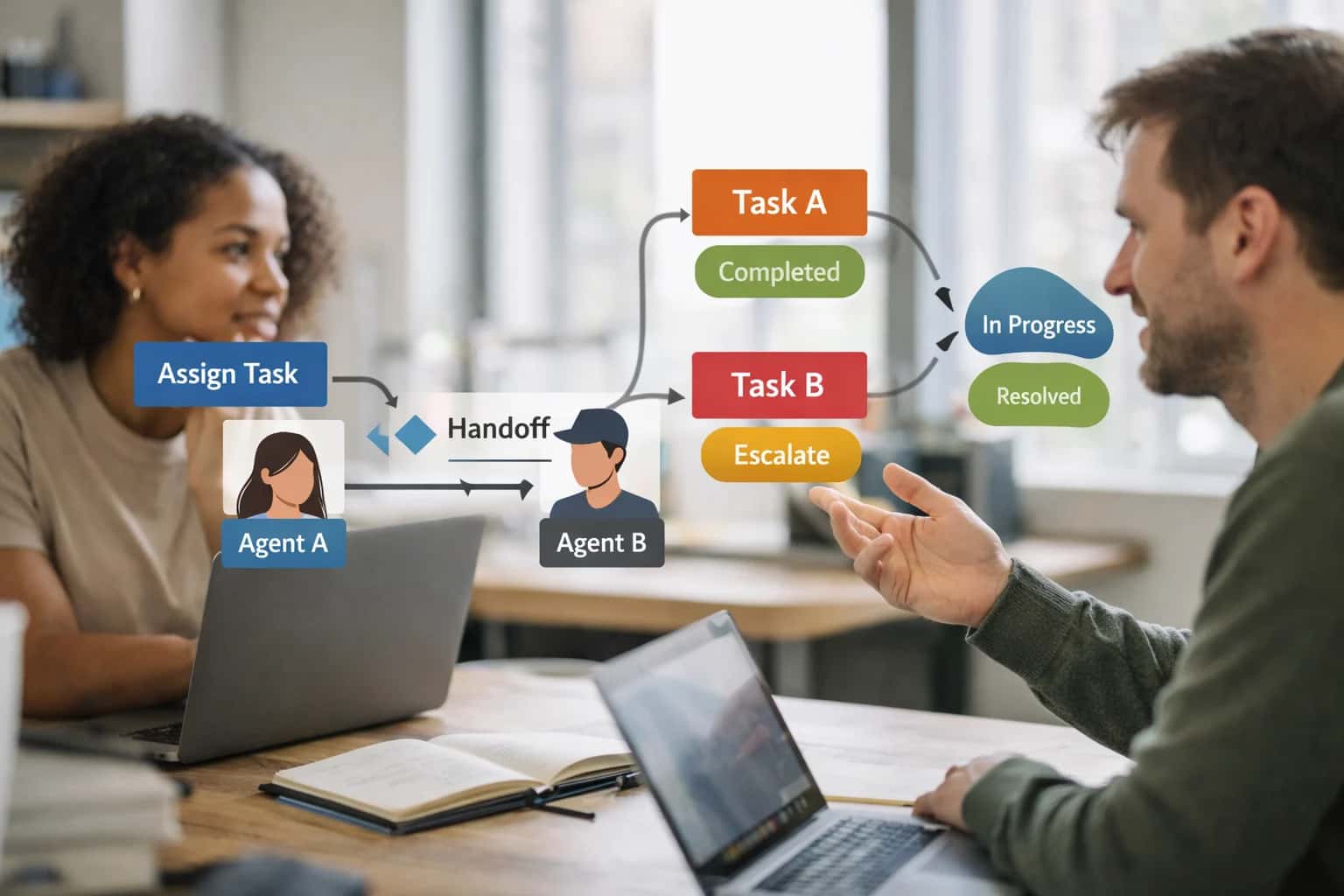
DYNAMIC TASK ALLOCATION
What is an Allocation Policy?
In heterogeneous fleet orchestration, the allocation policy is the core decision-making logic that determines task-to-agent assignments.
The policy operates on inputs including agent states from fleet state estimation, task requirements from a task queue, and environmental constraints. It must balance multiple, often competing objectives, a challenge addressed through multi-objective optimization. Implementation can be centralized, with a single scheduler using a global view, or decentralized, using mechanisms like the Contract Net Protocol or work stealing. The choice of policy directly impacts system efficiency, scalability, and resilience.
DYNAMIC TASK ALLOCATION
Core Characteristics of Allocation Policies
An allocation policy is the rule-based or algorithmic logic that defines how a scheduler or orchestrator decides which agent should execute a given task from the set of available candidates. These policies are the core decision engines within heterogeneous fleet orchestration systems.
01
Objective Function
The objective function is the quantifiable goal the policy is designed to optimize. It mathematically defines 'goodness' for an allocation decision. Common objectives include:
- Minimizing Makespan: The total time to complete all tasks.
- Maximizing Throughput: The number of tasks completed per unit time.
- Minimizing Travel Cost: Reducing total distance or energy consumed by the fleet.
- Maximizing Utility: A weighted sum of multiple factors like speed, cost, and reliability. The choice of objective directly dictates the fleet's operational behavior and efficiency metrics.
02
Assignment Granularity
This characteristic defines the scope of a single allocation decision. Policies operate at different levels:
- Task-Level: Assigns individual, atomic work items (e.g., 'move pallet A to zone 5').
- Job-Level: Assigns a collection of related sub-tasks that form a complete workflow.
- Bundle-Level: Uses combinatorial auctions to assign sets of tasks together, capturing synergies (e.g., two deliveries to the same area).
- Zone-Level: Assigns responsibility for a geographic area for a time window. Finer granularity offers flexibility; coarser granularity reduces communication overhead and can improve optimization for dependent tasks.
03
Decision Architecture
This defines the control topology for making assignment decisions.
- Centralized: A single centralized task scheduler with a global view makes all decisions. Enables global optimization but creates a single point of failure.
- Decentralized: Agents use inter-agent communication protocols to negotiate assignments (e.g., Contract Net Protocol, market-based task allocation). Improves scalability and fault tolerance.
- Hybrid: A central orchestrator sets high-level goals, while agents make local adjustments. Balances optimization with reactivity. The architecture determines system scalability, fault tolerance, and communication latency.
04
Constraint Modeling
Effective policies must respect the hard and soft limits of the system. This involves constraint satisfaction across multiple dimensions:
- Capability Constraints: Matching tasks to agents with the required skills, tools, or payload capacity (capability-based assignment).
- Temporal Constraints: Adhering to task deadlines, time windows, and precedence defined in a task graph.
- Spatial Constraints: Respecting zone management protocols, physical dimensions, and collision avoidance systems.
- Resource Constraints: Accounting for agent battery life, leading to battery-aware scheduling. Policies evaluate candidate assignments against these constraints before execution.
05
Temporal Horizon
This refers to how far into the future the policy plans when making a current assignment.
- Myopic (Greedy): Assigns each task to the best agent at the present moment. Simple and fast but can lead to poor long-term outcomes.
- Receding Horizon: Plans a sequence of assignments over a short, rolling time window. Balances immediacy with foresight.
- Global (Offline): Offline assignment with complete a priori knowledge of all tasks. Computationally intensive but theoretically optimal.
- Online with Forecasting: Online assignment augmented with predictions of future task arrivals or agent states. The horizon impacts the policy's ability to handle dynamic environments and its computational cost.
06
Adaptivity & Reactivity
A critical characteristic is the policy's ability to respond to change. This is enabled by:
- Real-Time Replanning Engines: Trigger re-allocation when the fleet state estimation updates (e.g., agent breaks down).
- Dynamic Rebalancing: Redistributes tasks proactively in response to shifting workload patterns.
- Task Preemption & Migration: Allows interrupting a low-priority task or moving it to another agent to accommodate a higher-priority goal.
- Exception Handling Frameworks: Provides structured fallbacks for allocation failures. High adaptivity is essential for operating in unpredictable, real-world environments.
COMPARISON
Common Allocation Policy Types
A comparison of core algorithmic strategies for assigning tasks to agents within a heterogeneous fleet, detailing their operational mechanisms, strengths, and trade-offs.
| Policy Type | Centralized Scheduler | Market-Based Auction | Decentralized Consensus |
|---|---|---|---|
Decision Authority | Single central orchestrator | Auctioneer agent or protocol | Distributed among all agents |
Primary Mechanism | Global optimization algorithm (e.g., Hungarian Algorithm) | Bid solicitation and evaluation | Peer-to-peer negotiation (e.g., Contract Net) |
Scalability | |||
Fault Tolerance | |||
Optimality Guarantee | Global optimum (for offline problems) | Local optimum; depends on market design | Nash equilibrium; no global guarantee |
Communication Overhead | Low (star topology) | Moderate (broadcast bids) | High (all-to-all potential) |
Real-Time Reactivity | < 100 ms for plan updates | 100-500 ms per auction cycle | Varies; can be slow with many agents |
Typical Use Case | Structured environments with complete information | Dynamic environments with self-interested agents | Ad-hoc networks or highly fault-tolerant systems |
ALLOCATION POLICY
Real-World Applications
Allocation policies are the decision-making engines within heterogeneous fleet orchestration systems. They translate high-level business goals into executable assignments, directly impacting operational efficiency, cost, and resilience.
01
Warehouse Order Fulfillment
In modern fulfillment centers, allocation policies dynamically assign picking tasks to a mixed fleet of autonomous mobile robots (AMRs) and human-operated forklifts. The policy evaluates:
- Agent capability: Can the agent reach the shelf height and carry the item weight?
- Proximity and travel time: Which agent is closest to the target inventory location?
- Current load: Is the agent already carrying a full totes or partially assigned?
- Task urgency: Does the order have a same-day shipping deadline?
Policies often use combinatorial optimization to batch multiple picks for a single agent's route, minimizing total travel distance. For example, an AMR might be assigned a sequence of picks in the same aisle, while a forklift handles pallet retrieval in the bulk storage zone.
02
Hospital Logistics & Delivery
Hospitals use allocation policies to coordinate the transport of critical items—medications, lab samples, sterile supplies—via a fleet of robots and human couriers. The policy must incorporate strict constraints:
- Priority tiers: Stat lab samples override routine linen delivery.
- Security zones: Only authorized agents can enter pharmacy or ICU areas.
- Contamination risk: Robots used for biohazard waste cannot later transport food.
- Human-in-the-loop escalation: Complex, non-standard deliveries are flagged for manual assignment.
The policy acts as a real-time scheduler, constantly reprioritizing as new urgent requests arrive. It often employs a hybrid push-pull model, where the central system pushes critical tasks but allows idle agents to pull lower-priority work from a shared board.
03
Manufacturing Material Handling
In a just-in-time production line, allocation policies manage the flow of components from storage to assembly stations using automated guided vehicles (AGVs), forklifts, and conveyors. Key policy considerations include:
- Line-side buffer levels: Prevent stockouts at workstations without overstocking.
- Sequence dependency: Ensure sub-assemblies arrive in the correct order for kitting.
- Dynamic re-routing: Reassign vehicles if a primary path is blocked by maintenance or congestion.
- Battery-aware scheduling: Schedule charging cycles during natural lulls in production demand.
Policies are tightly integrated with the Manufacturing Execution System (MES), receiving production schedules and translating them into a spatio-temporal plan for the material handling fleet.
04
Airport Baggage Handling
Baggage handling systems are a classic application of large-scale, real-time allocation. Policies assign each bag to a specific destination-coded vehicle (DCV) or conveyor segment based on:
- Flight departure time: Bags for imminent flights receive highest priority.
- Transfer windows: For connecting flights, the policy must guarantee minimum connection time.
- Load balancing: Distribute bags across multiple screening machines to avoid bottlenecks.
- Exception handling: Re-route bags flagged for manual inspection to a secondary screening area.
The policy must solve a massive online assignment problem with thousands of agents (bags) and resources (vehicles, chutes) under hard deadlines. Failure can lead to flight delays and customer dissatisfaction.
05
Agricultural Harvesting & Hauling
In large-scale farming, allocation policies coordinate autonomous harvesters and transport tractors to maximize yield and minimize crop spoilage. The policy processes data from:
- Yield maps: Identify areas of the field ready for harvest.
- Vehicle capacity: Match harvester bin size with tractor trailer capacity.
- Unload site location: Optimize routes to the silo or processing station.
- Weather forecasts: Prioritize harvesting in areas predicted to receive rain.
The policy often uses a market-based approach, where harvesters 'sell' their full bins to the highest-bidding (closest/emptiest) transport vehicle. This decentralized method scales well across vast, GPS-coordinated fields.
06
Last-Mile Delivery Fleets
Delivery companies optimize last-mile logistics by allocating packages to a heterogeneous fleet of drones, autonomous delivery robots, and human drivers. The allocation policy evaluates a multi-objective optimization problem:
- Delivery window promises: Meet customer-specified time slots.
- Vehicle range and payload: Drones for lightweight, urgent packages within a 5-mile radius.
- Traffic conditions: Dynamically reroute ground vehicles based on real-time congestion data.
- Failed delivery cost: Assign packages with a history of failed attempts to human drivers for higher first-attempt success rates.
Advanced policies use machine learning to predict delivery times and likelihood of access, continuously improving allocation accuracy. They balance cost minimization with service level agreement (SLA) adherence.
ALLOCATION POLICY
Frequently Asked Questions
Allocation policies are the core decision-making logic within a fleet orchestrator. This FAQ addresses common technical questions about how these rules and algorithms determine which agent executes a given task.
An allocation policy is the rule-based or algorithmic logic that defines how a scheduler or orchestrator decides which agent from a heterogeneous fleet should execute a given task. It acts as the decision engine within a dynamic task allocation system, evaluating candidates based on variables like capability, location, current load, battery state, and priority to optimize for system-level objectives such as throughput, cost, or latency.
Policies range from simple rules (e.g., "assign to the nearest idle agent") to complex optimization algorithms solving the assignment problem. The policy is a critical component of the orchestration middleware, translating high-level operational goals into executable assignments for robots and manual vehicles.
Enabling Efficiency, Speed & Accuracy
Intelligent Analysis, Decision & Execution
We build AI systems for teams that need search across company data, workflow automation across tools, or AI features inside products and internal software.
Talk to Us
Search across company data
Give teams answers from docs, tickets, runbooks, and product data with sources and permissions.
Useful when people spend too long searching or get different answers from different systems.
Enterprise searchRAGPermissions
Read more
Automate internal workflows
Use AI to route work, draft outputs, trigger actions, and keep approvals and logs in place.
Useful when repetitive work moves across multiple tools and teams.
AI agentsWorkflow automationGovernance
Read more
Add AI to products and internal tools
Build assistants, guided actions, or decision support into the software your team or customers already use.
Useful when AI needs to be part of the product, not a separate tool.
AI integrationDecision supportModel routing
Read more
About the author
Prasad Kumkar
CEO & MD, Inference Systems
Prasad Kumkar is the CEO & MD of Inference Systems and writes about AI systems architecture, LLM infrastructure, model serving, evaluation, and production deployment. Over 5+ years, he has worked across computer vision models, L5 autonomous vehicle systems, and LLM research, with a focus on taking complex AI ideas into real-world engineering systems.
His work and writing cover AI systems, large language models, AI agents, multimodal systems, autonomous systems, inference optimization, RAG, evaluation, and production AI engineering.
LinkedIn
Limited slotsGet a Free AI Consultation
Partnered with leading AI, data, and software stack.





How We Work
Custom AI workflows for your Business
One-fit-all AI don't work for modern businesses. At Inferensys, we aim to understand your business & custom requirements; which we use to define most efficient agentic workflows, the data, and the tools for your business.
01
Review the use case
We understand the task, the users, and where AI can actually help.
Read more02
Pick the right approach
We define what needs search, automation, or product integration.
Read more03
Build the first useful version
We implement the part that proves the value first.
Read more04
Improve from there
We add the checks and visibility needed to keep it useful.
Read moreThe first call is a practical review of your use case and the right next step.
Talk to Us