An edge-chasing algorithm is a distributed deadlock detection method where special probe messages are propagated along the edges of a wait-for graph (WFG) to identify cycles, which indicate a deadlock. It operates without a centralized controller, making it suitable for systems like heterogeneous fleets where agents (processes) are distributed. The canonical example is the Chandy-Misra-Haas algorithm, where probes initiated by a blocked process traverse dependencies; if a probe returns to its initiator, a deadlock cycle is confirmed.

Glossary
Edge-Chasing Algorithm
The edge-chasing algorithm is a distributed deadlock detection method where probe messages traverse wait-for graph edges to identify cycles, enabling deadlock identification without centralized control.
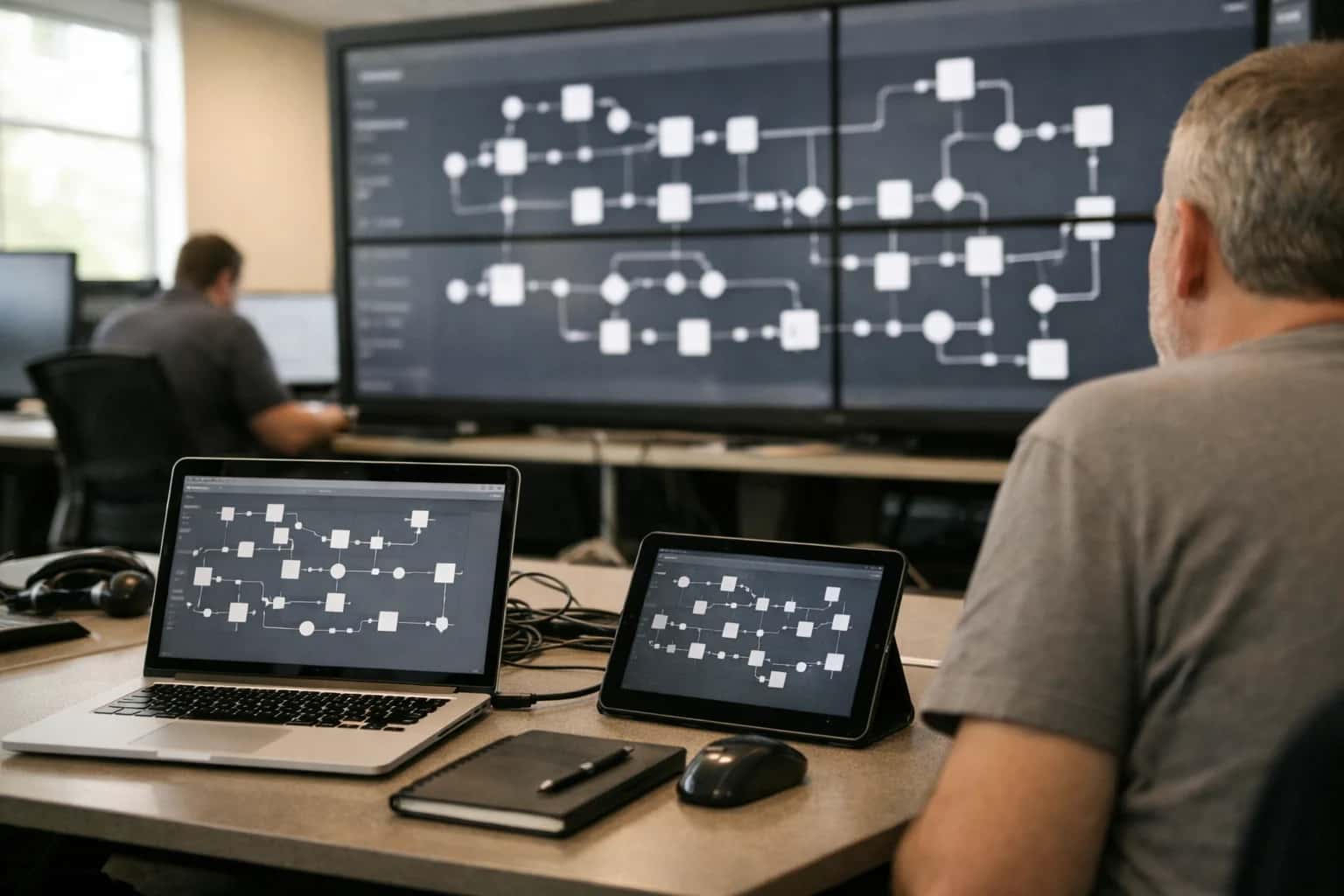
DEADLOCK DETECTION
What is Edge-Chasing Algorithm?
A distributed algorithm for identifying deadlocks in multi-agent and concurrent systems by passing probe messages along dependency chains.
The algorithm's efficiency stems from its message-passing design, which avoids maintaining a global WFG. Probes contain unique identifiers for the initiating process and the blocked resource. This method is particularly relevant in multi-agent orchestration for logistics, where robots may wait for shared pathways or charging stations. While effective, it requires mechanisms to handle false positives from transient conditions and to clean up probes after deadlock resolution to prevent stale state accumulation.
DISTRIBUTED DEADLOCK DETECTION
Key Characteristics of Edge-Chasing Algorithms
Edge-chasing algorithms are a class of distributed deadlock detection methods that identify cycles in a system's wait-for graph by passing special probe messages along dependency edges between processes or agents.
01
Probe-Based Cycle Detection
The core mechanism involves propagating probe messages along the edges of the distributed wait-for graph (WFG). A probe initiated by a blocked process travels from process to process along dependency chains. If a probe returns to its initiator, it has traversed a cycle, confirming a deadlock. This is exemplified by the Chandy-Misra-Haas algorithm, where probes carry the initiator's ID to detect cycles.
02
Fully Distributed Operation
Unlike centralized detectors, edge-chasing algorithms require no single point of control or failure. Each node (process/agent) participates in detection by:
- Maintaining its local view of outgoing wait-for edges.
- Forwarding, responding to, or initiating probes.
- Making local decisions based on received messages. This decentralization aligns with the architecture of modern multi-agent and robotic fleets, where coordination is peer-to-peer.
03
Lazy (On-Demand) Detection
Detection is typically initiated only when a process blocks on a resource request. This on-demand approach is efficient, avoiding constant cycle-checking overhead in large, dynamic systems. It contrasts with periodic detection schemes that run at fixed intervals, which can waste resources if deadlocks are infrequent. The trade-off is a delay between deadlock formation and its detection.
04
False Deadlock Considerations
A key challenge is managing transient conditions that can cause false positives. In dynamic systems like robot fleets, dependencies can resolve naturally before a detected cycle is acted upon. Mitigations include:
- Probe sequence numbers or timestamps to identify stale dependencies.
- Stable storage for probe state to handle system failures.
- Integration with timeout mechanisms to invalidate old waits.
05
Communication and Complexity
The algorithm's cost is measured in message complexity. In the worst case, a probe may traverse all edges in the WFG. For a system with N processes and E wait-for edges, message complexity is O(E) per detection initiation. This makes it scalable for sparse dependency graphs common in well-orchestrated fleets but costly for highly interconnected, contentious systems.
06
Integration with Recovery
Edge-chasing detects a deadlock but does not resolve it. It must be coupled with a deadlock recovery policy. Upon cycle confirmation, a victim selection algorithm chooses a process to abort or preempt. Common policies select the process with:
- Lowest priority.
- Least computational work invested (minimum rollback cost).
- Most easily preemptible resources. The detector passes the cycle information to the recovery module.
COMPARISON
Edge-Chasing vs. Other Deadlock Detection Methods
A technical comparison of distributed deadlock detection algorithms, focusing on the edge-chasing approach exemplified by the Chandy-Misra-Haas algorithm, against centralized and timeout-based methods.
| Feature / Metric | Edge-Chasing (e.g., Chandy-Misra-Haas) | Centralized Coordinator | Timeout-Based Detection |
|---|---|---|---|
Detection Paradigm | Distributed probe propagation | Centralized graph analysis | Heuristic timeout triggers |
Architectural Overhead | No single point of failure | Single coordinator is a bottleneck & SPOF | Minimal coordination overhead |
Detection Latency | O(d) where d is graph diameter | O(n + m) for graph cycle search | Fixed by timeout threshold (e.g., 30 sec) |
Communication Cost | Probe messages along WFG edges | Periodic state reports to coordinator | None (local timers only) |
False Positives | Theoretically zero (exact detection) | Theoretically zero (exact detection) | High (waiting ≠ deadlock) |
False Negatives | Theoretically zero (exact detection) | Theoretically zero (exact detection) | High (deadlock may resolve before timeout) |
Probe Message Complexity | O(k) per deadlock, k = cycle length | N/A (uses state messages) | N/A |
Adaptability to Dynamic WFGs | High (probes follow live edges) | Low (depends on report frequency) | Medium (timer resets on progress) |
Integration with Recovery | Direct (probe initiator can trigger action) | Indirect (coordinator signals victims) | Indirect (local timeout triggers abort) |
Typical Use Case | Distributed databases, multi-agent fleets | Controlled environments with reliable coordinator | Simple embedded systems, legacy protocols |
HETEROGENEOUS FLEET ORCHESTRATION
Real-World Applications and Examples
The Edge-Chasing Algorithm is a foundational distributed deadlock detection technique. Its principles are applied in modern systems where multiple autonomous agents compete for shared resources.
01
Warehouse Robotics Coordination
In automated fulfillment centers, Autonomous Mobile Robots (AMRs) and automated guided vehicles navigate shared aisles and compete for access to charging stations, pick stations, and narrow pathways. A distributed edge-chasing implementation can detect when robots have formed a circular wait (e.g., Robot A waits for a station held by Robot B, which waits for a path blocked by Robot C, which waits for Robot A).
- Probe messages traverse the wait-for graph between robot controllers.
- Detection triggers recovery protocols like priority-based preemption or dynamic rerouting.
- This prevents systemic gridlock that halts all material flow.
02
Manufacturing Cell Conveyor Systems
Flexible manufacturing systems use software-defined workflows where pallets (agents) move between workstations (resources) via a network of conveyors and switches. Deadlocks occur when pallets block each other in buffering zones.
- The Chandy-Misra-Haas algorithm, a classic edge-chasing variant, is often modeled in these discrete event systems.
- Probes initiated by a blocked pallet chase dependencies through the control network.
- Upon cycle detection, the orchestration middleware may command a specific workstation to complete its cycle or utilize a pre-designated deadlock buffer to break the wait condition.
03
Autonomous Vehicle Intersection Management
In Vehicle-to-Everything (V2X) networks, connected autonomous vehicles approaching an unsignaled intersection must negotiate right-of-way. A distributed agreement protocol can lead to a deadlock if each vehicle yields to another.
- Edge-chasing logic can be adapted where vehicles are nodes and "wait-for" edges represent yielded right-of-way.
- A probe initiated by a vehicle that has been waiting too long circulates to detect a circular yield condition.
- The system can then break the deadlock by assigning a temporary priority based on vehicle ID or emergency status, forcing one vehicle to proceed.
04
Multi-Agent Software Task Scheduling
In heterogeneous compute clusters (e.g., for simulation or rendering), tasks (agents) require exclusive access to GPU pools, licensed software, or dataset locks. A distributed scheduler must detect when tasks are mutually blocking.
- Edge-chasing provides a low-overhead detection mechanism compared to centralized graph analysis.
- Each scheduler instance manages probes for its local tasks. When a probe returns to its initiator, it confirms a deadlock.
- Recovery involves victim selection—terminating or suspending the lowest-priority or most easily restarted task to release its held resources.
05
Container Port AGV Logistics
At automated container ports, dozens of Automated Guided Vehicles transport containers between ships, cranes, and storage stacks. Deadlocks form in congested transfer areas where each AGV's path is blocked by another.
- A hierarchical control system uses edge-chasing within zones. The zone controller initiates probes when AGVs report prolonged blocking.
- Detecting a cycle allows the system to implement a non-preemptive recovery strategy: one AGV is given a temporary reroute command to a holding bay, breaking the spatial circular wait.
- This minimizes disruption compared to a full fleet replanning operation.
06
Comparison to Centralized Detection
Edge-chasing is chosen over centralized deadlock detection in specific architectural contexts.
Advantages of Edge-Chasing:
- Scalability: No single point of failure or bottleneck.
- Communication Efficiency: Probes are only sent along dependency edges, not broadcast.
- Fault Tolerance: The algorithm can tolerate node failures with timeouts.
Disadvantages & Trade-offs:
- Probe Overhead: Each deadlock generates multiple messages; under high contention, this can create network load.
- Complex Recovery: Detecting a deadlock is distinct from resolving it. Recovery (preemption, termination) requires additional consensus.
- False Positives: In dynamic systems, the wait-for graph can change after a probe is sent, leading to detection of a cycle that no longer exists (phantom deadlock).
EDGE-CHASING ALGORITHM
Frequently Asked Questions
A deep dive into the distributed deadlock detection method where probe messages traverse wait-for graph edges to identify cycles, critical for heterogeneous fleet orchestration.
The Edge-Chasing Algorithm is a distributed deadlock detection method where special probe messages are passed along the edges of a Wait-For Graph (WFG) to detect cycles, which indicate a deadlock. It operates without a central coordinator, making it suitable for decentralized systems like multi-agent fleets. The classic implementation is the Chandy-Misra-Haas algorithm, where probes initiated by a blocked process traverse dependency chains; if a probe returns to its initiator, a deadlock cycle is confirmed. This method is foundational for identifying gridlock in systems where agents (e.g., autonomous mobile robots) are waiting for resources held by others.
Enabling Efficiency, Speed & Accuracy
Intelligent Analysis, Decision & Execution
We build AI systems for teams that need search across company data, workflow automation across tools, or AI features inside products and internal software.
Talk to Us
Search across company data
Give teams answers from docs, tickets, runbooks, and product data with sources and permissions.
Useful when people spend too long searching or get different answers from different systems.
Enterprise searchRAGPermissions
Read more
Automate internal workflows
Use AI to route work, draft outputs, trigger actions, and keep approvals and logs in place.
Useful when repetitive work moves across multiple tools and teams.
AI agentsWorkflow automationGovernance
Read more
Add AI to products and internal tools
Build assistants, guided actions, or decision support into the software your team or customers already use.
Useful when AI needs to be part of the product, not a separate tool.
AI integrationDecision supportModel routing
Read more
About the author
Prasad Kumkar
CEO & MD, Inference Systems
Prasad Kumkar is the CEO & MD of Inference Systems and writes about AI systems architecture, LLM infrastructure, model serving, evaluation, and production deployment. Over 5+ years, he has worked across computer vision models, L5 autonomous vehicle systems, and LLM research, with a focus on taking complex AI ideas into real-world engineering systems.
His work and writing cover AI systems, large language models, AI agents, multimodal systems, autonomous systems, inference optimization, RAG, evaluation, and production AI engineering.
LinkedIn
Limited slotsGet a Free AI Consultation
Partnered with leading AI, data, and software stack.





How We Work
Custom AI workflows for your Business
One-fit-all AI don't work for modern businesses. At Inferensys, we aim to understand your business & custom requirements; which we use to define most efficient agentic workflows, the data, and the tools for your business.
01
Review the use case
We understand the task, the users, and where AI can actually help.
Read more02
Pick the right approach
We define what needs search, automation, or product integration.
Read more03
Build the first useful version
We implement the part that proves the value first.
Read more04
Improve from there
We add the checks and visibility needed to keep it useful.
Read moreThe first call is a practical review of your use case and the right next step.
Talk to Us