Cross-Device Federated Learning is a decentralized training topology that orchestrates model optimization across a massive, heterogeneous population of edge clients—typically smartphones, wearables, or IoT sensors—characterized by unreliable connectivity, limited compute, and highly non-IID local data. Unlike cross-silo federated learning, which involves a small number of reliable institutional nodes, cross-device systems must handle severe federated client dropout, straggler mitigation, and intermittent participation from millions of devices.

Glossary
Cross-Device Federated Learning
A federated learning topology designed for massive-scale training across thousands or millions of unreliable, resource-constrained edge devices like smartphones or wearables.
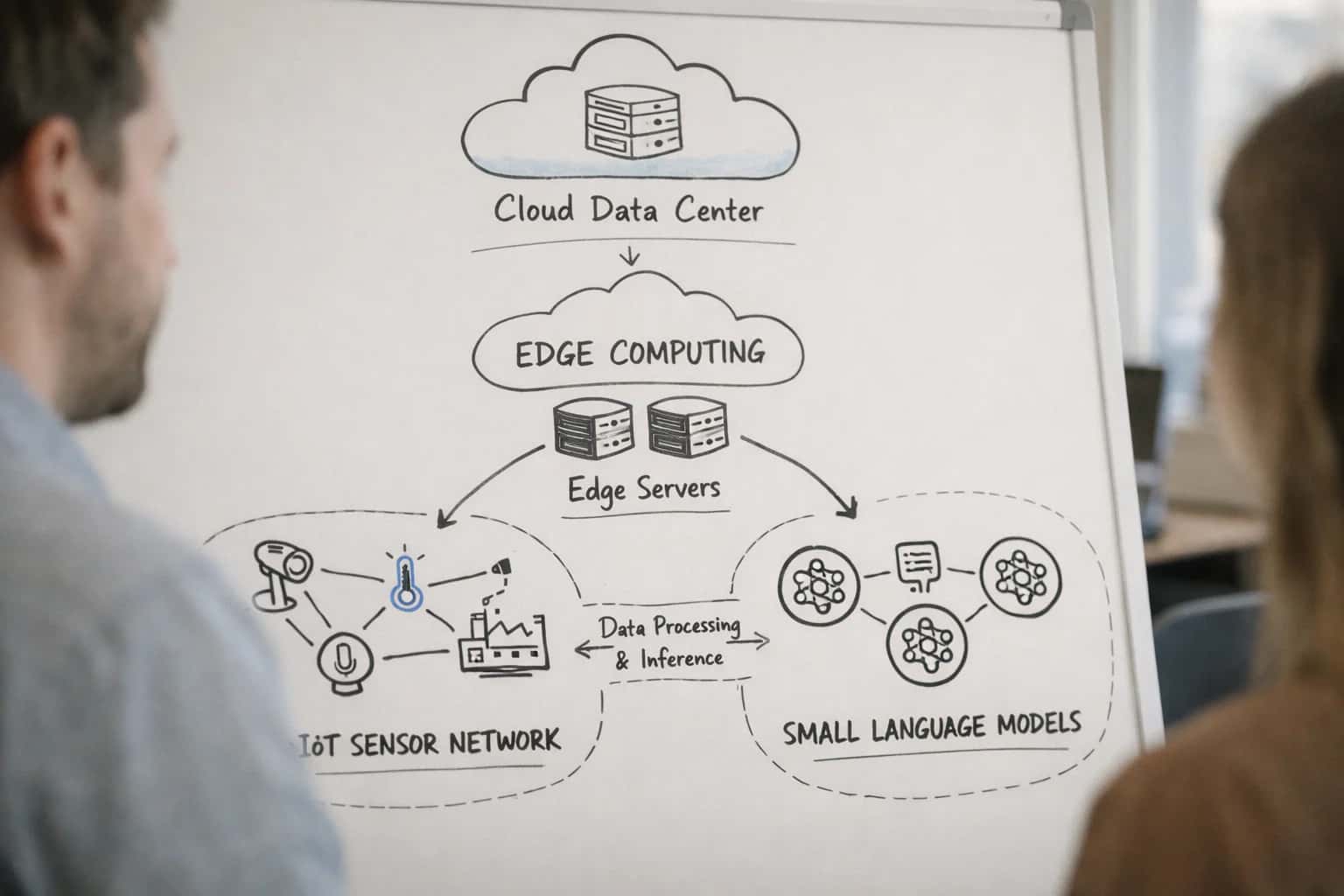
MASSIVE-SCALE EDGE TOPOLOGY
What is Cross-Device Federated Learning?
A federated learning topology designed for massive-scale training across thousands or millions of unreliable, resource-constrained edge devices like smartphones or wearables.
The architecture relies on federated synchronous training rounds coordinated by a central federated parameter server, employing aggressive communication-efficient protocols like gradient compression and Federated Averaging to minimize bandwidth. Security is enforced through federated secure aggregation, ensuring the server can only compute the sum of updates without inspecting individual contributions, while federated client selection strategies prioritize available, charged, and idle devices to maximize convergence speed under strict resource constraints.
MASSIVE-SCALE EDGE TOPOLOGY
Key Characteristics of Cross-Device Federated Learning
Cross-device federated learning is defined by its operation across thousands to millions of unreliable, resource-constrained clients. Unlike institutional cross-silo settings, this topology must handle extreme system heterogeneity, intermittent connectivity, and stringent on-device privacy budgets.
01
Massive Client Populations
This topology scales to millions of edge devices—smartphones, wearables, IoT sensors—dwarfing the client count in cross-silo settings. A single training round may involve sampling from a pool of 10,000+ devices.
- Scale: Orders of magnitude larger than institutional FL (typically 2–100 clients).
- Implication: Aggregation algorithms must be statistically robust to high client dropout and stragglers.
- Example: Google's Gboard trains next-word prediction models across millions of Android devices.
10M+
Typical Client Pool Size
0.1%–1%
Clients Sampled Per Round
02
Extreme System Heterogeneity
No two devices are identical. The network must accommodate vast differences in compute capability, memory, battery level, and network bandwidth.
- Hardware Variance: From flagship smartphones to low-RAM IoT microcontrollers.
- Availability: Clients are only eligible when idle, charging, and on unmetered Wi-Fi.
- Challenge: Local training time can vary by 10x–100x between the fastest and slowest device in a round.
10x–100x
Compute Variance
03
Intermittent Connectivity & Client Dropout
Clients are unreliable by design. They may drop out mid-computation due to connectivity loss, battery depletion, or user interruption.
- Dropout Rates: Often 50%–90% of selected clients fail to report back in a given round.
- Mitigation: Protocols use oversampling and asynchronous aggregation to avoid blocking on stragglers.
- Straggler Handling: The server sets a timeout window; updates arriving late are discarded for that round.
50%–90%
Typical Client Dropout
05
Communication Efficiency Imperative
Uploading full model updates over cellular networks is prohibitively expensive. The topology demands aggressive gradient compression and quantization.
- Techniques: Random sparsification, structured pruning, and low-bit quantization reduce update sizes by 100x–1000x.
- Federated Averaging (FedAvg): Clients perform multiple local epochs before communicating, reducing total rounds.
- Trade-off: Higher local computation reduces communication but risks model divergence on non-IID data.
100x–1000x
Compression Ratio
06
Non-IID Data Distribution
Each device generates a highly personalized, non-representative data shard. A user's typing history or health metrics are statistically unique.
- Pathological Non-IID: Data distributions across clients can be entirely disjoint, violating the IID assumption of standard SGD.
- Consequence: Local models can diverge significantly from the global optimum, slowing or preventing convergence.
- Mitigation: Proximal terms (FedProx), variance reduction, and personalized FL layers help stabilize training.
Enabling Efficiency, Speed & Accuracy
Intelligent Analysis, Decision & Execution
We build AI systems for teams that need search across company data, workflow automation across tools, or AI features inside products and internal software.
Talk to Us
Search across company data
Give teams answers from docs, tickets, runbooks, and product data with sources and permissions.
Useful when people spend too long searching or get different answers from different systems.
Enterprise searchRAGPermissions
Read more
Automate internal workflows
Use AI to route work, draft outputs, trigger actions, and keep approvals and logs in place.
Useful when repetitive work moves across multiple tools and teams.
AI agentsWorkflow automationGovernance
Read more
Add AI to products and internal tools
Build assistants, guided actions, or decision support into the software your team or customers already use.
Useful when AI needs to be part of the product, not a separate tool.
AI integrationDecision supportModel routing
Read moreCROSS-DEVICE FEDERATED LEARNING
Frequently Asked Questions
Clear, technically precise answers to the most common questions about training machine learning models across massive, unreliable edge device networks.
Cross-device federated learning is a decentralized training topology designed for massive-scale networks involving thousands to millions of unreliable, resource-constrained edge devices, such as smartphones, wearables, or IoT sensors. The fundamental distinction from cross-silo federated learning lies in scale, reliability, and computational capacity. Cross-silo involves a small number (typically 2–100) of highly reliable, computationally robust institutional clients like hospitals or data centers with large, curated local datasets and persistent availability. In contrast, cross-device clients are ephemeral—they are only available for training when charging, connected to unmetered Wi-Fi, and idle. This topology must handle extreme client dropout, where a significant percentage of selected devices fail to return updates, and straggler mitigation becomes critical. Architecturally, cross-device systems rely on a federated parameter server with a hub-and-spoke topology, employing protocols like Federated Averaging (FedAvg) with aggressive client selection strategies to maximize convergence despite heterogeneous, non-IID data shards distributed across the population.

About the author
Prasad Kumkar
CEO & MD, Inference Systems
Prasad Kumkar is the CEO & MD of Inference Systems and writes about AI systems architecture, LLM infrastructure, model serving, evaluation, and production deployment. Over 5+ years, he has worked across computer vision models, L5 autonomous vehicle systems, and LLM research, with a focus on taking complex AI ideas into real-world engineering systems.
His work and writing cover AI systems, large language models, AI agents, multimodal systems, autonomous systems, inference optimization, RAG, evaluation, and production AI engineering.
LinkedIn
Limited slotsGet a Free AI Consultation
Partnered with leading AI, data, and software stack.





How We Work
Custom AI workflows for your Business
One-fit-all AI don't work for modern businesses. At Inferensys, we aim to understand your business & custom requirements; which we use to define most efficient agentic workflows, the data, and the tools for your business.
01
Review the use case
We understand the task, the users, and where AI can actually help.
Read more02
Pick the right approach
We define what needs search, automation, or product integration.
Read more03
Build the first useful version
We implement the part that proves the value first.
Read more04
Improve from there
We add the checks and visibility needed to keep it useful.
Read moreThe first call is a practical review of your use case and the right next step.
Talk to Us