A Federated Tool-Augmented LLM is an architecture where a central large language model securely invokes local computational tools—such as a drug interaction checker or a dosing calculator—hosted within each hospital's private infrastructure. The model dispatches function calls to the relevant site, executes the query against the local resource, and integrates the verified result into its reasoning chain without the raw clinical data ever leaving the institution.

Glossary
Federated Tool-Augmented LLM
An architecture where a centrally hosted large language model is granted secure, federated access to local computational tools and databases at each hospital, such as a drug interaction checker, to ground its reasoning in verified clinical resources.
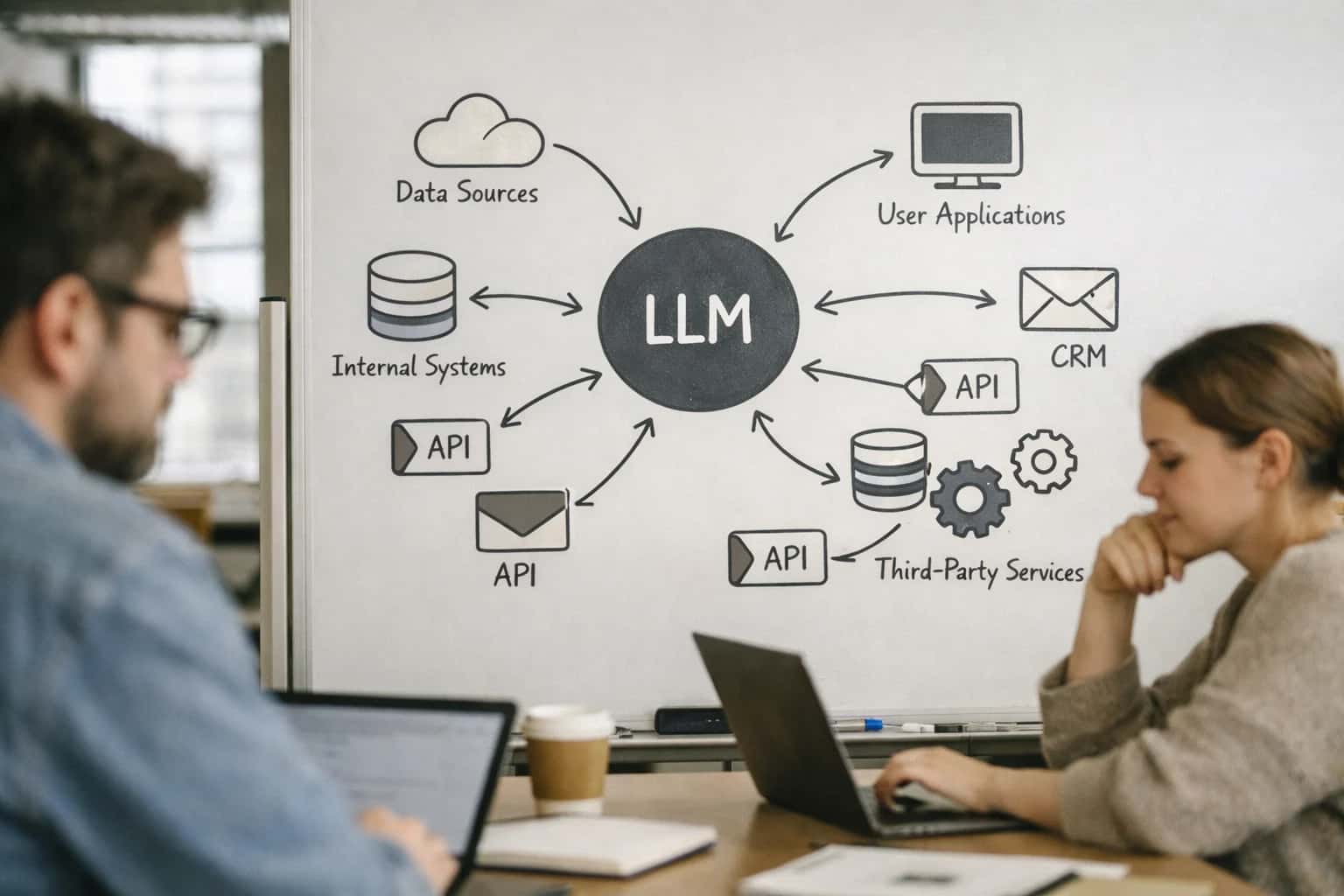
DECENTRALIZED REASONING ARCHITECTURE
What is Federated Tool-Augmented LLM?
A privacy-preserving architecture where a centrally hosted large language model is granted secure, federated access to local computational tools and databases at each hospital to ground its reasoning in verified clinical resources.
This paradigm extends federated retrieval-augmented generation (RAG) by moving beyond document retrieval to active computation. The LLM acts as a reasoning orchestrator, decomposing a complex clinical query into sub-tasks that are routed to the appropriate local tool. This ensures that generated recommendations are grounded in authoritative, site-specific resources while maintaining strict data locality and compliance with regulations like HIPAA.
Federated Tool-Augmented LLM
Key Architectural Features
The core architectural components that enable a centrally hosted large language model to securely invoke local computational tools and databases at each hospital without exposing protected health information.
01
Secure Tool Invocation Gateway
A cryptographic middleware deployed at each hospital that mediates all requests between the central LLM and local tools. The gateway validates the LLM's identity, enforces role-based access control (RBAC) on tool execution, and ensures that only the computed result—never the raw patient data—leaves the institution. It typically operates within a hardened enclave or trusted execution environment (TEE) to prevent tampering by local system administrators.
Zero
Raw Data Egress
02
Federated Function Calling Protocol
An extension of standard LLM function-calling that routes tool execution requests to the correct hospital node based on a patient-context binding. When the LLM generates a function call—such as check_drug_interactions(patient_id, new_medication)—the protocol resolves the patient_id to a specific institution's gateway. This requires a federated identity registry that maps anonymized patient tokens to their home institution without revealing cross-institutional patient lists.
03
Differential Privacy Budget Controller
A mechanism that tracks and limits the cumulative information leakage from repeated tool queries. Each invocation of a local database or computational tool consumes a fraction of a pre-defined privacy budget (ε) . The controller applies calibrated noise to query results and may reject requests when the budget is exhausted, preventing adversaries from reconstructing private patient data through statistical analysis of multiple LLM-generated answers.
ε < 1.0
Typical Privacy Budget
04
Local Tool Registry and Schema Sync
Each hospital maintains a local tool registry that describes the capabilities, input schemas, and output formats of its available computational resources—such as a drug interaction checker, a dosing calculator, or a clinical trial matcher. A lightweight schema synchronization service periodically pushes anonymized tool definitions to the central LLM's tool catalog, enabling the model to generate correct function calls without ever seeing the underlying implementation or data.
05
Auditable Execution Ledger
An immutable, append-only log that records every tool invocation across the federated network, including the requesting LLM prompt hash, the tool called, the timestamp, and a cryptographic commitment to the result. This ledger—often implemented on a permissioned blockchain or distributed ledger—provides compliance officers with a tamper-proof audit trail for HIPAA and GDPR requirements without exposing the actual patient data that was processed.
Immutable
Audit Trail Integrity
06
Result Grounding and Attribution Engine
A post-processing module that attaches verifiable provenance to every piece of information the LLM incorporates from a federated tool. When the model cites a drug interaction warning, the engine appends a cryptographically signed attribution token that links back to the specific hospital's tool invocation ledger entry. This allows downstream clinicians to verify the source and recency of the clinical knowledge without accessing the originating hospital's systems.
FEDERATED TOOL-AUGMENTED LLM
Frequently Asked Questions
Explore the architecture that grants a centrally hosted large language model secure, federated access to local computational tools and databases at each hospital, grounding its reasoning in verified clinical resources without exposing patient data.
A Federated Tool-Augmented LLM is an architecture where a centrally hosted large language model is granted secure, federated access to local computational tools and databases residing within each hospital's private infrastructure. Instead of centralizing sensitive clinical resources, the LLM issues a tool-use request—such as a drug interaction check or a lab value lookup—which is executed locally at the institution. Only the verified, de-identified result is returned to the central model to ground its reasoning. This mechanism allows the model to generate contextually accurate clinical summaries or recommendations by leveraging live, authoritative hospital resources without ever exposing the underlying patient data or proprietary algorithms to the central server.
Enabling Efficiency, Speed & Accuracy
Intelligent Analysis, Decision & Execution
We build AI systems for teams that need search across company data, workflow automation across tools, or AI features inside products and internal software.
Talk to Us
Search across company data
Give teams answers from docs, tickets, runbooks, and product data with sources and permissions.
Useful when people spend too long searching or get different answers from different systems.
Enterprise searchRAGPermissions
Read more
Automate internal workflows
Use AI to route work, draft outputs, trigger actions, and keep approvals and logs in place.
Useful when repetitive work moves across multiple tools and teams.
AI agentsWorkflow automationGovernance
Read more
Add AI to products and internal tools
Build assistants, guided actions, or decision support into the software your team or customers already use.
Useful when AI needs to be part of the product, not a separate tool.
AI integrationDecision supportModel routing
Read more
About the author
Prasad Kumkar
CEO & MD, Inference Systems
Prasad Kumkar is the CEO & MD of Inference Systems and writes about AI systems architecture, LLM infrastructure, model serving, evaluation, and production deployment. Over 5+ years, he has worked across computer vision models, L5 autonomous vehicle systems, and LLM research, with a focus on taking complex AI ideas into real-world engineering systems.
His work and writing cover AI systems, large language models, AI agents, multimodal systems, autonomous systems, inference optimization, RAG, evaluation, and production AI engineering.
LinkedIn
Limited slotsGet a Free AI Consultation
Partnered with leading AI, data, and software stack.





How We Work
Custom AI workflows for your Business
One-fit-all AI don't work for modern businesses. At Inferensys, we aim to understand your business & custom requirements; which we use to define most efficient agentic workflows, the data, and the tools for your business.
01
Review the use case
We understand the task, the users, and where AI can actually help.
Read more02
Pick the right approach
We define what needs search, automation, or product integration.
Read more03
Build the first useful version
We implement the part that proves the value first.
Read more04
Improve from there
We add the checks and visibility needed to keep it useful.
Read moreThe first call is a practical review of your use case and the right next step.
Talk to Us