Data locality is a foundational constraint in healthcare edge computing that mandates computation occur directly on the device where patient data is generated. By keeping sensitive information within the medical device or edge gateway, this principle enforces strict compliance with data residency regulations like GDPR and HIPAA, eliminating the risk of exposure during network transit to a central server.

Glossary
Data Locality
Data locality is the architectural principle of processing and storing data physically close to its generation source on an edge device or local gateway, rather than transmitting it to a distant cloud data center.
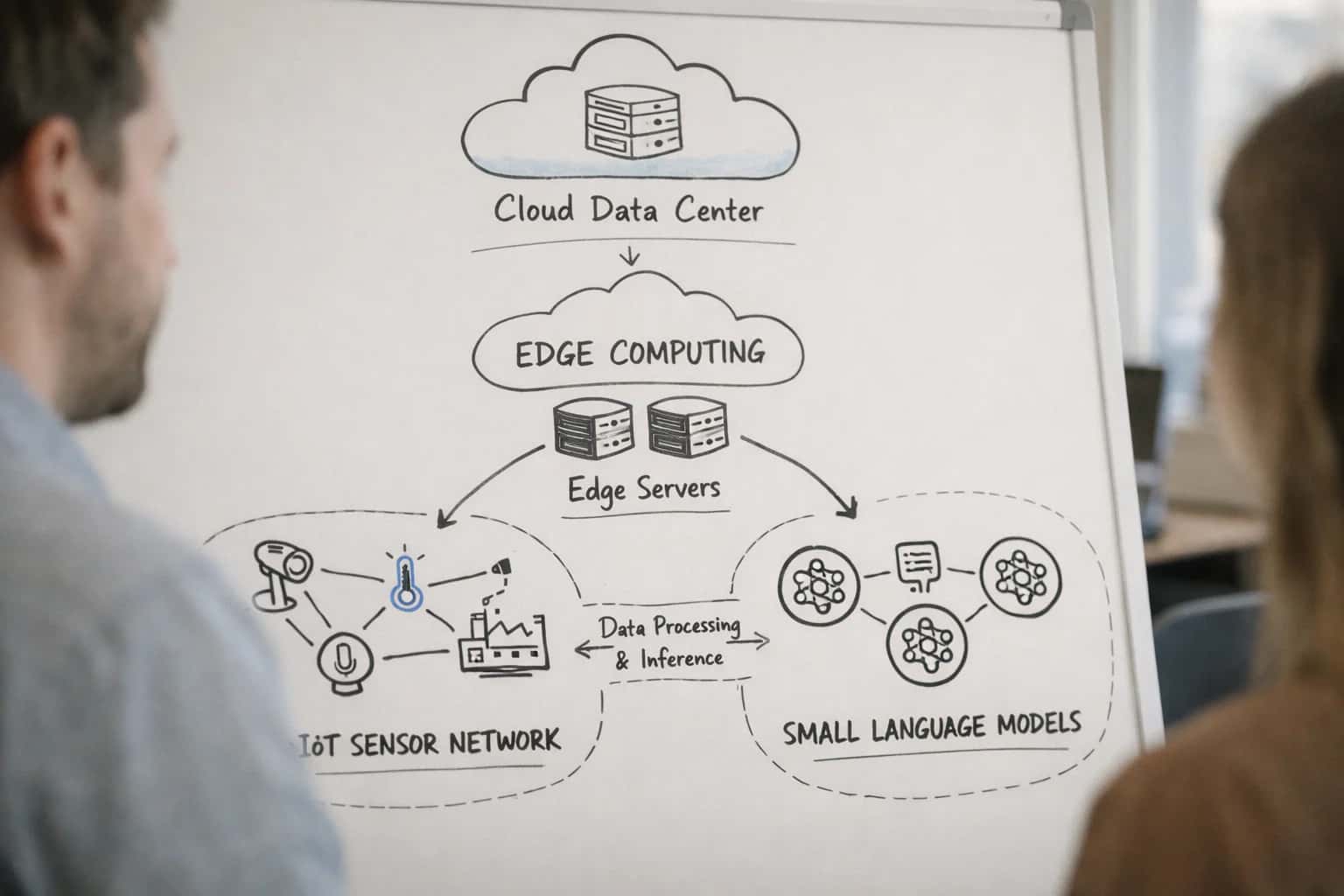
EDGE COMPUTING PRINCIPLE
What is Data Locality?
Data locality is the architectural principle of processing and storing data physically close to its point of origin on an edge device or local gateway, rather than transmitting it to a distant cloud data center.
In a federated learning context, data locality ensures that raw clinical data never leaves the source institution. Only anonymized model updates, such as gradients, are transmitted. This architecture is critical for on-device inference and on-device training, enabling low-latency diagnostics on wearables while providing a verifiable technical control for sovereign data governance.
PRIVACY-PRESERVING ARCHITECTURE
Core Properties of Data Locality
Data locality is the foundational principle that sensitive patient information must be processed and stored as close as possible to its point of origin. In healthcare federated learning, this ensures compliance with strict data residency regulations while enabling collaborative AI development.
01
Physical Proximity
The core tenet of data locality is that computation moves to the data, not the reverse. Raw patient records, medical images, and sensor telemetry never leave the edge device or local gateway. Instead, a training script is dispatched to the local node, and only encrypted, abstracted model updates—never raw data—are transmitted externally. This eliminates the need for a centralized data lake, directly satisfying HIPAA and GDPR data minimization requirements.
02
Regulatory Compliance by Design
Data locality transforms a legal requirement into a technical invariant. By ensuring data never crosses jurisdictional boundaries, the architecture inherently complies with data residency laws. Key mechanisms include:
- Geofencing: Restricting model training to servers within a specific country or legal entity.
- Audit Trails: Immutable logs proving that raw data never left the local node.
- Data Sovereignty: Guaranteeing that the data owner retains full physical and legal control over their assets at all times.
03
Bandwidth Efficiency
Transmitting massive clinical datasets—such as high-resolution 3D MRI scans or whole-genome sequences—over a network is prohibitively slow and expensive. Data locality eliminates this bottleneck by processing data on-site. The system only shares compact model gradients or weight updates, which are orders of magnitude smaller than the training data itself. This enables collaborative learning even in bandwidth-constrained environments like rural clinics or mobile health units.
04
Low-Latency Inference
For real-time medical applications, a round-trip to the cloud is often clinically unacceptable. Data locality enables on-device inference where a model runs directly on a medical wearable or surgical robot. This guarantees sub-millisecond response times for critical tasks such as:
- Cardiac arrhythmia detection from ECG streams.
- Hypoglycemia prediction from continuous glucose monitors.
- Anomaly detection in robotic-assisted surgery. The result is a system that remains fully functional even during network outages.
05
Heterogeneous Data Handling
Medical data is notoriously non-IID (not independent and identically distributed). A model trained on a centralized dataset from one hospital often fails when deployed at another with different patient demographics or equipment. Data locality preserves this natural statistical diversity. By training local models on their own unique data distributions, a federated system can learn a more robust and generalizable global model that captures the full spectrum of clinical reality without ever homogenizing the source data.
06
Trust and Patient Consent
Data locality is the technical embodiment of patient trust. It enables a consent-based architecture where a patient or institution can revoke access at any time, and the local data is immediately and verifiably removed from the collaborative process. This granular control is impossible in a centralized data lake where data is copied and distributed. The principle ensures that the patient remains the ultimate arbiter of their own health information, fostering the ethical foundation required for large-scale medical AI research.
DATA LOCALITY IN HEALTHCARE
Frequently Asked Questions
Clear answers to the most common technical and regulatory questions about processing and storing sensitive patient data directly on medical devices and local gateways.
Data locality is the architectural principle of processing and storing data physically close to its source—on the edge device or a local gateway—rather than transmitting it to a centralized cloud. In healthcare, this is critical because it directly enforces data residency regulations such as GDPR Article 48 and HIPAA, which mandate that protected health information (PHI) must remain within specific jurisdictional or institutional boundaries. By keeping data local, organizations eliminate the risk of cross-border data transfer violations and reduce the attack surface for breaches. The principle is the technical foundation for privacy-preserving machine learning, enabling sensitive computations like on-device inference and federated learning without raw data ever leaving the clinical environment.
- Regulatory Compliance: Satisfies data residency and sovereignty mandates.
- Reduced Attack Surface: Minimizes exposure during transit and in cloud storage.
- Operational Continuity: Enables AI functionality during network outages.
- Patient Trust: Demonstrates a verifiable commitment to data stewardship.
Enabling Efficiency, Speed & Accuracy
Intelligent Analysis, Decision & Execution
We build AI systems for teams that need search across company data, workflow automation across tools, or AI features inside products and internal software.
Talk to Us
Search across company data
Give teams answers from docs, tickets, runbooks, and product data with sources and permissions.
Useful when people spend too long searching or get different answers from different systems.
Enterprise searchRAGPermissions
Read more
Automate internal workflows
Use AI to route work, draft outputs, trigger actions, and keep approvals and logs in place.
Useful when repetitive work moves across multiple tools and teams.
AI agentsWorkflow automationGovernance
Read more
Add AI to products and internal tools
Build assistants, guided actions, or decision support into the software your team or customers already use.
Useful when AI needs to be part of the product, not a separate tool.
AI integrationDecision supportModel routing
Read moreREGULATORY ARCHITECTURE COMPARISON
Data Locality vs. Data Residency vs. Data Sovereignty
A technical comparison of three distinct but interrelated concepts governing the physical and jurisdictional control of data in healthcare edge computing environments.
| Feature | Data Locality | Data Residency | Data Sovereignty |
|---|---|---|---|
Core Definition | Processing and storing data physically close to its source on the edge device or local gateway | Storing data within a specified geographic or political boundary as mandated by law or policy | Data is subject to the laws and governance of the nation where it is physically collected or stored |
Primary Driver | Latency reduction and bandwidth optimization | Legal compliance with national data protection regulations | National strategic autonomy and jurisdictional control |
Enforcement Mechanism | System architecture and network topology design | Contractual obligations and regulatory audits | Government legislation and sovereign legal authority |
Data in Transit Control | |||
Data at Rest Control | |||
Cross-Border Transfer | Permitted if latency constraints allow | Restricted without adequate safeguards or adequacy decisions | Prohibited or strictly controlled by national law |
Healthcare Example | ECG analysis performed directly on a wearable patch before transmitting only the arrhythmia alert | Patient records from an EU hospital stored exclusively in AWS Frankfurt region | Genomic data of citizens legally barred from leaving the national territory under biosecurity laws |
Typical Compliance Standard | ISO/IEC 27040 for storage security | GDPR Article 44-49, HIPAA | National data protection acts, EU Data Governance Act |

About the author
Prasad Kumkar
CEO & MD, Inference Systems
Prasad Kumkar is the CEO & MD of Inference Systems and writes about AI systems architecture, LLM infrastructure, model serving, evaluation, and production deployment. Over 5+ years, he has worked across computer vision models, L5 autonomous vehicle systems, and LLM research, with a focus on taking complex AI ideas into real-world engineering systems.
His work and writing cover AI systems, large language models, AI agents, multimodal systems, autonomous systems, inference optimization, RAG, evaluation, and production AI engineering.
LinkedIn
Limited slotsGet a Free AI Consultation
Partnered with leading AI, data, and software stack.





How We Work
Custom AI workflows for your Business
One-fit-all AI don't work for modern businesses. At Inferensys, we aim to understand your business & custom requirements; which we use to define most efficient agentic workflows, the data, and the tools for your business.
01
Review the use case
We understand the task, the users, and where AI can actually help.
Read more02
Pick the right approach
We define what needs search, automation, or product integration.
Read more03
Build the first useful version
We implement the part that proves the value first.
Read more04
Improve from there
We add the checks and visibility needed to keep it useful.
Read moreThe first call is a practical review of your use case and the right next step.
Talk to Us