Hierarchical Aggregation (FedHier) is a multi-tier federated learning topology where edge servers perform intermediate model averaging on local client updates before transmitting the partially aggregated result to a central cloud server for final global aggregation. This architecture reduces the communication bottleneck at the central node by distributing the aggregation workload across geographically proximate edge aggregators, significantly lowering end-to-end training latency in large-scale, cross-silo deployments such as multi-hospital healthcare networks.

Glossary
Hierarchical Aggregation (FedHier)
A multi-tier aggregation topology where edge servers perform intermediate model averaging on client updates before a central cloud server executes the final global aggregation, reducing latency.
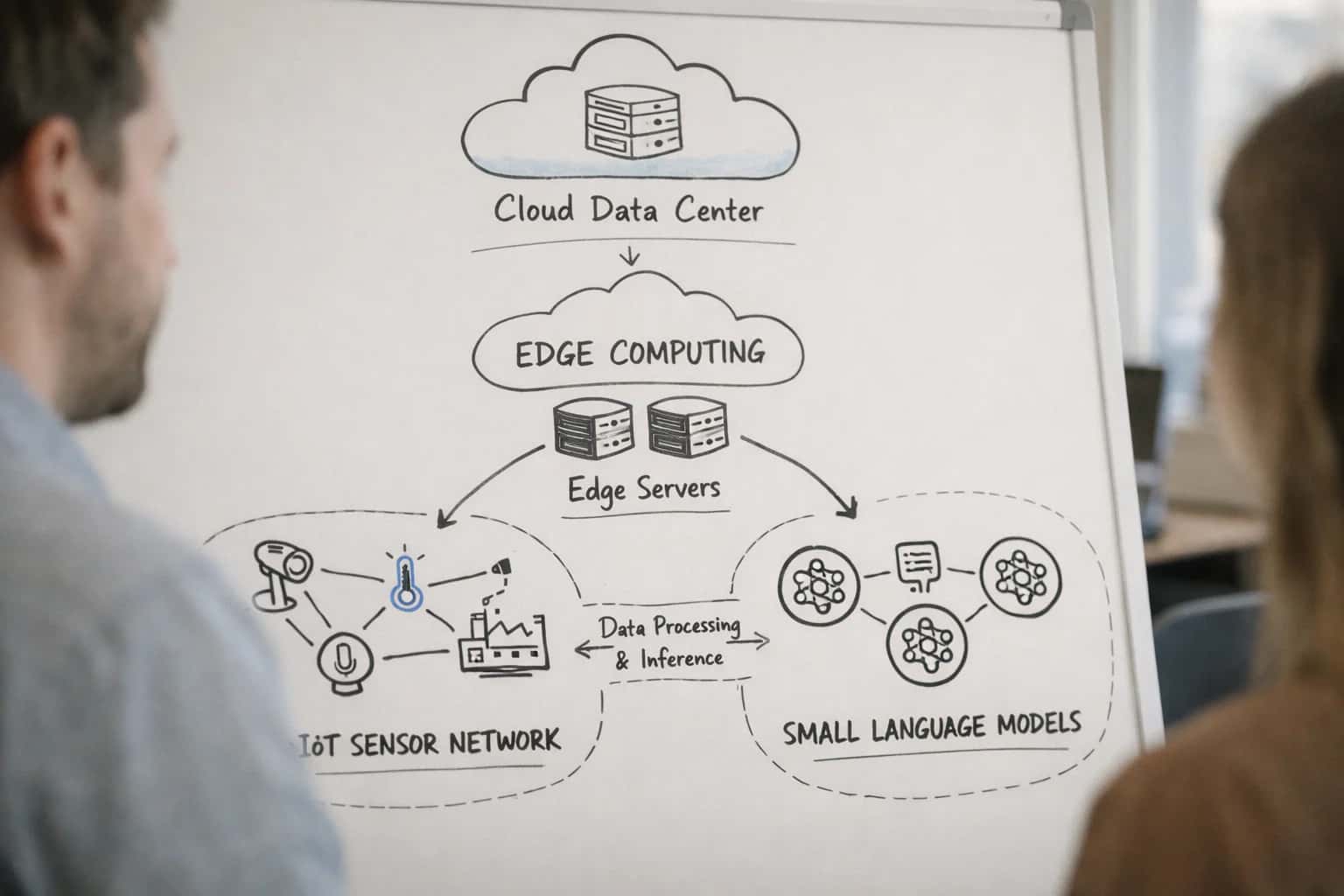
MULTI-TIER FEDERATED LEARNING TOPOLOGY
What is Hierarchical Aggregation (FedHier)?
A federated learning architecture that introduces intermediate edge servers to perform partial model aggregation on client updates before a central cloud server executes the final global aggregation, reducing communication latency and backbone bandwidth requirements.
In a typical FedHier deployment, clients within a single institution or regional cluster send their local model updates to a designated edge aggregator rather than directly to the distant cloud. The edge server executes a synchronization round—often using Federated Averaging (FedAvg) or a variant—and forwards only the consolidated update upstream. This hierarchical structure also enhances privacy by limiting raw gradient exposure to local trusted aggregators and aligns naturally with existing organizational boundaries in healthcare federated learning ecosystems.
HIERARCHICAL AGGREGATION
Key Features of FedHier
Hierarchical Aggregation (FedHier) introduces a multi-tier topology that strategically places intermediate edge servers between clients and the central cloud, fundamentally optimizing latency, communication efficiency, and scalability in large-scale federated learning deployments.
01
Multi-Tier Edge Aggregation
FedHier decouples the global aggregation process into distinct edge-level and cloud-level phases. Local client updates are first sent to a nearby edge aggregator (e.g., a regional hospital server), which performs an intermediate weighted average. This partial model is then forwarded to the central cloud server for final global fusion. This topology drastically reduces the distance and network hops required for raw gradient transmission, mitigating the bottleneck of a single central node.
02
Latency Reduction via Proximity
By processing updates at the network edge, FedHier minimizes the round-trip time (RTT) for client synchronization. Clients communicate with a low-latency local aggregator instead of a distant cloud data center. This is critical for time-sensitive healthcare applications where model updates from ICU monitoring devices must be incorporated rapidly. The architecture effectively parallelizes the aggregation workload, preventing straggler clients from stalling the entire global training loop.
03
Communication Efficiency
FedHier significantly reduces wide-area network (WAN) traffic. Instead of N clients transmitting full model updates to the cloud, only K edge-aggregated models (where K << N) traverse the backbone network. This hierarchical compression of the communication graph lowers bandwidth costs and alleviates congestion. The edge servers can also perform model compression or gradient quantization on the aggregated updates before cloud transmission, further optimizing throughput.
04
Cross-Silo Federation Topology
This architecture naturally maps to cross-silo organizational structures, such as a network of hospitals within a healthcare system. Each hospital acts as an edge aggregator for its internal departments (clients), enforcing local data governance policies before sharing a de-identified, aggregated model update with a central health authority. This provides a technical enforcement point for data sovereignty and hierarchical trust domains.
05
Heterogeneity Management
FedHier provides a structural advantage in handling statistical heterogeneity. Edge aggregators can be configured to group clients with similar data distributions (e.g., patients with similar demographics). The edge-level model can learn cluster-specific features, while the cloud model captures global patterns. This prevents the global model from being dominated by a single large cluster and improves personalization through a natural clustered federated learning approach.
06
Fault Tolerance and Scalability
The hierarchical topology enhances system resilience. If a single edge server fails, only its subordinate clients are affected; the rest of the network continues training. The cloud server can implement Byzantine-resilient aggregation on the edge-level updates, treating each edge aggregator as a trusted super-client. This design scales horizontally by simply adding more edge servers to accommodate growing client populations without overloading the central coordinator.
Enabling Efficiency, Speed & Accuracy
Intelligent Analysis, Decision & Execution
We build AI systems for teams that need search across company data, workflow automation across tools, or AI features inside products and internal software.
Talk to Us
Search across company data
Give teams answers from docs, tickets, runbooks, and product data with sources and permissions.
Useful when people spend too long searching or get different answers from different systems.
Enterprise searchRAGPermissions
Read more
Automate internal workflows
Use AI to route work, draft outputs, trigger actions, and keep approvals and logs in place.
Useful when repetitive work moves across multiple tools and teams.
AI agentsWorkflow automationGovernance
Read more
Add AI to products and internal tools
Build assistants, guided actions, or decision support into the software your team or customers already use.
Useful when AI needs to be part of the product, not a separate tool.
AI integrationDecision supportModel routing
Read moreHIERARCHICAL AGGREGATION
Frequently Asked Questions
Clarifying the multi-tier topology that reduces communication bottlenecks in geographically distributed federated learning networks.
Hierarchical Aggregation (FedHier) is a multi-tier federated learning topology where edge servers perform intermediate model averaging on client updates before a central cloud server executes the final global aggregation. Instead of every hospital transmitting model updates directly to a distant cloud aggregator, FedHier introduces an intermediate layer of regional edge servers. In a typical workflow, local clients within a geographic region send their encrypted updates to a nearby edge server. This edge server performs a weighted aggregation of the regional updates, producing a single, consolidated regional model. The central cloud server then collects these regional aggregates and performs a second round of aggregation to produce the final global model. This two-stage process reduces wide-area network traffic, lowers latency, and isolates regional data variability. The architecture is particularly effective in national healthcare networks where data sovereignty regulations require patient data to remain within specific jurisdictions while still enabling collaborative model training across the entire system.

About the author
Prasad Kumkar
CEO & MD, Inference Systems
Prasad Kumkar is the CEO & MD of Inference Systems and writes about AI systems architecture, LLM infrastructure, model serving, evaluation, and production deployment. Over 5+ years, he has worked across computer vision models, L5 autonomous vehicle systems, and LLM research, with a focus on taking complex AI ideas into real-world engineering systems.
His work and writing cover AI systems, large language models, AI agents, multimodal systems, autonomous systems, inference optimization, RAG, evaluation, and production AI engineering.
LinkedIn
Limited slotsGet a Free AI Consultation
Partnered with leading AI, data, and software stack.





How We Work
Custom AI workflows for your Business
One-fit-all AI don't work for modern businesses. At Inferensys, we aim to understand your business & custom requirements; which we use to define most efficient agentic workflows, the data, and the tools for your business.
01
Review the use case
We understand the task, the users, and where AI can actually help.
Read more02
Pick the right approach
We define what needs search, automation, or product integration.
Read more03
Build the first useful version
We implement the part that proves the value first.
Read more04
Improve from there
We add the checks and visibility needed to keep it useful.
Read moreThe first call is a practical review of your use case and the right next step.
Talk to Us