Gradient quantization is the process of mapping high-precision 32-bit (FP32) floating-point gradient values to a lower bit-width representation, such as 8-bit integers (INT8) or even binary values. This lossy compression technique directly reduces the payload size per communication round in federated learning and distributed training, trading a controlled amount of numerical precision for significant bandwidth savings without proportionally degrading model convergence.

Glossary
Gradient Quantization
A communication-efficiency technique that maps high-precision 32-bit floating-point gradient values to a lower bit-width representation, such as 8-bit integers, to reduce the payload size per communication round.
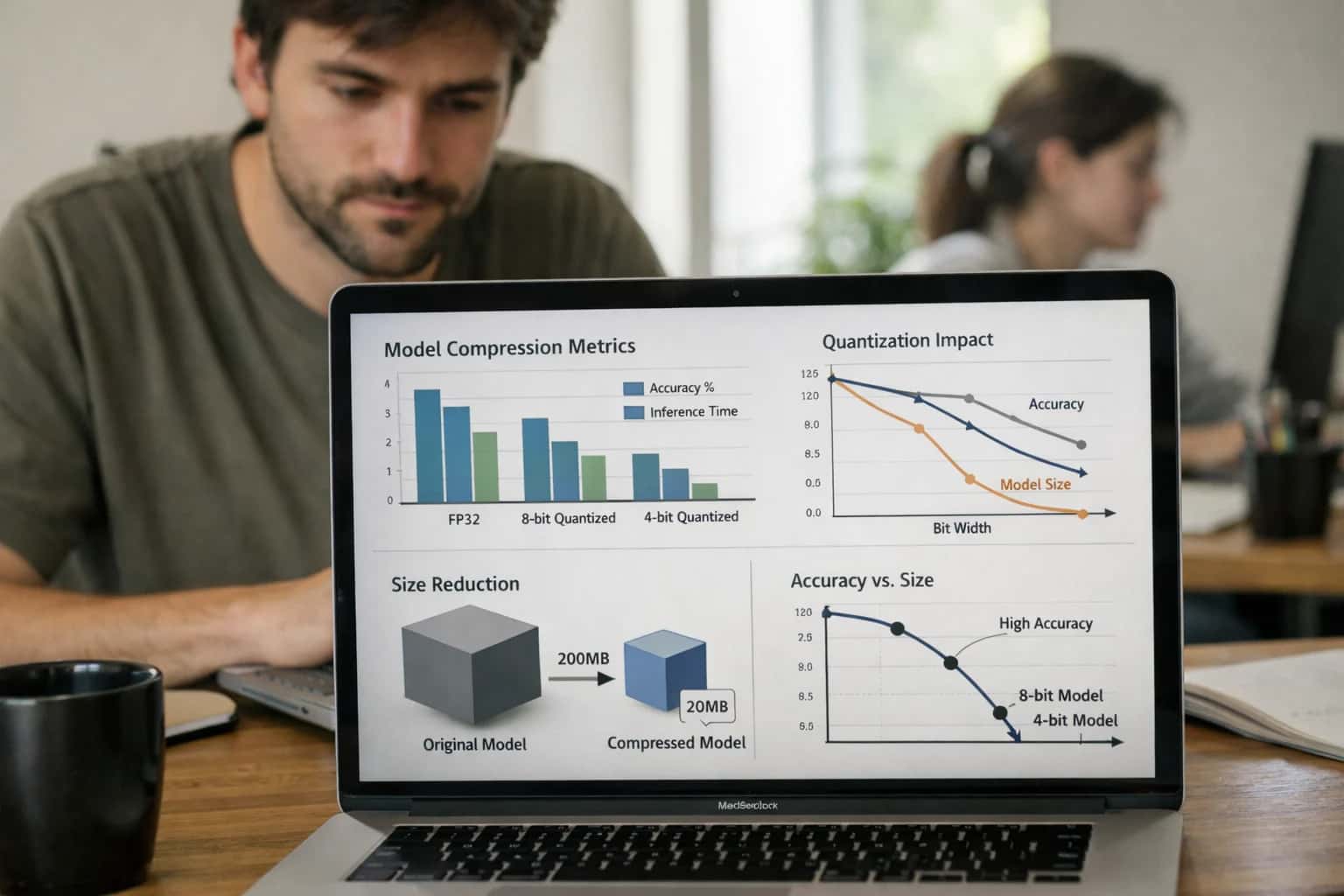
COMMUNICATION-EFFICIENT FEDERATED LEARNING
What is Gradient Quantization?
Gradient quantization is a lossy compression technique that reduces the communication overhead in distributed and federated learning by mapping high-precision gradient values to a lower bit-width representation before transmission.
Common quantization schemes include uniform scalar quantization, which maps values to equally spaced bins, and non-uniform or stochastic quantization, which introduces randomness to unbias the rounding error. Advanced implementations often combine quantization with error feedback—accumulating the residual quantization error and adding it to the subsequent gradient—to preserve convergence properties even at extreme compression ratios like 1-bit SignSGD.
PRECISION REDUCTION
Key Characteristics
Gradient quantization systematically reduces the numerical precision of gradient values exchanged during federated training, trading a controlled amount of information fidelity for substantial communication savings.
01
Bit-Width Reduction
The core mechanism maps 32-bit floating-point (FP32) gradients to lower bit-width representations. Common targets include 8-bit integers (INT8) for a 4× compression ratio, or extreme 1-bit binary schemes like SignSGD. The quantization function typically involves scaling the tensor by its maximum absolute value, then rounding to the nearest representable level in the target format. Stochastic rounding—where the rounding direction is probabilistic—is often employed to preserve statistical unbiasedness and prevent systematic error accumulation across thousands of communication rounds.
02
Stochastic vs. Deterministic Quantization
Two primary quantization strategies exist:
- Deterministic Quantization: Maps each value to the nearest representable level using standard rounding. Simple and fast, but introduces biased error that can degrade convergence.
- Stochastic Quantization: Rounds values probabilistically based on their distance to adjacent quantization levels. A value 0.7 between levels 0 and 1 has a 70% chance of rounding to 1 and 30% to 0. This preserves the expected value of the gradient, making it an unbiased estimator critical for maintaining model accuracy under aggressive compression.
03
QSGD: Quantized Stochastic Gradient Descent
A foundational algorithm that generalizes stochastic quantization. QSGD supports configurable bit-widths per coordinate, allowing variable precision across layers. It encodes quantized values using Elias integer coding for additional lossless compression. Key properties include:
- Convergence guarantees for convex and non-convex objectives
- Variance bound proportional to the number of quantization levels squared
- Trade-off: more quantization levels reduce variance but increase communication cost QSGD demonstrates that 4-bit quantization often achieves near-lossless convergence compared to full-precision FedAvg.
04
Error Feedback Integration
Aggressive quantization introduces compression error that can cause model divergence. Error feedback addresses this by:
- Accumulating the residual error between the original gradient and its quantized version
- Injecting this accumulated error back into the gradient before the next quantization step This creates a closed-loop system where no information is permanently discarded—it is merely delayed. Error feedback is essential for extreme compression regimes (1-bit or 2-bit quantization) and ensures the global model converges to the same optimum as uncompressed training, albeit potentially with more rounds.
05
Layer-Wise Precision Allocation
Not all layers contribute equally to model convergence. Layer-wise quantization allocates higher bit-widths to layers with greater gradient variance or sensitivity:
- Convolutional layers in early network stages often require more precision
- Fully connected layers can tolerate aggressive quantization
- Batch normalization layers may be transmitted at full precision due to their small parameter count This adaptive strategy optimizes the communication budget, achieving better accuracy-per-bit than uniform quantization across the entire model.
06
Ternarization and Binary Connect
Extreme quantization schemes reduce gradients to three values {-1, 0, +1} (ternarization) or two values {-1, +1} (binary). TernGrad is a notable ternary scheme that:
- Uses a single scaling factor per layer to minimize distortion
- Introduces zero as a valid quantized value, naturally incorporating sparsification
- Achieves up to 16× compression relative to FP32 Binary schemes like SignSGD transmit only gradient signs, achieving 32× compression. Both require error feedback and careful learning rate tuning to maintain convergence, but are viable for bandwidth-constrained edge deployments.
GRADIENT COMPRESSION TECHNIQUES
Quantization vs. Sparsification
A technical comparison of the two primary gradient compression paradigms used to reduce communication overhead in federated learning, evaluating their mechanisms, error profiles, and operational trade-offs.
| Feature | Gradient Quantization | Gradient Sparsification | Deep Gradient Compression (DGC) |
|---|---|---|---|
Core Mechanism | Maps 32-bit floats to lower bit-width integers (e.g., 8-bit, 1-bit) | Transmits only the top-k gradient elements by magnitude; zeros out the rest | Combines top-k sparsification with momentum correction and error feedback |
Compression Ratio | 3-32x (8-bit to 1-bit) | 100-1000x (transmitting 0.1-1% of gradients) |
|
Error Feedback Required | |||
Momentum Correction | |||
Local Gradient Accumulation | |||
Information Preservation | Retains dense structure with reduced precision | Retains only high-magnitude elements; discards low-magnitude | Retains only high-magnitude elements with error accumulation |
Convergence Guarantee | Biased estimator; converges under specific conditions | Unbiased with error feedback; provable convergence | Provable convergence matching dense baseline |
Typical Use Case | Bandwidth-constrained environments tolerating minor precision loss | Extreme compression scenarios with sufficient local compute | Production-scale distributed training requiring high accuracy |
Enabling Efficiency, Speed & Accuracy
Intelligent Analysis, Decision & Execution
We build AI systems for teams that need search across company data, workflow automation across tools, or AI features inside products and internal software.
Talk to Us
Search across company data
Give teams answers from docs, tickets, runbooks, and product data with sources and permissions.
Useful when people spend too long searching or get different answers from different systems.
Enterprise searchRAGPermissions
Read more
Automate internal workflows
Use AI to route work, draft outputs, trigger actions, and keep approvals and logs in place.
Useful when repetitive work moves across multiple tools and teams.
AI agentsWorkflow automationGovernance
Read more
Add AI to products and internal tools
Build assistants, guided actions, or decision support into the software your team or customers already use.
Useful when AI needs to be part of the product, not a separate tool.
AI integrationDecision supportModel routing
Read moreGRADIENT QUANTIZATION FAQ
Frequently Asked Questions
Precise answers to the most common technical questions about mapping high-precision gradients to low-bit representations for communication-efficient federated learning.
Gradient quantization is a lossy compression technique that maps high-precision 32-bit floating-point (FP32) gradient values to a lower bit-width representation—such as 8-bit integers (INT8), 4-bit, or even binary values—to reduce the payload size per communication round in distributed training. The process works by first observing the dynamic range of the gradient tensor, then partitioning that range into discrete bins. Each gradient value is assigned to the nearest bin and transmitted as a compact index rather than a full 32-bit value. On the receiving end, the indices are dequantized back to approximate floating-point values using a shared codebook or scaling factor. Stochastic quantization adds controlled noise by probabilistically rounding to adjacent bins, which preserves the unbiased statistical properties of the gradient and prevents systematic error accumulation. The compression ratio scales linearly with bit-width reduction: quantizing from FP32 to INT8 yields a 4× compression, while 1-bit quantization achieves a 32× reduction in communication volume.

About the author
Prasad Kumkar
CEO & MD, Inference Systems
Prasad Kumkar is the CEO & MD of Inference Systems and writes about AI systems architecture, LLM infrastructure, model serving, evaluation, and production deployment. Over 5+ years, he has worked across computer vision models, L5 autonomous vehicle systems, and LLM research, with a focus on taking complex AI ideas into real-world engineering systems.
His work and writing cover AI systems, large language models, AI agents, multimodal systems, autonomous systems, inference optimization, RAG, evaluation, and production AI engineering.
LinkedIn
Limited slotsGet a Free AI Consultation
Partnered with leading AI, data, and software stack.





How We Work
Custom AI workflows for your Business
One-fit-all AI don't work for modern businesses. At Inferensys, we aim to understand your business & custom requirements; which we use to define most efficient agentic workflows, the data, and the tools for your business.
01
Review the use case
We understand the task, the users, and where AI can actually help.
Read more02
Pick the right approach
We define what needs search, automation, or product integration.
Read more03
Build the first useful version
We implement the part that proves the value first.
Read more04
Improve from there
We add the checks and visibility needed to keep it useful.
Read moreThe first call is a practical review of your use case and the right next step.
Talk to Us